Why Does My Central Air Have Two Filters?
May 5, 2026
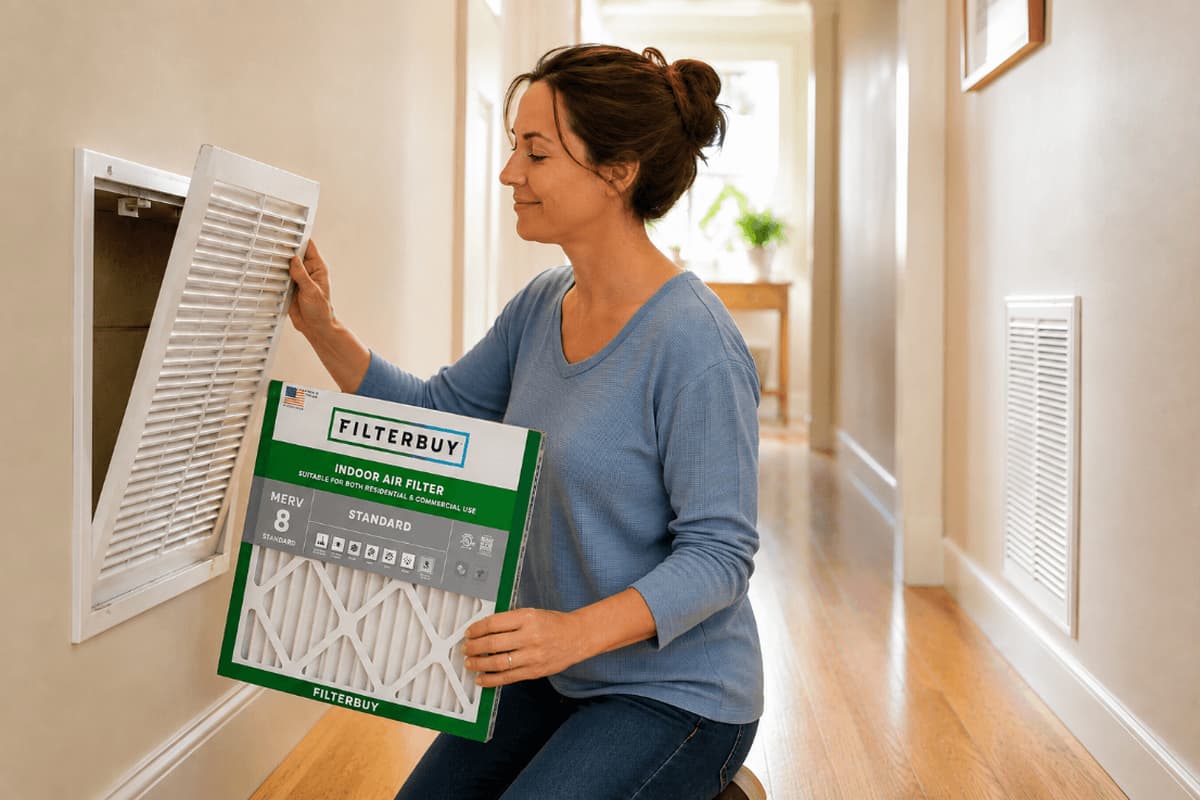
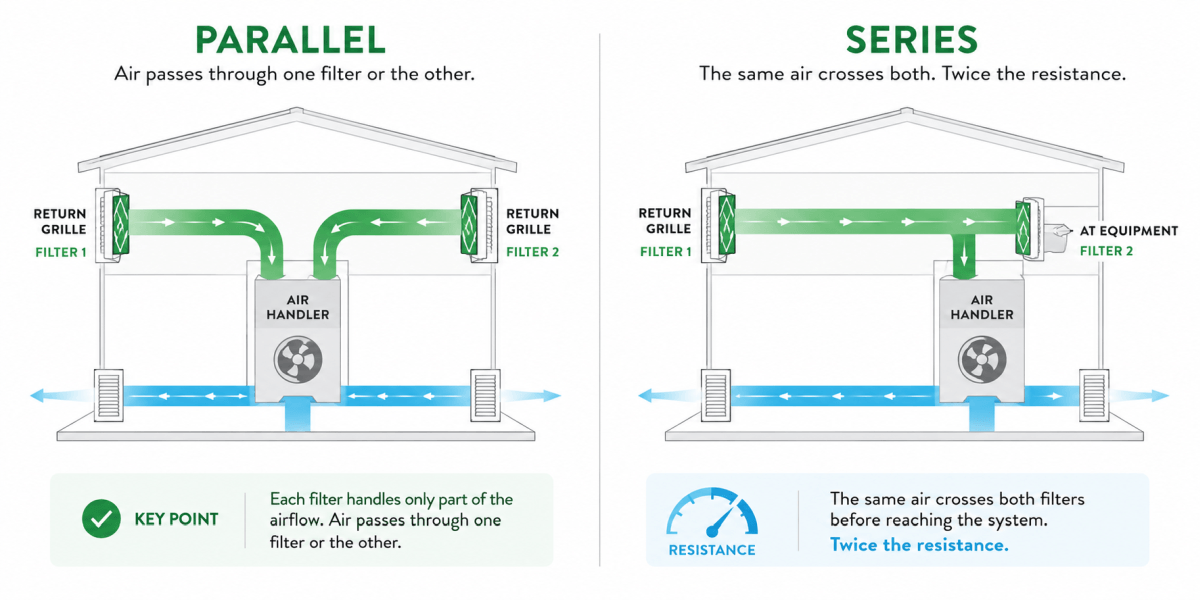
Your central air has two filters because your system has two separate paths for return air. That usually means two return vents, a zoned home running two air handlers, or a furnace filter rack paired with a filter grille on another duct run. In all three, the filters work in parallel, so air passes through one or the other and never both. The one setup worth fixing is two filters in the same duct run.
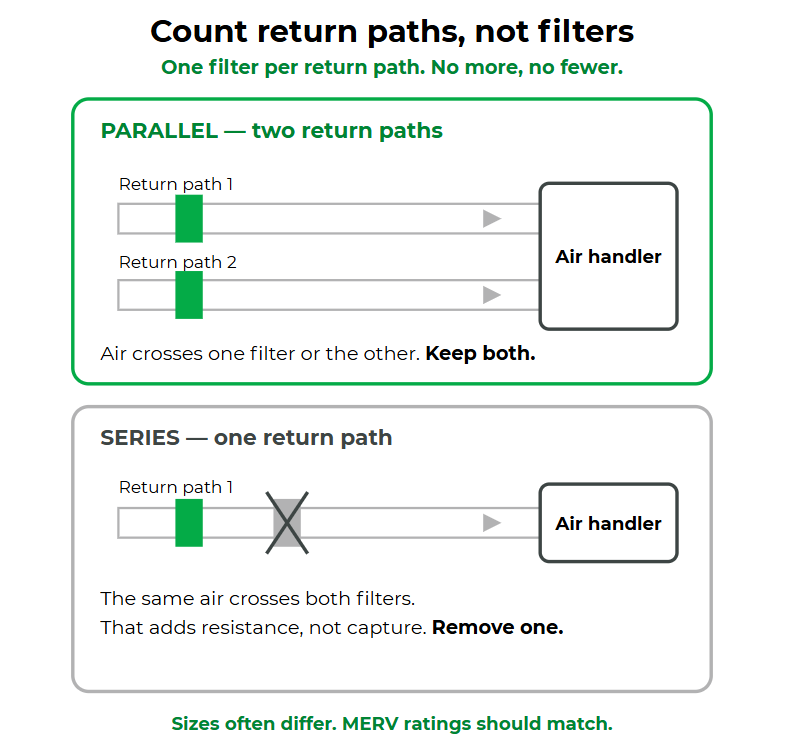
Parallel (two return paths): keep both filters. Sizes often differ, but the MERV ratings should match.
Series (both filters in one path): remove one. The second adds resistance without adding capture.
Not sure which one you have, or what each filter should be? Take the quick match quiz below.
Answer a few quick questions and we will match you to the right filter.
Already know both sizes? Shop air filters made in the USA in over 600 sizes.
Author: Michelle Wan, Brand Manager and Air Quality Writer
Reviewer: David Clark, Licensed HVAC Technician
Updated: August 13, 2026
TL;DR
Your central air has two filters because your HVAC system has two separate paths for return air, usually two return vents, a zoned home with two air handlers, or a furnace filter paired with a filter grille on another duct run. Those filters work in parallel rather than as a two-stage team. The only arrangement worth fixing is two filters in one duct run, where the second restricts airflow without improving filtration.
Key Takeaways
Two air filters almost always means two return air paths, not two stages of filtration.
Every return air path should have exactly one filter. No more, no fewer.
Filters at separate return vents work in parallel, so air passes through one or the other but never both.
Skip one filter and its return goes restrictive, which pushes air toward the other one.
Your two filters will often be different sizes, but their MERV ratings should match.
Why Does My Central Air Have Two Filters?
A central air system has two filters because it has two separate paths for return air. Homes with two filters fall into three configurations: two return vents that each hold a filter, a zoned house running two air handlers, or a furnace filter rack paired with a grille on another duct run. In all three, the filters work in parallel.
Two return vents. Multi-story homes need more than one return grille to move enough air back to the equipment, often one per floor, and when a system is built around filter grilles instead of a furnace filter, each holds its own.
Two air handlers. Zoned homes run two independent systems, each with its own filter, size, and schedule.
An equipment filter plus a filter grille. Whether that third setup is normal comes down to one question: are those filters on different duct runs, or the same one? Different runs is a normal parallel layout and both filters belong there. The same run puts them in series, and one of them should come out.
Parallel vs. Series: The Distinction Most Articles Get Wrong
Almost every article on the two-filter question describes them as a two-stage team, the return vent filter catching hair and dust while the furnace filter catches whatever slipped past. Filterbuy has manufactured filters for these systems in the USA since 2013, and residential systems rarely work that way. Filters on separate returns never see the same air. Filters on one run do, and that is what costs you airflow.
Parallel means air passes through one filter or the other. Series means the same air crosses both, which adds resistance without adding capture.
Most of the internet answers this with a story about two-stage filtration. It sounds tidy, and it is almost never what is happening in the house. Stop counting filters, start counting return paths, and the whole thing gets simple.
Michelle Wan, Brand Manager and Air Quality Writer, Filterbuy
How Do I Know If My AC Unit Has Two Filters?
Count return air paths, not filter slots. Walking the house in this order takes ten minutes.
Find every return grille. Returns are larger than supply vents and pull air in, so hold a tissue to one while the system runs. It sticks to a return and blows away from a supply.
See which grilles open by hand. A filter-ready grille has hinges plus latches or tabs, while one screwed flat into drywall holds no filter.
Check the equipment. Look where the return duct meets the furnace or air handler for a slot, hinged door, or track.
Trace the duct if you find both. The same run means series, a different branch means parallel.
Count air handlers. Two units means two systems and two independent filters.
Filterbuy's customer service team hears one version constantly: someone has changed one filter faithfully for years, and a second in a hallway ceiling has never come out. Our guide to where HVAC air filters are located covers every spot, and how to measure your air filter size handles a faded frame.
Do I Need Filters in My Return Vents?
Every return air path needs exactly one filter, so the answer depends on where your system already filters.
If your furnace or air handler has a filter rack in use, the return vents on that run do not need filters too, because a second filter in the same path only makes the blower work harder.
If your equipment has no filter rack, then yes, every return vent needs its own. The U.S. Department of Energy's Building Science Education program is plain about it: when the air handler sits somewhere inaccessible, like a crawlspace or an attic without stairs, a filter belongs in each return grille.
You can usually feel it when two filters fight each other. Watch for whistling at a return grille, a bowed filter, longer run times, or a coil that freezes in summer. Most systems are designed to run under 0.5 in. w.g. of static pressure, a figure from Filterbuy's own testing, and two filters in series eat into that budget fast. If you find a pair in one run, the usual fix is to keep the equipment filter and remove the grille filter, but which one goes depends on your system, so have a technician read your static pressure before pulling either.
REVIEWER'S TIP FROM DAVID CLARK, LICENSED HVAC TECHNICIAN, FILTERBUY HVAC SOLUTIONS
“When I find two filters on the same run, I do not pull one on the spot. I take a static pressure reading, remove the grille filter, and read it again. The difference tells you whether that second filter was ever the problem. It takes five minutes and it beats guessing.” Book a technician.
Why Does My Furnace Have 2 Slots for Filters?
Two filter slots are almost always alternatives rather than a pair. Three explanations cover nearly every case.
The cabinet accepts two thicknesses. Many units take either a 1" filter or a thicker 4"–5" media filter, so you fill one, not both.
Return ducts enter from two sides, through the bottom and a side panel, each with its own track, so filter every opening that carries air.
A media cabinet or air cleaner was removed, and its slot may still be sitting open.
Whatever the reason, cover any slot you are not using, and never leave a grille built to hold a filter sitting empty. The EPA's advice on filter fit is to seat it snugly so air cannot leak around it, and an open slot or bare grille breaks that seal completely. A blank-off plate solves it.
Can You Put Two Air Filters Together?
No, stacking two air filters in one slot is not a good idea. Two filters back to back roughly double the resistance across the same opening without improving capture, because the blower still pulls air through twice the media in the same face area. You lose airflow and add motor wear for nothing.
The EPA's guidance is to use the highest-rated filter your fan and slot can accommodate, so one filter rated up beats two stacked. Two good ways to do that:
Step up the MERV rating on a single filter, within what your system is rated for.
Move to a thicker 4" or 5" media filter if your cabinet takes one. More media area means better capture and lower resistance at once, and a 4" MERV 13 can drop less pressure than a 1" MERV 11. Our MERV pressure drop chart has the numbers.
Do Both Filters Need to Be the Same Size and MERV Rating?
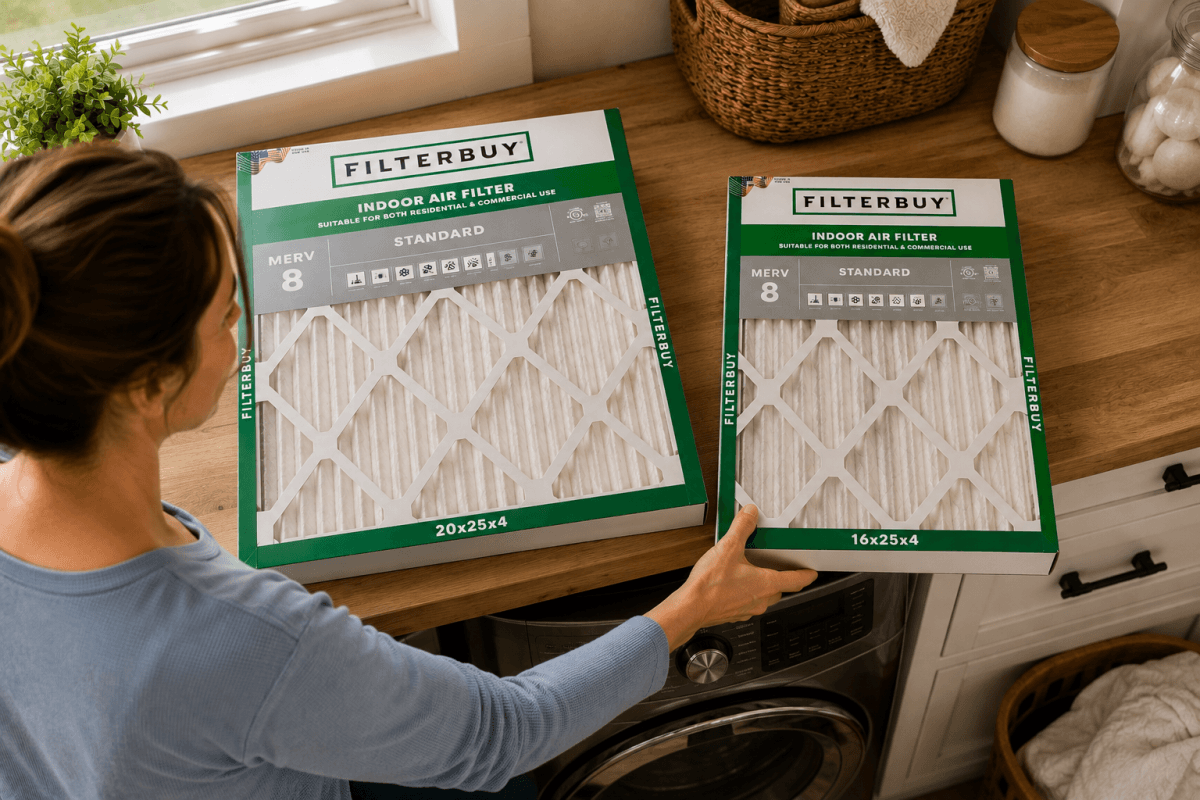
Different sizes are normal. Different MERV ratings usually are not. A grille and a furnace rack are built to different dimensions, so order each filter by the size on its own frame rather than matching one to the other. Because Filterbuy cuts over 600 sizes and makes custom filters to order, we see which pairs turn up in the same house, and matched pairs are the exception.
Ratings are the part to keep consistent. Pair a MERV 8 with a MERV 13 and airflow skews toward the less restrictive filter, so more of your air ends up getting the lower filtration.
What Happens If You Only Change One of Two Filters?
A neglected filter does not just stop cleaning. It redirects air to the other return. As one filter loads with dust, its return gets more restrictive, and more of the house's air shifts to the path of least resistance, the return holding the clean filter.
Three things follow, usually noticed in this order:
Rooms on the neglected return get less air, so temperatures go uneven before anything looks wrong.
The filter you do change loads faster than it used to, because it is handling more than its share.
Total airflow still drops, since one restricted path drags on the whole system.
There is useful information in how dirty each filter gets. If one comes out filthy while the other looks nearly new after the same interval, that is not random. The dirtier filter's return is moving more air, usually because it is larger, sits closer to the equipment, or serves a dustier part of the house. Some imbalance is normal, but loading that stays lopsided across several changes is worth raising with a technician, since it can point to an undersized return on the cleaner side.
One expectation to set: a second filter does not upgrade your filtration. Each cleans its own airstream to its own MERV rating, and having two does not make either last longer.
How Do I Replace Two Air Filters?
Replacing two filters is the same job as replacing one, done twice, with two sizes to keep straight. The whole thing takes about ten minutes.
Turn the system off at the thermostat.
Locate every filter using the walkthrough above.
Note the airflow arrow before pulling each filter, since it points toward the equipment.
Note the size on each frame, because the two are frequently different.
Slide the new filters in with the arrows pointing the same way as the old ones.
Close the grille or slot cover and restart the system.
ENERGY STAR recommends inspecting filters monthly, and most homes replace pleated filters every 1–3 months, or monthly with pets or allergies. Our full replacement schedule breaks it down by household.
Why Is My Central Air Filter Wet?
A wet air filter is a symptom, not a cause. The usual source is a clogged condensate drain line backing water into the pan, the item ENERGY STAR flags as a cause of water damage. A thawing coil, a cracked pan, or humid air pulled through leaky return ducts can do it too. Replace the filter first, then find the source: why your air filter is wet.
Supporting Statistics
1. Airflow problems can cut system efficiency by up to 15%
Two filters in one duct run add resistance without adding capture, one of the restrictions this figure covers.
2. MERV 13 and above must remove at least 50% of the smallest particles tested
Capture comes from the rating rather than the count, so the EPA advises the highest rating your fan and slot allow.
3. Two-thirds of U.S. homes run central AC or a central heat pump
Based on 18,496 households across an estimated 123.5 million U.S. homes. Ducted systems are the ones with return-side filter slots.
Two Filters, One Delivery
Two sizes and two dates to track is why so many second filters go a year without a change. Write both sizes on tape inside the furnace door, or put them on auto-delivery so they show up together. Filterbuy makes over 600 sizes in the USA and cuts custom sizes for anything a shelf will not carry.
Frequently Asked Questions
Why does my AC have 2 filters?
Because it has two return air paths, usually two return vents or two air handlers in a zoned home.
Why does my house have two air filters?
Multi-story homes need more than one return vent to move enough air back, and when a system is built around filter grilles, each vent holds a filter.
Glossary