
What Your Smart Thermostat's Air Quality Sensor Can (and Can't) Tell You
November 26, 2026
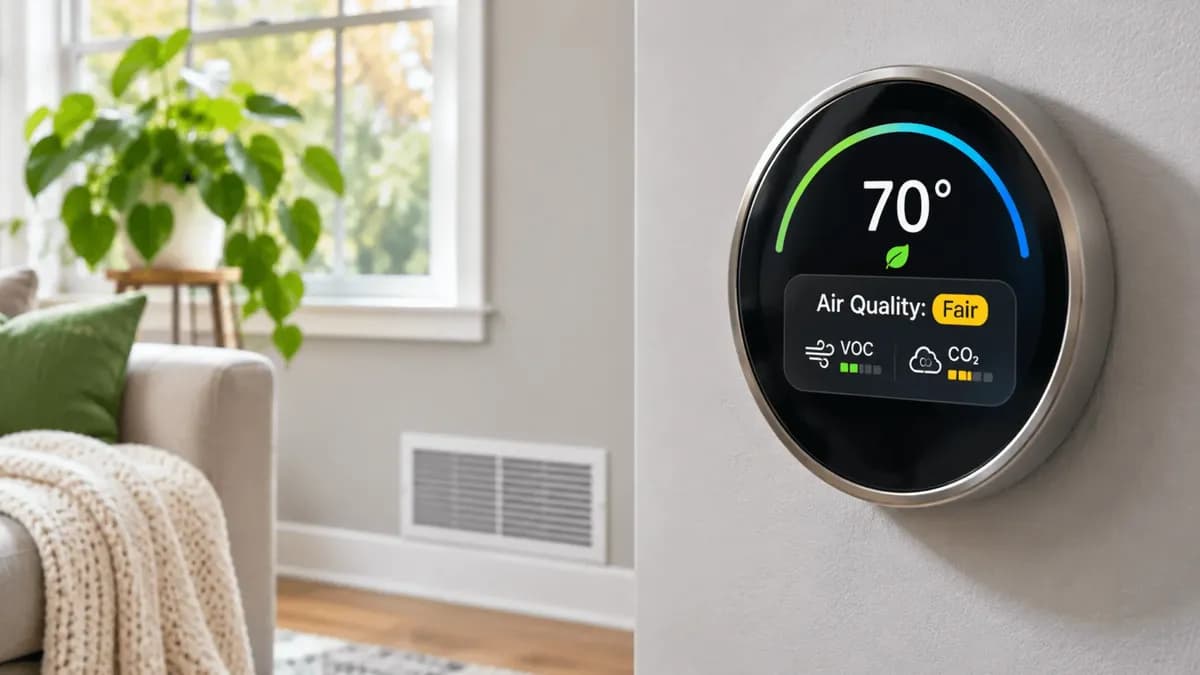
Most smart thermostat air quality sensors estimate gases, not particles. They track fumes and stale air in one room, but usually skip fine particles (PM2.5), the kind your HVAC filter captures.
Here's what that reading really covers:
- Reads: total VOCs, estimated CO2 (eCO2), and humidity.
- Usually misses: dust, pet dander, and other fine particles.
- Isn't: a carbon monoxide alarm.
- Got an alert? Clear the source and ventilate first. Then check your filter.
Your filter handles the particles your sensor can't see. Take the quick quiz below to find your filter match.
Two tools, two jobs
Your sensor reads gases. Your filter catches particles.
Thermostat sensor
Reads gases
Total VOCs
fumes from paint and cleaners
Estimated CO2
a stale-air signal
Humidity
moisture in the room
HVAC air filter
Catches particles
Dust and dust mites
larger debris in the air
Pet dander and pollen
finer particles
Fine particles (PM2.5)
the ones most sensors skip
The gap: most thermostat sensors don't measure PM2.5.
Not a carbon monoxide alarm.
Find your filter match
Your thermostat watches the gases. Let your filter handle the particles. Answer a few quick questions, and we'll match you to the right filter.
Already know your size? Order the size printed on your old filter's frame. Custom sizes are available too.
Don't take that little air quality badge on your thermostat for granted. At Filterbuy, we make the filters that catch particles, so we pay close attention to what a smart thermostat with an air quality sensor can and can't see. Most models read gases and estimate carbon dioxide. Here's what each reading means and what to do when an alert pops up.
TL;DR
Some smart thermostats, including the ecobee Smart Thermostat Premium and Honeywell Home X8S, use a built-in gas sensor to estimate VOCs and carbon dioxide. The readings catch changes well but cover only one room and skip fine particles (PM2.5). When an alert appears, clear the source and ventilate first, then check the filter.
Key Takeaways
A thermostat air quality sensor typically reports total VOCs, estimated CO2, and humidity.
Many thermostat CO2 numbers are equivalent CO2 (eCO2), calculated from VOC readings.
Most thermostat sensors don't measure PM2.5, the fine particles pleated HVAC filters capture.
The air quality figure on some thermostats, like the Google Nest Learning Thermostat (4th gen), describes outdoor air.
A thermostat air quality sensor isn't a carbon monoxide alarm.
Can A Thermostat Measure Air Quality?
Yes, but only some models can, and only partly. A smart thermostat with an air quality sensor uses a small gas sensor near the wall where it hangs. It tracks volatile organic compounds (VOCs), the gases given off by things like cleaners and paint, and estimates carbon dioxide (CO2). Then it rolls those readings into a simple rating, such as Good, Fair, or Poor. Most don't measure airborne particles.
Table: Indoor Air Quality Thermostat Options Compared
Filterbuy isn't affiliated with or endorsed by ecobee, Honeywell Home, Lennox, or Google.
What Do Thermostat VOC And CO2 Sensors Actually Detect?
A thermostat VOC sensor reads the combined level of many airborne gases at once, reported as total VOCs (TVOC), so it can't tell you which chemical is present. A thermostat CO2 sensor reading is often an estimate, too. Many models calculate an equivalent CO2 (eCO2) value from VOC readings, on the assumption that people give off VOCs and CO2 together.
Most are small metal-oxide chips. Research on low-cost VOC sensors shows they are hard to calibrate because temperature and humidity sway them as well, so many researchers use them to spot trends.
Measuring CO2 directly takes a nondispersive infrared (NDIR) sensor, which uses infrared light. Without one, an eCO2 estimate can drift from real CO2 when something other than people, like a scented candle, pushes VOCs up.
Table: Thermostat Readings Vs. What They Miss
What Does Air Quality On My Thermostat Mean?
The air quality rating on your thermostat is a simplified score built from its VOC and CO2 readings. Good means gas levels near the thermostat sit low against the maker's thresholds, while Fair or Poor means they've climbed. Because each brand sets its own thresholds, Poor on one thermostat doesn't equal Poor on another.
Honeywell Home's X8S user guide, for example, rates CO2 below 600 parts per million (ppm) as Very Good and 1,000 to 1,999 ppm as Medium. It also notes that a Poor reading doesn't necessarily mean a hazard.
Before acting on any rating, check which air it describes. A number pulled from your local forecast reflects outdoor conditions.
Why Most Thermostat Sensors Miss What Your Filter Catches
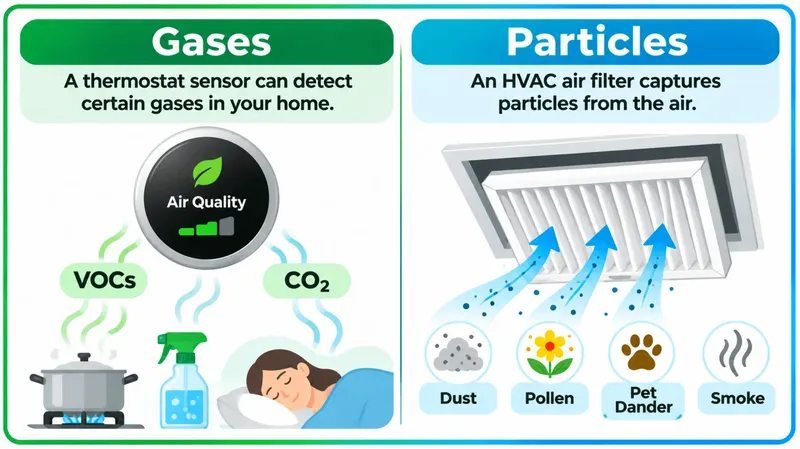
Your HVAC filter and your thermostat sensor are watching for different pollutants. Pleated furnace filters capture particles like dust, pollen, pet dander, and smoke, while most thermostat sensors track gases like VOCs.
The EPA's guide to air cleaners in the home notes that home HVAC filters are usually designed for particles, while gases call for a separate filter type, such as activated carbon. Filterbuy's MERV 8, 11, and 13 filters are rated on MERV, the scale for how well a filter captures particles. A higher MERV rating won't fix a VOC spike from a cleaning spray.
Match the filter to your household. For most homes, Filterbuy recommends MERV 8 air filters as the standard choice. MERV 11 air filters are for homes with allergies or asthma, plus pets and pollen. MERV 13 air filters are the pick for smoke, and Odor Eliminator filters add activated carbon for odors. Whichever you choose, check your HVAC system's manual to confirm the fit, just as you'd confirm your size. For odors in a single room, look at air purifier filters with activated carbon.
How Far Should You Trust A Thermostat Air Quality Sensor?
Filterbuy's rule of thumb is to trust the direction more than the number. A thermostat sensor is good at showing that something changed, like a spike while you cook or CO2 creeping up in a closed room. It's less dependable as an exact measurement, since built-in sensors aren't lab calibrated and only read one spot.
That one spot matters. A thermostat near the kitchen or garage door picks up fumes the rest of the house rarely sees, and new furniture or paint can keep VOC readings high while the products off-gas. The same placement issues explain why your thermostat reads the wrong temperature.
Location also limits coverage. A hallway thermostat may never notice CO2 building behind a closed bedroom door overnight. For stuffiness at night, a portable monitor on the nightstand tells you more.
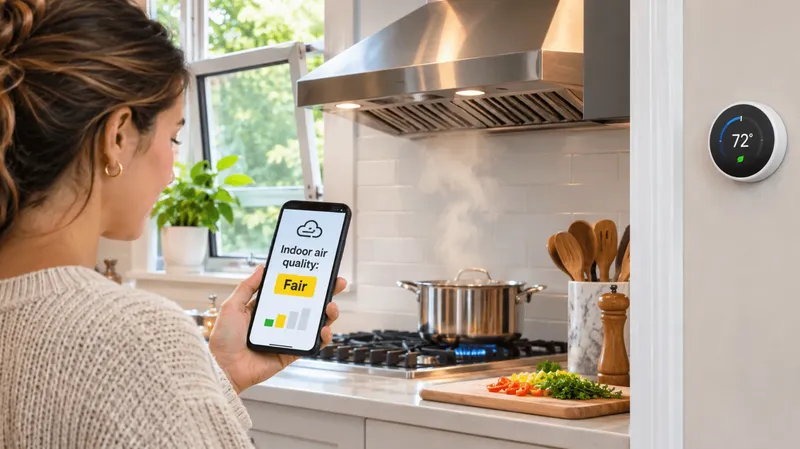
You can sanity-check your own sensor during dinner. A reading that rises while you cook and falls once the range hood runs is doing its job. One that doesn't move, or sits at Poor for days with no clear source, deserves a second opinion from a portable monitor.
Many apps flag 1,000 ppm CO2 as a line, but ASHRAE's position on indoor carbon dioxide states that its ventilation standards don't include CO2 limits. Carbon dioxide (CO2) and carbon monoxide (CO) are also different gases, and no thermostat air quality sensor replaces a CO alarm.
What To Do When You Get A Thermostat Air Quality Alert
When a thermostat air quality alert appears, start with the source, then ventilate, then filter. Filterbuy calls this the Gas or Particle Check, because knowing which one you're facing shapes the steps below.
Check which reading moved. A VOC spike points to fumes, and a CO2 climb points to stale air. A jump in outdoor AQI (the EPA's Air Quality Index) points to smoke or pollution outside.
Pause the source. Turn on the range hood and cap cleaning products, then move paint or solvents outside.
Ventilate when outdoor air is clean. Open a few windows or run a ventilator, but skip this step when outdoor AQI is high.
Run the fan to filter particles. Switching the thermostat fan from Auto to On pushes more air through your filter, and our breakdown of thermostat fan Auto vs. On covers when that makes sense.
Check the filter. A clogged filter moves less air. If you just replaced it, here's how to reset the change filter reminder on your thermostat.
Plan for smoke days. When smoke pushes outdoor AQI above 100, homes with central HVAC should switch to the EPA-recommended MERV 13 filter. Run HEPA air purifiers in each room, too, as our guide to running your HVAC fan during wildfire smoke explains.
Is A Smart Thermostat With An Air Quality Sensor Worth It?
Filterbuy's take: a smart thermostat with an air quality sensor is worth it if you want nudges about ventilation and fumes from a device already on your wall. It isn't the right tool for tracking smoke or dust. If particles are your main concern, pair any thermostat with a portable monitor that reads PM2.5.
Expert Insight From Michelle Wan
"Our MERV filters are built for particles, and most thermostat sensors are built for gases, so I tell readers to let each one do its own job. When the thermostat flags fumes, deal with the source and let fresh air in. When the outdoor AQI climbs, that's when the filter does the heavy lifting."
Michelle Wan, Brand Manager and Air Quality Writer, Filterbuy
Supporting Statistics
Almost 30 years without a CO2 limit
ASHRAE Standard 62.1 has had no indoor CO2 limit for almost 30 years. No current ASHRAE standard has one.
Why it matters: Treat a 1,000 ppm app warning as a ventilation cue, not a pass line.
About 1.0 indoor-to-outdoor PM2.5 ratio
A 2011 review of 77 studies and 4,000+ homes found indoor PM2.5 roughly matched outdoor levels.
Why it matters: Most thermostat sensors can't see these particles, so keep your filter on schedule.
Source: Health Risks of Indoor Exposure to Particulate Matter: Workshop Summary
About 101,847 ER visits a year from CO
A CDC report cites roughly 101,847 emergency department visits a year from unintentional non-fire-related CO poisoning.
Why it matters: Keep a CO alarm on every level of your home and outside sleeping areas.
Source: Morbidity and Mortality of Unintentional Carbon Monoxide Poisoning: United States 2005 to 2018
Frequently Asked Questions
Why Doesn't My Thermostat Reading Match My Air Purifier's Display?
They usually measure different things. Many purifier displays run on a particle sensor, while most thermostats track gases. One can read Poor during a cleaning spree while the other shows clean air, and the reverse happens on smoky days.
Why Does My Thermostat Say Poor Air Quality When The Air Seems Fine?
You can't always smell what a VOC sensor picks up. Cleaning products and new furniture are common causes, and so is a thermostat mounted near the kitchen. Ventilate and watch the reading.
Can A Thermostat Air Quality Sensor Tell Me When To Change My Air Filter?
Not directly. VOC and CO2 sensors can't tell how loaded your filter is, so stick to your filter's replacement schedule. Filterbuy can send replacement reminders to help.
Do Thermostat Air Quality Sensors Detect Smoke?
Most don't measure smoke particles. During smoke events, watch the outdoor AQI and rely on a monitor with PM2.5 sensing.
Does Opening A Window Fix A Poor Thermostat Air Quality Reading?
Often, yes, for gas spikes and stale air, as long as the outdoor air is clean. Check the outdoor AQI first.
Keep The Air Your Thermostat Can't See In Check
Your filter handles the particles your thermostat can't see. Filterbuy cuts, pleats, and frames MERV 8, MERV 11, MERV 13, and Odor Eliminator air filters to order in our own US plants, in standard and custom sizes. Orders get fast and free 2-day delivery to most US states. Find your size and shop Filterbuy air filters today.
Glossary
Volatile Organic Compounds (VOCs): Carbon-based chemicals that evaporate from products like paints and cleaners.
Total VOCs (TVOC): One combined reading of many VOCs.
Equivalent CO2 (eCO2): A CO2 value calculated from VOC readings.
NDIR Sensor: A nondispersive infrared sensor that measures CO2 directly.
PM2.5: Fine particles 2.5 micrometers or smaller, from smoke, cooking, and dust.
Air Quality Index (AQI): The U.S. EPA scale for reporting outdoor air pollution.
MERV: Minimum Efficiency Reporting Value, a rating of how well an HVAC filter captures particles.
Carbon Monoxide (CO): An odorless gas from fuel burning that thermostat sensors don't detect.