Can You Add A HEPA Filter To Your Mini Split? Upgrade Options Explained
July 31, 2026
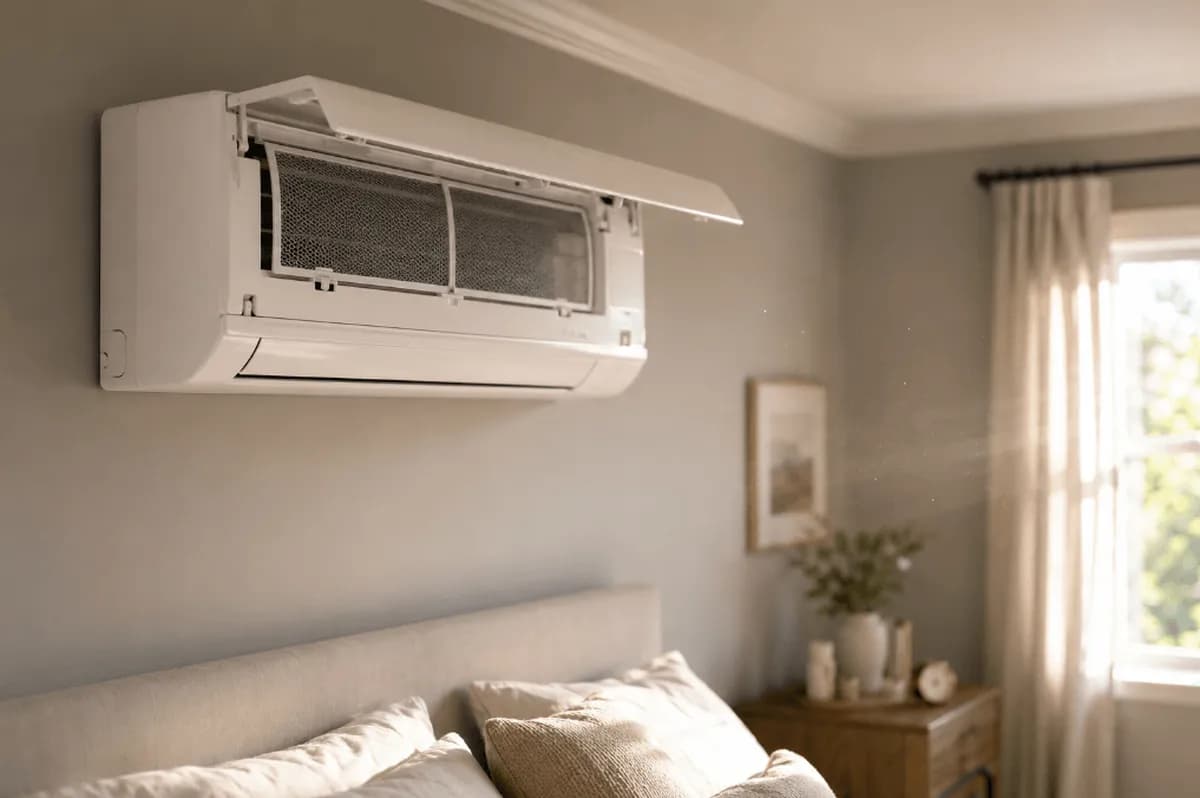
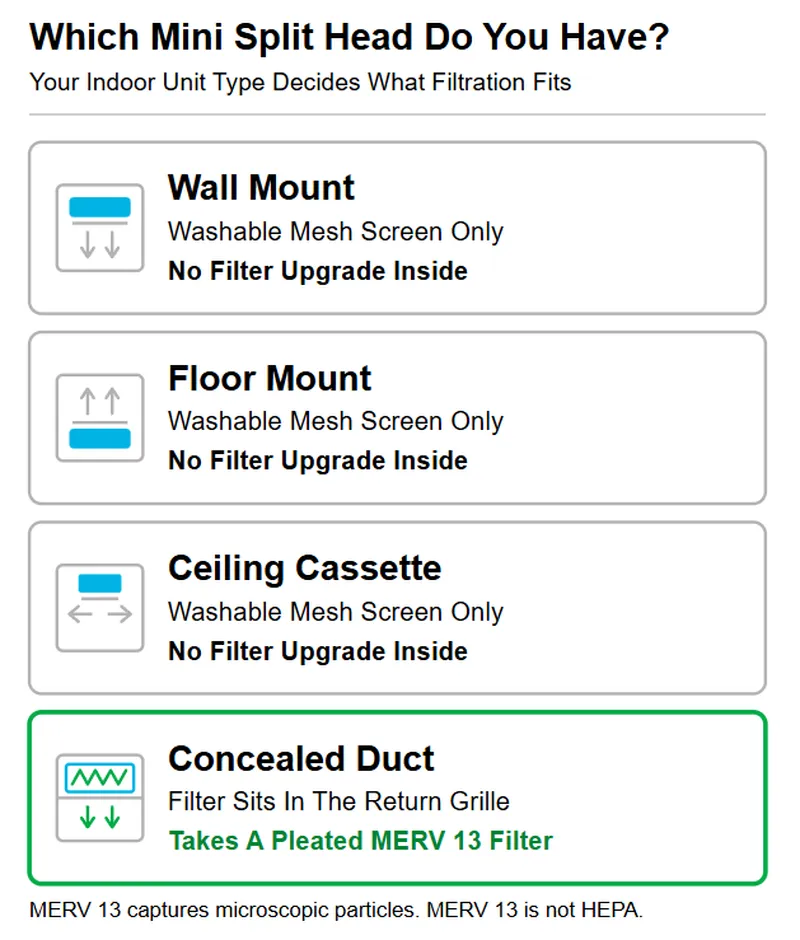
No. A standard wall-mounted, floor-mounted, or ceiling cassette mini split cannot take a true HEPA filter. The slim blower behind that front panel was built to move air across the coil, not to push it through dense HEPA media. Concealed duct models are the one exception, because they pull air through a return that holds a pleated MERV 13 filter. Every other ductless layout gets its fine particle filtration from a portable HEPA air cleaner in the room.
- Washable mesh screen: catches lint, hair, and visible dust to keep the coil clean
- Pleated MERV 13 in a concealed duct return: captures microscopic particles
- Portable HEPA air cleaner: captures fine particles in the room it occupies
Find your indoor unit type below, then take the quick match quiz to see what fits it.
Shopping for a ductless system rather than a filter for one?
Shop Ductless Mini Split Systems
12,000 to 24,000 BTU. Free 2-day delivery.
Answer a few quick questions and we will match you to the right filter for your system.
TL;DR
You cannot add a true HEPA filter to a standard wall-mounted or ceiling cassette mini split. The blower in a ductless head moves air across the coil with almost no pressure behind it, and HEPA media resists airflow more than that fan can overcome. Concealed duct models are the exception, since they pull air through a return that holds a pleated MERV 13 filter. Every other ductless layout needs a portable HEPA air cleaner instead.
Key Takeaways
HEPA media captures at least 99.97 percent of particles at 0.3 microns, the size that slips through filters most easily.
Wall-mounted and cassette mini splits use washable mesh screens engineered to protect the coil, not to clean the air your family breathes.
HEPA media in equipment never designed for it cuts airflow and can damage the blower.
Concealed duct mini splits route air through a return, which gives them room for a pleated MERV 13 filter a wall unit cannot hold.
In one home study, a portable HEPA air cleaner cut fine particle levels about 79 percent in the room it occupied and about 58 percent in an adjacent room.
MERV 13 is not HEPA. It captures far more than a mesh screen and far less than a sealed HEPA cartridge.
Filterbuy has built replacement filters for every major mini split brand for more than a decade, and homeowners who install ductless systems tend to reach the same point within a few months. The room holds temperature beautifully, the unit runs quietly, and the air still carries dust, pollen, and cooking smoke. That washable screen behind the front panel looks like a filter, so swapping it for something stronger feels like the obvious fix. The way a ductless head moves air turns that swap into a problem instead of an upgrade.
Can You Add A HEPA Filter To A Mini Split?
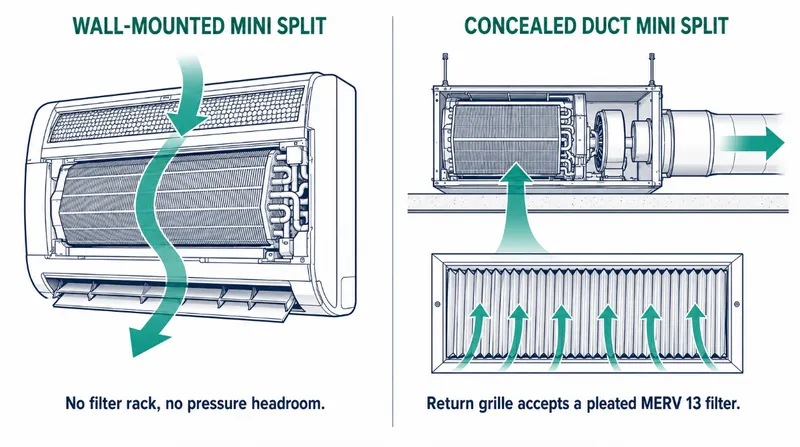
No standard mini split accepts a true HEPA filter. Manufacturers build wall-mounted and ceiling cassette heads around a slim tangential blower that sweeps air across the evaporator coil with almost no static pressure behind it. HEPA media needs substantial pressure to pass air through it. Concealed duct models are the exception, since they draw air through a return duct that can hold a deeper pleated filter.
The federal agencies that define HEPA agree on the tradeoff. The U.S. Environmental Protection Agency defines HEPA as a pleated mechanical filter that removes at least 99.97 percent of particles at 0.3 microns. The National Institute for Occupational Safety and Health adds the part most product pages leave out. That capture rate costs significant pressure drop, which is why most conventional HVAC systems cannot run HEPA at all and why standalone HEPA units pair the filter with a dedicated fan built to push through it.
"Every week someone sends me a photo of their mini split with the front panel open, asking which HEPA filter fits it. I understand the instinct, because that screen is the only filter they can see. What I tell them is that the screen was designed to keep the coil clean, and the fan behind it was sized for that job and nothing harder. The filtration they are actually after has to live somewhere else in the room."
Michelle Wan, Brand Manager and Air Quality Writer, Filterbuy
Why Ductless Systems Cannot Handle HEPA Media
ASHRAE, the engineering body that writes the MERV test standard, states the retrofit case plainly. A HEPA retrofit on an existing system is usually not feasible. The pressure drop runs too high, and the sealed filter racks that stop air slipping around the media are rarely there. HEPA installed in equipment not built for it can cause significant damage.
"On a wall-mounted head I am looking at a cross-flow blower with no filter rack and no gasket. There is nowhere to seal a HEPA cartridge. Even if you cut one to fit, most of the air travels around it instead of through it. On a service call that shows up as a unit running constantly and still missing setpoint."
David Clark, Licensed HVAC Technician, technical reviewer
What The Mesh Screen In Your Mini Split Actually Does
The mesh screen in your ductless head is a coil guard. It stops lint, hair, and visible dust from packing onto the evaporator fins and the blower wheel, which protects capacity and keeps the drain pan from turning into a mold habitat. That job matters. It is simply not the same job as capturing the fine particles that drive allergy symptoms.
A washable mesh screen carries no MERV rating at all. The mesh in virtually every mini split, regardless of brand, was designed for dust and large particle capture rather than fine filtration. For comparison, NIOSH reports that a MERV 8 pleated filter captures roughly 20 percent of particles in the 1 to 3 micron range and is not even rated for the 0.3 to 1.0 micron range where smoke and combustion particles live.
Clean the mesh faithfully and you protect your equipment. Our step by step filter cleaning guide walks through the routine for every major brand.
Table 1. Filtration Levels Compared
MERV figures per NIOSH. HEPA definition per the U.S. Department of Energy, referenced by the EPA. MERV 13 is not HEPA.
Four Ways To Upgrade Mini Split Filtration
Four upgrades get marketed to ductless owners. Manufacturer media panels handle odors, ionizer and UV accessories treat air rather than filtering it, a MERV 13 filter in a concealed duct return captures fine particles, and a portable HEPA cleaner captures them one room at a time. Only the last two change what you actually breathe.
Table 2. Ductless Filtration Upgrade Paths Compared
ASHRAE and NIOSH both advise homeowners to request as-used performance and safety data before installing ionizers or UV accessories, since some units generate ozone.
What About Filters Sold As HEPA For Mini Splits?
Aftermarket panels marketed as HEPA replacements for mini splits are not HEPA. True HEPA meets a Department of Energy standard of 99.97 percent capture at 0.3 microns, and media dense enough to hit that number will not pass air through a ductless blower. Labels reading HEPA-type, HEPA-style, or 99 percent HEPA describe no standard at all.
Ask three questions before you buy one.
Does the listing state a MERV rating or a capture percentage at a named particle size?
Does it name the test standard behind that number?
Does your mini split manufacturer list the panel as an approved accessory?
Check your owner manual before you put anything other than the factory screen in the unit. Manufacturers specify the filter their blower was designed around, and the manual is the only place that tells you what your specific model permits.
Filter options differ by manufacturer. Our guide to the most reliable mini split brands breaks down the filter stage brand by brand.
The One Ductless Design That Accepts A Real Filter
Concealed duct mini splits, sometimes called ducted or slim duct units, hide in a ceiling cavity or closet and distribute air through short duct runs. Because they are rated for external static pressure, many of them accommodate a pleated filter in the return grille or filter box. That is the single ductless configuration where a filter upgrade is a real option rather than a workaround.
Table 3. What Each Mini Split Indoor Unit Accepts
Confirm your unit rated external static pressure with your installer before increasing filtration.
NIOSH recommends MERV 13 or the highest efficiency your equipment tolerates without hurting performance. Confirm your rated external static pressure with your installer first, because a higher efficiency filter raises pressure drop and cuts airflow.
Depth matters as much as rating on a concealed duct return. A four-inch pleated filter holds far more media surface than a one-inch filter at the same MERV rating, which spreads the same airflow across more material and drops the resistance your blower has to overcome. Filterbuy builds both depths, and where the housing allows it, the deeper filter is the safer choice.
Size accuracy matters more on a concealed duct return than anywhere else in the house. Filterbuy analyzed more than 500,000 customer orders and found that confusion between nominal and actual dimensions drives 30 percent of all filter returns. Second, measure the actual opening rather than trusting a nominal size, since concealed duct returns rarely match hardware store dimensions.
Source: Filterbuy Manufacturing, based on analysis of 500,000-plus customer orders
https://filterbuy.com/air-filters/20x25x4/
Filterbuy manufactures custom size pleated filters for exactly this situation.
How To Size A Portable HEPA Cleaner For One Room
Size a portable air cleaner by clean air delivery rate rather than by the room size printed on the box. The CDC publishes a simple rule. Pick a unit whose CADR in cubic feet per minute reaches at least two thirds of the room floor area in square feet. A 300 square foot bedroom needs 200 CFM. Taller ceilings need more.
Measure the room floor area in square feet.
Multiply that number by 0.67. The result is your minimum CADR in CFM.
If the ceiling rises above eight feet, multiply the result again by the ceiling height divided by eight.
Read the smoke CADR on the AHAM label rather than the dust or pollen figure, because smoke particles are the smallest of the three.
If nothing on the shelf reaches your number, buy the highest CADR you can and run it one speed higher.
Worked example. A 14 by 16 foot bedroom measures 224 square feet. Two thirds of that is 150, so the unit needs a smoke CADR of at least 150 CFM. Raise the ceiling to 10 feet and the target climbs to 187 CFM.
The American Lung Association places effective portable cleaners between 50 and a few hundred dollars, with capable units available under 100.
How To Pick The Right Upgrade For Your Home
Three factors decide your upgrade path. The type of indoor head you own rules options in or out, what you are trying to remove points to a media type, and the rooms where you spend the most hours set your priority. A concealed duct unit opens the MERV 13 option, and every other head sends you to a portable cleaner sized for that room.
Ask what kind of head you own. A wall mount, floor mount, or ceiling cassette rules out any filter upgrade inside the equipment.
Ask what you are trying to remove. Odors point toward carbon media. Fine particles and smoke point toward MERV 13 in a return or a portable HEPA unit in the room.
Ask where you spend your hours. Filtration only cleans the air that passes through it, so a bedroom and a home office earn a dedicated air cleaner before a spare room does. If you run three or four heads, buy for the two rooms where you spend the most hours before you buy for the rest. The American Lung Association is direct on this point. Air cleaning supplements source control and ventilation rather than replacing them.
If you are still choosing equipment, our complete mini split buying guide covers filtration alongside sizing and efficiency.
"After manufacturing filters for over a decade and serving more than two million households, we have learned that the mesh screen in a ductless head is a comfort filter and not a health filter. The fan behind it was never built to pull air through HEPA media, and pretending otherwise costs people both capacity and clean air. Put real filtration where the system can actually support it."
David Heacock, Founder and CEO, Filterbuy
Frequently Asked Questions
Can I Put A HEPA Filter In My Ductless Mini Split?
No. Wall-mounted, floor-mounted, and ceiling cassette mini splits use a low pressure blower with no sealed filter rack, so HEPA media either starves the coil of airflow or gets bypassed around the frame. Concealed duct models can usually take a pleated MERV 13 filter in the return, which is the closest ductless equivalent.
What MERV Rating Can A Mini Split Handle?
Wall-mounted and cassette heads carry no MERV rating and accept only the washable mesh screen or the manufacturer own media panel. Concealed duct units vary. Check the rated external static pressure in your manual and confirm the filter upgrade with your installer before ordering.
Does A Mini Split Filter Remove Wildfire Smoke?
A washable mesh screen does not capture smoke particles, which fall largely under 2.5 microns. A MERV 13 filter in a concealed duct return captures at least half of particles from 0.3 to 1.0 microns. During smoke events, a portable HEPA air cleaner in your bedroom gives you the strongest protection. For the full comparison, see MERV 13 and HEPA compared for wildfire smoke.
Should I Run My Mini Split Fan While An Air Cleaner Runs?
Yes. The mesh screen will not capture fine particles no matter how long the fan runs, but moving air improves room mixing. Better mixing helps a portable cleaner pull particles from the whole room instead of only its own corner. CDC ventilation guidance credits improved mixing with distributing clean air more evenly.
Do I Still Need An Air Purifier If My Mini Split Has A Filter?
Yes, for most households. Because ductless heads filter only for equipment protection, a portable HEPA cleaner sized by CADR handles the fine particles the mesh cannot. Pair it with a consistent mini split maintenance schedule so the equipment side stays healthy too.
Filtration alone will not fix a home with an active pollutant source, and it will not rescue a system running on a dirty coil. Clean the mesh on schedule. If your unit has a return, put MERV 13 in it. Then size a HEPA cleaner for the rooms where your family actually spends its hours. Filterbuy manufactures pleated filters in more than 600 standard sizes plus made-to-order dimensions, all built in the USA. Measure your return grille and order the size that actually fits it.
Seven Sources To Check Before You Upgrade Your Mini Split Filter
Seven sources support every factual claim on this page. All seven come from U.S. federal agencies or nonprofit medical organizations, and none of them sell filters or air cleaners. That independence makes them the right place to verify any manufacturer claim about HEPA capture rates, MERV ratings, or what a ductless system can physically handle.
1. Confirm What HEPA Actually Means Before You Shop
The U.S. Environmental Protection Agency defines HEPA as removing at least 99.97 percent of particles at 0.3 microns, the hardest size to catch. Check any product claiming HEPA performance against this definition.
Source: What Is a HEPA Filter? – U.S. Environmental Protection Agency
2. Understand Why A Stronger Filter Starves Your Airflow
The National Institute for Occupational Safety and Health explains pressure drop in plain language and lists capture rates for MERV 8, MERV 13, and HEPA. This is the page that shows why most systems cannot run HEPA.
Source: Ventilation FAQs – CDC / National Institute for Occupational Safety and Health
3. Identify Which Mini Split Style You Own
ENERGY STAR describes the four indoor unit styles, covering wall mounts, floor mounts, ceiling cassettes, and concealed duct models. Your style decides whether a filter upgrade is possible at all.
Source: Ductless Heating and Cooling – ENERGY STAR
4. See How Ductless Systems Move Air Room By Room
The U.S. Department of Energy walks through how ductless heat pumps condition individual zones. That zone-by-zone design is why filtration in a ductless home also has to work room by room.
Source: Going Ductless with Heat Pumps – U.S. Department of Energy
5. Put Filtration In The Right Order Of Priority
The American Lung Association ranks source control and ventilation ahead of air cleaning and covers both portable units and HVAC filters. Read it before you spend money on any device.
Source: Air Cleaning – American Lung Association
6. Buy An Air Cleaner Without Falling For Marketing Claims
The Asthma and Allergy Foundation of America explains CADR, filter types, and its own certification standard for allergy and asthma households. This is the practical buying guide for the portable HEPA unit most ductless homes need.
Source: Air Cleaners: What You Need to Know – Asthma and Allergy Foundation of America
7. Match Filtration To Allergy And Asthma Symptoms
Board-certified allergists at the American College of Allergy, Asthma and Immunology set air filtration alongside the other allergen controls that matter in a bedroom. Useful for checking any health claim on a filter box.
Source: Air Filters – American College of Allergy, Asthma and Immunology
Three Research Findings Behind These Recommendations
Three U.S. research sources support the filtration advice on this page. All three come from federal agencies or federally funded laboratories.
1. MERV 13 Is The Practical Ceiling For Residential Equipment
Lawrence Berkeley National Laboratory field-tested ten central forced-air systems for a year, using filters from MERV 6 through MERV 16.
MERV 10 to MERV 13 changed annual energy use by less than 1 percent.
MERV 16 raised energy use by more than 5 percent.
MERV 16 pushed blowers already near capacity past their limits.
Why it matters. HEPA resists airflow well beyond MERV 16. A ductless blower has a fraction of a furnace fan capacity, so most of the air would slip around the media rather than pass through it.
2. An Air Cleaner Works Hardest In The Room It Occupies
A randomized crossover study measured portable air cleaner performance in occupied homes.
PM2.5 fell 78.8 percent in the room holding the cleaner.
PM2.5 fell 57.9 percent in a secondary room.
PM10 fell 63.9 percent in the primary room.
Why it matters. That 21-point gap is why a ductless owner should place the first air cleaner in the bedroom.
3. Half Of Northeast Homes Cool With Individual Units Like Mini Splits
The U.S. Energy Information Administration Residential Energy Consumption Survey reports two figures on home cooling.
88 percent of American households use air conditioning.
50 percent of Northeast households rely primarily on individual units, a group covering mini splits, window units, and portable air conditioners.
Why it matters. Millions of households already cool one room at a time. Their filtration has to work the same way.
Source: Nearly 90% of U.S. Households Used Air Conditioning in 2020 – U.S. Energy Information Administration
Glossary
HEPA. A mechanical filter that removes at least 99.97 percent of airborne particles at 0.3 microns, as defined by the U.S. Department of Energy and referenced by the EPA.
MERV. Minimum Efficiency Reporting Value, the ASHRAE scale from 1 to 16 that rates how well a filter captures particles between 0.3 and 10 microns.
Concealed duct mini split. A ductless indoor unit installed above a ceiling or inside a closet that distributes air through short duct runs and is rated for external static pressure.
Static pressure. The resistance a blower must overcome to move air through filters, coils, and ducts, measured in inches of water column.
CADR. Clean Air Delivery Rate, the Association of Home Appliance Manufacturers metric that matches a portable air cleaner to room size.
PM2.5. Fine particulate matter under 2.5 microns in diameter, the fraction of smoke and combustion pollution that reaches deep into the lungs.