How Much Does It Cost to Heat With a Mini Split? Winter Cost by State
October 15, 2026
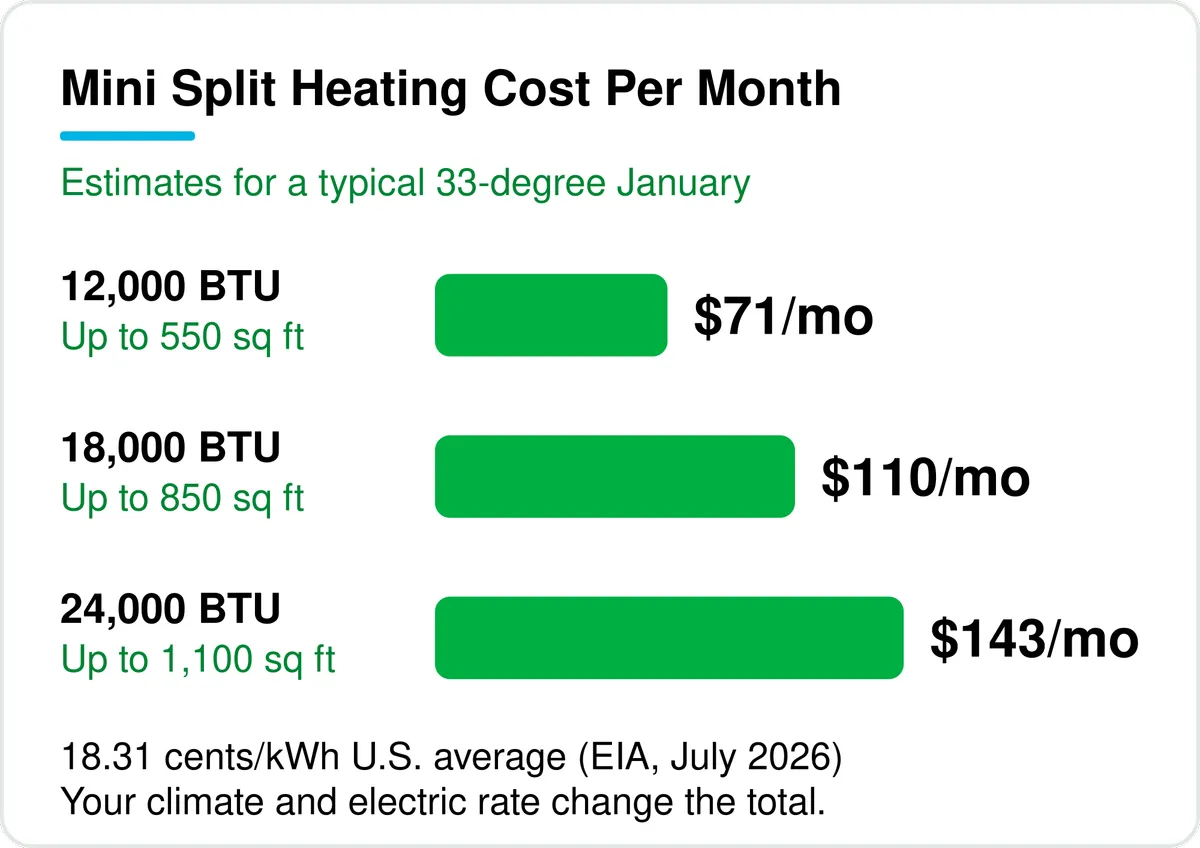
A 12,000 BTU mini split costs about $71 a month to heat a room in a typical January. That estimate uses a 33-degree month and the July 2026 U.S. average electric rate of 18.31 cents per kWh. Your climate and power rate can move it from a few dollars in Miami to about $227 in Anchorage.
12,000 BTU (up to 550 sq ft): about $71 a month
18,000 BTU (up to 850 sq ft): about $110 a month
24,000 BTU (up to 1,100 sq ft): about $143 a month
In every state we modeled, a mini split costs an estimated 46% to 72% less to run than baseboard heat. Use the quick quiz below to find the size that fits your room.
Filterbuy mini splits come with fast and free 2-day delivery to most US states and a 7-year compressor, 3-year parts warranty.
Shop Mini Split Systems
Answer a few quick questions and we'll match you to the right mini split size for your space.
TL;DR
A ductless mini split costs roughly $70 a month to heat a 550 sq ft room in a typical 33°F January at the U.S. average rate of 18.31¢/kWh, according to the Filterbuy Winter Heating Cost Index. The same unit costs almost nothing to run in Honolulu or Miami and about $227 a month in Anchorage.
Key Takeaways
Nationwide, the median January heating cost is $74 for a 12,000 BTU mini split, $114 for 18,000 BTU and $147 for 24,000 BTU.
Cold, high-rate states such as Alaska and Maine pay the most.
Filterbuy estimates a mini split heats a room for 46% to 72% less than baseboard or space heaters in every state.
How Much Does It Cost to Heat With a Mini Split per Month?
In a typical January, a mini split heat pump costs roughly $70 to $145 a month to run, depending on its size. These figures assume a 33°F month (about 1,000 heating degree days), a room held at 68°F to 70°F, and the July 2026 U.S. average residential rate of 18.31¢/kWh from the U.S. Energy Information Administration (EIA) Electric Power Monthly.
For cooling costs, see Filterbuy's mini split running cost per month guide.
Mini Split Heating Cost by State
The table below estimates one January of mini split heating in every state and DC. For each state, we paired its July 2026 EIA residential rate with the normal January heating load in its largest metro, using NOAA Climate Prediction Center degree day statistics.
Monthly cost to heat with a mini split for one normal January, by unit size. HDD = heating degree days.
January averages near or below 20°F. Colder nights can push past a standard mini split's comfortable heating range, so plan for backup heat or a cold-climate model.
Sources: U.S. Energy Information Administration, Electric Power Monthly, Table 5.6.A (residential, July 2026); NOAA Climate Prediction Center January heating degree day normals for each state's largest metro. Estimates, not quotes.
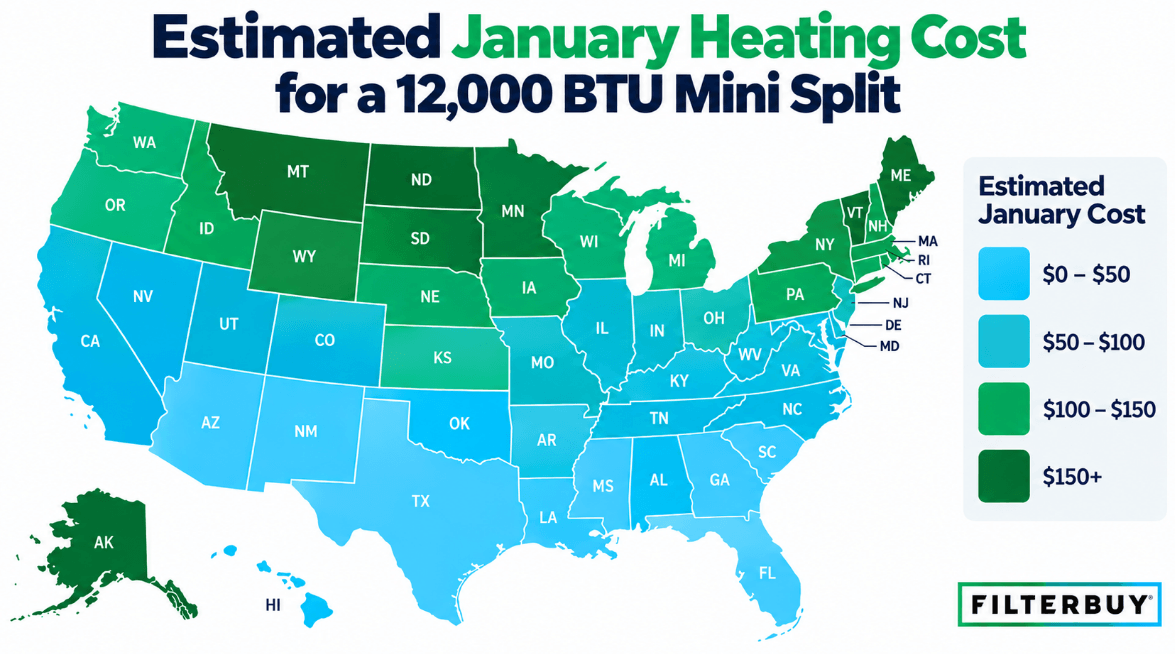
"When we ran all 51 rows, the electricity rate often mattered more than the cold. Portland, Maine, and Omaha need almost the same heat in January, yet our estimate is $203 for Maine and $86 for Omaha, because Maine's electricity rate is more than double Nebraska's."
— Filterbuy Team
How We Built These Estimates
The Filterbuy Winter Heating Cost Index combines four disclosed inputs:
Heat needed. We used NOAA's normal January heating degree days for each reference city and an assumed heat loss of 0.30 BTU per hour per sq ft per °F (165 BTU/h per °F for 550 sq ft).
Efficiency at that temperature. We modeled a 17 SEER2 inverter mini split like Filterbuy's, with a coefficient of performance (COP) of 3.6 at 47°F and 2.3 at 17°F, scaled to each city's January temperature. In the Filterbuy model, the same unit needs nearly twice as much electricity per unit of heat in Fargo (COP 1.85) as in Atlanta (COP 3.41).
Electricity price. EIA's July 2026 residential average for each state; winter rates can differ.
The math. Monthly cost = (heat-loss factor × January HDD × 24 ÷ 3,412 ÷ COP) × rate.
Worked example, Minneapolis: A 550 sq ft room needs 165 × 1,616 HDD × 24 hours, or 6.4 million BTU (about 1,876 kWh of heat). At a COP of 2.12, the mini split draws roughly 885 kWh, and at 17.45¢/kWh the January bill comes to $154.
These are planning estimates, not quotes.
How to Estimate Your Own Mini Split Heating Cost
To estimate your own cost, adjust our state figure to the rate you actually pay. Divide your bill's total by the kWh used, then use this shortcut:
Your monthly cost ≈ table cost × (your rate ÷ the state rate in the table)
Is a Mini Split Cheaper Than Other Electric Heat?
Yes. In every state Filterbuy modeled, a mini split is estimated to heat the same 550 sq ft room for 46% to 72% less than baseboard or space heaters. Resistance heat turns each kWh into one kWh of heat, while a mini split moves heat rather than generating it. In these estimates, mild-climate homes see the largest percentage gap, while cold, high-rate states see the largest dollar gap.
If you heat with gas or oil, Filterbuy's heat pump heating cost guide runs those numbers.
Can a Mini Split Keep Up in a Cold Winter?
Most mini splits keep heating well below freezing, although output and efficiency drop as the temperature falls. We publish two numbers for the Filterbuy 12,000 BTU mini split: reliable heating down to 5°F and operation down to −4°F. We plan around the 5°F figure because we'd rather tell you where our unit needs help than oversell it.
In the eight states marked , January nights regularly approach or drop below 5°F. Plan on one of these setups:
Use the mini split as the main heat for a well-insulated room, with baseboard or furnace backup. See Filterbuy's guide to mini split backup heat by climate zone.
Choose a cold-climate model from the NEEP cold-climate air-source heat pump list if it must carry the full load. Compare options in our best mini splits for cold climates ranking.
How to Lower Your Mini Split Heating Bill
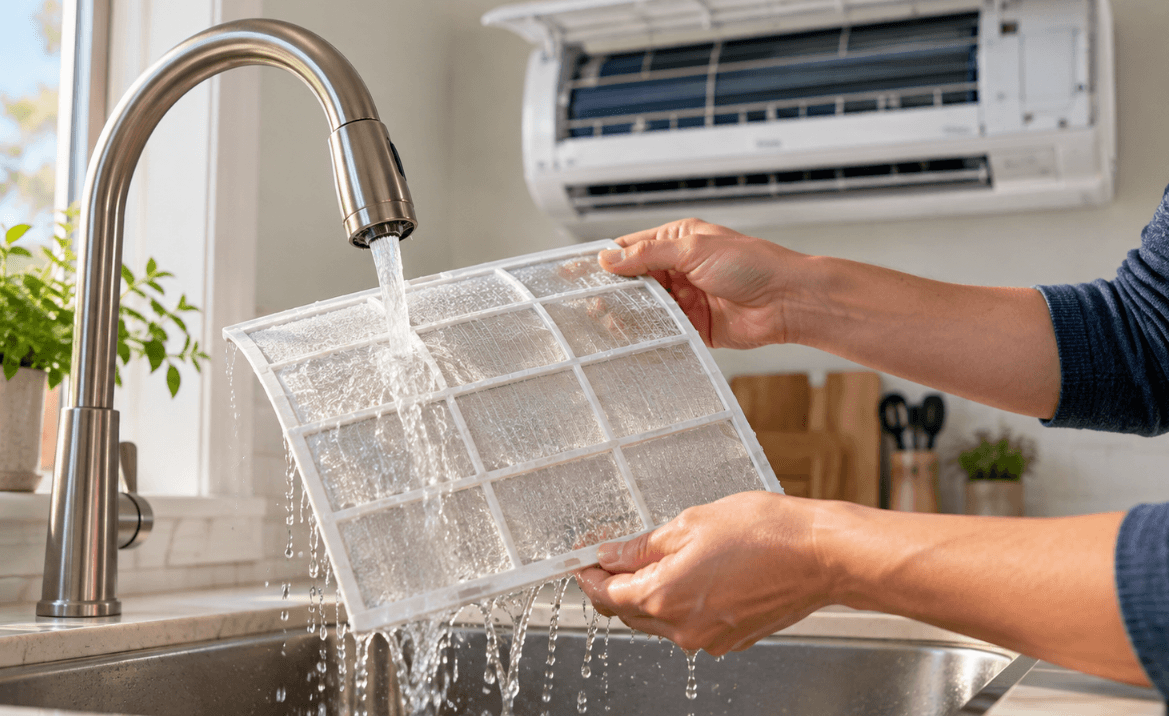
Rinse the indoor pre-filter every 2 to 4 weeks in winter. As a U.S. filter manufacturer, Filterbuy puts this tip first. The pre-filter protects the coil; when it clogs, airflow drops and the compressor runs longer for less heat. Your whole-home filter is what handles the air. See our mini split maintenance guide.
Hold a steady, slightly lower setpoint. ENERGY STAR recommends picking a comfortable temperature and leaving it there. In the Filterbuy model, each 1°F lower trims roughly 2% in Minneapolis and 4% to 5% in Atlanta or Dallas.
Keep the outdoor unit clear of snow and ice.
Close doors and seal drafts.
What surprised us most: the same mini split can cost ten times more to heat a room in one state than in another. Full disclosure: Filterbuy sells single-zone 12,000 to 24,000 BTU mini splits and manufactures air filters in the USA, so we ran every state through one model built on public data.
Supporting Statistics
3.0 seasonal COP in real homes. Ductless heat pumps metered in a Northwest Energy Efficiency Alliance (NEEA) field study averaged a seasonal COP of 3.0 and cut net heating use by 3,049 kWh a year.
53% less heating electricity in Minnesota. In a Minnesota Department of Commerce cold-climate heat pump field study, ductless heat pumps that replaced baseboard heat cut heating electricity use and cost by 53%, saving roughly $350 to $610 a year.
42% of U.S. households heat mainly with electricity. According to the U.S. Energy Information Administration, 42% of households named electricity as their main space heating fuel in 2024.
Frequently Asked Questions
How Much Does It Cost to Run a Mini Split in Winter?
From December through February, a 12,000 BTU mini split runs roughly $180 to $200 in a moderate climate at the U.S. average rate. In Maine, it can top $500.
How Much Does a Mini Split Cost to Run per Day in Winter?
Expect roughly $2.30 a day for a 12,000 BTU unit in a typical 33°F January at 18.31¢/kWh. The daily cost falls to about $1.20 in Atlanta or Dallas and climbs to about $7.30 in Anchorage.
Is It Expensive to Run a Mini Split 24/7 in Winter?
No. A variable-speed inverter adjusts output based on demand, using less energy when maintaining temperature, so a steady setting is usually the efficient choice.
Does a Mini Split Work Below Freezing?
Yes, with less output as it gets colder. Filterbuy mini splits deliver reliable heating down to 5°F; for colder winters, choose a cold-climate model.
What Size Mini Split Do I Need to Heat a Room?
Filterbuy's 12,000 BTU model heats up to 550 sq ft, the 18,000 BTU model up to 850 sq ft and the 24,000 BTU model up to 1,100 sq ft. A Manual J load calculation confirms the right fit.
Keep Your Mini Split Heating Efficiently All Winter
Clean filters protect the efficiency you paid for, including the furnace backing up your mini split. Filterbuy ships custom-size furnace filters fast and free, with auto-delivery. For a new system, Filterbuy mini split systems come with published prices, free 2-day delivery on in-stock systems and a 7-year compressor / 3-year parts warranty. Professional installation is required, and the warranty is void if self-installed.
Glossary
Mini split (ductless heat pump): an outdoor compressor linked by refrigerant lines to wall-mounted indoor units, with no ductwork.
COP (coefficient of performance): units of heat delivered per unit of electricity used.
SEER2: the federal seasonal cooling efficiency rating.
Heating degree days (HDD): how far daily average temperatures fall below 65°F, added up over a period.
EIA (U.S. Energy Information Administration): the federal agency that publishes U.S. electricity prices.
NOAA Climate Prediction Center (CPC): the federal source of U.S. heating degree day data.
Filterbuy Winter Heating Cost Index: Filterbuy's state-by-state model of January mini split heating costs.
Manual J: the standard method contractors use to size heating and cooling for a room.