How to Deep Clean a Mini Split: DIY Steps vs. Professional Service
September 2, 2026
AUTHOR Michelle Wan, Brand Manager & Air Quality Writer, Filterbuy · REVIEWER David Clark, Licensed HVAC Technician; President, Filterbuy HVAC Solutions · PUBLISHED September 2, 2026 · UPDATED September 2, 2026
How to Deep Clean a Mini Split
A mini split deep clean reaches the three parts a filter rinse never touches: the evaporator coil, the blower wheel, and the drain pan. You can clean the coil and drain line yourself in about an hour, for $15 to $40 in supplies. The blower wheel needs partial disassembly, so it goes to a licensed technician at $150 to $450 per indoor head.
If the smell came back days after you washed the filter, the blower wheel is why.
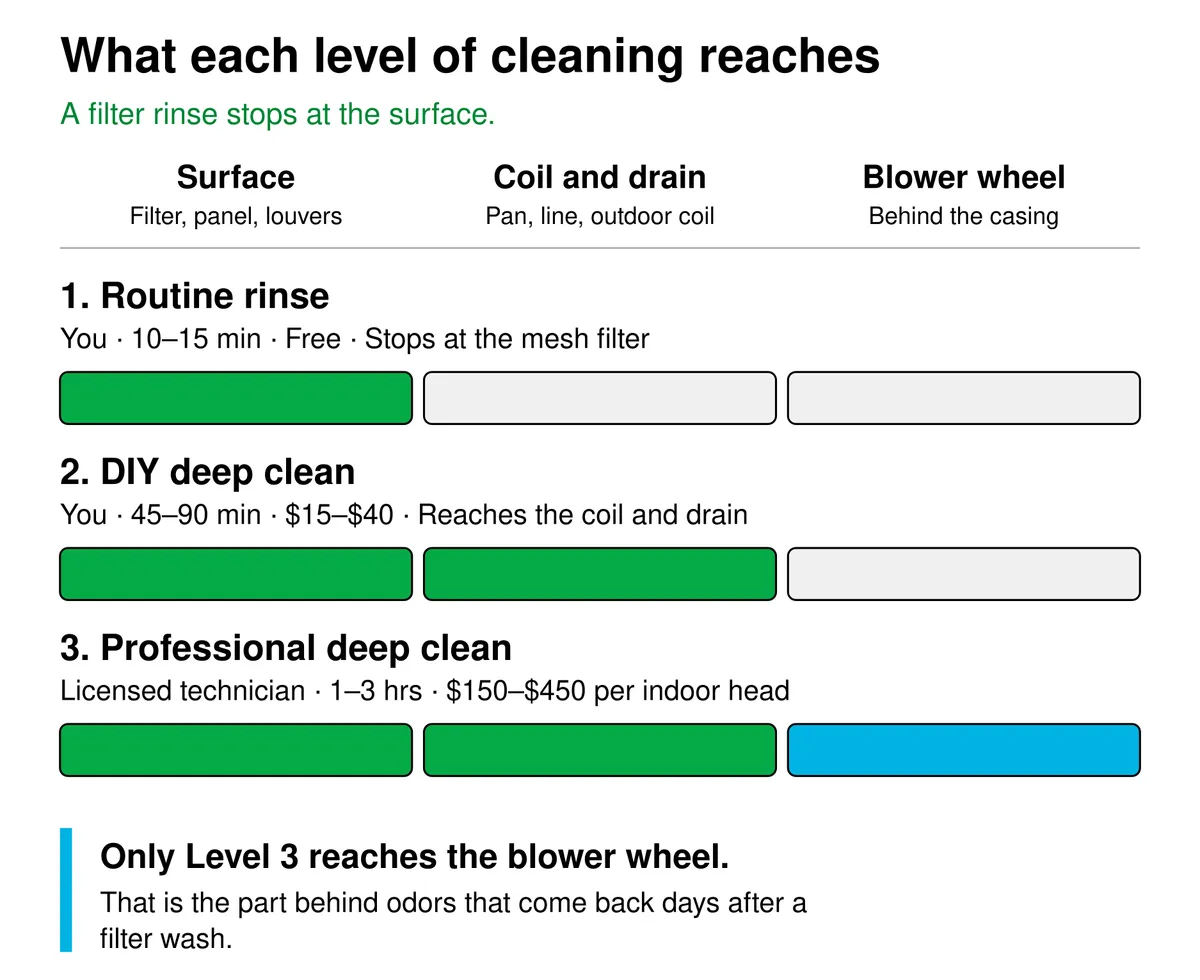
- Routine rinse: mesh filter, front panel, louvers. You, 10 to 15 minutes, free. Every 2 to 4 weeks in season.
- DIY deep clean: coil surface, drain pan and line, outdoor unit. You, 45 to 90 minutes, $15 to $40 in supplies. Once or twice a year.
- Professional deep clean: blower wheel washed, coil flushed, pan sanitized, electrical check. Licensed technician, 1 to 3 hours, $150 to $450 per indoor head. Every 1 to 2 years.
Not sure which level your system needs? The match quiz below narrows it down.
Answer a few quick questions and we will match you to the right mini split for your space.
A deep clean will not fix a system that is undersized or short-cycling. If that sounds like yours, compare ductless mini split systems from 12,000 to 24,000 BTU.
What a Mini Split Deep Clean Actually Involves
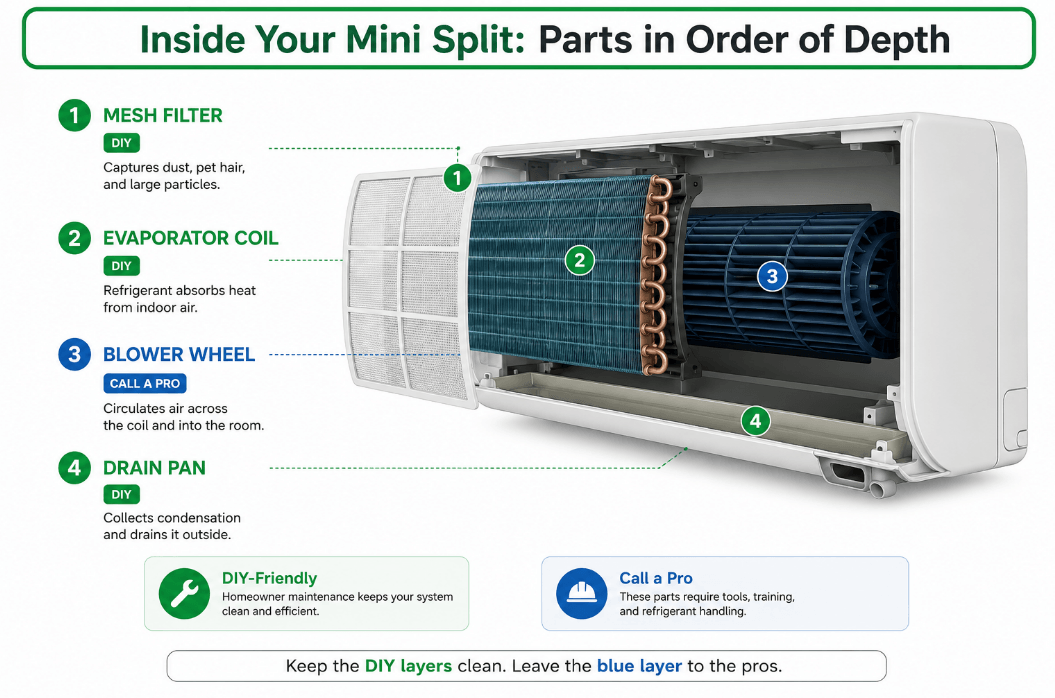
A mini split deep clean goes past the washable filter to the three parts that hold grime: the evaporator coil, the blower wheel and the drain pan. You can handle the coil and drain line yourself with a no-rinse cleaner in about an hour. The blower wheel needs partial disassembly and a licensed technician, typically $150 to $450 per indoor head.
TL;DR
Once or twice a year, set aside an hour and clean the coil and drain line yourself with a no-rinse cleaner. Leave the blower wheel to a technician every year or two, at $150 to $450 per indoor head. If the smell returns days after a filter wash, that wheel is why.
Key Takeaways
A filter rinse is not a deep clean. The mesh pre-filter catches lint, but the fine dust behind weak airflow and odors settles further in, on the coil and blower wheel.
The blower wheel is where recurring smells live. Its molded blades hold a damp film of dust that a cloth cannot reach, which is why odors return days after a filter wash.
Professional cleaning is priced per indoor head, not per system. That single detail is why published estimates swing anywhere from $75 to $650.
The Three Levels of Mini Split Cleaning
Most guides use "deep clean" to mean anything past a filter rinse, which is exactly why the smell comes back after people are sure the job is done. Filterbuy makes the replacement filters that go into these systems, and the three levels below are how we separate the work. The difference is depth rather than technique, and only one level reaches the part that smells.
Level 3 pricing is per indoor head, not per system. Levels 1 and 2 are your own time plus supplies.
Level 2 gives back the most airflow for the least money, and it is the one almost everybody skips. For the every-few-weeks habit instead, see our guide to routine mini split cleaning.
"We make the replacement filters for these systems, so mini split questions reach us in a very predictable order. First it is which filter fits. A season later it is: I cleaned the filter and it still smells. That second question is the reason this page exists. The filter was never the thing that smelled."
— Michelle Wan, Brand Manager & Air Quality Writer, Filterbuy
How to Deep Clean a Mini Split Yourself
Set aside about an hour. You will want a no-rinse foaming coil cleaner, a soft brush, a vacuum with a brush attachment, microfiber cloths, gloves and eye protection. Work from the filter inward so debris travels toward the drain.
1. Cut the power at the breaker. Switching off with the remote is not enough, because the control board stays live either way. Flip the dedicated breaker for both the indoor and outdoor units, then confirm the unit is dead before you open anything.
2. Wash the filters. Lift the front panel, slide the mesh filters out and vacuum off the loose dust before washing them in warm water with mild dish soap. Let them air-dry completely, because a damp filter going back into a warm unit starts the problem over again.
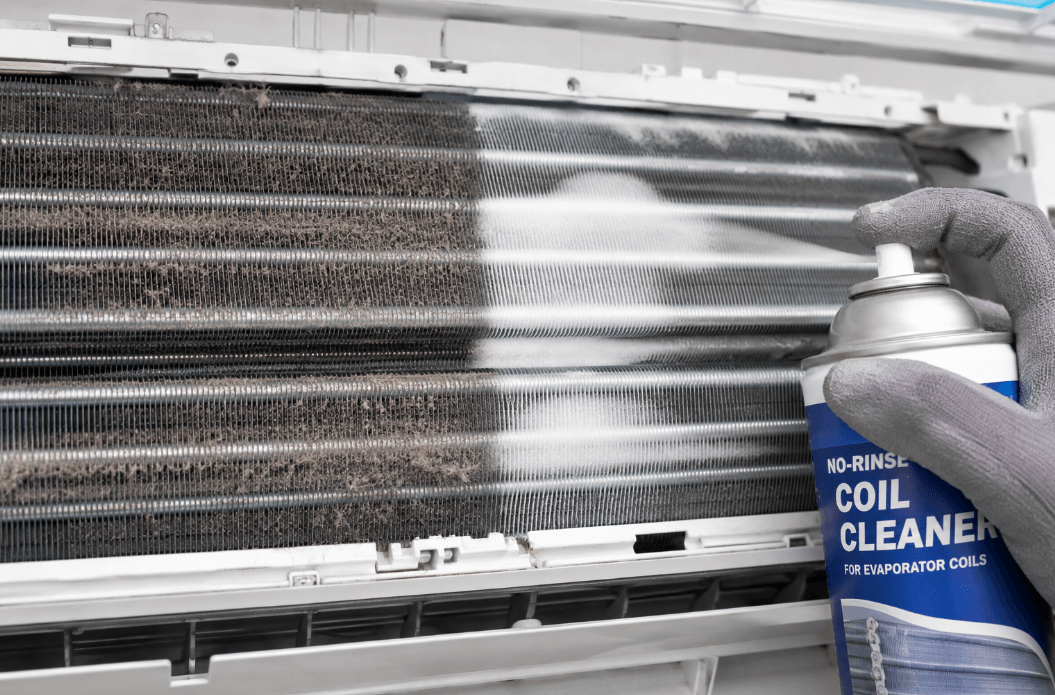
3. Clean the evaporator coil. With the filters out you will see rows of thin aluminum fins. Vacuum gently and parallel to the fins so they do not bend, then spray on a no-rinse coil cleaner and let it foam for five to ten minutes. Skip bleach and vinegar, which corrode the fins and degrade the drip pan. Daikin warns off solvents and abrasive pads.
4. Wipe the blower wheel. Run a damp microfiber cloth over the blades you can reach, and be honest with yourself about how much of the wheel that is. It is usually less than half.
5. Flush the drain pan and line. Clear out standing water and sludge, then flush the line with warm water or pull the gunk from the outdoor end with a wet/dry vacuum. The EPA lists clean drip pans and flowing drain lines among its core moisture-control steps.
6. Rinse the outdoor condenser. Clear away debris, keep the two feet of clearance DOE recommends and rinse the fins on low pressure, working inside out. A pressure washer will flatten them.
7. Reassemble and test. Once everything is dry, slide the filters back in, restore power and run the unit on medium fan for ten or fifteen minutes. The airflow should feel stronger and the unit should sound clean.
Where DIY Deep Cleaning Has to Stop
Call a licensed technician when the job needs the casing removed, when the smell returns within days, or when you see growth deep in the fins. Three reasons the line sits there.
The blower wheel is hard to reach. Cleaning it properly means unclipping the casing and often pulling the wheel, with a sensor harness and control board inches away.
Water and electronics share a small box. A cleaning bib channels runoff into a bucket, and without one a rinse quickly becomes a repair.
Manufacturers draw the line too. Mitsubishi and Daikin manuals route internal service to an authorized technician, and going further risks the warranty.
The EPA advises a professional for any moldy area over about 10 square feet, and warns against running a system you suspect is contaminated. If yours shows growth rather than dust, see mold in your mini split.
Filterbuy is not affiliated with or endorsed by Mitsubishi or Daikin.
What Professional Mini Split Cleaning Includes
Professional cleaning is a partial teardown rather than a wipe-down. The technician cuts power at the disconnect, applies lockout and tagout, takes off the cover and louvers, fits a cleaning bib to catch runoff, then washes the coil and blower wheel with an EPA-registered cleaner and low-pressure sprayer. The pan and drain line get flushed on the way out.
A thorough visit also covers airflow, electrical connections, refrigerant pressure, and the outdoor coil, which matches the ENERGY STAR checklist. A $149 tune-up is often just a filter rinse, which is why our service arm, Filterbuy HVAC Solutions, prices the teardown separately on the ductless systems it services in Texas and Florida. Check licensing and EPA 608 certification with our technician hiring guide.
How Much Does a Deep Clean of a Ductless AC Cost?
Professional mini split cleaning typically runs $150 to $450 per indoor head, depending on how much of the unit comes apart. We built the table around scope rather than headline price, because published ranges only look contradictory until you notice nobody says whether they quote per system or per head.
Compiled by Filterbuy from published US service-cost data, August 2026. Always confirm whether a quote is priced per system or per indoor head.
Before You Book, and After They Leave
Head count, access and buildup all move the price, but scope moves it more. Ask three questions before agreeing to a number. Is the quote per head or per system? Does the blower wheel come out, or just get wiped? Is the drain line flushed? Those three answers separate a $150 wipe-down from a $450 teardown.
After the technician leaves you can check the work in a minute. Shine a flashlight into the blower wheel through the outlet vanes. A cleaned wheel has clean gaps between the blades, not just clean faces. Ask to see the runoff too, since a real wash fills a bucket with grey water and a wipe-down produces none.
One upsell worth declining. Ozone treatments get pitched as a permanent fix for odor. The EPA states that at concentrations which do not exceed public health standards, ozone does not effectively remove mold or other biological pollutants, and that no federal agency has approved these devices for occupied spaces.
What a Deep Clean Won't Fix
If the smell comes back weeks after a professional cleaning, cleaning was never really the fix. The EPA gives a wet surface 24 to 48 hours to dry before mold takes hold, and a mini split only dries its coil while the fan runs. A unit that shuts off the moment the room hits temperature never gives the coil that long. The smell is a scheduling problem before it is a cleaning problem, which is why scrubbing keeps failing.
The durable fixes are moisture habits. Hold humidity in the 30% to 50% range the EPA recommends, run dry or fan mode long enough to dry the coil, and keep the drain clear. If sizing is the culprit, our buying guide covers load calculation.
Supporting Statistics
Three findings explain why the coil, rather than the filter, decides how a mini split ages. They come from Berkeley Lab, the DOE and the EPA.
Sources: eta.lbl.gov/publications/dirty-air-conditioners-energy; energy.gov/energysaver/operating-and-maintaining-your-heat-pump; epa.gov/mold/brief-guide-mold-moisture-and-your-home
Frequently Asked Questions
How often should a mini split be deep cleaned?
Clean the coil and drain yourself once or twice a year, and book a professional teardown every one to two years. Make it annual in humid climates or pet homes.
How much does it cost to deep clean a ductless AC?
Expect $150 to $450 per indoor head for a deep clean, or $100 to $250 for a basic tune-up. Quotes are per head, so a three-zone home pays roughly three times a single-zone home.
Is professional mini split cleaning worth the cost?
For a system that has run two or more seasons without one, usually yes. A teardown restores airflow a surface clean cannot, and it catches drain and electrical faults early. For a newer unit in a dry climate, a DIY deep clean each spring is enough.
Keep the Deep Clean From Being Necessary
The less dust that reaches the coil, the longer a deep clean holds. Here is one thing we correct constantly, because we make these replacement filters. Most ductless mini splits use a proprietary washable mesh pre-filter and will not take a boxed pleated filter, so please do not force one in. Keep the mesh spotless and let your central HVAC filter carry the rest, since the Department of Energy notes that air bypassing a dirty filter deposits dirt onto the coil. Filterbuy makes those in standard and custom sizes, including MERV 13. Higher-MERV media restricts airflow more, so check what your system is rated to handle before upgrading.
BETTER AIR FOR ALL™. Find your exact filter size →
Glossary
Evaporator coil: The cold aluminum-finned coil inside the indoor unit. It produces condensation whenever the system cools.
Blower wheel: The barrel-shaped fan behind the coil. Dust and moisture collect between its blades, the most common source of recurring odor.
No-rinse coil cleaner: A foaming cleaner made for HVAC coils. It lifts buildup and drains away through the condensate line without rinsing.
Condensate drain line: The narrow tube carrying condensation from the drain pan outdoors. A clog or poor slope lets water back up.
Indoor head: A single indoor air handler. Multi-zone systems have several on one compressor, and service is priced per head.
About the Author
Michelle Wan is Brand Manager and Air Quality Writer at Filterbuy. She works directly with Filterbuy's U.S. manufacturing team across plants in Alabama, Florida, Pennsylvania, and Utah. B.A., University of California, Santa Cruz.
Reviewed by David Clark, an EPA-certified Licensed HVAC Technician, graduate of the South Florida Academy of Air Conditioning, and President of Filterbuy HVAC Solutions.