Should You Leave Your Mini Split On All Winter? The Cost Math
October 6, 2026
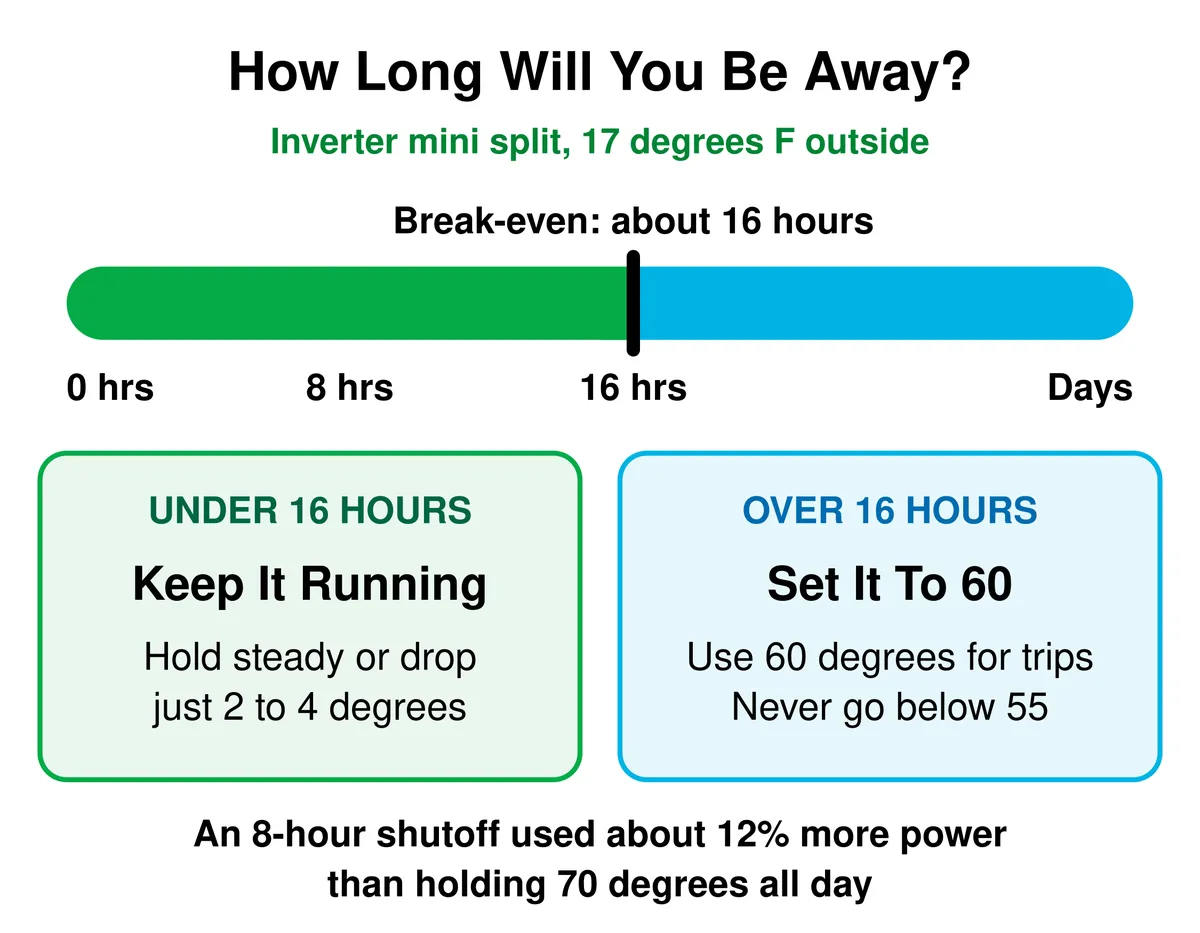
Yes. For most inverter mini splits, keeping the system on all winter costs the same or less than shutting it off. A cold restart pushes the compressor to full speed, where it runs least efficiently. In this guide's cost math, an 8-hour shutoff at 17°F used about 12% more electricity than holding 70°F.
Workdays and nights: hold steady or set back just 2 to 4°F.
Away more than about 16 hours: set it to 60°F.
Any absence: never go below 55°F.
Shopping for a new system? Take the quick match quiz below.
Find The Right Mini Split For Your Space
Answer a few quick questions and we'll match you to a mini split that fits your room.
Prefer to browse? Filterbuy mini splits ship with fast, free 2-day delivery to most US states and carry a 7-year compressor and 3-year parts warranty. Shop ductless mini split systems
TL;DR
For most inverter mini splits, Filterbuy's numbers show that holding a steady temperature through the workday costs about the same as turning the system off, and often less, because a cold restart pushes the compressor to full speed, where each kilowatt-hour buys less heat. If you'll be gone a few days or more, set it to about 60°F (never below 55°F) instead of shutting it off.
Key Takeaways
In Filterbuy's model, shutting off a 1-ton cold-climate mini split for an 8-hour workday at 17°F used about 12% more electricity than holding 70°F.
In the same model, you'd need to be gone about 16 hours before turning the unit down beats holding steady.
In the northern states we priced, a month of daily shutoffs on cold days adds about $9–$15 per zone.
Should I Leave My Mini Split On All The Time In Winter?
Yes, in most cases. An inverter-driven ductless mini split heat pump is designed to run continuously, nudging its compressor up and down to match the heat your room loses. You save a little while it's off, but the full-speed recovery afterward often costs more, especially below freezing.
The U.S. Department of Energy's advice to turn the thermostat back 7–10°F for 8 hours a day, worth up to 10% a year on heating and cooling, was written with furnaces in mind. The same guidance, republished by the Maryland Energy Administration, warns that setting back a heat pump in heating mode can wipe out those savings.
See our guide to the best mini split settings for winter.
"The furnace habit of turning the heat way down when you leave doesn't carry over to an inverter mini split. These systems are built to run low and steady, and our numbers show that's where they use the least energy."
— Filterbuy Team
Why Inverter Mini Splits Are Different From Furnaces
A heat pump's efficiency is measured by its coefficient of performance, or COP: the amount of heat it delivers for each unit of electricity. Inverter mini splits reach their best COP at partial output and lose efficiency as they ramp toward maximum.
We used Mitsubishi Electric's published submittal for the MSZ-FS12NA / MUZ-FS12NA, a 1-ton (12,000 Btu/h) Hyper-Heating wall-mounted unit built for cold-weather heating. We chose it because it lists rated and maximum output at 17°F. Filterbuy is not affiliated with or endorsed by Mitsubishi Electric.
Source: Mitsubishi Electric MSZ-FS12NA / MUZ-FS12NA submittal (2022). COP calculated from the listed heat output and power input.
At 17°F, this unit makes about 32% less heat per kilowatt-hour at full speed than at its rated speed. That gap is the hidden cost of a cold restart: the whole room has to be reheated while the compressor is at its least efficient.
Check your own unit's full-speed penalty in two minutes:
1. Find the model number on the outdoor unit's label.
2. Look up its 17°F heating data in the manufacturer's submittal sheet or on the cold-climate heat pump product list from Northeast Energy Efficiency Partnerships (NEEP), which lists output and power at each capacity level.
3. Divide the maximum-capacity COP by the rated COP. If you only have output and power, COP equals Btu/h ÷ 3,412 ÷ kW. Our example unit scores 2.74 ÷ 4.04 = 0.68, and the lower your number, the more holding steady pays.
The Cost Math: Steady Vs. Setback Vs. Off
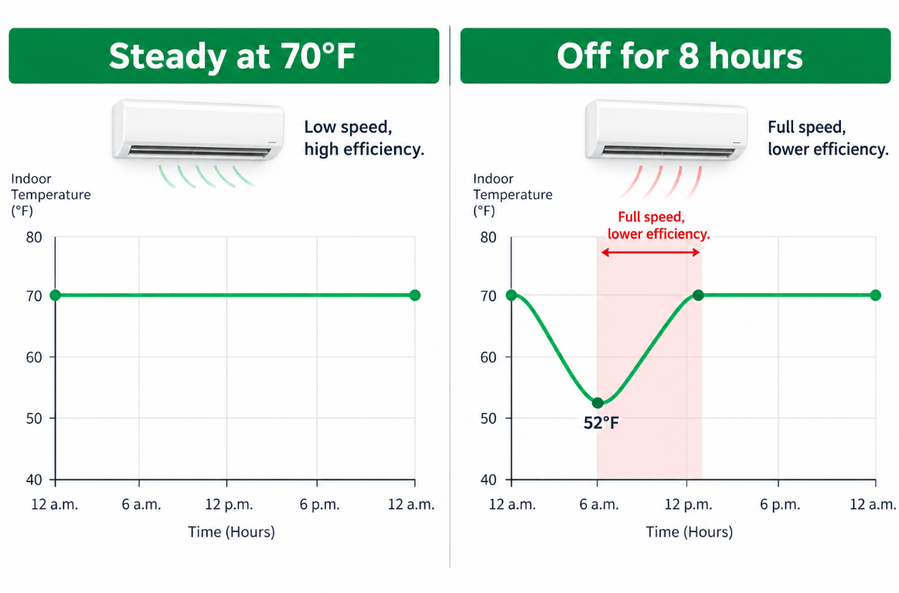
In Filterbuy's model, turning a 1-ton mini split off for an 8-hour workday on a 17°F day used 16.3 kWh, about 12% more than the 14.6 kWh needed to hold 70°F. Figures are modeled, not measured.
Filterbuy model: one zone served by a 1-ton cold-climate mini split on a 17°F day, 8-hour absence. Modeled figures, not field measurements.
What stood out to us: even an 8°F setback cost more than holding steady on a day this cold, and shutting off means coming home to a 52°F room.
How we built the model: The zone's heat loss matches the unit's rated 8,400 Btu/h output at 17°F with a 70°F setpoint, and the room and its contents store about 3,000 Btu per °F. Steady and holding periods run at the rated COP of 4.04, while recovery runs at the maximum-output COP of 2.74.
What It Costs In Your State
The extra cost of shutting off a mini split grows with your electricity rate. Filterbuy priced the modeled day at average residential rates from the U.S. Energy Information Administration (EIA), Electric Power Monthly Table 5.6.A, June 2026 data, as compiled by JouleIO.
Rates: U.S. Energy Information Administration, Electric Power Monthly Table 5.6.A, June 2026 data (energy charge only). Costs apply the Filterbuy 17°F model to one zone over 30 consistently cold days.
These figures assume one zone over 30 cold days. For monthly estimates by unit size, see what a mini split costs to run per month.
How Long Do You Have To Be Away Before Turning It Down Pays Off?
On a 17°F day, you need to be away about 16 hours before turning a cold-climate mini split down saves more than holding it steady, according to Filterbuy's model. The table compares a 60°F setback with holding 70°F, recovery included.
Filterbuy model: one zone, 1-ton cold-climate mini split, 17°F outdoors. Energy covers the time away plus 12 hours after you return, so recovery is counted.
The surprise was how little the setback depth mattered. Break-even landed at 16 to 16.5 hours whether we set back to 66°F or 55°F, so trip length is the number to plan around. Past two days, each extra day at 60°F saves about 2.7 kWh per zone.
What Is The Best Mini Split Setback Temperature?
For overnight or workday absences, we recommend a setback of 2–4°F at most. Deeper 7–10°F setbacks, the classic furnace advice, tend to erase the savings in freezing weather. A few habits help:
Ramp back up gradually. Raising the setpoint a degree or two at a time keeps the compressor out of its top speed.
Set back more in mild weather. Above roughly 40°F, recovery is quicker and the efficiency gap narrows (about 27% at 47°F versus 32% at 17°F).
Turn eco mode off in a cold snap. Eco settings, including the one on Filterbuy mini splits, cut power draw, which limits heat right when you need it.
Should I Turn My Mini Split Off When I'm Not Home In Winter?
Not for a normal workday: leave the mini split running or use a small setback. Daily shutoffs also add full-speed starts, which inverters are built to avoid. For trips longer than about 16 hours, turn it down to around 60°F rather than off. Don't go below 55°F, the floor the American Red Cross recommends when you travel in cold weather.
Many units have a freeze-protection or 10°C (50°F) mode for this. Switching a zone fully off only makes sense for a room you won't use for days that has no plumbing in its walls, or for an older single-speed unit.

Keep It Efficient While It Runs
The most common failure Filterbuy's HVAC Solutions team finds in the ductless systems it services is a filter no one thought to check. In our service data, a dirty mesh filter cuts a mini split's efficiency by 5–30%. Clean the mesh every two weeks in heating season; our guide on how to clean mini split filters covers every major brand.
"The number-one callback we could prevent is the damp-filter mold call. A mesh that goes back in even slightly wet is how mold gets started inside the head. Give it the full drying time."
— David Clark, Licensed HVAC Technician, Filterbuy
The mesh pre-filter protects the coil; if you also have a ducted system, its whole-home air filter is what handles the air, so replace it on schedule. Our mini split maintenance guide covers the rest. Filterbuy mini split systems come with free 2-day delivery on in-stock systems and a 7-year compressor / 3-year parts warranty. Professional installation is required, and the warranty is void if self-installed. They offer reliable heating down to 5°F; if one will be your main heat in a colder climate, choose a cold-climate model.
Your Next Step
Tonight, open your mini split's schedule. If it shuts off or drops more than 4°F during the workday, set it to hold steady and save 60°F for trips. Then check the mesh filter; if it looks gray, rinse it and let it dry fully.
Supporting Statistics
1.75 Cop At Full Speed
NEEP's cold-climate specification requires a COP of at least 1.75 at 5°F at full speed; our example unit lists 2.24 there, versus 4.04 at partial output at 17°F.
Source: NEEP, Cold Climate Air Source Heat Pump Specification, Version 4.0
50%–60% Less Energy Than Electric Resistance Heating
DOE-supported research indicates that heat pumps can save 50%–60% of space-conditioning energy compared with electric resistance heating.
$15,400 Per Water Damage Or Freezing Claim
Water damage and freezing claims averaged $15,400 from 2019–2023, and about 1 in 60 insured homes files one each year.
Source: Insurance Information Institute, Facts + Statistics: Homeowners and Renters Insurance
Frequently Asked Questions
Is it cheaper to leave a mini split on or turn it off?
Usually, yes, for inverter units in cold weather. In Filterbuy's 17°F model, an 8-hour shutoff used about 12% more electricity than holding 70°F.
How long should I be away before turning my mini split down?
In Filterbuy's 17°F model, about 16 hours. Past two days, each extra day at 60°F saves about 2.7 kWh per zone.
What temperature should I set my mini split to when I'm away for a week?
Set it to about 60°F or use your unit's freeze-protection mode, and never go below 55°F.
Glossary
Mini split (ductless heat pump): An outdoor compressor linked by refrigerant lines to one or more indoor units, with no ductwork.
Inverter compressor: A variable-speed compressor that matches its output to the room's heat needs.
COP (coefficient of performance): Heat delivered divided by electricity used.
Setback: Lowering the setpoint overnight or while away.
Recovery: Bringing the room back to its setpoint after a setback.
Btu/h: British thermal units per hour; 12,000 Btu/h is one ton.
kWh (kilowatt-hour): 1,000 watts used for one hour.
Sources
Mitsubishi Electric Trane HVAC US, MSZ-FS12NA / MUZ-FS12NA submittal (2022)
U.S. EIA, Electric Power Monthly Table 5.6.A, June 2026, via JouleIO
Maryland Energy Administration, Thermostats (republishes DOE guidance)
American Red Cross frozen-pipe guidance, via Village of Croton-on-Hudson
Insurance Information Institute, Facts + Statistics: Homeowners and Renters Insurance