
Snow Forecast Map: How to Read One and Prep Your Home Before the Storm
October 22, 2026
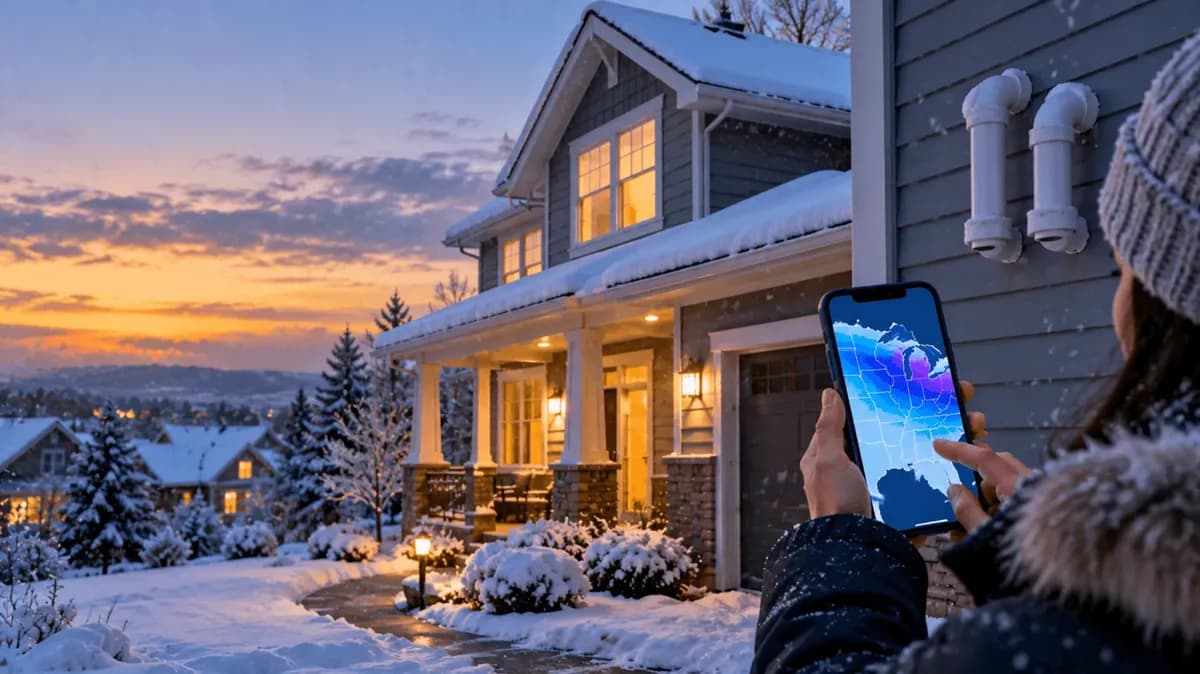
Find your location’s color band, then check the high-end total. On National Weather Service (NWS) winter pages, the high-end amount has only a 10% chance of being exceeded, so it’s the number to plan your home prep around.
Our rule at Filterbuy: order a fresh filter when the 7-day map first shows snow, and install it before a high-end forecast of 6 inches or more.
Find the right filter for your system with the quick quiz below.
Snow Map Action Plan
Find your high-end NWS forecast. Match the prep.
Plan for the high end, not the expected total.
Under 2"
Locate furnace vents and heat pump.
Test your CO detector.
2–6"
Replace your filter if it looks gray.
Clear vents after the snow stops.
6–12"
Install a fresh filter before the storm.
Check vents during the storm.
12"+ or WSSI Major/Extreme
All of the above, plus a spare filter.
Plan for a power outage.
WSSI Moderate or higher? Step up one level.
General guidance. Call 911 if a CO alarm sounds.
Find your filter before the storm
Stick with the MERV rating your system is built for. Answer a few quick questions and we’ll match you to your filter.
Already know your size?
TL;DR
A snow forecast map shows how much snow is expected in your area over a set period, usually in color-coded bands. The most reliable U.S. version comes from your local National Weather Service (NWS) office, which also maps low-end and high-end totals. At Filterbuy, we read snow on that map as the signal to get the house ready. Clear the furnace vents and test the carbon monoxide alarms, then put in a fresh air filter.
Key Takeaways
Plan around the NWS high-end snowfall number.
Filterbuy's rule: order a fresh filter when the 7-day map first shows snow, and install it before a high-end forecast of 6 inches or more arrives.
Drifting snow can bury a high-efficiency furnace's vents, shutting it down or pushing carbon monoxide indoors.
What Is a Snow Forecast Map?
A snow forecast map shows how many inches of snow forecasters expect across an area during a set period.
An observed map, such as the NWS National Snowfall Analysis, shows what has already fallen. After a storm, use it to judge how buried your vents might be.
Where Can You Find an Official Snow Forecast Map?
For a snow forecast map today, go to the NWS Weather Forecast Office responsible for your address. The NWS keeps a clickable directory of local NWS winter weather forecast pages, and these NWS snow forecast maps now cover 116 of its 122 local offices. Each page adds low-end, high-end, and ice maps. For a USA-wide look at how disruptive a storm will be, the NWS Weather Prediction Center (WPC) publishes the Winter Storm Severity Index (WSSI).
The WSSI doesn't replace official NWS warnings, and private maps have quirks of their own. OpenSnow's forecast snowfall map FAQ notes that its maps count sleet and freezing rain as snow, which can overstate totals. Treat a 7-day snow forecast map or 10-day totals as an early nudge to get ready, and use Filterbuy's guide to the winter storm warning map to see which alerts are active now.
How Do You Read a Snow Forecast Map?
Reading a snow forecast map comes down to five quick checks. The gap between the expected, low-end, and high-end maps tells you how confident forecasters are.
Read the valid time. Six inches in 12 hours is a different storm than six inches over three days.
Find your color band. Match your location to the legend. On an interactive snow forecast map, zoom in, since elevation and lake-effect bands can swing totals within a few miles.
Compare the range. On NWS winter pages, the low-end amount has a 90% chance of being exceeded, while the high-end amount has only a 10% chance (see the NWS Reno probabilistic snowfall page). Plan your home prep around the high end.
Check the impact. Open the WSSI for the same window. A few inches of heavy, wet snow on trees and power lines can rate a higher impact than a deeper powder.
Look for the rain-snow line. If you're near the edge of a color band, a small temperature shift can turn snow into sleet or rain.
Example: Reading One Storm on the Map
Say your NWS winter page shows 3 inches low-end, 6 expected, and 10 high-end, and the WSSI rates the storm a Moderate impact. Here's how we'd read it at Filterbuy:
Plan for 10 inches. The high end puts you in the 6–12 inch row of the Snow Map Action Plan below.
Step up one level. A Moderate WSSI rating moves you to the top row of the plan.
Note the spread. A wide range signals uncertainty, so check back after the next update.
Watch the snow type. Near freezing, snow falls heavy and wet and is harder to clear from vents.
"I tell readers to treat a snow forecast map like a delivery deadline. Once the high-end number reaches 6 inches inside five days, order the filter and mark your vents while trucks can still reach your street." Michelle Wan, Brand Manager & Copywriter, Filterbuy
Why Do Snow Forecast Totals Keep Changing?
Forecasters predict how much liquid will fall, then convert it to snow depth using the snow-to-liquid ratio. That ratio depends on temperature, so a small forecast shift can move the snow total. The classic rule of thumb is 10:1, or 10 inches of snow for every inch of liquid.
A 30-year climatology of NWS observer data published in Weather and Forecasting (Baxter et al., 2005) found that a mean near 13:1 fits much of the U.S. better.
Source: Baxter, Graves & Moore (2005), Weather and Forecasting.
The Snow Map Action Plan: What to Do at Each Forecast Level
Most snow maps stop at "how much," but homeowners also need "what now." After making filters in our own U.S. plants since 2013, we read every snow map from the furnace closet, so we built this plan at Filterbuy. Find your high-end NWS amount below, and step up one level if the WSSI shows Moderate impact or higher.
General guidance. Call 911 if a CO alarm sounds.
"After a heavy snow, most no-heat calls I see on high-efficiency furnaces trace back to a drift or an ice cap over the exhaust pipe. Clearing it by hand at the wall usually gets the heat back on." David Clark, Licensed HVAC Technician, Filterbuy HVAC Solutions
For a timed plan, see the Filterbuy Storm Clock winter storm emergency checklist.
How to Clear Furnace Vents After Snow
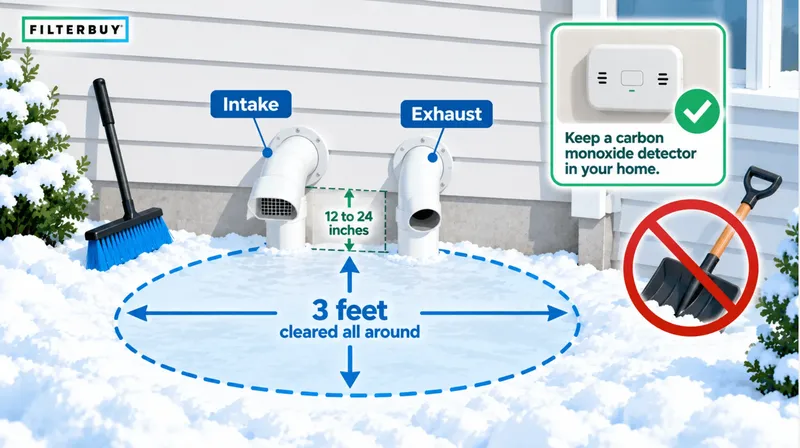
Most high-efficiency furnaces vent through two white PVC pipes, one for intake and one for exhaust, set 12–24 inches above the ground on an outside wall. New Castle County, Delaware's intake and exhaust clearance guide advises clearing a 3-foot circle with a soft brush, not a shovel, and checking again during and after every storm.
When snow blocks those pipes, the furnace usually shuts itself off, and a blocked exhaust can push carbon monoxide indoors. At Filterbuy, we treat a vent check the way we treat a filter change: a small habit on a schedule. For ice inside the pipe, see our frozen furnace vent pipe guide and call a licensed HVAC technician. If your CO alarm sounds, get everyone outside and call 911.
Heat pumps need a gentler touch: brush snow off the outdoor unit, but leave ice on the coil to the defrost cycle.
How Does a Snowstorm Affect Your Indoor Air?
In a storm, the windows stay shut and the heat runs for hours, so dust and pet dander circulate again and again. It's one reason why winter indoor air quality gets worse.
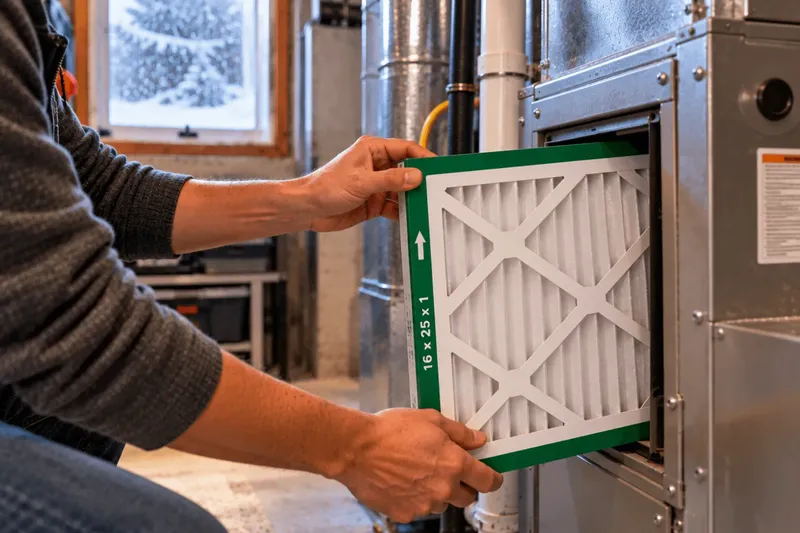
Install a fresh air filter before a big storm. A clogged filter chokes airflow and makes the furnace strain. We've pulled filters from customers' homes in February that were completely black after just 30 days.
On Filterbuy's manufacturing floor in Talladega, Alabama, our 1-inch filters get 14 pleats per foot and our 4-inch filters get 8, and each deeper 4-inch pleat holds more dust through days of nonstop heating. Check how often to change your furnace filter in winter, then shop Filterbuy air filters by size from more than 600 sizes.
"During any winter warning, stick with the MERV rating your system is built for, usually MERV 8 to 11, and save a first-time jump to MERV 13 for a mild week when you can watch how it runs." David Clark, Licensed HVAC Technician, Filterbuy HVAC Solutions
Carbon monoxide is the other winter indoor air risk. The CDC's carbon monoxide poisoning basics describe its symptoms as "flu-like" and advise battery-operated or battery backup CO detectors near every sleeping area. Test yours before a storm and know the carbon monoxide warning signs.
Supporting Statistics
Three U.S. government data sets back up Filterbuy's steps.
1. Snow forecasts lose accuracy fast.
5-day forecast: right about 90% of the time
7-day forecast: right about 80% of the time
10-day forecast: right only about half the time
Our take: We cut filters to order and ship within 24 hours, but no truck can reach an iced-over street. Order as soon as snow appears on the 7- to 10-day map.
2. Winter weather is deadly. (U.S. yearly averages, 2015–2024)
28 deaths a year from winter weather
38 more deaths a year from extreme cold
Our take: Snow on the map is a safety signal. Get the heat ready first.
Source: National Weather Service, U.S. weather fatality statistics, 1940–2024
3. Home heating fires peak in winter. (U.S. yearly averages, 2017–2019)
34,200 residential heating fires a year
January is the peak month, with 20% of the yearly total
77% are confined to chimneys, flues, or fuel burners
Our take: Have the furnace and flue inspected each fall, as the CDC advises, and check the vents and filter before snow starts.
Source: U.S. Fire Administration, Heating Fires in Residential Buildings (2017–2019)
Frequently Asked Questions
How Far Ahead Is a 10-Day Snow Forecast Map Reliable?
NOAA says 10-day forecasts are right only about half the time, so use one to spot a possible storm and plan around shorter-range totals.
What Do the Colors on a Snow Forecast Map Mean?
They show snowfall ranges in inches. Light blue usually means a dusting and purple or pink a foot or more, but scales vary, so check the legend.
What Is the Best Snow Forecast Map for This Week or the Weekend?
Your local NWS winter page, since its expected, low-end, and high-end maps update as the storm nears. Pair it with the WSSI for impact.
Should I Change My Air Filter Before a Snowstorm?
Yes, if it's due or looks dirty. A storm keeps the heat running longer, and Filterbuy auto-delivery can keep a spare on the shelf.
Can Snow Make My Furnace Shut Off?
Yes. Snow over a high-efficiency furnace's intake or exhaust pipe can trigger its safety shutdown. Clearing the vents usually lets it restart, though some models need a reset.
Glossary
Snow forecast map: A color-coded map of predicted snowfall, in inches, for a set area and time.
National Weather Service (NWS): The NOAA agency that issues official U.S. forecasts and warnings.
Winter Storm Severity Index (WSSI): A WPC map rating expected storm impacts from Minor to Extreme.
Snow-to-liquid ratio (SLR): Inches of snow produced by one inch of liquid precipitation.
Filterbuy: A U.S. maker of HVAC air filters, cut to order since 2013.
Carbon monoxide (CO): A colorless, odorless, poisonous gas produced by burning fuel.