
Do Heat Pumps Work in Extreme Cold? Auxiliary Heat and Performance Explained
November 3, 2026

Every bit of heat your heat pump delivers passes through the air filter first, so a clean filter is one of the simplest ways to keep auxiliary heat from running when the weather doesn't call for it. Heat strips return one unit of heat for each unit of electricity. Variable-speed heat pumps averaged 2.5 across a full winter in NREL field testing.
Long winter run times also fill filters faster. A filter that lasts 90 days in spring can fill up in 30 to 45 days in January, and the DOE says a severely neglected heat pump can use 10% to 25% more energy than a well-maintained one. Check yours monthly until the cold breaks.
Heat Delivered Per Unit Of Electricity
Coefficient of performance (COP). Higher means more heat for the same electricity.
Aux heat strips (electric resistance)
ENERGY STAR Cold Climate minimum at 5°F
DOE Challenge heat pumps in real homes at -15°F
Variable-speed heat pumps, full winter average
How Long A Filter Lasts
Spring
January
Sources: NREL, Field Validation of Air-Source Heat Pumps for Cold Climates (2023), ENERGY STAR Cold Climate key product criteria, and PNNL via ACEEE Summer Study (2024), compressor only. Filter life reflects Filterbuy's experience and varies by home.
Fast and free 2-day delivery to most US states. Auto-delivery saves 5% on every order.
Find The Right Filter For Your Heat Pump This Winter
TL;DR
Yes, heat pumps work in extreme cold, though their output drops as the temperature falls. When the heat pump can’t keep up alone, auxiliary heat (usually electric heat strips) switches on to fill the gap. That’s normal on the coldest days and during defrost. If aux heat runs on mild days, or your home can’t stay warm, it’s time to call an HVAC technician.
Key Takeaways
Cold-climate heat pumps keep at least 70% of their heating capacity at 5°F; look for the ENERGY STAR Cold Climate label.
Auxiliary heat is a backup that turns on automatically in deep cold, during defrost, or after a big thermostat jump.
A clean air filter and a steady thermostat setting do the most to keep aux heat use low.
Do Heat Pumps Work in Extreme Cold?
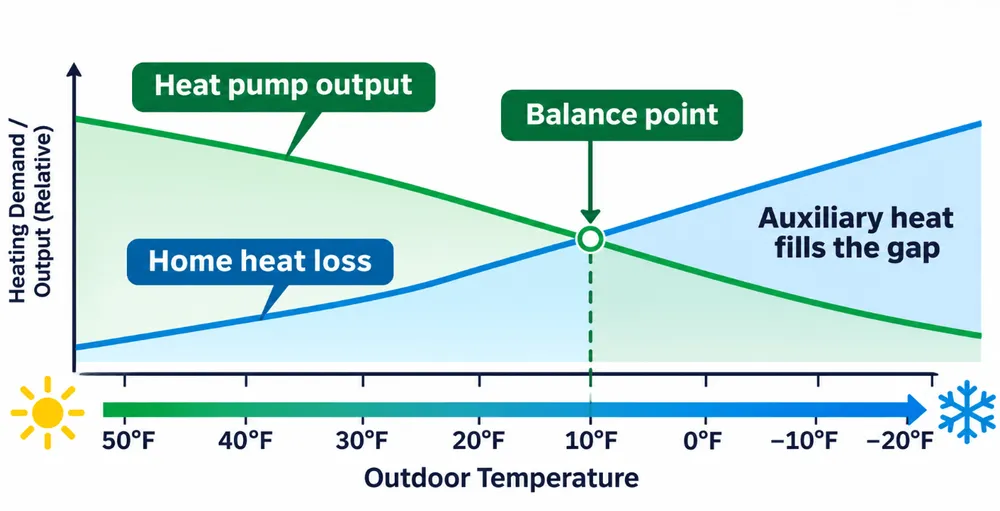
Heat pumps do work in extreme cold. An air-source heat pump moves heat from outdoor air into your home, and even 0°F air holds heat it can use. The catch is timing: as it gets colder, the heat pump’s output falls just as your home starts losing heat faster.
The point where those two trends cross is the balance point: the outdoor temperature at which your heat pump’s maximum output equals your home’s heat loss. Below it, auxiliary heat makes up the difference. In a National Renewable Energy Laboratory (NREL) field study of 12 ducted heat pumps, balance points ranged from about 13°F in well-sized homes to about 39°F in homes with undersized heat pumps.
Efficiency tells the rest of the story:
| Heat source | Heat delivered per unit of electricity (COP) | Source |
|---|---|---|
| Electric resistance aux heat (heat strips) | 1.0 | NREL, 2023 |
| Variable-speed ducted heat pumps, full winter season, real homes | 2.5 average (1.7–3.5) | NREL, 2023 |
| ENERGY STAR Cold Climate minimum at 5°F | 1.75 or higher | ENERGY STAR |
| DOE Cold Climate Heat Pump Challenge target at 5°F | 2.1–2.4 | DOE |
| DOE Challenge prototypes in real homes, compressor only, at -15°F | About 1.8 | PNNL via ACEEE, 2024 |
Sources: NREL, Field Validation of Air-Source Heat Pumps for Cold Climates (2023); ENERGY STAR Cold Climate key product criteria; U.S. DOE Residential Cold Climate Heat Pump Technology Challenge; PNNL, Rising Up to the Challenge (ACEEE Summer Study, 2024).
Even at −15°F, the DOE Challenge heat pumps in real homes got about 1.8 units of heat per kilowatt-hour from the compressor, nearly double what heat strips manage.
What Is Heat Pump Auxiliary Heat, and When Does It Kick In?
Auxiliary heat, or “aux heat,” is a backup heat source your thermostat turns on automatically when the heat pump needs help. In most all-electric homes, it’s a bank of electric resistance heat strips inside the indoor air handler. In cold weather, it usually comes on for one of three reasons:
It’s colder than your balance point. The heat pump runs at full output, and the heat strips add the rest.
The heat pump is defrosting. Frost builds on the outdoor coil in cold, damp weather, so the system briefly reverses to melt it. Aux heat warms the air during that cycle so your vents don’t blow cold.
You turned the thermostat up several degrees. A big jump, including recovery from an overnight setback, can prompt the system to call in aux heat. That’s why the DOE recommends skipping setbacks that trigger backup heat.
Aux heat vs. emergency heat: aux heat comes on by itself and works alongside the heat pump. Emergency heat (“EM heat”) is a manual setting that shuts the heat pump off and runs only backup heat. Use it only if the outdoor unit fails, then call a technician.
“Auxiliary heat is not a sign of failure,” writes David Clark, president of Filterbuy HVAC Solutions and an EPA-certified technician, in his guide to what aux heat on your thermostat means. Still, heavy use erases a heat pump’s efficiency advantage over heat strips. Filterbuy’s view: some “AUX” time in deep cold is expected, so watch for aux heat on days the weather doesn’t call for it.
What Do Cold-Climate Heat Pumps Do Differently?
A cold-climate heat pump is an air-source heat pump built and tested to keep heating efficiently in deep cold. Most use a variable-speed (inverter) compressor that ramps up as it gets colder instead of cycling fully on and off. Three labels help you spot one:
ENERGY STAR Cold Climate: The U.S. EPA’s ENERGY STAR program requires a COP of at least 1.75 and at least 70% of 47°F capacity at 5°F, tested with the unit’s native controls.
NEEP Cold Climate listing: Many utilities base rebates on the product list kept by Northeast Energy Efficiency Partnerships (NEEP), a nonprofit. Its specification also requires a variable-capacity compressor.
DOE Cold Climate Heat Pump Challenge: This DOE program pushed manufacturers to deliver 100% of rated capacity at 5°F.
That’s a big step up: the heat pumps in NREL’s study were rated to deliver only 48% to 68% of their 47°F capacity at 5°F. Filterbuy’s advice when you shop: judge a heat pump by its capacity at your area’s design temperature, from a load calculation (ACCA Manual J), not by the lowest temperature on the brochure. Filterbuy’s guide to choosing a heat pump for cold climates goes deeper.
What’s Normal for a Heat Pump in Extreme Cold, and What’s Not?
Long run times, cooler vent air and a little steam from the outdoor unit are normal in cold weather. Filterbuy’s cold-snap check helps you sort normal from not:
| What you notice | Usually normal | Call a technician |
|---|---|---|
| Vent air feels lukewarm | Heat pump supply air rarely topped 100°F in NREL's study, and about 80°F was common. | The house can't reach your setpoint on a typical winter day. |
| Steam or a whoosh from the outdoor unit | A defrost cycle, usually a few minutes long. | The coil stays encased in ice for hours. |
| "AUX" on the thermostat | Very cold weather, during or right after defrost, or after a big setpoint jump. | Aux runs often when it's above roughly 35–40°F outside. |
| Heat pump runs nonstop | Variable-speed systems are designed to run long and steady in the cold. | Short on-off cycling, or the outdoor unit isn't running at all. |
Supply air temperatures from NREL field monitoring of 12 ducted heat pumps, winter 2021–2022. Your HVAC technician should confirm any problem before repairs.
Check even when the house feels fine: in NREL’s study, a control fault left one home heating with strips alone for nearly two months, unnoticed. If your thermostat has a runtime report, review it monthly in winter.
What Temperature Should Aux Heat Come On?
Filterbuy built this guide from NREL data and federal specifications:
| Outdoor temp | What is typical | Call a technician if |
|---|---|---|
| Above 40°F | Mostly heat pump alone, apart from brief aux during defrost. Most systems in NREL's study locked out aux heating above 35–40°F. | Aux heat runs for long stretches. |
| 15°F to 40°F | Aux may join below your balance point, which NREL measured at 13–39°F. | Aux runs for hours above your balance point. |
| 0°F to 15°F | Heat pump and aux often run together. Some systems stop the compressor in this range. | The house can't hold your setpoint with both running. |
| Below 0°F | Cold-climate units keep running; the DOE Challenge requires compressor operation to at least -10°F. Standard units may run on aux alone. | There is no heat at all, or the outdoor unit is iced solid. |
Built by Filterbuy from NREL field data (2023), ENERGY STAR Cold Climate criteria and the DOE Cold Climate Heat Pump Challenge specification. Settings vary by system; your HVAC technician can confirm yours.
How Can You Keep Auxiliary Heat Use Low?
You can’t avoid aux heat on the coldest nights, but a few habits keep it from running when it doesn’t need to:
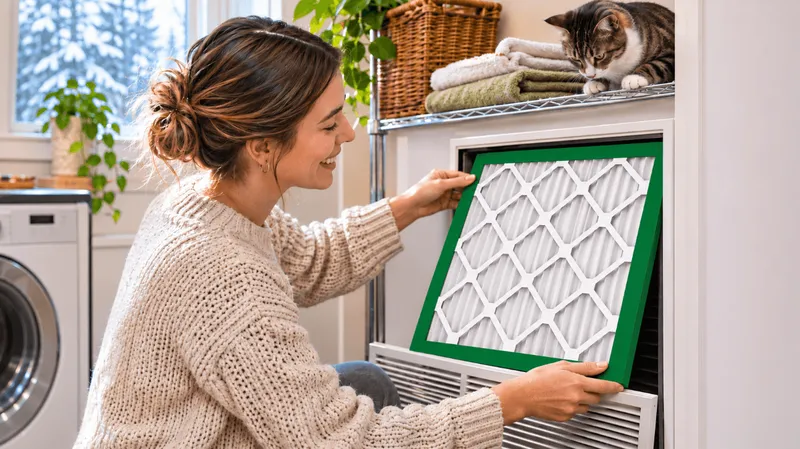
Keep the air filter clean. Every bit of heat your system delivers passes through the filter first, so we at Filterbuy treat the filter as part of the heating system. In our experience, a filter that lasts 90 days in spring can fill up in 30 to 45 days in January, so check it monthly. The DOE says a severely neglected heat pump can use 10% to 25% more energy than a well-maintained one. See Filterbuy’s guides to heat pump filters and how often to change your air filter.
Keep the outdoor unit clear. Brush off snow, ice and debris, and leave 18 to 24 inches of open space on every side.
Book a yearly tune-up and bring four questions. What are my compressor and aux lockout temperatures? How many kW of heat strips do I have, and are they staged? Does aux heat run after every defrost? What is my home’s balance point? Filterbuy’s winter prep checklist for heat pumps covers the do-it-yourself steps.
“When I started digging into heat pump questions from our customers, I expected complicated answers,” says Filterbuy’s Michelle Wan. “Most came back to two simple habits: change the filter on time, and stop cranking the thermostat.”
Filterbuy cuts, pleats and frames every filter to order in its U.S. plants, in 600+ sizes. Find your filter size or set up auto-delivery.
Supporting Statistics
42% of U.S. households heat mainly with electricity, a share the EIA ties in part to better air-source heat pumps. Source: U.S. EIA, 2025
Heat pumps cut heating electricity by about half versus resistance heat like aux strips (nearly 2,000 U.S. homes). Source: ACEEE, 2016
In 5 of 11 all-electric homes, aux heat used over 40% as much energy as the compressor. Source: NREL, 2023
Frequently Asked Questions
At what temperature does a heat pump stop working?
There’s no single cutoff. Systems in NREL’s study that used a compressor lockout set it between 0°F and 15°F, while cold-climate models keep running well below 0°F.
Is it normal for aux heat to come on every night in winter?
Yes, if overnight lows drop below your home’s balance point or the system is defrosting. If aux heat runs often when it’s above about 35°F to 40°F outside, schedule a service call.
Should I turn off aux heat to save money?
Usually not; your home may not stay warm without it on the coldest nights. Instead, ask a technician to set an aux lockout temperature so the strips stay off in milder weather.
Is it normal for my heat pump to ice up?
A light coat of frost is normal and should clear within minutes during a defrost cycle. Ice that stays for hours, or keeps returning, points to an airflow, refrigerant or defrost problem; call a technician.
How often should I change my heat pump filter in winter?
Check it monthly. Most 1-inch filters need changing every 60 to 90 days, or every 30 to 45 days with pets, and longer winter run times can shorten that.
Glossary
Auxiliary heat (aux heat): Backup heat, usually electric strips or a gas furnace, that turns on automatically.
Balance point: The outdoor temperature where a heat pump’s maximum output equals a home’s heat loss.
Coefficient of performance (COP): Heat delivered per unit of electricity; heat strips have a COP of 1.
Cold-climate heat pump: An air-source heat pump verified to perform well at 5°F and below.
Defrost cycle: A short reverse cycle that melts frost off the outdoor coil.
DOE: The U.S. Department of Energy.
Emergency heat (EM heat): A manual thermostat setting that runs only backup heat.
ENERGY STAR Cold Climate: An EPA label requiring, at 5°F, a COP of at least 1.75 and 70% of 47°F heating capacity.
Lockout temperature: A setting that stops the compressor below, or aux heat above, a set outdoor temperature.
MERV: Minimum Efficiency Reporting Value, a rating of how well an air filter captures particles; Filterbuy makes MERV 8, 11 and 13 filters.
NEEP: Northeast Energy Efficiency Partnerships, a regional energy-efficiency nonprofit.
NREL: The National Renewable Energy Laboratory, a DOE research lab.