
Recirculate or Fresh Air? When to Use Each Button in Your Car
September 1, 2026
By Michelle Wan · Reviewed by David Clark, Licensed HVAC Technician
Published September 1, 2026 · Updated September 1, 2026
Press recirculate when the air outside is worse than the air inside. That covers traffic, tunnels, wildfire smoke, heavy pollen, and a hot cabin you want cooled fast. Switch back to fresh air as soon as the windows start to fog. If you are not sure which filter your car takes, you can find your cabin air filter in about a minute.
TL;DR
Use recirculation when the outside air is the problem, and fresh air when it isn't. Recirculation closes the outside-air intake and loops cabin air back through your cabin air filter instead, which cuts fine particles sharply but lets exhaled carbon dioxide build up. Think of it as a setting you cycle through a drive, rather than one you set once and forget.
Key Takeaways
The recirculation button closes your car's outside-air intake, looping cabin air back through the cabin air filter instead of pulling in air from the road.
Recirculation cuts fine particles sharply. A Chalmers University and Volvo Cars study found that 70% recirculation lowered cabin PM2.5 by 55% with a new filter.
The U.S. EPA tells drivers to run the A/C on recirculate to keep wildfire smoke out of the car.
It also traps exhaled carbon dioxide. With three occupants aboard, CO₂ passed 2,500 ppm in about eight minutes in the fastest-rising test vehicle.
A parked car builds up CO₂ faster than a moving one, because speed pushes cabin air out through the seams. Idling with the windows up is the worst case of all.
Recirculation is a multiplier, not a cleaner. It sends the same air back through whatever filter is already in your car, so it amplifies a good one and exposes a loaded one.
What Does The Recirculation Button In Your Car Actually Do?
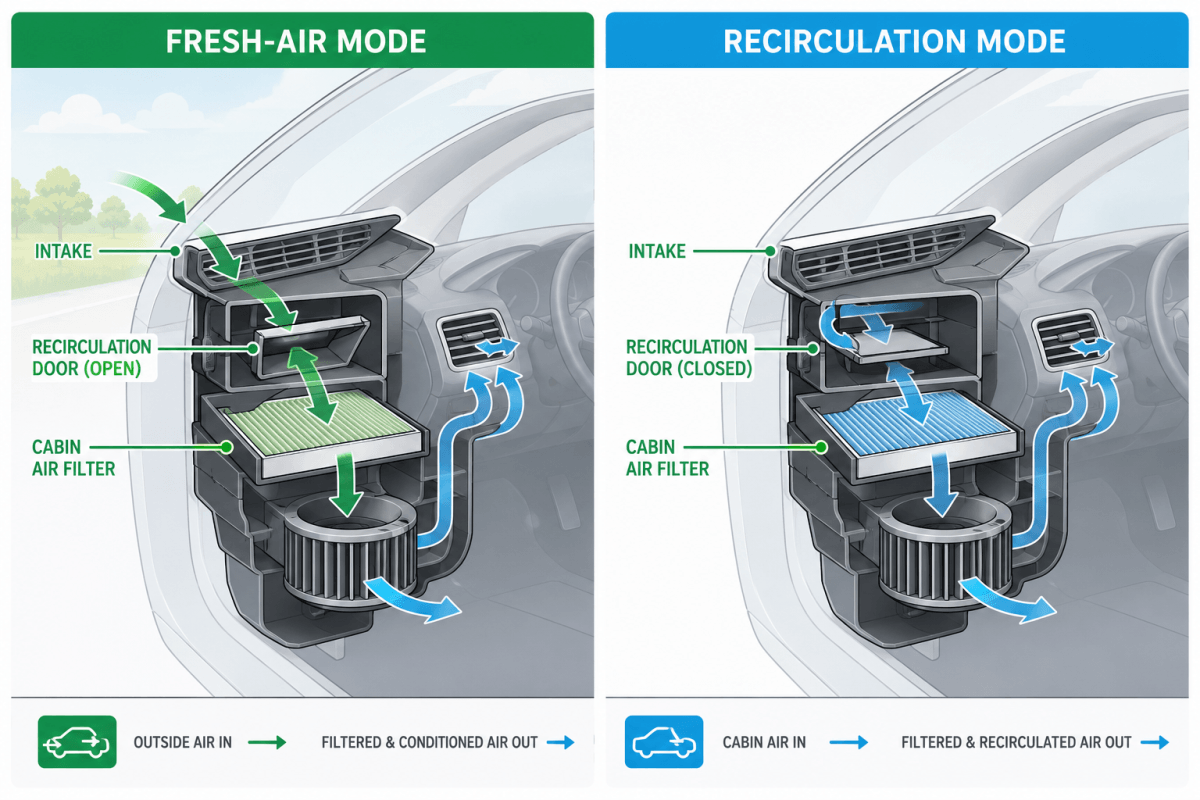
The recirculation button closes a flap called the recirculation door, which normally lets outside air into your car's heating and air conditioning system. With that door shut, the blower stops drawing from the road and pulls cabin air instead, sending it through the cabin air filter, across the evaporator or heater core, and back out the vents. Fresh-air mode does the opposite, opening the door and drawing from outside. In plain terms, recirculate means your car is breathing its own air instead of the road's.
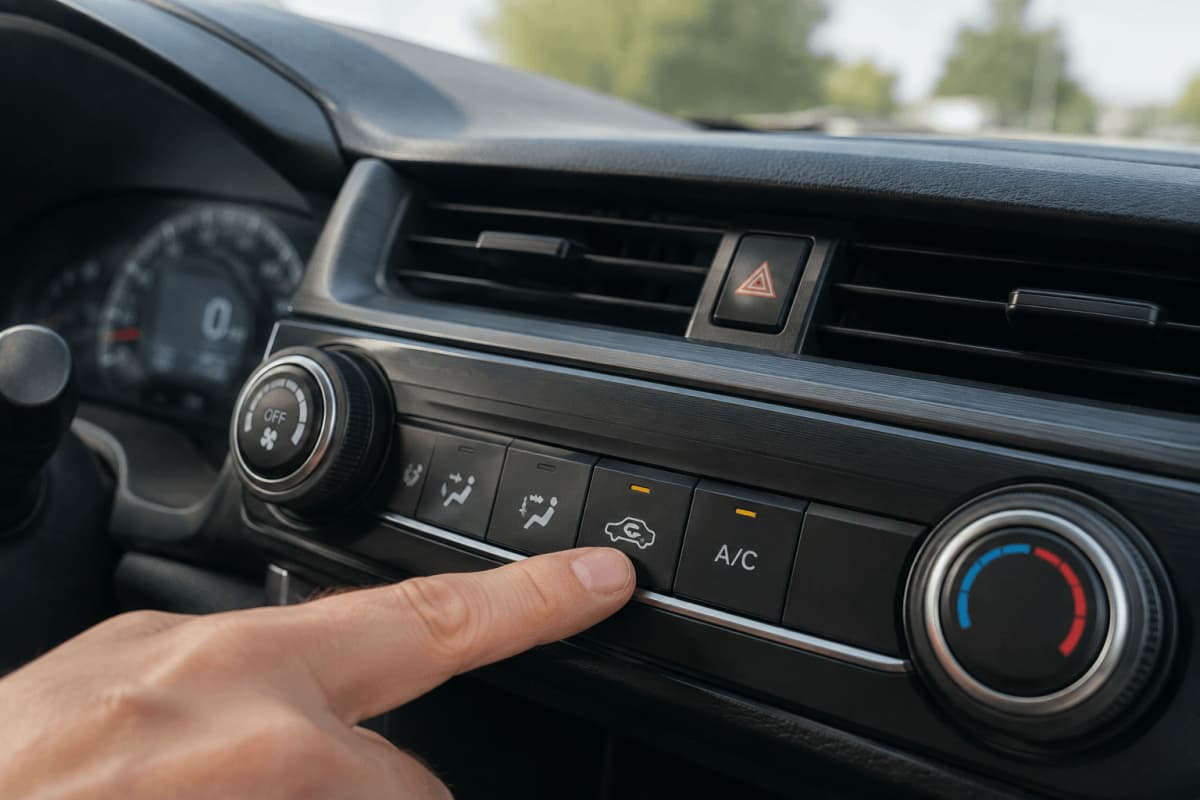
You can spot the setting by its symbol, a car outline with an arrow curving back on itself. Fresh-air mode shows the same outline with the arrow entering from outside. On cars with automatic climate control, the system may move between the two without being asked.
Recirculate Or Fresh Air? A Situation-By-Situation Guide
| Situation | Setting | How long | Why |
|---|---|---|---|
| Stop-and-go traffic, tunnels, behind a diesel truck | Recirculate | Until you clear it | Cuts exhaust and brake dust from a few feet ahead |
| Wildfire smoke or an air quality alert | Recirculate | Whole drive, windows up | EPA guidance; stops outdoor PM2.5 being pulled in |
| High pollen day | Recirculate | Most of the drive | Limits new pollen; the filter catches the rest |
| Hot car, cooling it fast | Recirculate | 5 to 10 min, then reassess | Re-cools cool air instead of fighting outside heat |
| Windows fogging, or defrosting | Fresh air | Until the glass clears | Outside air is drier; recirculated breath worsens fog |
| Long drive with passengers | Fresh air, or cycle | Reset every 15 to 20 min | Prevents the CO₂ buildup that causes drowsiness |
| Mild day, clean air, windows up | Fresh air | Default | Nothing to filter out; fresh air keeps you alert |
| Approaching a drive-through or a farm | Recirculate first | Briefly | Once an odor is inside, recirculating cycles it around |
When Should You Use Recirculate In Your Car?
Use it whenever the outside air is the problem. Traffic is the everyday case, since the air directly behind another vehicle carries the highest concentration of exhaust particles you will meet all day, and fresh-air mode feeds it straight into your vents. Tunnels produce the sharpest spike of all. In one Montreal commuting study, peak in-tunnel PM2.5 averaged about 2.2 times the median measured inside the same vehicle.
Recirculation earns its keep a second way, by cooling a hot car faster, because the system is re-cooling air that has already come partway to your target temperature. A Chalmers University and Volvo Cars simulation of a 2018 Volvo XC90, validated against road measurements, found that 30%, 50%, and 70% recirculation cut cabin PM2.5 by 22%, 36%, and 55% respectively with a new filter.
Does Recirculate Help With Smoke?
Yes, and it is the most effective thing you can do about smoke inside a car. EPA wildfire guidance tells drivers to set the car A/C on recirculate to keep smoke out, with the windows and sunroof closed. Wildfire smoke is mostly PM2.5, the fine fraction that travels deepest into the lungs, and fresh-air mode draws it in continuously.
Two things it will not do, though. No car is airtight, so smoke still finds its way in through body seams and door seals, and recirculation reduces that load without eliminating it. A particle filter also leaves the gases and odors in smoke untouched, since those call for activated carbon media. The same holds at home, which is why Filterbuy publishes a companion guide on wildfire smoke and HVAC filters.
When Is Fresh Air The Better Setting?
Fresh air wins any time visibility or alertness is at stake, and two situations cover most of it.
Fog and defrost. Recirculation traps the moisture from your breath, your damp coat, and wet floor mats, and that moisture condenses the moment it meets cold glass. Outside air is drier, so it clears the problem instead of feeding it. When the glass hazes over, switch to fresh air, turn the A/C on to dehumidify, and aim warm air at the windshield. A clogged filter slows the whole process by limiting the airflow your defroster needs.
This is also where the most common advice online goes wrong. "Never use recirculation in winter" describes a humidity problem, not a seasonal one. On a dry, clear cold day in traffic, recirculating is fine. With four damp passengers and fogging glass, it is not. The Chalmers simulation bears that out: fog risk showed up only in cold conditions, and it grew sharply once more than three people were aboard.
Long drives and full cars. Everyone in the car exhales carbon dioxide, and with the intake closed it has nowhere to go. How fast that matters is the next question.
Is Your Car Overriding You?
Your car may change this setting without telling you, and three overrides account for nearly every "I thought I turned that off" moment.
MAX A/C engages recirculation automatically, because chilling air that is already cold cools the cabin faster. One click off MAX releases the door, so anyone who leaves MAX on is recirculating whether they meant to or not.
Defrost usually disables it. Most vehicles force fresh air the moment you hit windshield defrost, since dry outside air clears glass and recirculated breath does not.
Automatic climate control decides for itself. Systems with humidity or air-quality sensors move between modes on their own, often recirculating at startup and returning to fresh air later.
So check the indicator light rather than your memory. And if your car has no recirculation button at all, it is already making the choice for you.
How Long Can You Leave Recirculation On? The Recirculate Reset Rule
Leave recirculation on until the air starts to feel stale, then reset it with about two minutes of fresh air. How quickly "stale" arrives depends almost entirely on how many people are breathing in the car, which is why the table below is organized by occupants rather than by the clock. It draws on three published studies.
| Occupants | What the research shows | Practical reset interval |
|---|---|---|
| Driver alone | Stayed under 1,000 ppm at 70% recirculation; on full recirculation, road testing measured 2,152 ppm after 20 minutes. | Cycle when the air feels stale |
| Two people | Not directly measured. Falls between the one- and three-occupant results below. | Reset every 20 to 30 minutes |
| Three or more | Hit 1,000 ppm in about 2.5 minutes and 2,500 ppm in about 8 minutes in the fastest-rising test vehicle. | Reset every 10 to 15 minutes |
For context, most indoor air quality guidelines treat 1,000 ppm as a comfort ceiling, and researchers Neelakshi Hudda and Scott Fruin identified 2,500 ppm as the automotive threshold above which fatigue and reduced concentration begin to appear. On a smoke day, take your reset on the cleanest stretch of the route.
What About Recirculating While Parked Or Idling?
This is the case that gets the least attention and deserves the most. A stopped car builds up carbon dioxide faster than a moving one, and the reason is physical: at speed, air pressure around the body pushes cabin air out through seams and seals, so some of what you exhale leaves on its own. The road study that measured CO₂ in two Chinese passenger cars captured this directly, recording a slower rise on the expressway than on suburban roads. Which leaves idling in a school pickup line or a drive-through, windows up, as the fastest-accumulating condition most drivers ever sit in, and almost nobody thinks of it as driving.
One hard safety line. Never idle with recirculation on in a closed garage. Filterbuy makes cabin air filters and will still tell you plainly what they cannot do: a filter captures particles, and it does nothing about carbon monoxide, which is odorless and passes through every filter medium on the market.
Does Recirculate Save Gas?
Slightly, and only in hot weather. Recirculation eases the load on the A/C compressor, because the system is cooling air that has already been cooled once instead of chilling hot outside air over and over. In the Chalmers and Volvo simulation, average climate-system power fell from 1.4 kW to 1.0 kW at 70% recirculation, a reduction of 27%. Treat that as a bonus rather than a reason to leave the button on.
Does Your Cabin Air Filter Still Work On Recirculate?
Yes, and in most vehicles it works harder. The cabin air filter sits on the intake side of the blower motor, downstream of the recirculation door, so air passes through it in either mode. What changes on recirculate is that the same cabin air makes repeated passes through the media, which is why particle levels inside a closed car keep dropping the longer you drive.
That mechanism looks different from inside a filter factory. Filterbuy has manufactured air filters in the USA since 2013, in plants across Alabama, Florida, Pennsylvania, and Utah, and from that vantage point the button is doing something more specific than most guides describe. Recirculation does not clean anything. It is a multiplier. It keeps sending the same air back through whatever filter is already in your car, so it amplifies a good filter and exposes a loaded one. Two drivers pressing the same button can end up breathing very different air.
Then there is the uncomfortable half of that. Every home filter we make carries a MERV rating printed on the box, a number you can hold up against any other brand. Cabin air filters carry no equivalent, no U.S. regulation requires one to meet a stated efficiency, and no independent body audits what the box claims. So the setting that rewards good media most is also the place where drivers know least about what they are running.
"Recirculate is the only setting where your cabin filter gets a second pass at the same air. It is the closest a car comes to working like a house. Which means the filter you chose six months ago, and forgot about, is quietly deciding how well that button works today."
Michelle Wan, Brand Manager and Air Quality Writer, Filterbuy
That difference is measurable. In a randomized cross-over study of 48 commuters, upgrading cabin air filtration cut in-vehicle PM2.5 by 30%, ultrafine particles by 28%, and black carbon by 32% across the same drive. It did not reduce gaseous pollutants or change in-cabin CO₂, which sums up the division of labor in one line: filters handle particles, ventilation handles gases.
Where we stand. We sell cabin air filters, so we have a stake in what you conclude here. We are telling you anyway that recirculation itself, not the filter, does most of the work on a smoke day, and that no filter stops the gases. Within those limits, Filterbuy auto cabin air filters use HEPA-certified media rated to capture 99.97% of particles down to 0.3 microns, cut to OEM dimensions so air travels through the filter instead of slipping around the edges. Our guide on how to choose a cabin air filter walks through the media and fit trade-offs, and if exhaust odors are your main complaint, an activated carbon filter is the type to look for. The approved interval is 12 months or 12,000 miles, though heavy pollen, smoke, or a season of stop-and-go traffic all argue for changing it sooner. The signs your cabin air filter needs replacing usually show up before the mileage does.
Supporting Statistics
Three numbers, from three U.S. authorities.
45 million: Americans who live, work, or attend school within 300 feet of a major road.
Pollution runs higher close to heavy traffic.
Your commute sits nearer the source than your driveway does.
Source: U.S. EPA: Research on Near Roadway Air Pollution
684: people killed in U.S. crashes involving a drowsy driver in 2021.
That was 1.6% of all traffic deaths.
Drowsiness is why recirculation is a setting you cycle.
Source: NHTSA: Countermeasures That Work, Drowsy Driving
82 million: people in the U.S. diagnosed with seasonal allergies in 2024.
Roughly 67 million adults and 14 million children.
The trigger is tree, grass, and weed pollen.
Source: Asthma and Allergy Foundation of America: Allergy Facts
Frequently Asked Questions
Is Recirculating Air In A Car Bad For You?
Not on its own. Recirculation reduces your exposure to road pollution, and the trade-off is CO₂ buildup over time. Cycling back to fresh air every 15 to 30 minutes, sooner with passengers, matters far more than avoiding the setting altogether.
Should I Use Recirculate In Traffic?
Yes, and it is the clearest case for the setting, because fresh-air mode draws in exhaust from the vehicle directly ahead of you.
Does Recirculate Help With Pollen?
Yes. Recirculation limits how much new pollen gets in, and the filter captures whatever is already circulating, so a clean and well-fitting filter matters more here than anywhere else.
Why Do My Windows Fog Up On Recirculate?
Because recirculation traps the moisture you and your passengers exhale, and it condenses as soon as it meets cool glass. Switching to fresh air or defrost brings in drier air and clears it.
Glossary
Recirculation mode: The setting that closes a vehicle's outside-air intake and cycles cabin air through the system instead. Fresh-air mode is the opposite, and the default.
Recirculation door: The flap in a vehicle's HVAC housing that opens or closes the outside-air intake.
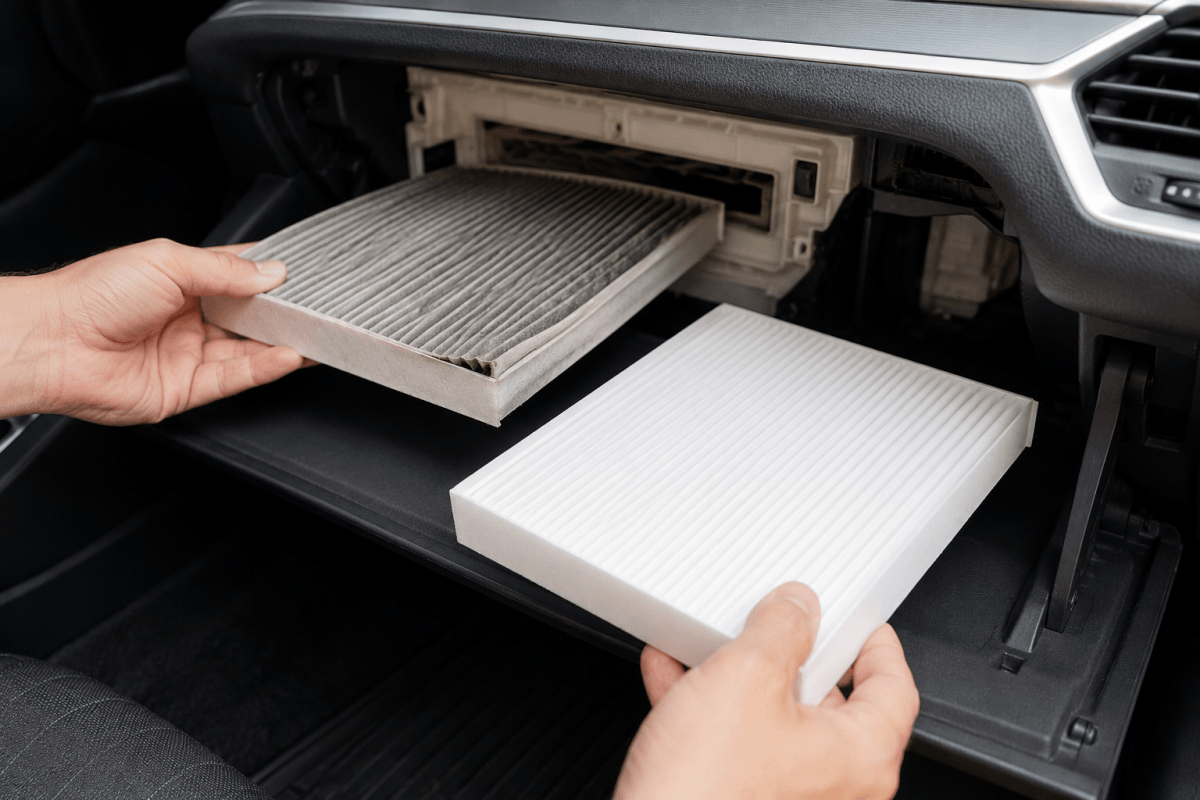
Cabin air filter: The pleated filter in a vehicle's climate path, usually behind the glove box, that captures dust, pollen, and soot before air reaches the vents.
PM2.5: Fine particulate matter 2.5 microns and smaller, the dominant component of wildfire smoke and exhaust.
ppm (parts per million): The unit for carbon dioxide concentration. Outdoor air is roughly 420 ppm; 1,000 ppm is a common indoor comfort ceiling.
MERV: The standardized 1 to 20 efficiency scale used on home HVAC filters. Cabin air filters carry no equivalent rating.
Filterbuy: A U.S. air filter manufacturer producing auto cabin air filters and home HVAC filters, sold factory-direct since 2013.
Sources
Wei, D., et al. Vehicle cabin air quality: influence of air recirculation on energy use, particles, and CO₂. Environ Sci Pollut Res, 2023.
Mallach, G., et al. Randomized Cross-Over Study of In-Vehicle Cabin Air Filtration. Environ Sci Technol, 2023.
Han, J., Lin, H., & Qin, Z. Prediction and Comparison of In-Vehicle CO₂ Concentration. Applied Sciences, 2023.
U.S. EPA: Research on Near Roadway and Other Near Source Air Pollution
Asthma and Allergy Foundation of America: Allergy Facts, Figures, and Stats
About the author
Michelle Wan is Filterbuy's Brand Manager and air quality writer (B.A., University of California, Santa Cruz). Working directly with Filterbuy's U.S. manufacturing team across its factories in Alabama, Florida, Pennsylvania, and Utah, she bases her guidance on how filters are actually built and used, not just spec sheets. Reviewed for technical accuracy by David Clark, a Licensed HVAC Technician.