
K&N Cabin Air Filter vs. Filterbuy: Washable or Fresh Media?
July 24, 2026
By Michelle Wan
Reviewed by David Clark, Licensed HVAC Technician
Published July 23, 2026 · Updated July 23, 2026
TL;DR
A K&N cabin air filter is washable and reusable, built to last the life of your vehicle instead of being replaced each year. It costs $48 to $84 upfront plus a $23.99 cleaning kit, and its value depends on you completing every wash. Filterbuy takes the opposite approach: single-use HEPA-grade media rated to capture 99.97% of particles at 0.3 microns, swapped in two minutes. K&N publishes no capture percentage for its cabin filters, so the choice is between a verified filtration number with fresh media, or the lowest ten-year cash outlay.
Key Takeaways
K&N publishes no particle-capture efficiency percentage for its cabin air filters, so buyers cannot compare its filtration to a rated filter on paper.
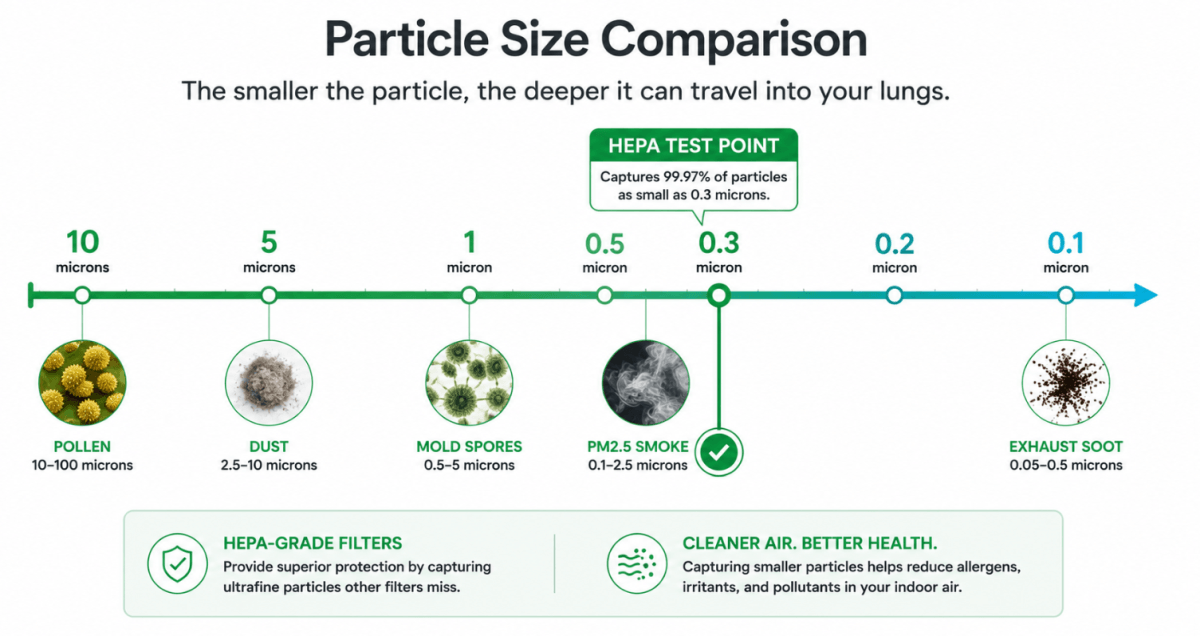
Filterbuy cabin air filters use HEPA-grade media rated to capture 99.97% of particles down to 0.3 microns, the range that includes wildfire smoke, exhaust soot, and fine pollen.
A washable filter only saves money if every cleaning actually happens. All seven cleanings over 100,000 miles works out to about $11 per service. Complete three and it costs about $26 per effective service, with four intervals spent on loaded media.
With K&N, activated carbon and washability are an either/or. Carbon sits on K&N's disposable line, not its washable line. Filterbuy offers carbon without that trade.
Three K&N pages state three different warranties for the same cabin filter line. Get your part number's terms in writing before you count on coverage.
How We Compared These Filters
We read every surface K&N publishes on its cabin filter line in July 2026: the VF-series listings, the cleaning guide, the warranty page, the homepage. We set them against Filterbuy's published specs. Every price, claim, and omission below is tied to the page it came from, so you can check our work.
Filterbuy builds cabin air filters ourselves, using HEPA-grade media cut and assembled at our plants in Alabama, Florida, Pennsylvania, and Utah. That is the lens we brought to this. Making the product is what tells you which specifications a manufacturer publishes because it tested for them, and which lines get written by a marketing department.
Two ground rules. Where K&N's pages disagree with each other, we say so rather than quote the version that flatters us. And where we reach a different conclusion than K&N's published instructions, we tell you that too, and why. We sell a competing filter, so weigh the sourced numbers below rather than our adjectives.
What Is a K&N Cabin Air Filter?
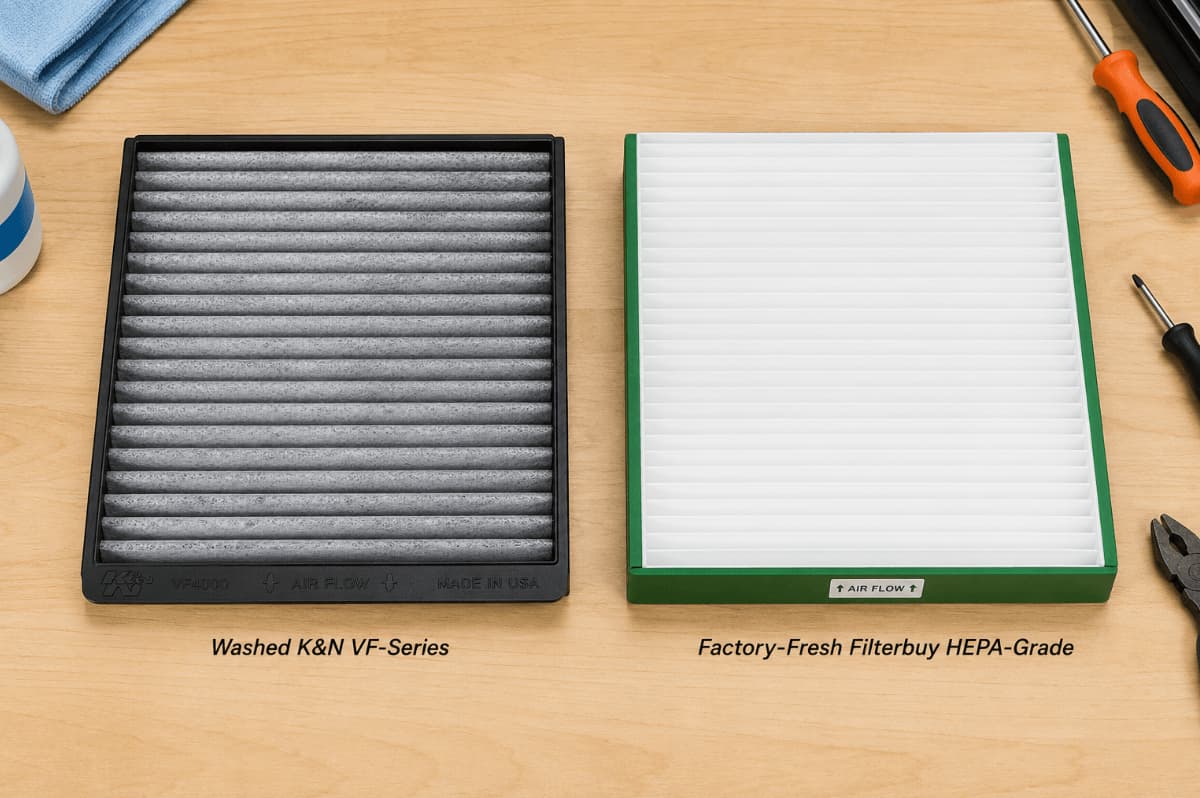
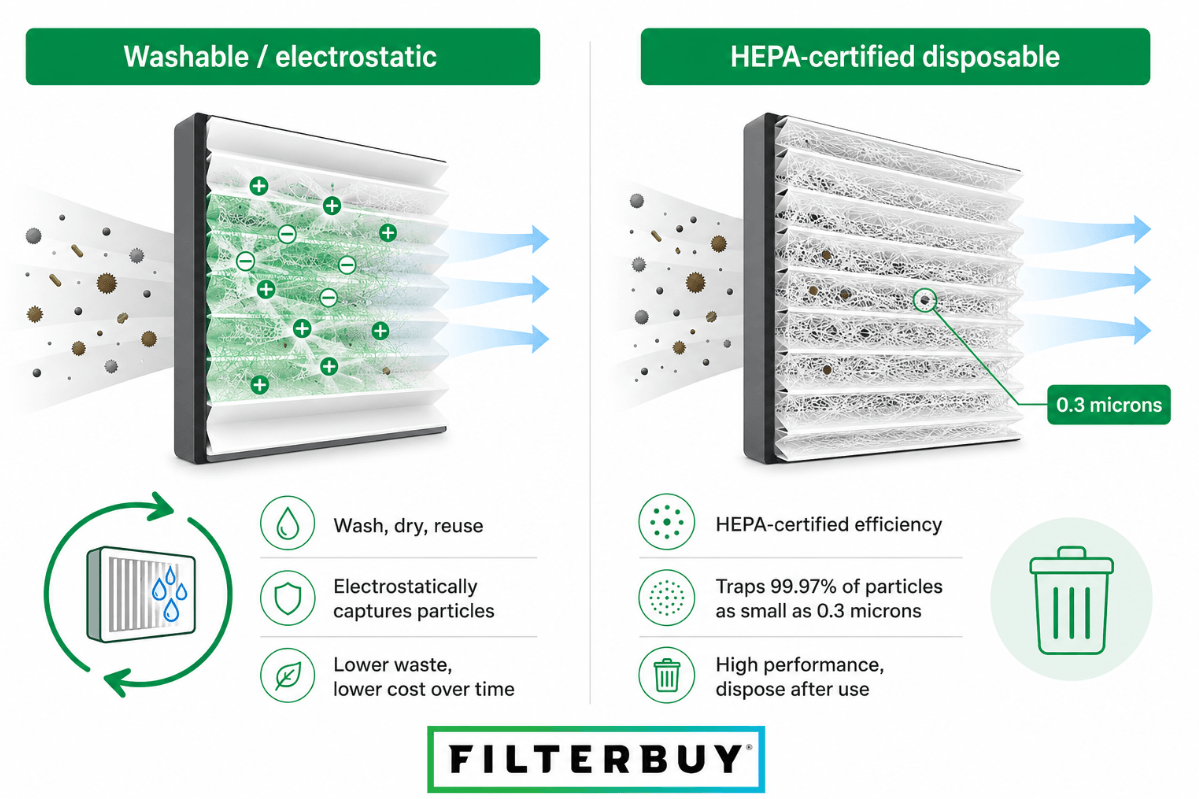
A K&N cabin air filter is a washable, reusable replacement for the disposable filter that cleans air entering your car's heating and air conditioning system. K&N Engineering, founded in California in 1963 by racers Ken Johnson and Norm McDonald, sells these under its VF-series part numbers. K&N does not build a cabin filter for every vehicle, so check the by-make index before anything else. K&N also sells two cabin lines: a washable High-Flow Lifetime, and an Extended-Life Disposable with carbon. Check which one a listing offers, because only the first is reusable. The washable media is electrostatically charged to attract pollen, mold, mildew, spores, and bacteria, and treated to control odor. K&N's product pages state a No-Hassle Lifetime Limited Warranty on the line, and installation takes under five minutes with no tools. On most vehicles the filter sits behind the glove box.
K&N is a well-regarded brand with six decades in filtration, and the washable concept is sound engineering. Filterbuy builds the same part the opposite way. The question here is narrower than which brand is better: for a cabin filter, does reusable beat fresh?
One thing we ran into while checking: K&N's pages contradict each other on the warranty. The VF-series listings state a No-Hassle Lifetime Limited Warranty. The cabin filter cleaning guide says Million-Mile Limited Warranty. The homepage scopes the Lifetime warranty to engine air filters, with separate terms for intakes and oil filters. Three pages, three answers. If the warranty is part of why you are buying, get the terms for your part number from K&N in writing.
K&N vs. Filterbuy: What Does Each Filter Actually Capture?
Filterbuy publishes a filtration rating. K&N does not. Filterbuy cabin air filters use HEPA-grade synthetic media rated to capture 99.97% of airborne particles as small as 0.3 microns: bacteria, pollen, mold spores, smoke, and pet dander. K&N's product pages describe the media as electrostatically charged and treated for odor control, but state no capture percentage. Most cabin filter comparisons skip this question, and it matters most if anyone in your car has allergies or asthma.
That absence is not proof of weak filtration, but it leaves you with nothing to compare against. And 0.3 microns is no arbitrary benchmark. The EPA defines HEPA as removing at least 99.97% of particles at 0.3 microns, and calls that the most penetrating particle size. That is the worst case, with larger and smaller particles trapped at even higher efficiency. Wildfire smoke and diesel soot fall under 2.5 microns, squarely where a rated filter earns its keep.
There is a second wrinkle. Washing rinses away the electrostatic charge the media depends on, which is why K&N's kit includes a refresher spray to restore it. K&N publishes no data comparing a washed filter to a new one. A disposable sidesteps the question: every Filterbuy interval starts with media that has never been loaded, rinsed, or re-treated.
Filtration and Maintenance Specs Side by Side
As published by each manufacturer, July 2026. K&N does not publish a particle-capture percentage for cabin air filters.
K&N vs. Filterbuy: Cost per Service Over 100,000 Miles
A K&N cabin filter runs $47.99 to $83.99, plus $23.99 for the 99-6000 Cabin Filter Cleaning Care Kit needed to maintain it. Across 100,000 miles that is genuinely less cash than buying disposables, provided every cleaning gets done.
We built the table below around cost per completed service rather than sticker price, because that is where the washable math turns. Every other comparison we found stops at purchase price, which quietly assumes a maintenance schedule nobody audits. The middle column is our modeling assumption, not survey data.
Cost per Effective Service Over 100,000 Miles
K&N's advantage is real but conditional. Filterbuy's is unconditional: the cost is the same whether you are diligent or busy.
The column a sticker price hides is time. Using K&N's published figures of a 10-minute soak plus 20 to 30 minutes of drying, seven cleanings come to three and a half to five hours across 100,000 miles, before you count removal, rinsing, and reinstallation, which K&N does not time. Set that against the roughly $60 the washable filter saves and you are working for $12 to $18 an hour. For plenty of people that is a fine trade, and some enjoy the job. A Filterbuy swap costs about two minutes and no drying time, which is the other end of that same trade.
How to Clean a K&N Cabin Air Filter
Use K&N's 99-6000 kit, and never substitute the oiled cleaner sold for K&N engine air filters. Cabin filters are not oiled.
Remove the filter from behind the glove box, noting the airflow arrow first.
Spray the cleaner across the pleats and let it soak to loosen grime, mold, mildew, spores, and bacteria.
Rinse gently with low-pressure water from the clean side outward, so debris exits the way it came in.
Air-dry, and here we part ways with K&N. Their guide calls for 20 to 30 minutes and says damp is fine. We would let it dry fully. Damp media in a dark housing is how mildew starts, and musty vent odor is the exact complaint that sends drivers looking for a new cabin filter. No heat, no compressed air, no hair dryer either way.
Apply the refresher spray to restore the electrostatic charge rinsing strips away.
Reinstall with the airflow arrow oriented correctly.
Filterbuy owners skip this section. A disposable filter is replaced, not serviced.
Already Own a K&N? How to Decide Whether to Keep It
Keep it if you have washed it at least once, you are holding onto the car, and nobody riding in it has breathing trouble. The money is spent and the routine fits you.
Retire it if it has sat past its interval unwashed, or if the drying time is why you keep putting the job off. A filter you will not maintain performs worse than the cheapest disposable, with your money already spent. Sunk cost is no reason to keep breathing through loaded media, and a Filterbuy replacement for your vehicle costs less than the cleaning kit you would otherwise buy.
One Free Thing That Helps Either Way
Whichever filter you run, the EPA notes that in vehicles with properly functioning cabin air filters, switching ventilation to recirculate reduces particulate coming in from outside. Worth doing in stop-and-go traffic, behind a diesel, or when smoke is in the air. Switch back once you are clear, since recirculating indefinitely lets humidity build up.
Four Questions Before You Choose
Four questions settle this for most drivers. We run them in this order because the first two do most of the work.
1. Is anyone in the car managing allergies, asthma, or smoke exposure? If yes, choose the filter with a published capture rating. A verified 99.97% at 0.3 microns is something you can act on; an unrated filter is a judgment call.
2. Will you complete seven cleanings over 100,000 miles? Be honest. A washable filter that goes unwashed restricts airflow and underperforms a $20 disposable.
3. Do you need odor control and reusability together? With K&N you pick one. Activated carbon lives on the disposable line. Filterbuy offers activated carbon cabin air filters without that trade.
4. How long will you keep the vehicle? A lifetime warranty is worth only as much as your remaining ownership. Sell within two or three years and the premium never pays back.
For most drivers, questions one and two settle it.
Why Drivers Choose Filterbuy Cabin Air Filters
Filterbuy builds cabin filters around a simpler promise: fresh, rated media at every interval, with nothing to remember but the swap.
A filtration spec you can verify. HEPA-grade media rated at 99.97% capture down to 0.3 microns.
Made in the USA to exact OEM tolerances. Precise fit reduces bypass air, the gap-leakage that slips past even a good filter.
Hydrocharged fibers, permanently charged without choking airflow.
Carbon when you want it, with no trade-off against reusability.
Free shipping, backed by 7,000-plus customer reviews.
Replace a disposable cabin filter every 12,000 to 15,000 miles, or once a year. Sooner in smoke, dust, or heavy traffic.
Find the Filterbuy cabin air filter that fits your vehicle →
Essential Resources
Seven things worth a look before you commit. Three from K&N, two from the EPA, two from Filterbuy. We'd rather you make the right call than a fast one.
Start Here: Does K&N Even Make One for Your Car?
K&N doesn't build a cabin filter for every vehicle. Their by-make index runs Acura to Volvo, so check yours first. If there's no VF part for your car, the rest of this sorts itself out.
Don't Forget the Cleaning Kit
Here's the part that catches people: a washable filter isn't a one-time buy. The K&N 99-6000 kit runs $23.99 and holds the cleaner and refresher spray you'll need at every wash.
See What Cleaning Actually Involves
K&N's published cleaning guide walks through all seven steps, soak and dry time included. Read it before you buy, since you're signing up to do this at every service interval.
What That 99.97% Number Really Means
Wondering whether 99.97% is impressive or just good marketing? The EPA explains the HEPA standard in plain language, including why filters get tested at 0.3 microns. It's the toughest size to catch, so anything bigger or smaller is easier. A handy yardstick for any brand's claim, ours included.
Why the Tiny Stuff Is the Stuff That Matters
PM2.5 sounds technical, but the EPA's short version makes it click: these particles are roughly 30 times thinner than a human hair, small enough to reach deep into your lungs. That's the whole reason the micron number on a filter box matters.
Not Sure Washable Is for You?
If the washing routine sounds like more than you bargained for, the Filterbuy guide to choosing a cabin air filter weighs standard, carbon, and HEPA-grade media against how you actually drive: city traffic, dirt roads, allergy season, wildfire smoke.
Supporting Statistics
Three findings that put a cabin air filter in context, all from U.S. government and nonprofit research.
1. 45 Million Americans Live Within 300 Feet of a Major Road, Airport, or Railroad
Traffic pollutants sit at higher concentrations near busy roads.
The EPA links that exposure to lung and heart problems.
If your daily drive runs through that zone, your cabin filter is the last barrier.
Source: U.S. EPA, Research on Near Roadway and Other Near Source Air Pollution, updated June 2026.
2. The Average American Spends More Than an Hour a Day in Travel
Most of that hour happens on major roadways, where traffic pollution runs thickest.
The EPA states that in vehicles with properly functioning cabin air filters, the recirculation setting reduces particulate coming in from outside.
Source: U.S. EPA, Near Roadway Air Pollution and Health: FAQ (EPA-420-F-14-044), August 2014.
3. 152.3 Million People, or 44% of the U.S., Live Where the Air Earns a Failing Grade
Counties are graded on ozone and particle pollution.
Grades use EPA monitoring data from 2022 through 2024.
More than four in ten Americans live somewhere that failed at least one measure.
Source: American Lung Association, "State of the Air" 2026 Key Findings, published 2026.
What this does and does not mean. A cabin filter fixes none of the above. It gives you control over the slice of air you breathe on your commute, which is why the spec on the box is worth reading.
Frequently Asked Questions
Is a K&N cabin air filter worth the money?
It suits drivers who keep vehicles long-term and do their own maintenance. Cleaned on schedule, it costs less per service than disposables, though at $12 to $18 an hour for the labor. Drivers who want a published filtration rating, carbon, or a two-minute swap are better served by a HEPA-grade disposable.
Which is better, a K&N or a Filterbuy cabin air filter?
Neither wins outright. K&N wins on ten-year cash cost if you complete every cleaning. Filterbuy wins on verified filtration, fresh media at every interval, and zero maintenance. Filterbuy also publishes a capture rating; K&N does not.
How often should you clean a K&N cabin air filter?
Whenever a disposable would have been replaced, so every 12,000 to 15,000 miles or annually. Sooner if vent airflow weakens or a musty smell appears.
What is the best cabin air filter for allergies?
Choose media with a published capture rating at 0.3 microns. Filterbuy HEPA-grade cabin filters are rated 99.97% at that size. Our guide to how to choose a cabin air filter covers matching a spec to your driving.
Ready to Swap? Here's Where to Look
Most cars hide it behind the glove box, but not all. Our guide to where the cabin air filter lives covers the three spots to check and how to find yours fast.
Glossary
| Term | Definition |
|---|---|
| Cabin air filter | The filter that cleans outside air before it enters a vehicle's passenger compartment through the heating and air conditioning vents. Usually behind the glove box. |
| K&N Engineering | A California filtration manufacturer founded in 1963, known for washable automotive air filters, cold air intakes, and oil filters. |
| Filterbuy | A US air filter manufacturer selling since 2013, producing HVAC and automotive cabin filters factory-direct from plants in Alabama, Florida, Pennsylvania, and Utah. |
| VF series | The part-number prefix for K&N washable automotive cabin air filters, for example VF2033, VF2049, and VF2057. |
| 99-6000 | The K&N Cabin Filter Cleaning Care Kit: a 12-ounce cleaner plus an 8-ounce refresher spray, $23.99 on knfilters.com . |
| Electrostatic charge | A static charge on filter fibers that attracts and holds fine particles that would otherwise pass between them. Rinsing reduces this charge. |
| Hydrocharging | A process that permanently charges synthetic filter fibers using water rather than heat, raising particle capture without raising airflow restriction. Used in Filterbuy cabin filters. |
| HEPA-grade media | Media meeting the HEPA standard: 99.97% capture of particles at 0.3 microns, the size most difficult for a filter to trap. |
| Bypass air | Unfiltered air that leaks around a poorly fitted filter instead of passing through the media. |
| Micron | One millionth of a meter. Wildfire smoke and exhaust soot fall largely under 2.5 microns. |