
Allergies Or Air Pollution? How To Tell Which One You Are Reacting To
September 14, 2026
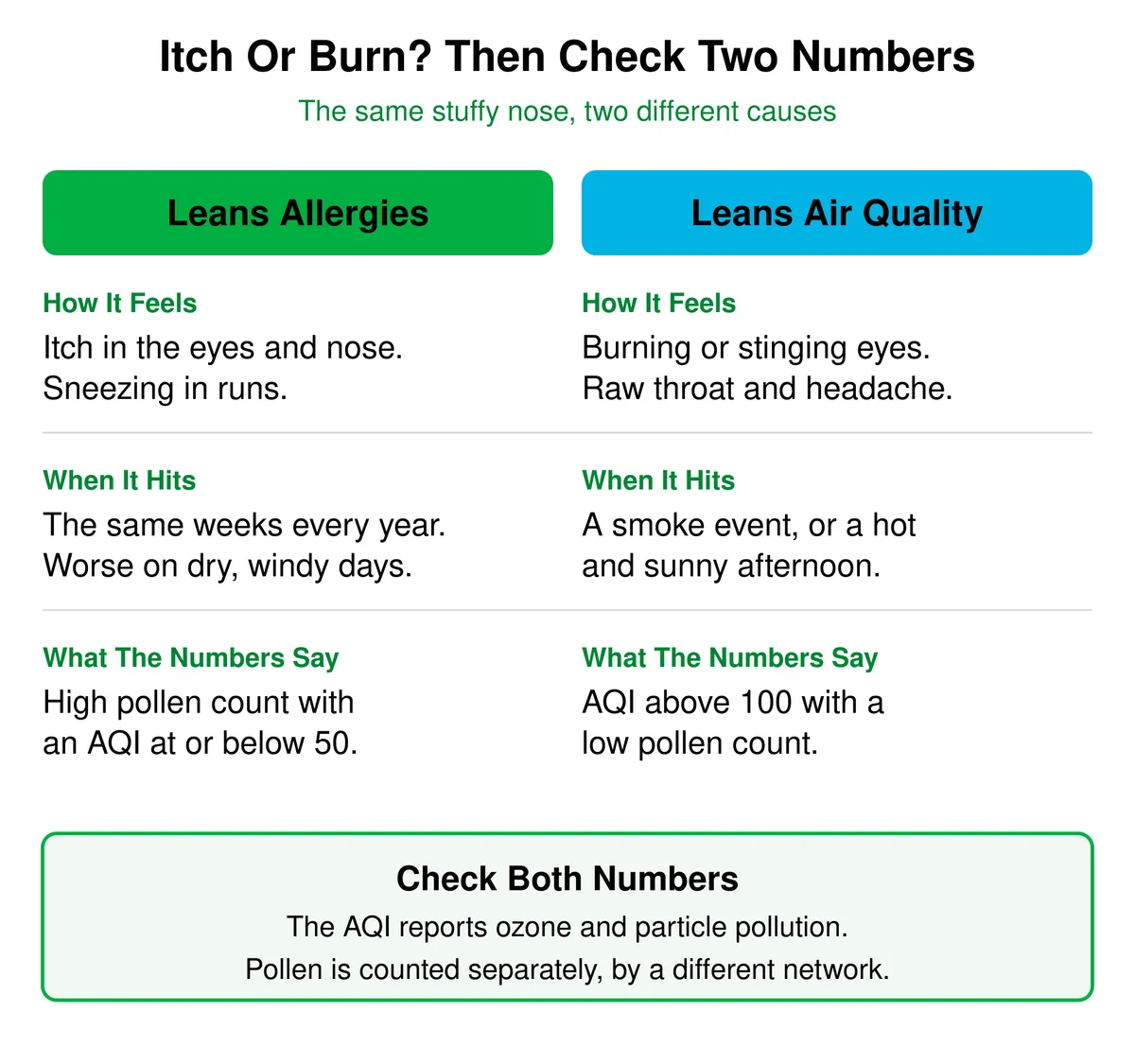
Itch points to allergies. Burning points to air quality. Histamine drives an allergic reaction, so pollen brings itchy eyes and sneezing in runs. Smoke and ozone irritate tissue on contact, so they bring stinging eyes, a raw throat, and headache.
How it feels: itch and sneezing runs lean pollen. Burning, chest tightness, and headache lean air quality.
When it hits: the same weeks every year lean pollen. A smoke event or a hot afternoon leans air quality.
What the numbers say: a high pollen count with a low AQI leans pollen. An AQI above 100 with a low pollen count leans air quality.
Two numbers settle it, because the AQI reports ozone and particle pollution while pollen is counted by a separate network. The quiz below matches a filter to your system and the air you are working with.
Answer a few quick questions and we will match you to the right filter for your system.
Is It Allergies Or Air Quality?
An itch points to allergies. A burning or stinging feeling points to air quality. Allergic rhinitis is an immune reaction driven by histamine, so it produces itchy eyes, an itchy nose, and sneezing in bursts. Particle pollution and smoke irritate tissue on contact, so they produce stinging eyes, a raw throat, chest tightness, and headache. Before you decide, check two numbers: today’s Air Quality Index and today’s pollen count.
TL;DR
Seasonal allergy symptoms and air pollution symptoms overlap in the nose and eyes, but they come apart on three tells: how the symptom feels, when it arrives, and what the day’s two numbers say. Itch, sneezing runs, and thin clear drainage point to pollen. Burning, chest tightness, headache, and fatigue point to particle pollution, smoke, or ozone. The AQI and the pollen count come from separate systems, so checking one leaves half the picture.
Key Takeaways
Itch is the strongest single tell for an allergic reaction, because histamine produces nasal and eye itching that direct irritant exposure usually does not.
Stinging eyes, a scratchy throat, coughing, headache, and tiredness are among the immediate effects the CDC lists for breathing wildfire smoke.
The Air Quality Index is built from ozone, particle pollution, carbon monoxide, nitrogen dioxide, and sulfur dioxide. Pollen is not one of them.
Ozone symptoms concentrate in the afternoon on hot sunny days, while tree pollen symptoms concentrate in the morning.
The Three-Tell Check For Allergies Versus Air Quality
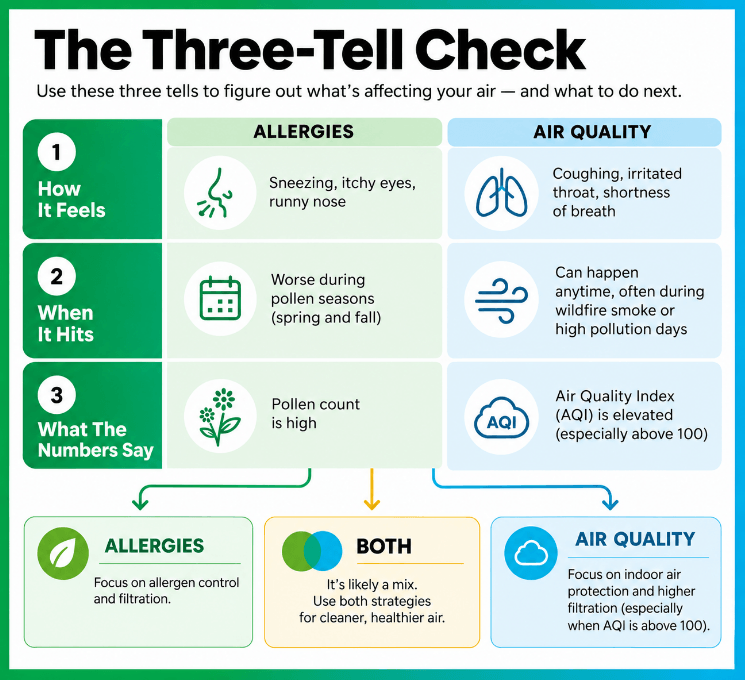
Three tells separate a pollen reaction from an air quality reaction on the same day: the character of the symptom, its timing, and the two published numbers for your location. None of them settles the question alone, but two in agreement give you a working answer and three give you a confident one.
Scoring it takes a few seconds. Say your eyes burn rather than itch, the symptoms show up after an August afternoon outdoors, and the AQI reads 118 on ozone against a moderate pollen count. Two tells point to air quality and the third is mixed, so treat it as an ozone day.
When both numbers run high, expect both causes at once. The two can even feed each other, since rain and humidity rupture pollen grains into fragments small enough to register in particle readings. For the measurement side of that overlap, see how pollen affects air quality readings.
Which Symptoms Point To Pollen And Which Point To Pollution
The two reactions share a lot of ground, but their symptom profiles differ in shape. Allergic rhinitis is an IgE-mediated response, and it shows up as nasal itch, sneezing, clear rhinorrhea, and congestion. Irritant exposure from smoke or ozone brings burning, coughing, and chest symptoms, and it skips the itch almost entirely.
Symptom Profile: Pollen Versus Pollution
Congestion and a runny nose sit in both columns, which is why the eyes and chest tell you more than the nose does.
What The Timing Of Your Symptoms Tells You
Timing separates the two causes more reliably than any single symptom, because pollen runs on both a calendar and a clock. Tree pollen peaks in the morning from roughly February through April, grass pollen around midday from April into early June, and ragweed from late morning into early afternoon between August and the first hard frost.
Ozone keeps different hours. It forms when sunlight reacts with vehicle and industrial emissions, so levels build through hot sunny afternoons and ease after sunset. Symptoms that show up after a July afternoon outdoors but never during a March morning fit ozone better than pollen. See our guide to ground-level ozone health effects.
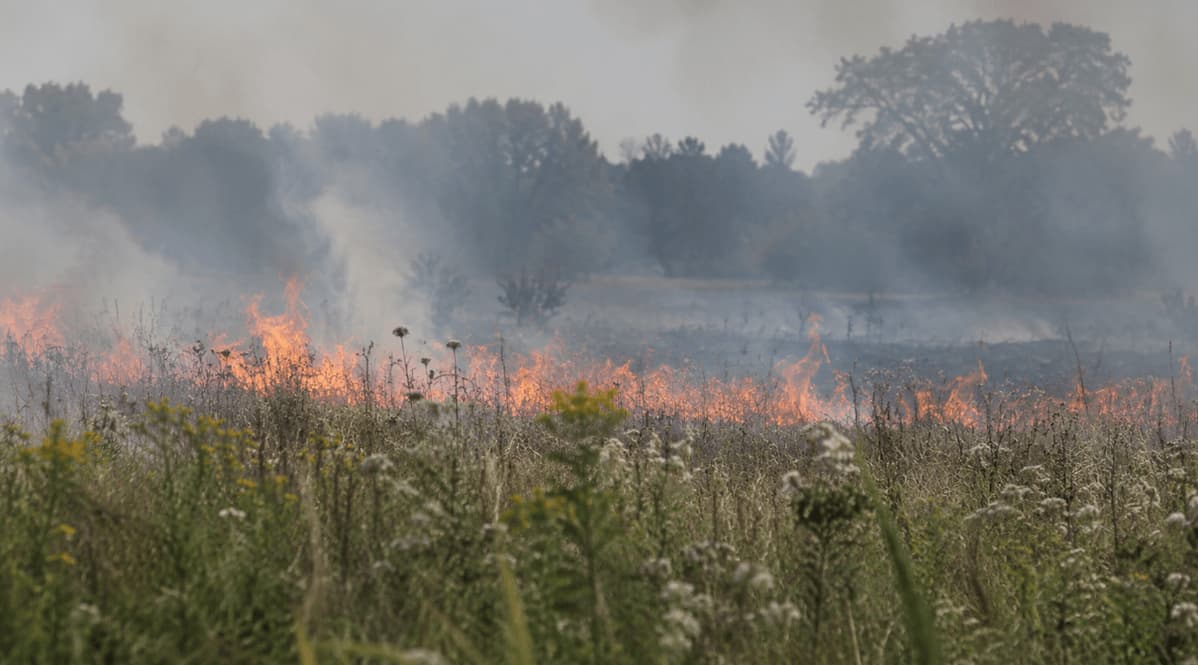
Wildfire smoke follows neither pattern. It arrives with the wind, travels far from the fire, and can push the AQI from good to unhealthy within hours. If your symptoms started the week a plume reached your region, in a season when your allergies are normally quiet, smoke is the likely answer. We cover whether wildfire smoke can trigger allergy symptoms separately.
One more test costs nothing. Go inside, close the windows, and give it an hour. Outdoor-driven symptoms usually ease in that time. If yours hold steady, the source is more likely indoors, something like dust mites, pet dander, or mold.
How To Check Both Numbers In Under Two Minutes
Pull your local AQI. AirNow, the EPA’s public air quality service, reports the index on a 0 to 500 scale and names the pollutant driving the number, which tells you whether it is smoke or smog. Our guide covers what each AQI category means.
Pull your local pollen count. The National Allergy Bureau, the AAAAI counting network, publishes figures from certified stations that identify pollen and mold spores under a microscope and report grains per cubic meter.
Check for smoke overhead. Filterbuy’s live AQI and wildfire smoke map overlays active fires and plumes on current readings.
Read them together. The pollen count answers one half of the question and the AQI answers the other.
What To Do Once You Know Which One It Is
Once you know the cause, the response splits cleanly. Outdoors, you are managing exposure by timing. Indoors, you are managing what your filter catches on the way through, and that is the half Filterbuy works on.
Response By Cause
MERV, short for Minimum Efficiency Reporting Value, rates how much of the airborne particle load a filter catches as air passes through it. Filterbuy manufactures pleated filters in MERV 8, MERV 11, and MERV 13. Higher ratings catch more fine particles, but they also add airflow resistance, so confirm your system supports the rating first. MERV 13 is the highest common residential rating, and it is not the same as a true HEPA filter. See our guide to choosing a MERV rating for high-AQI days, and for smoke events, the best MERV filter for wildfire smoke.
Ozone is a gas rather than a particle, so pleated media does not capture it. The answer there is activated carbon air filters, which Filterbuy pairs with pleated media in its odor eliminator line, and carbon only works while it stays fresh.
One caution before you buy anything. Devices sold as ionizers or ozone generators can add ozone to indoor air, the same gas the EPA ties to coughing and chest tightness. If your symptoms already point to irritation, that is the wrong tool.
No central system means a different tool, but the same plan. Window units and mini splits carry small washable screens that trap little fine particulate, so a portable air cleaner sized to the room does that work instead.
When It Is Neither Allergies Nor Air Quality
A fever changes the answer. Neither an allergic reaction nor an irritant exposure produces one, so fever, body aches, and a sore throat that hurts to swallow all point toward an infection instead.
Symptoms that persist after the smoke clears and your pollen season closes deserve a clinician’s attention, and so does wheezing, chest pain, or shortness of breath that does not settle on its own. This page is a triage guide, not medical advice.
Filterbuy’s Perspective: We manufacture pleated filters in more than 600 sizes at plants in Alabama, Florida, Pennsylvania, and Utah. All of that work sits on the indoor side of this problem. Outdoor pollen counts and pollution readings are conditions you plan around rather than change. What a household controls is what its filter catches once outside air gets in.
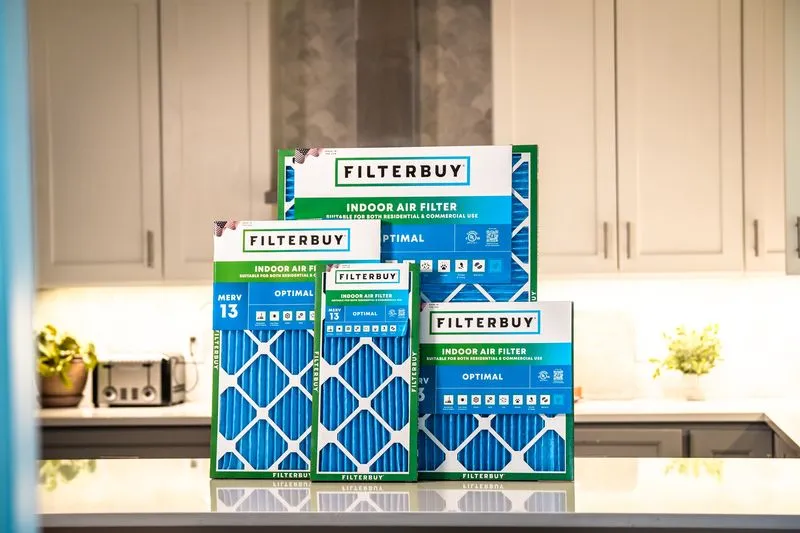
Ready to match a filter to the air you are breathing? Explore Filterbuy MERV 13 air filters for your system size.
Supporting Statistics
Three data points ground the claims on this page.
Nearly 1 in 3 U.S. adults and more than 1 in 4 U.S. children reported a seasonal allergy, eczema, or food allergy in 2021, which ACAAI tallies at over 100 million people. Source: ACAAI Allergy Facts
44 percent of Americans, or 152.3 million people, live in counties that earned failing grades for ozone or particle pollution in the 2026 report, which covers 2022 through 2024 data. Source: State of the Air 2026 Key Findings
Wildfire smoke accounted for 25 percent of all days with unhealthy ozone levels across the United States between 2018 and 2023, based on 600 monitoring stations and satellite data. Source: NOAA Climate Program Office Research Summary
Frequently Asked Questions
How Do I Tell If It Is Allergies Or Air Quality?
Start with the feel of the symptom. The itch is the giveaway, because histamine produces it and direct irritants usually do not. Burning, a raw throat, chest tightness, or headache point to smoke, smog, or ozone. Then check the pollen count and AQI against each other.
Why Do I Have Symptoms When The AQI Says The Air Is Good?
The AQI does not track pollen. It reports ozone, particle pollution, carbon monoxide, nitrogen dioxide, and sulfur dioxide, so a location can post a good AQI on a heavy pollen day. Check a pollen count alongside the index.
Is It Allergies Or Smoke?
Check the calendar and the map. Smoke symptoms start when a plume reaches your area and ease once it passes, often outside your normal allergy season. Smoke also brings headache, fatigue, and chest tightness more often than pollen. Clear skies are not proof of clean air.
Do Air Filters Help With Both Pollen And Smoke?
A pleated HVAC filter captures airborne particles, and both pollen grains and smoke particles are particles. Capture share rises with the MERV rating, and MERV 13 captures the largest share of fine particles among common residential ratings. Ozone, a gas, needs activated carbon instead.
When Should I See A Doctor About This?
See a clinician if symptoms outlast the smoke event and your pollen season, if you develop a fever, or if wheezing, chest pain, or shortness of breath does not settle. Allergy testing is the only way to confirm what you are sensitized to.
Glossary
Allergic Rhinitis: An IgE-mediated immune reaction to inhaled allergens such as pollen. Also called hay fever.
Air Quality Index (AQI): An EPA scale from 0 to 500 reporting daily levels of five regulated outdoor pollutants.
Histamine: A chemical released during an allergic reaction. Histamine drives the itching and sneezing typical of allergic rhinitis.
Irritant Response: A direct, non-immune reaction of airway and eye tissue to an inhaled irritant such as smoke or ozone, producing burning rather than itch.
PM2.5: Particulate matter measuring 2.5 microns or smaller. PM2.5 drives AQI readings during smoke events.
Ground-Level Ozone: A gas formed when sunlight reacts with vehicle and industrial emissions. It peaks on hot sunny afternoons.
Pollen Count: Airborne pollen grains per cubic meter, reported by certified counting stations rather than by the AQI.
National Allergy Bureau: The AAAAI pollen and mold reporting network, supplying counts from certified U.S. stations.
MERV Rating: Minimum Efficiency Reporting Value, the scale rating how much airborne particle load a filter captures.