Adding a Mini Split AC System in Washington
Installation, Costs & Rebates (WA Guide)
Author: Michelle Wan | Reviewed by: David Clark, Licensed HVAC Technician | Published: July 23, 2026 | Updated: July 23, 2026
Adding a Mini Split AC System in Washington: Which Rebates Apply to You
In Washington, mini split rebates are tied to the heating system you replace, not the cooling you add. Swap out electric baseboard, wall heat, or oil heat and you likely qualify for state or utility money. Already have a heat pump, or just want air conditioning? There is usually no rebate, though the upgrade can still be worth it.
Where you land depends on three things: what heats your home now, who your utility is, and your household income.

Not sure which bucket you are in?
Answer 3 quick questions and we will point you to the right mini split system for your space.
Shopping for the unit itself? Browse Filterbuy ductless mini split systems — variable-speed, SEER 17, with a 7-year compressor warranty and free 2-day delivery.
TL;DR
Adding a ductless mini split in Washington typically runs about $5,000 to $9,000 for a single-zone system and more for multi-zone, and in 2026 the money that is actually available comes from state and utility programs, not federal tax credits, which ended December 31, 2025. Washington’s state HEAR rebates are open now for households at or below 150% of area median income; the larger federal HARP rebates have not launched. And a mini split cools a room without filtering your home’s air, so your filtration plan still matters.
Key Takeaways
The federal 25C tax credit is gone. It expired December 31, 2025, so heat pump systems installed in 2026 do not qualify for it.
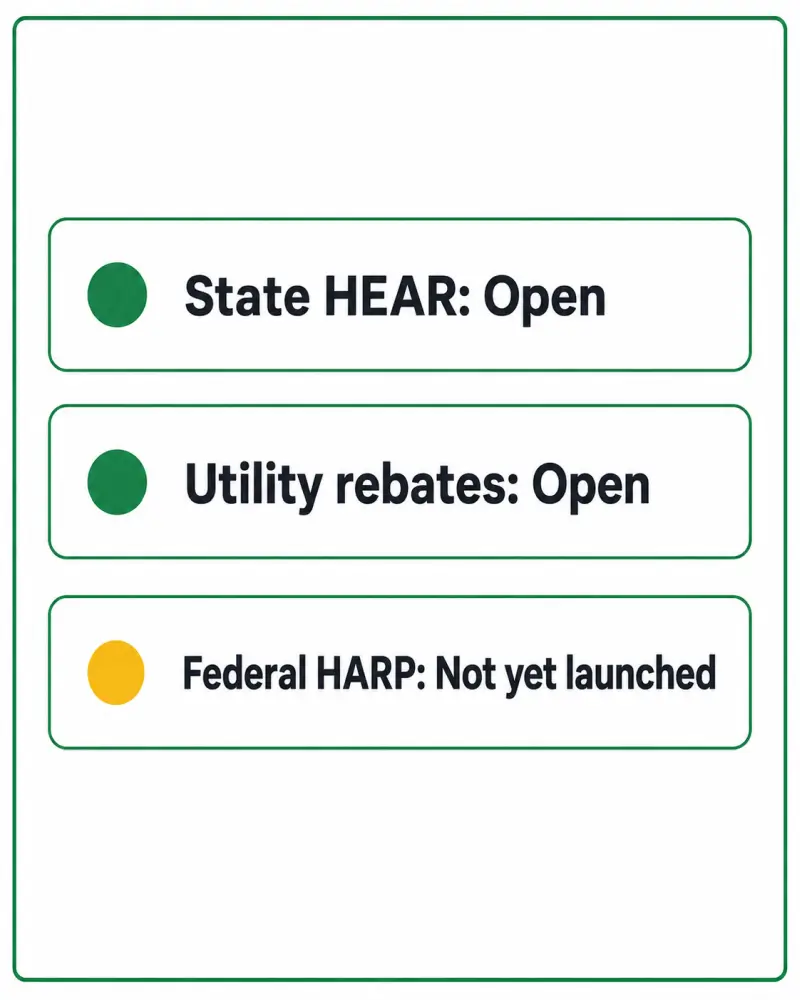
Washington’s state HEAR program is open and funded by the Climate Commitment Act, serving households at or below 150% of area median income, plus small businesses with 50 or fewer employees and licensed adult family homes.
The federal HARP/HOMES rebates have not launched in Washington as of July 2026, and they are not retroactive, so work done before approval cannot be reimbursed.
Puget Sound Energy requires a Trade Ally or Registered Energy Professional contractor for rebate-eligible heat pump installations as of April 2, 2026.
Your HOA cannot flatly prohibit a heat pump. Under RCW 64.90.580, Washington associations may not prohibit or unreasonably restrict installation within your unit’s boundaries.
What Does A Mini Split AC System Cost In Washington?
A ductless mini split in Washington generally costs $5,000 to $9,000 installed for a single-zone system, with multi-zone systems and whole-home air-source heat pumps running higher. Seattle-area installers commonly quote $12,000 to $20,000 for whole-home conversions. Price depends on tonnage, the number of indoor heads, line-set routing, and whether your electrical panel has capacity.
2026 market estimates, not quotes. Get at least three bids from licensed Washington contractors.
Before you sign: the panel upgrade is the most common surprise line item, and the contractor quoting it is paid either way. Ask for the load calculation in writing. And notice what the cost table does not include: no rebate is subtracted anywhere in it. That is deliberate. In Washington right now, whether you get $1,500 or $6,000 back depends less on the equipment than on the order you do things in, which is the next section.
One more thing no quote line-items: the filters your central system keeps going through afterward. And if you are still weighing equipment types, compare a heat pump against a mini split before you collect bids. The answer changes what you are pricing.
What Mini Split Rebates Are Available In Washington In 2026?
Washington mini split rebates in 2026 come from three layers: state HEAR, your local electric utility, and city programs. The federal layer is largely dormant. The single most common mistake is budgeting around the “$8,000 federal rebate.” That program has not opened in Washington yet.
Every figure below was checked on July 23, 2026 against the program’s own published materials rather than other rebate roundups. Two utility pages block automated checks, so confirm PSE and Seattle amounts by phone before you commit money. That is how the expired federal tax credit is still showing up as live money on HVAC sites across the state.
Rebate amounts and rules change without notice. Confirm with WA Commerce and your utility before purchasing equipment.
Sources: WA Commerce State HEAR · WA Commerce IRA Home Energy Rebates · PSE heat pump rebate · Seattle Clean Heat Program · IRS Form 5695.
Tacoma Power, Snohomish PUD, Clark Public Utilities, and Avista run their own heat pump incentives. Amounts and equipment rules change without notice. Confirm with your utility before buying.
Which Rebate Actually Applies To You? Start With What Heats Your House Today
Almost every Washington rebate is written around the heating system you are replacing, not the cooling you are adding. That single fact decides whether you are looking at thousands of dollars or nothing at all, and it is the first thing to sort out, before you price equipment.
You heat with electric baseboards or wall units. This is the best-funded path in the state. PSE pays $1,500 for the conversion, or $2,400 if you are income-qualified, and state HEAR is aimed squarely at this group. Utilities want this switch because electric resistance heat is the least efficient thing on their grid.
You heat with oil and live in Seattle. Up to $6,000 through Clean Heat, and the highest-value conversion available in Washington right now. But the bonus half of it expires September 30, 2026.
You heat with natural gas. This is where most people are disappointed. Gas-to-heat-pump conversions are generally not covered unless you are income-qualified, in which case PSE has reported a $4,000 conversion rebate. Confirm that figure directly with PSE before you count on it.
You already have a heat pump, or you just want air conditioning. There is probably no rebate for you, and it is worth saying that plainly. These are energy-conversion programs. Adding comfort cooling to an already-efficient home does not save the utility anything, so it does not pay anything. You are buying comfort at full price, which makes equipment cost the whole negotiation. Filterbuy sells ductless mini split systems factory-direct in 12,000, 18,000, and 24,000 BTU sizes, which is worth pricing against a contractor-supplied unit when no rebate is offsetting it.
Can You Stack A State Rebate On Top Of A Utility Rebate?
This is the most confidently answered question on the internet and the least reliably documented. Contractor blogs and rebate calculators say yes, state HEAR stacks with utility programs. The program pages themselves are far less explicit, and at least one aggregator warns in the same breath that not all programs stack.
So do not budget a stacked total until you have asked both administrators one specific question, in writing: can the same installation cost be counted toward both rebates, or must each program apply to a separate portion of the project? That distinction, not the headline amounts, is what determines your actual out-of-pocket cost. Get the answer by email and keep it.
East Or West Of The Cascades Changes The Equipment, Not The Paperwork
Spokane and Yakima see winter design temperatures that Seattle never approaches, so cold-climate rated equipment is not optional east of the mountains. A unit sized for Puget Sound can lose capacity exactly when you need it most. Eastern Washington also tends to sit closer to the fires, which means longer stretches of poor air quality and more frequent filter changes on whatever central system you keep running.
How Do You Claim A Washington Mini Split Rebate Without Losing It?
Apply in the right order. Most lost rebates in Washington are lost on sequence, not eligibility: the homeowner buys the equipment first, then discovers the program required pre-approval or a specific contractor. Do these five things in this order.
Identify your electric utility and your local HEAR administrator. Email HomeRebates@commerce.wa.gov to find the administrator serving your community, and check your utility’s rebate page the same week.
Confirm income eligibility before you shop. State HEAR serves households at or below 150% of area median income, which varies by county. Check the HUD income limits for yours. King County thresholds are far higher than Spokane’s.
Verify your contractor’s status. PSE customers: your installer must be a PSE Trade Ally or Registered Energy Professional as of April 2, 2026, or the rebate is void.
Check the equipment specs and placement against the rebate rules, not the brochure. PSE’s heat pump rebate requires AHRI certification, inverter technology, at least 3/4 ton in heating mode, and equipment meeting the current federal efficiency standard. At least one indoor head must also go in the main living area. Bedroom-only installs do not qualify.
Pull permits and submit paperwork inside the window. PSE residential heat pump applications are generally due within 30 days of installation, with the paid invoice and model numbers attached. Confirm the deadline on your specific rebate page.
One more rule for condo and townhome owners: since January 1, 2026, RCW 64.90.580 applies to all Washington common-interest communities. Your association may require an application and impose reasonable architectural standards, but it may not prohibit or unreasonably restrict a heat pump within your unit’s boundaries. If it does not deny your application in writing within 60 days, the application is deemed approved, and a willful violation carries a civil penalty payable to you.
What A Mini Split Does And Doesn’t Do For Your Indoor Air
A ductless mini split cools and heats the air already in the room. It does not clean your home’s air, and it does not bring in fresh air. You do not have to take our word for it: the EPA states that ductless mini split heat pumps generally do not filter fine particles, that the filters in them are designed to keep large debris like pet hair and lint out of the equipment, and that a ductless system treats only the room it is mounted in, only while it is running. EPA sets the bar at MERV 13 or higher before a filter counts as high-efficiency, a rating no standard mini split mesh screen approaches. In Washington, where wildfire smoke is the largest source of particle pollution, that gap stops being academic around August. Our guide to what a mini split’s built-in filter actually captures breaks down the layers.
That has three practical consequences:
Rinse the mini split’s mesh screens about monthly during smoke season. A loaded screen chokes airflow and drags down the efficiency you just paid for. Here is how to clean mini split filters by brand.
If you kept a furnace or air handler, its filter is still your home’s real filtration. A MERV 13 air filter is the practical choice for fine smoke particles. See the best MERV filter for wildfire smoke and how MERV ratings compare.
Ductless doesn’t mean filter-free. Odd-size returns are common in older Washington homes; order custom size air filters if nothing standard fits, or set up auto-delivery so a fresh filter arrives on schedule through smoke season.
Planning for smoke season? Check Washington’s live wildfire and smoke map first. Western and eastern Washington often sit two categories apart. Puget Sound households can track the Seattle smoke map specifically.
Which Rebate Actually Applies To You? Start With What Heats Your House Today
Almost every Washington rebate is written around the heating system you are replacing, not the cooling you are adding. That single fact decides whether you are looking at thousands of dollars or nothing at all, and it is the first thing to sort out, before you price equipment.
You heat with electric baseboards or wall units. This is the best-funded path in the state. PSE pays $1,500 for the conversion, or $2,400 if you are income-qualified, and state HEAR is aimed squarely at this group. Utilities want this switch because electric resistance heat is the least efficient thing on their grid.
You heat with oil and live in Seattle. Up to $6,000 through Clean Heat, and the highest-value conversion available in Washington right now. But the bonus half of it expires September 30, 2026.
You heat with natural gas. This is where most people are disappointed. Gas-to-heat-pump conversions are generally not covered unless you are income-qualified, in which case PSE has reported a $4,000 conversion rebate. Confirm that figure directly with PSE before you count on it.
You already have a heat pump, or you just want air conditioning. There is probably no rebate for you, and it is worth saying that plainly. These are energy-conversion programs. Adding comfort cooling to an already-efficient home does not save the utility anything, so it does not pay anything. You are buying comfort at full price, which makes equipment cost the whole negotiation. Filterbuy sells ductless mini split systems factory-direct in 12,000, 18,000, and 24,000 BTU sizes, which is worth pricing against a contractor-supplied unit when no rebate is offsetting it.
Can You Stack A State Rebate On Top Of A Utility Rebate?
This is the most confidently answered question on the internet and the least reliably documented. Contractor blogs and rebate calculators say yes, state HEAR stacks with utility programs. The program pages themselves are far less explicit, and at least one aggregator warns in the same breath that not all programs stack.
So do not budget a stacked total until you have asked both administrators one specific question, in writing: can the same installation cost be counted toward both rebates, or must each program apply to a separate portion of the project? That distinction, not the headline amounts, is what determines your actual out-of-pocket cost. Get the answer by email and keep it.
East Or West Of The Cascades Changes The Equipment, Not The Paperwork
Spokane and Yakima see winter design temperatures that Seattle never approaches, so cold-climate rated equipment is not optional east of the mountains. A unit sized for Puget Sound can lose capacity exactly when you need it most. Eastern Washington also tends to sit closer to the fires, which means longer stretches of poor air quality and more frequent filter changes on whatever central system you keep running.
How Do You Claim A Washington Mini Split Rebate Without Losing It?
Apply in the right order. Most lost rebates in Washington are lost on sequence, not eligibility: the homeowner buys the equipment first, then discovers the program required pre-approval or a specific contractor. Do these five things in this order.
Identify your electric utility and your local HEAR administrator. Email HomeRebates@commerce.wa.gov to find the administrator serving your community, and check your utility’s rebate page the same week.
Confirm income eligibility before you shop. State HEAR serves households at or below 150% of area median income, which varies by county. Check the HUD income limits for yours. King County thresholds are far higher than Spokane’s.
Verify your contractor’s status. PSE customers: your installer must be a PSE Trade Ally or Registered Energy Professional as of April 2, 2026, or the rebate is void.
Check the equipment specs and placement against the rebate rules, not the brochure. PSE’s heat pump rebate requires AHRI certification, inverter technology, at least 3/4 ton in heating mode, and equipment meeting the current federal efficiency standard. At least one indoor head must also go in the main living area. Bedroom-only installs do not qualify.
Pull permits and submit paperwork inside the window. PSE residential heat pump applications are generally due within 30 days of installation, with the paid invoice and model numbers attached. Confirm the deadline on your specific rebate page.
One more rule for condo and townhome owners: since January 1, 2026, RCW 64.90.580 applies to all Washington common-interest communities. Your association may require an application and impose reasonable architectural standards, but it may not prohibit or unreasonably restrict a heat pump within your unit’s boundaries. If it does not deny your application in writing within 60 days, the application is deemed approved, and a willful violation carries a civil penalty payable to you.
What A Mini Split Does And Doesn’t Do For Your Indoor Air
A ductless mini split cools and heats the air already in the room. It does not clean your home’s air, and it does not bring in fresh air. You do not have to take our word for it: the EPA states that ductless mini split heat pumps generally do not filter fine particles, that the filters in them are designed to keep large debris like pet hair and lint out of the equipment, and that a ductless system treats only the room it is mounted in, only while it is running. EPA sets the bar at MERV 13 or higher before a filter counts as high-efficiency, a rating no standard mini split mesh screen approaches. In Washington, where wildfire smoke is the largest source of particle pollution, that gap stops being academic around August. Our guide to what a mini split’s built-in filter actually captures breaks down the layers.
That has three practical consequences:
Rinse the mini split’s mesh screens about monthly during smoke season. A loaded screen chokes airflow and drags down the efficiency you just paid for. Here is how to clean mini split filters by brand.
If you kept a furnace or air handler, its filter is still your home’s real filtration. A MERV 13 air filter is the practical choice for fine smoke particles. See the best MERV filter for wildfire smoke and how MERV ratings compare.
Ductless doesn’t mean filter-free. Odd-size returns are common in older Washington homes; order custom size air filters if nothing standard fits, or set up auto-delivery so a fresh filter arrives on schedule through smoke season.
Planning for smoke season? Check Washington’s live wildfire and smoke map first. Western and eastern Washington often sit two categories apart. Puget Sound households can track the Seattle smoke map specifically.
WHERE WE STAND ON THISWe sell ductless mini split systems. We also sell the filters for the furnace or air handler most Washington homes keep running alongside one. That puts us on both sides of this purchase, which is exactly why we will say the unpopular part out loud: a mini split is a comfort and efficiency upgrade, not a filtration upgrade. The mesh screen in the indoor head is there to protect the coil, and our own guide on mini split filters reaches the same conclusion. We would rather you hear that before the installer packs up than in August when the sky turns orange.
The Filterbuy team
Essential Resources: 7 Places To Check Before You Add A Mini Split In Washington
Rebate rules change fast in this state, and the fine print is usually where good projects lose money. These are the seven sources we’d hand a neighbor. Every one is a government, utility, or certification site, checked July 23, 2026.
1. Start Here: See If You Qualify For Money That’s Already Funded
Washington’s state HEAR program is up and running right now, paid for by the Climate Commitment Act, and it covers ductless heat pumps along with the panel or wiring work an install can trigger. Local administrators hand out the money, so this page shows you who serves your county and whether your household lands under the 150% AMI line.
Source: Washington State Department of Commerce: State Home Electrification and Appliance Rebates (HEAR)
2. Know What Your Utility Pays, And What It Expects Back
If Puget Sound Energy powers your home, swapping electric resistance heat for a qualifying heat pump is worth $1,500, or $2,400 if you’re income-qualified, and fully ductless mini splits count. Read the requirements before you shop: AHRI-certified inverter equipment at 3/4 ton or larger, at least one indoor head in your main living area, and a PSE Trade Ally doing the work as of April 2, 2026.
Source: Puget Sound Energy: Electric resistance to air-source heat pump conversion rebate
3. Heating With Oil In Seattle? That’s Worth Up To $6,000
Seattle’s Clean Heat Program takes $2,000 straight off your invoice when you switch from oil to a qualifying heat pump, and households between 81% and 150% of area median income can stack another $4,000 on top. The bonus only covers installs finished by September 30, 2026, so this is the one deadline worth putting on the calendar today.
Source: City of Seattle: Seattle’s Clean Heat Program
4. Your HOA Can’t Just Say No
Since January 1, 2026, RCW 64.90.580 has covered every common-interest community in Washington, and it bars associations from blocking or unreasonably restricting a heat pump inside your unit’s boundaries. If your board doesn’t deny your application in writing within 60 days it counts as approved, and they can’t charge you a fee for the installation itself.
Source: Washington State Legislature: RCW 64.90.580, Heat pumps
5. Check Your Contractor Before You Sign Anything
Anyone doing more than $2,000 of construction work in Washington has to be registered with Labor & Industries, which means carrying a bond, liability insurance, and workers’ comp. This free lookup takes about two minutes and shows you registration status, bond details, safety citations, and whether anyone has sued against that bond.
Source: Washington State Department of Labor & Industries: Verify a Contractor, Tradesperson or Business
6. Make Sense Of The Efficiency Numbers In Your Quotes
Ratings like HSPF2 and SEER2 get thrown around fast, and this is the plain-English version. ENERGY STAR is the certification most Washington rebate programs accept, and its ductless guide walks through how these systems work, where the line set can run, and why certified mini splits use up to 60% less energy than standard electric resistance heat.
Source: ENERGY STAR: Ductless Heating & Cooling
7. Make Sure Your Exact Pairing Is Certified
This is the detail that trips people up: AHRI certifies the indoor and outdoor units as a matched set, not separately, and every pairing gets its own Certified Reference Number that most rebate programs want on the application. Ask your contractor for that number and look it up yourself before anything ships. A mismatched pair can run beautifully and still get your rebate denied.
Supporting Statistics: What The Research Shows
Three numbers explain why Washington homes are adding mini splits, and why the filter question doesn’t end at installation.
1. 69x: The Spike In Heat-Related ER Visits During Washington’s 2021 Heat Dome
The CDC compared June 25–30, 2021 against the same days in 2019. Across HHS Region 10, which includes Washington, mean daily heat-related ER visits ran 69 times higher.
Cooling is no longer optional in the Pacific Northwest.
That shift is what the state HEAR and utility rebate programs are funding.
Source: Washington State Department of Health: Heat Wave 2021
2. 30%+: The Share Of Space-Conditioning Energy Ductwork Can Waste
ENERGY STAR, the EPA-run certification program, puts duct losses above 30% of a home’s space-conditioning energy. Certified mini splits use up to 60% less energy than standard electric resistance heat.
Going ductless skips those duct losses entirely.
That math is why Puget Sound Energy pays you to retire baseboard heat.
Source: ENERGY STAR: Certified Mini Split Heat Pumps fact sheet (PDF)
3. 90%: The Share Of Their Time Americans Spend Indoors
The EPA reports that indoor concentrations of some pollutants run two to five times higher than outdoor levels. Tighter construction without matching ventilation has pushed those levels up.
A mini split recirculates room air. It doesn’t bring in fresh air.
Its mesh screen isn’t built to catch fine smoke particles.
Your central system’s filter stays the real defense in smoke season.
Source: U.S. Environmental Protection Agency: Indoor Air Quality, Report on the Environment
Frequently Asked Questions
Is The $8,000 Federal Heat Pump Rebate Available In Washington?
Not yet. The federal HARP/HOMES rebates administered by the Washington Department of Commerce have not launched. They are also not retroactive, so a system installed before the program opens will not qualify. Washington’s separate state HEAR program is open now.
Can I Still Get A Federal Tax Credit For A Mini Split In 2026?
No. The 25C energy efficient home improvement credit expired December 31, 2025. Systems installed on or after January 1, 2026 do not qualify. A system installed before that date can still be claimed on your 2025 return using IRS Form 5695.
Will A Single Mini Split Cool My Whole House?
Usually not. One indoor head conditions the space it’s mounted in, plus a little spillover. Cooling multiple bedrooms generally needs a multi-zone system with a head in each room.
Do I Need A Permit To Add A Mini Split In Washington?
Yes, in nearly every jurisdiction, mechanical and electrical both. Seattle permits through SDCI; elsewhere it runs through Washington L&I or your local building department. Your contractor should pull them and coordinate inspection.
Does A Mini Split Help With Wildfire Smoke?
Only indirectly. It lets you keep windows closed in the heat, which is genuinely protective. But the unit itself doesn’t filter fine smoke particles. Pair it with a high-MERV filter in your central system or a portable air cleaner in the room. Our guide to the best MERV filter for wildfire smoke covers what holds up in August.
Glossary
Ductless mini split: A heat pump system with an outdoor compressor connected by a refrigerant line set to one or more wall-, floor-, or ceiling-mounted indoor heads, requiring no ductwork.
HEAR (Home Electrification and Appliance Rebates): Washington’s state rebate program, funded by the Climate Commitment Act and delivered by local third-party administrators to households at or below 150% AMI.
HARP / HOMES: The federally funded Inflation Reduction Act home energy rebate programs, administered in Washington by the Department of Commerce. Not yet open to applications.
AMI (Area Median Income): The midpoint household income for your county, published by HUD, used to set rebate eligibility tiers.
HSPF2: Heating Seasonal Performance Factor 2, the current federal test standard for heat pump heating efficiency. Higher is better.
AHRI certification: Verification by the Air-Conditioning, Heating, and Refrigeration Institute that a specific equipment combination performs as rated. Most rebates require it.
PM2.5: Airborne particles 2.5 microns and smaller, the dominant health concern in wildfire smoke.
MERV: Minimum Efficiency Reporting Value, the 1–16 scale rating how well an air filter captures particles. MERV 13 captures a meaningful share of PM2.5. See Filterbuy’s MERV rating chart for the full scale.
Trade Ally: A contractor enrolled in Puget Sound Energy’s approved network; required for PSE heat pump rebates as of April 2, 2026.