Costs, Rebates & Air Quality (2026 Guide)
By Michelle Wan, Brand Manager and Air Quality Writer, Filterbuy · Reviewed by David Clark, President of Filterbuy HVAC Solutions; EPA-certified technician, South Florida Academy of Air Conditioning · Published July 23, 2026 · Updated July 23, 2026
A single-zone ductless mini split runs about $3,500 to $6,000 installed in Virginia, and your rebate depends on who sends your power bill. Appalachian Power customers can claim $300 per unit, or $400 through the assessment-first Home Performance path. Dominion customers get a variable rebate, but only if the energy audit comes before the install. The federal 25C tax credit ended for systems placed in service after December 31, 2025.
The right size comes down to the room:

Not sure which size fits your space?
Answer 3 quick questions and we will match you to the right mini split.
Prefer to shop directly? See the Filterbuy mini split systems ›
Adding a ductless mini split in Virginia costs roughly $3,500 to $6,000 installed for a single zone and $7,000 to $15,000 for a multi-zone system in 2026. Your rebate depends entirely on which utility bills you: Appalachian Power pays $300 per qualifying ductless mini split, Dominion Energy offers audit-based retrofit rebates, and the federal 25C tax credit is gone.
Worth saying up front: we sell both sides of this decision. Filterbuy is an American air filter manufacturer, and we also build our own ductless mini split line. That is exactly why the air quality section below tells you what a mini split will not do. This page is written from the plant floor, not a contractor’s van, and we would rather you buy the right thing than the thing with our name on it.
Adding a mini split AC system, including rebates, in Virginia in 2026 means working with utility programs rather than federal tax credits. The Section 25C Energy Efficient Home Improvement Credit expired for equipment placed in service after December 31, 2025, and Virginia’s $188.3 million in IRA-funded HOMES and HEAR rebates have not launched. Appalachian Power, Dominion Energy Virginia, and Washington Gas each run their own programs, with different deadlines and efficiency thresholds.
A single-zone ductless mini split in Virginia runs about $3,500 to $6,000 installed in 2026, with Northern Virginia labor rates pushing quotes toward the top of that range and Southwest Virginia toward the bottom.
Appalachian Power runs two mini split rebates, $300 and $400, and you can only have one. The $300 Efficient Products rebate needs SEER2 15+ and EER2 12.5+ and a filing within 45 days of purchase. The $400 Home Performance rebate pays more but starts with a free home energy assessment.
Dominion Energy Virginia’s Home Energy Evaluation rebate is variable, not a flat amount, and requires a home energy audit with a participating contractor before the work is done.
The federal Section 25C tax credit is not available for 2026 installations. The One Big Beautiful Bill Act (P.L. 119-21, signed July 4, 2025) ended it for property placed in service after December 31, 2025.
Virginia’s HEAR and HOMES rebates are still pending. Virginia Energy is updating its application documents to match U.S. Department of Energy guidance issued May 29, 2026, and is awaiting DOE approval before launch.
A mini split’s built-in mesh screen is equipment protection, not air cleaning. The EPA states that mini split filters are designed to keep large particles like pet hair and lint out of the equipment and generally do not filter fine particles.
Your mini split rebate in Virginia is determined by your electric utility, not by your county or your equipment brand. Three territories cover nearly every Virginia home, and their programs do not overlap. Check your power bill before requesting a quote, because the answer changes what you buy and when you schedule the work.
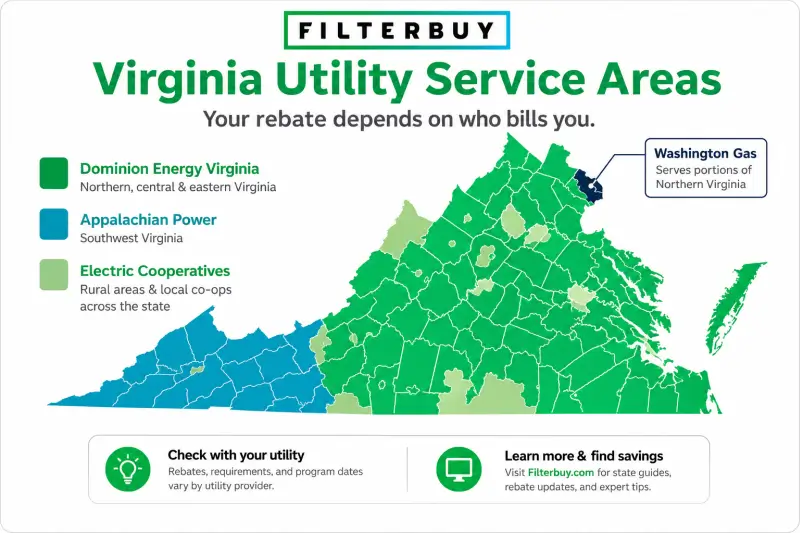
Table 1: Mini split rebates in Virginia, 2026
Rebate amounts verified [DATE]. Confirm current terms at takechargeva.com and domsavings.com before purchase.
Two deadlines decide whether you actually collect. Appalachian Power requires the rebate application within 45 days of purchase, or by January 15 of the following year, whichever comes first, and limits each customer to one mini split rebate per calendar year. Dominion’s Home Energy Evaluation path starts with an energy audit, so installing first closes it. Sequence matters more than paperwork here.
On a cooperative or municipal bill? Do not assume nothing exists. Most Virginia electric cooperatives offer no direct mini split rebate, but municipal utilities are a different story. Harrisonburg Electric Commission runs its Energy Save & Earn program with rebates on qualifying electric heating and cooling equipment, filed within 90 days of purchase. Danville Utilities runs a separate Home$ave rebate. One phone call settles it.
“I went into this expecting the hard part to be the rebate amounts. It is not. It is the order of operations. Dominion’s rebate depends on booking the audit before anyone touches your wall, and Appalachian Power’s 45-day clock starts the day you buy, not the day it runs. Miss either one and you own the exact same equipment. The money is just gone.”
Michelle Wan, Brand Manager and Air Quality Writer, Filterbuy
Appalachian Power runs two separate ductless mini split rebates, and applying for the smaller one disqualifies you from the larger one. The rebate portal states it plainly: apply for the mini split appliance rebate and you are no longer eligible for a mini split rebate under the Home Performance Program. Most homeowners find the $300 first, because it is the faster form, and never learn the $400 existed.
How the two paths differ:
Efficient Products, $300 per unit. Buy the equipment, then file. Fastest route, no home visit, 45-day filing deadline.
Home Performance, $400 per unit. Starts with a free home energy assessment. An advisor walks the house, installs basic measures, and gives you a report that opens up other rebates, including attic insulation.
You choose one. The programs are mutually exclusive for mini splits.
Our read, from a company that sells the equipment: if you are installing a single head and want it done, take the $300 and file inside 45 days. If your house is older, drafty, or you were already thinking about insulation, book the assessment first. The extra $100 is the small part. The report is what tends to pay, because attic insulation rebates through the same program run considerably higher than the mini split rebate itself.
Expect $3,500 to $6,000 installed for a single-zone ductless mini split in Virginia, and $7,000 to $15,000 for a multi-zone system serving two to four rooms. Equipment accounts for less of that number than most homeowners assume. Labor, electrical work, and permitting drive the spread between quotes.
Table 2: What a Virginia mini split installation costs in 2026
Cost ranges are directional estimates based on regional labor patterns. Confirm against local quotes.
Get three quotes, and check the spec sheet before you sign. A system rated below SEER2 15 forfeits the Appalachian Power rebate outright, a $300 swing. ENERGY STAR’s certified ductless product finder confirms a model’s ratings. Filterbuy’s ductless line is rated 17 SEER2 in the 12,000 BTU and 18,000 BTU sizes; for capacity, start with mini split sizing by square footage.
Yes. Under Virginia Code 54.1-1100, any contractor performing work valued at $1,000 or more, labor and materials combined, must hold a valid license from the Virginia Board for Contractors within the Department of Professional and Occupational Regulation (DPOR). Virginia licenses individual HVAC tradesmen separately, at journeyman and master tiers.
Refrigerant is the harder limit. Handling it requires EPA Section 608 certification regardless of state, so an uncertified homeowner cannot legally buy or charge refrigerant. Pre-charged DIY kits sidestep that, but trade away line-set length, placement flexibility, and usually the full warranty.
Run any Virginia contractor through the DPOR license lookup before you sign. It takes two minutes and it is the cheapest due diligence in this project.
A ductless mini split filters only the room it is installed in, and only while it is running. The U.S. EPA states that the filters installed in mini split heat pumps are designed to protect the equipment from clogging with large particles like pet hair and lint, and generally do not filter fine particles out of indoor air. Some models advertise higher-efficiency filtration; the EPA’s guidance is to verify a MERV 13 or higher rating before accepting the claim.
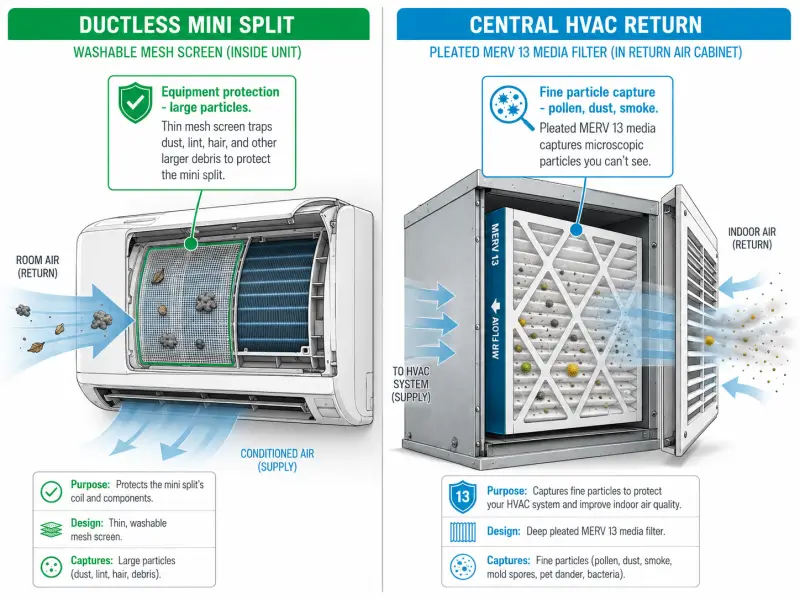
Virginia homes feel that gap more than most. The Asthma and Allergy Foundation of America ranked Richmond the 14th most challenging U.S. city for seasonal pollen allergies in its 2026 Allergy Capitals report, and Richmond has placed in the top 10 in five of the last six years. You can watch that load move in real time on the Richmond live AQI map or the Virginia Beach AQI map.
Table 3: What each filter in a Virginia home actually captures
MERV 11 is the sensible Virginia baseline. MERV 13 is the upgrade for households with allergy sufferers, pets, or a Richmond-area pollen load.
Two habits protect the investment. Clean the mini split mesh screen every two to four weeks during the May-through-September cooling season, since a loaded screen chokes airflow and lets moisture linger on the coil, which is how mini split mold starts. Remembering it is the hard part, which is why some units, including the Filterbuy ductless line, ship with a built-in filter-cleaning reminder. Then keep your central HVAC filter on schedule, because that pleated filter is what captures pollen and fine dust for the rest of the house.
“The call I take most often in a mixed-humid state is not a broken mini split. It is an oversized one. Too much capacity cools the room in minutes, shuts off, and never runs long enough to pull the moisture out. You end up with a cold, clammy room and a homeowner who thinks the equipment failed. That is a sizing decision, and a Manual J calculation catches it before anybody spends a dollar.”
David Clark, President of Filterbuy HVAC Solutions and EPA-certified HVAC technician
Filterbuy stocks more than 600 standard filter sizes and cuts custom sizes to order, so an odd return in a 1940s Norfolk bungalow is not a dead end. Shop MERV 11 filters for the Virginia baseline, MERV 13 filters for allergy and smoke season, or set up auto-delivery.
We can tell you how these programs looked the day we published this. We can’t tell you what your utility will say when you call next month. These seven sources are the ones actually running the rebates, certifying the equipment, and setting the install standards, so bookmark whichever ones match your address.
Source: Virginia Energy, Home Energy Rebates FAQ
Virginia Energy runs the state’s HOMES and HEAR programs, and its FAQ is refreshingly blunt: the money is allocated, all $188,334,635 of it, but nobody can apply yet. Check here before you pencil a state rebate into your budget, because this is the page that will say so first.
Best for: Deciding whether to wait it out or move ahead now.
Source: Appalachian Power, TakeCharge VA Rebates
TakeCharge VA is Appalachian Power’s rebate hub for Virginia customers, and the $300 ductless mini split rebate lives here along with the application itself. One detail worth catching before the paperwork slides to the bottom of the pile: that 45-day filing window starts the day you buy, not the day it’s installed.
Best for: Southwest Virginia homes on an Appalachian Power bill.
Source: Dominion Energy, Home Energy Evaluation
Dominion’s Home Energy Evaluation program merged the old Home Retrofit and Home Energy Assessment programs, and it lists mini split upgrades right there among the eligible measures. The order is what trips people up: audit first, install second. Flip those two and the rebate is gone.
Best for: The roughly 2.7 million Virginia homes Dominion serves.
Source: ENERGY STAR, Ductless Heating & Cooling
ENERGY STAR, the certification program run by the EPA, publishes verified SEER2 and EER2 numbers model by model in its certified product finder. Two minutes here tells you whether the unit on your quote clears the rebate bar or quietly costs you $300.
Best for: Sanity-checking the equipment a contractor put on your estimate.
Source: U.S. Department of Energy, Going Ductless with Heat Pumps
The Department of Energy’s Energy Saver guide lays out when a ductless system beats a ducted one, and when it honestly doesn’t. It’s written for homeowners rather than contractors, so you won’t need a glossary open beside it.
Best for: Anyone still weighing mini split zones against central air.
Source: U.S. EPA, Do Ductless Mini Splits Filter Fine Particles?
The EPA says mini split filters are built to keep lint and pet hair out of the equipment, not to clean the air your family breathes, and it tells you to look for a MERV 13 rating before believing any filtration claim. We’ve been making filters in the U.S. for over a decade, and we’d still rather you hear that from the EPA than from us.
Best for: Anyone who’s been told a ductless unit will handle their allergies.
Source: Building America Solution Center, Ductless Mini-Split Heat Pumps
The Building America Solution Center is a technical library from Pacific Northwest National Laboratory, and its ductless guide spells out what a complete install actually includes: electrical assessment, unit placement, refrigerant and condensate lines, and commissioning. Read it once and a thin proposal gets obvious fast.
Best for: Comparing three quotes that all look the same on paper.
Three numbers do most of the work on this page. Each one comes from the agency that produced it.
The stat: Up to 60% less energy than standard home electric radiators. More than 4,500 lbs of greenhouse gas avoided over the system’s lifespan, whole-house.
Why it matters in Virginia:
Bonus rooms, sunrooms, and converted garages usually run on baseboard heat or a space heater.
A ductless zone replaces both. One box, heating and cooling.
Virginia needs both: cooling May through September, heating through winter.
Source: ENERGY STAR, Ductless Heating & Cooling
The stat: Roughly 90% of time is spent indoors. Some pollutants run 2 to 5 times higher inside than outside.
Why it matters in Virginia:
A mini split filters one room, and only while it runs.
The rest of your home’s air still moves through the central system.
That makes the pleated filter the workhorse, not the mini split.
Source: U.S. EPA Report on the Environment: Indoor Air Quality
The stat: 14th out of 100 metro areas in 2026. Top 10 in five of the last six years.
Why it matters in Virginia:
AAFA scores pollen counts, allergy medicine sales, and allergist availability.
MERV 11 is the Virginia baseline.
MERV 13 is the upgrade for allergy and pet households.
February through May: change monthly, not every 90 days.
Source: Asthma and Allergy Foundation of America, 2026 Allergy Capitals Report
Appalachian Power pays $300 per qualifying ductless mini split through TakeCharge VA. Dominion Energy Virginia offers a variable, audit-based rebate through its Home Energy Evaluation program, which merged the former Home Retrofit and Home Energy Assessment programs and lists mini split upgrades among its eligible measures. Washington Gas offers up to $2,000 for qualifying dual-fuel heat pump systems in Northern Virginia. Most Virginia electric cooperatives offer no direct mini split rebate.
For the $300 Efficient Products rebate, the unit must reach SEER2 of 15 or higher and EER2 of 12.5 or higher, be purchased by December 31, 2026, and be filed within 45 days of purchase or by January 15 of the following year, whichever comes first. One rebate per customer per calendar year.
You cannot take both. The $300 Efficient Products rebate is a straight purchase-and-file. The $400 Home Performance rebate requires a free home energy assessment first, and that assessment unlocks other rebates such as attic insulation. Older or draftier homes usually come out ahead on the assessment path.
Not for a 2026 installation. Section 25C ended for property placed in service after December 31, 2025. If your system was installed on or before that date, you may still claim it on your 2025 return using IRS Form 5695. Confirm your situation with a tax professional.
No launch date has been announced. Virginia Energy is updating its application documents to conform with DOE program guidance released May 29, 2026, and is awaiting DOE review and approval. For incentives available now, check Virginia Energy Connect.
Only partially, and only in the room where they are installed. The EPA notes that mini split filters are built to protect the equipment from large particles and generally do not capture fine particles. For pollen and fine dust, a MERV 11 or MERV 13 pleated filter in your central system does the real work.
Michelle Wan is Brand Manager and Air Quality Writer at Filterbuy, where she translates MERV ratings, filtration, and HVAC efficiency into plain English for homeowners. She earned her B.A. in Sociology from the University of California, Santa Cruz, and works directly with Filterbuy’s U.S. manufacturing team across the company’s plants in Alabama, Florida, Pennsylvania, and Utah, which is where the practical detail in her writing comes from. More from Michelle Wan.
David Clark reviewed this page for technical accuracy. He is President of Filterbuy HVAC Solutions, the HVAC service arm of the Filterbuy family of companies, an EPA-certified technician, and a graduate of the South Florida Academy of Air Conditioning. He has worked nearly every role in the trade, including installation, dispatch, maintenance, and customer service, and his crews take the service calls that follow a bad install.
Filterbuy is an American air filter manufacturer headquartered in Talladega, Alabama. The company has built filters in the United States since 2013, ships more than 600 standard sizes plus made-to-order custom sizes factory-direct, and serves more than two million households. Filterbuy also builds its own ductless mini split systems, which is why this page is willing to say what a mini split will not do for your air.
Ductless mini split - A heating and cooling system with an outdoor compressor connected to one or more indoor wall- or ceiling-mounted air handlers by a refrigerant line set, requiring no ductwork.
Single-zone / multi-zone - A single-zone mini split serves one room from one indoor head. A multi-zone system connects two to five heads to one outdoor unit, each independently controlled.
SEER2 and EER2 - Federal efficiency ratings for cooling equipment. SEER2 measures seasonal efficiency; EER2 measures efficiency at a fixed high-temperature condition. Appalachian Power requires SEER2 of 15 or higher and EER2 of 12.5 or higher for its mini split rebate.
Manual J - The ACCA load calculation method used to size HVAC equipment based on square footage, insulation, windows, and local climate rather than square footage alone.
MERV - Minimum Efficiency Reporting Value, the ASHRAE 1-20 scale rating how effectively an air filter captures particles. MERV 13 captures fine particles including pollen and smoke.
HEAR and HOMES - The two Inflation Reduction Act Home Energy Rebate programs. Virginia has been allocated $188,334,635 across both. Neither has launched.
Section 25C - The federal Energy Efficient Home Improvement Credit, which ended for property placed in service after December 31, 2025.
EPA Section 608 - The federal certification required to handle refrigerants in stationary air conditioning equipment.
DPOR - The Virginia Department of Professional and Occupational Regulation, which licenses HVAC contractors and tradesmen through its Board for Contractors.