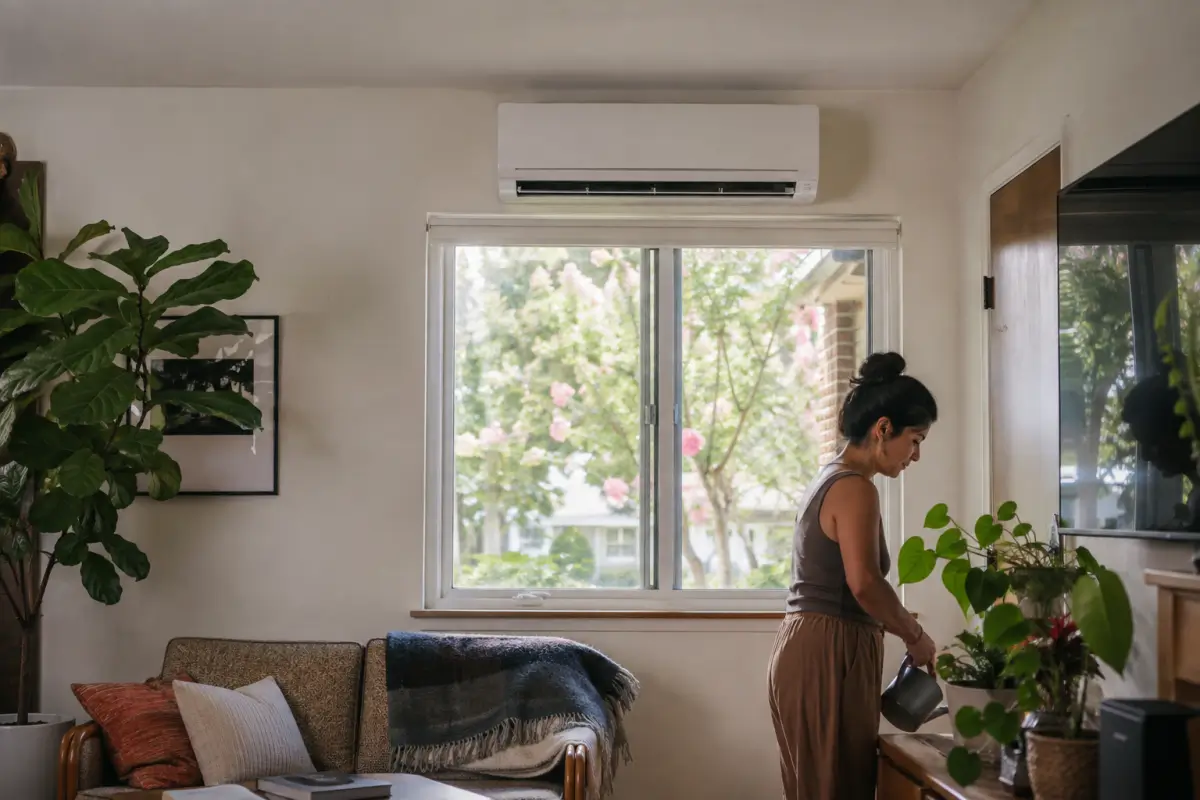
Mini Split AC In Houston, TX
Installation, Costs & Filter Guide (TX Climate)
By Michelle Wan · Technically reviewed by David Clark, Licensed HVAC Technician · Published August 5, 2026 · Updated August 2026
What does a mini split cost in Houston, TX?
A single-zone mini split runs $2,500 to $6,000 installed in Houston. A multi-zone system runs $6,500 to $15,000 or more. Each additional indoor head adds $1,500 to $4,000. The city permit costs less than most quotes suggest, and there is no federal tax credit in 2026.
- One zone for a single room, garage, or addition: $2,500 to $6,000
- Each added zone for one more indoor head: $1,500 to $4,000
- Multi-zone home with several rooms on one outdoor unit: $6,500 to $15,000+
- City of Houston permit, at 2% of job cost plus fees: about $160 on a $4,000 job
How many zones you need depends on your rooms, not your square footage. The quiz below sorts that out in under a minute.

Answer a few quick questions and we will match you to a mini split sized for your space.
Prefer to look around first? Browse Filterbuy mini split systems.
TL;DR
A ductless mini split is a heating and cooling system that pairs an outdoor compressor with one or more indoor heads, skipping ductwork entirely. In Houston, a single-zone install runs $2,500 to $6,000 and multi-zone systems reach $6,500 to $15,000+. The federal heat pump tax credit expired December 31, 2025. Houston humidity means cleaning the washable filter every two weeks, not monthly.
Key Takeaways
The $2,000 federal heat pump tax credit expired December 31, 2025. Section 25C was terminated by the One Big Beautiful Bill Act. Any 2026 quote citing it is outdated.
The City of Houston requires a mechanical permit for installation or changeout, at 2% of job cost plus fees. Unpermitted work can void warranties.
Houston average July dew point is 72.1°F (NWS 1991–2020 normals). That is why an oversized unit is worse here than in a dry climate: it cools fast, shuts off, and never dehumidifies.
Clean the washable mesh filter every two weeks during cooling season. Damp Gulf Coast air plus trapped dust causes the musty smell from a ductless head.
Where This Guide Comes From
Filterbuy has manufactured air filters in the United States since 2013, and the Filterbuy HVAC Solutions team services ductless systems in Texas and Florida homes. We are not a Houston installer competing for your quote, so we have no reason to inflate a permit line or repeat an expired incentive. What we do see constantly is what a ductless head looks like after a humid summer of neglect. That is why filter care gets as much room here as install cost.
Disclosure: Filterbuy sells a ductless mini split line and replacement filters, so treat the buying advice here the way you would treat any manufacturer’s. We have kept it brand-neutral on purpose. Nothing in the cost ranges, the incentive status, the sizing guidance, or the contractor checks below depends on you buying anything from Filterbuy.
How Much Does Mini Split Installation Cost In Houston In 2026?
Mini split installation in Houston costs roughly $2,500 to $6,000 for a single zone and $6,500 to $15,000+ for a multi-zone system, per 2026 HomeGuide data. Angi Houston figures start lower, from $700, because they include small-capacity installs.
Equipment and labor ranges reflect 2026 national and Houston-area data from HomeGuide and Angi. Permit fees are the City of Houston published schedule for an HVAC alteration permit.
Installer calendars fill from May through September, so spring and fall quotes are often better.
We checked this line ourselves rather than repeat the aggregator range of $350 to $1,100. The City of Houston published fee for an HVAC alteration permit is 2% of job cost plus $47, with a $33.56 admin fee. On a $4,000 install that lands near $160. If a quote shows several times that, ask what it covers.
Is There Still A Tax Credit For A Mini Split In Houston?
No. There is no federal tax credit for a mini split or heat pump installed in 2026. Section 25C, which covered up to $2,000, was terminated by the One Big Beautiful Bill Act. The IRS instructions for Form 5695 say it plainly: no credit for property placed in service after December 31, 2025. Texas has no state income tax either. See also the IRS FAQs on the Public Law 119-21 changes.
This is the most common piece of outdated information we see in Houston HVAC marketing. Material written before July 2025 still promises credits through 2032, because the Inflation Reduction Act had extended 25C to that date. Those pages were accurate when published and nobody fixed them. If a 2026 proposal lists a $2,000 credit, that money is not coming. See our guide to heat pump tax credits and what is still available.
Section 25C was terminated by the One Big Beautiful Bill Act (P.L. 119-21). Verify current rebate terms with CenterPoint Energy.
What is still on the table in Houston: CenterPoint Energy efficiency programs and rebates are the primary incentive, and the free CoolSaver tune-up is worth asking about. Confirm whether it is paid to you or passed through by a registered contractor, and whether ductless qualifies.
What Size Mini Split Does A Houston Home Actually Need?
Size a Houston mini split for humidity removal, not just heat. Average July dew point here is 72.1°F, per NWS 1991–2020 normals. In that air an oversized unit hits setpoint fast, shuts off, and stops pulling moisture out. The room reads 72°F and still feels clammy.
In a hot-humid climate:
Get a Manual J load calculation, not a square-footage rule of thumb, which ignores ceiling height, west-facing glass, insulation, and infiltration.
Choose a variable-speed inverter compressor. Inverter systems modulate instead of cycling, running longer at lower output. That is what dehumidifies.
Resist the urge to size up, and use dry mode on sticky days. Oversizing causes the short-cycling that leaves moisture behind, and the coil dries only while the system runs.
For room-by-room BTU guidance, see the Filterbuy mini split sizing and installation guide, or the complete mini split buying guide for how inverter compressors and SEER2 ratings affect humidity control.
What Do Houston Mini Split Guides Leave Out?
Four things: a high-efficiency unit can dehumidify worse than an older one, the outdoor unit should be raised off the slab, every head on a multi-zone system has to run the same mode, and a high wall unit reads temperature at the ceiling. Each costs money or comfort if nobody raises it before install day.
1. A more efficient mini split may dehumidify worse, not better.
Dehumidification is measured by sensible heat ratio, or SHR. Lower is better.
Traditional systems run around 0.75. Newer high-efficiency units trend higher.
The U.S. DOE notes this is particularly true of ductless systems.
In a Houston August that can mean a cool room that still feels damp.
Ask for the SHR at design conditions, and budget for a dehumidifier if it runs high.
2. Get the outdoor unit up off the slab.
Street flooding is the Houston risk nobody prices into a mini split quote.
A condenser sitting at grade is exposed; a submerged unit is usually a replacement, not a repair.
Wall brackets and raised stands cost little at install and a great deal afterward.
Raise the question yourself. Ask where the unit sits relative to your flood zone.
3. On a multi-zone system, every head has to run the same mode.
Set one head to heat and another to cool and some systems flip the outdoor unit back and forth.
That wrecks efficiency, and it is easy to do by accident in a Houston shoulder season.
Switching heads off does not reliably save energy. It can drop load below the outdoor unit minimum and cause cycling.
4. A high wall unit reads the temperature near the ceiling.
Warm air rises, so the sensor sits in the warmest air in the room.
The result is a room that runs colder at head and chest height than the setpoint suggests.
The fix is free: set the unit a degree or two higher than you think you need.
How Do You Hire And Verify A Mini Split Contractor In Houston?
Every HVAC contractor in Texas must hold an active ACR license and register with the City of Houston to pull permits. Verification takes three minutes.
Ask for the ACR license number. Texas HVAC contractors are licensed through the TDLR Air Conditioning and Refrigeration program. Licenses read TACLA (any capacity) or TACLB (up to 25 tons, covering essentially every home). Hesitation is a stop sign.
Check it on TDLR License Search. Free, no account. Confirm the status is Active and the name matches.
Confirm they pull the mechanical permit. The Houston Permitting Center requires one for installation, changeout, or relocation, and the contractor must register with the city first. Mitsubishi, Daikin, and Fujitsu condition compressor coverage on a permitted install.
Get three written quotes itemizing model numbers, SEER2 rating, permit, and warranty terms, and confirm EPA Section 608 certification for whoever handles refrigerant.
How Often Should You Clean A Mini Split Filter In Houston?
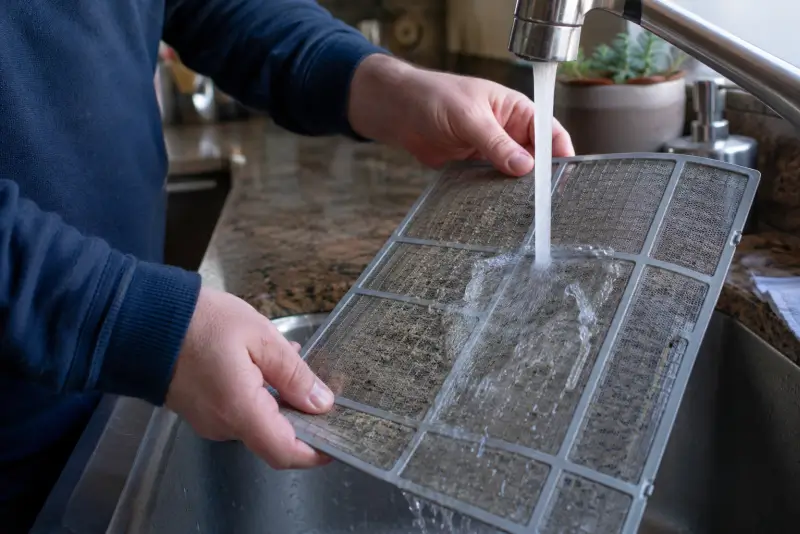
Clean the washable mesh filter every two weeks during Houston cooling season. Manufacturer guidance is two to four weeks, and Houston sits at the two-week end. Two things push it there: Gulf Coast moisture and the particulate mix. Houston-Galveston-Brazoria is a long-standing EPA ozone nonattainment area, and spring pollen loads the mesh fast. Our mini split filter cleaning guide covers every major brand.
Houston sits at the two-week end of standard guidance because of Gulf Coast humidity and spring pollen.
Two numbers from our own service and customer-support data explain why the two-week habit pays. A dirty filter cuts a mini split’s efficiency by 5 to 30%. Restoring a dust-coated coil afterward runs roughly $350 to $600, against a mesh you rinse for free. On a ductless head the mesh sits right in front of the coil, so airflow loss shows up fast.
Testing particle capture in our own factories taught us the related lesson: fine dust under 10 microns is harder on a system than visible dirt, because it settles deeper and is tougher to clean off later. Do not wait until the mesh looks filthy.
The routine takes about ten minutes:
Power off at the remote and the breaker, then open the panel and slide the mesh filters out.
Vacuum loose dust, then wash in lukewarm water, never above 104°F, with mild soap. No scrub brushes.
Air-dry completely. A damp filter in a warm, humid unit is the leading cause of the smell that returns a week later.
Reinstall, then run fan or dry mode for 20 to 30 minutes.
“The number-one callback we could prevent is the damp-filter mold call. A mesh that goes back in even slightly wet is how mold gets started inside the head. Give it the full drying time. A few extra minutes beats a service visit.”
David Clark, Licensed HVAC Technician, Filterbuy
The mesh screen is washable and reusable, not disposable. Carbon and ion inserts are replaced instead, and mesh that is torn, warped, or permanently gray should be replaced.
One more thing worth stating plainly, and the EPA says it directly: wall-mounted ductless units filter mainly to keep the unit itself clean, not to remove fine particles from the room. Many Houston homes add ductless zones to a garage or addition without removing central air, and there the ducted pleated filter still carries whole-home air quality. The EPA recommends MERV 13, or as high as the system accepts. After a decade of manufacturing them, Filterbuy will say it plainly: the highest rating cannot outperform an overdue filter.
Shop Filterbuy MERV 13 filters, size a custom filter, or set up auto-delivery so it arrives on schedule.
Houston Dew Point And Filter-cleaning Cadence
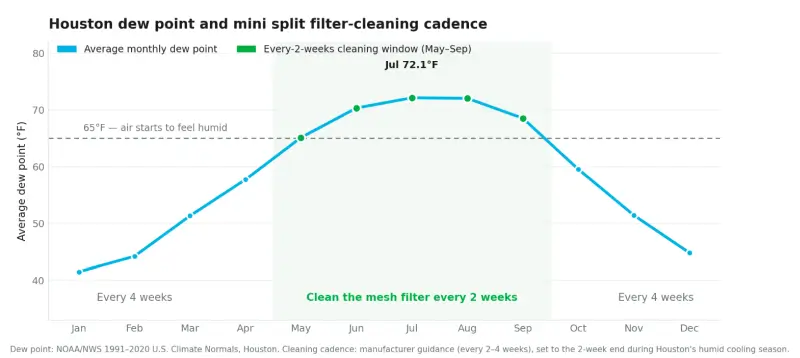
Houston average monthly dew point (NOAA/NWS 1991-2020 U.S. Climate Normals) plotted against the recommended mini split filter-cleaning interval. Original Filterbuy graphic.
Supporting Statistics
Three findings from federal and nonprofit research behind the guidance above.
1. More than 30% of heating and cooling energy can be lost to ductwork.
The loss occurs when ducts sit in unconditioned space.
Houston ducts and air handlers typically run through vented attics.
A ductless head sits inside the conditioned space, so those losses do not happen.
Source: U.S. DOE Building America Solution Center, Ductless (Mini-Split) Heat Pumps
2. Harris County averaged 43.3 unhealthy ozone days per year.
Houston-Pasadena ranks 6th worst in the nation for ozone, up from 7th.
That is up from 34.8 days the prior year. An F grade for 2022 to 2024.
The metro also ranked 8th worst for year-round particle pollution.
This is the air that loads a mesh filter, which is why Houston cleans every two weeks, not four.
Source: American Lung Association, State of the Air 2026, Texas findings
3. MERV 13 filters capture at least 50% of the smallest particles tested.
MERV 13 is the EPA recommended minimum for a home furnace or HVAC filter.
The EPA also notes ductless units filter mainly to keep the unit clean.
In a Houston home running both systems, the ducted filter does the whole-home work.
Source: U.S. EPA, Guide to Air Cleaners in the Home
Frequently Asked Questions
About The Author
“I don’t want anyone to feel like they need an HVAC license just to pick the right filter. My job is to give you the straight answer, explain why it matters, and let you get back to your day.”
Michelle Wan, Brand Manager and Air Quality Writer, Filterbuy
Written by Michelle Wan, Brand Manager and air quality writer at Filterbuy. She works directly with Filterbuy’s U.S. manufacturing team across factories in Alabama, Florida, Pennsylvania, and Utah, so her guidance is grounded in how filters are built, tested, and used in real homes. Reviewed by David Clark, Licensed HVAC Technician, whose team services ductless systems in Texas and Florida. Filterbuy has made air filters in the U.S. since 2013, more than 50 million of them, serving over two million households.
Glossary
Ductless mini split. A heating and cooling system with an indoor head connected to an outdoor compressor by a refrigerant line set, with no ductwork.
Inverter compressor. A variable-speed compressor that modulates output instead of cycling, improving humidity control.
Manual J. The ACCA-standard heating and cooling load calculation used to size equipment.
Dew point. The temperature at which air saturates. A better measure of mugginess than relative humidity; Houston July average is 72.1°F.
SHR (sensible heat ratio). A measure of how much moisture a cooling system removes. Lower is better; traditional systems run near 0.75, and many high-efficiency ductless units run higher.
MERV. Minimum Efficiency Reporting Value, the 1 to 16 scale for pleated filter particle capture. Applies to ducted systems, not mesh screens.
ACR license (TACLA / TACLB). The TDLR credential required of every Texas HVAC contractor. Class A covers any capacity, Class B up to 25 tons.
Nonattainment area. An EPA designation for a region failing an air quality standard, which Houston-Galveston-Brazoria has carried for ozone.