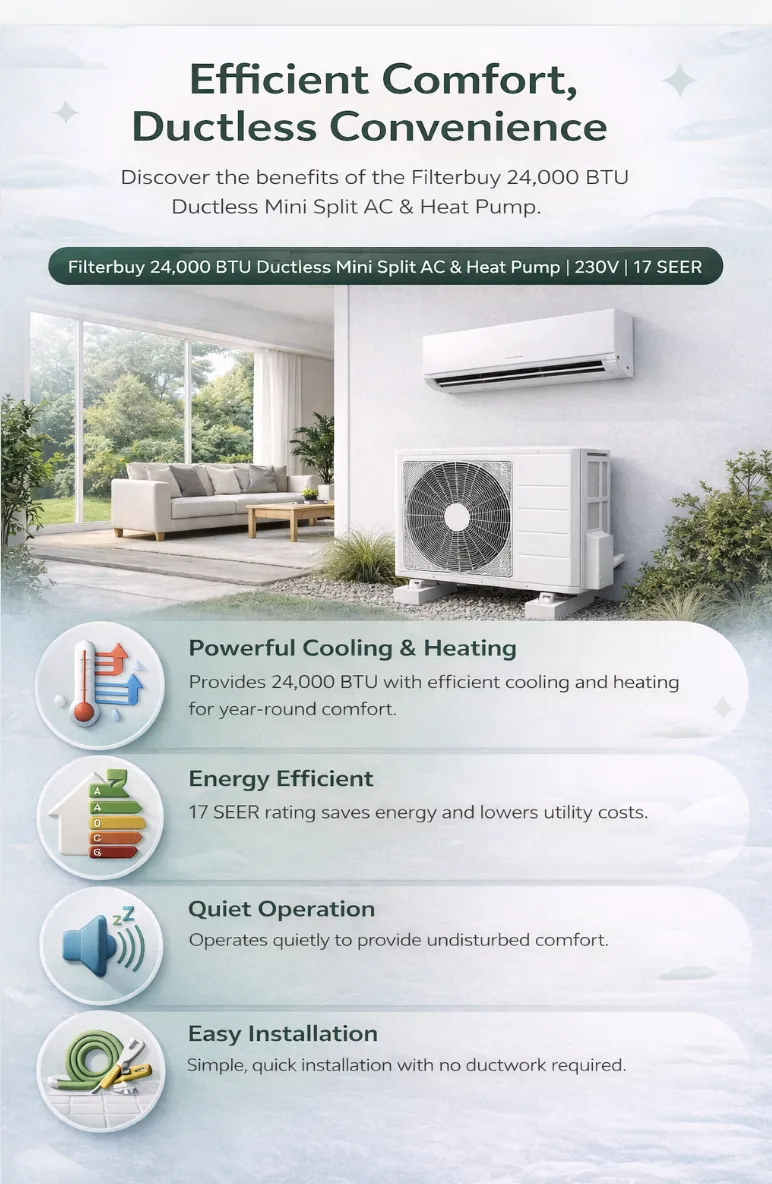
Filterbuy 24,000 BTU Ductless Mini Split AC & Heat Pump | 230V | 17 SEER2
24,000 BTU 230V Mini Split: Sized for Rooms Up to 550 Sq Ft
A 24,000 BTU mini split is a 2-ton system that cools and heats a single room up to 550 square feet. It is built for large living rooms, open floor plans, finished basements, oversized garages, and workshops, and it runs on a dedicated 208/230V circuit installed by a licensed HVAC contractor.
A variable-speed inverter adjusts output to match the room instead of cycling on and off, so temperatures stay steady. Not sure whether 24,000 BTU is the right size for your space? Answer a few quick questions below and we'll match you to the right system.

Answer a few quick questions and we'll match you to the right size mini split.
Not every room gives you a clean install. The open living area that has been running on window units for three summers. The detached garage where space heaters are doing work they were never designed for. The finished basement that stays swampy from June through September because nothing with enough capacity can run on the outlets down there. When 12,000 BTU is not enough and central air is not an option, 24,000 BTU at 230V is where serious climate control begins.
The Filterbuy 24,000 BTU 230V ductless mini split is the largest single-zone system in the lineup. Two tons of cooling and heating capacity, a variable speed DC inverter compressor, built-in WiFi, app control, and free 2-day shipping with everything your contractor needs already in the box. At 208/230V, it runs on the same electrical standard HVAC contractors work with every day, drawing low amperage for an installation that is clean, familiar, and straightforward.
Here is everything you need to know about the 230V version: how it works, where it fits, how to size and install it correctly, and why it performs differently from what you will find at other brands.
TL;DR Quick Answers
24,000 BTU Mini Split 230V
A 24,000 BTU 230V ductless mini split is a 2-ton single-zone heat pump system that cools and heats rooms up to 1,100 square feet. It runs on a dedicated 208/230V circuit — the same voltage as central air conditioners, clothes dryers, and EV chargers — and requires professional installation by a licensed HVAC contractor.
What it does: Cools and heats from a single wall-mounted unit, year-round. Who it's for: Large living rooms, open floor plans, garages, workshops, finished basements, and studio apartments. What sets 230V apart: Lower amp draw, better efficiency over distance, and the electrical standard every HVAC contractor already works with at this capacity. Key specs: 2-ton capacity, 17 SEER2, variable speed DC inverter compressor, built-in WiFi and app control, free 2-day shipping. Maintenance: Clean the built-in washable filter every 2 to 4 weeks. At 2-ton output, the filter loads faster than at any smaller residential capacity.
Top Takeaways
• 24,000 BTU covers rooms up to 1,100 square feet. That includes large living rooms, open floor plans, finished basements, oversized garages, workshops, and studio apartments. Filterbuy rates conservatively for real-world comfort, not inflated marketing numbers.
• 230V is the universal industry standard at this capacity. Every HVAC manufacturer specifies it. Every contractor expects it. Low amp draw at this voltage keeps the installation clean and the panel load manageable.
• The variable speed DC inverter compressor does not cycle on and off. It adjusts output in real time to match room demand, which means steadier temperatures, fewer energy spikes, and a longer service life than fixed-speed compressors of the same size.
• Professional installation is required. Self-installation voids the warranty. Everything your contractor needs is already in the box, and free 2-day shipping means no waiting on parts.
• Filter maintenance matters more at 2 tons. Clean the built-in washable filter every 2 to 4 weeks. At this output level, the filter loads faster than at any smaller size in the lineup. Maintenance consistency is what separates long-term performance from early degradation.
• Free 2-day shipping, anywhere in the US. Most competitors ship in 3 to 10 business days. Your contractor can schedule knowing the equipment will be there.
The HVAC Standard at 2 Tons — Why 230V
At 24,000 BTU, 230V is not a design preference. It is the electrical standard every HVAC manufacturer specifies at this capacity and every contractor expects when they arrive for the install. Three reasons account for the standard's staying power.
First, amp draw. At 230V, a 2-ton mini split draws roughly 8 to 12 amps. The same cooling output at 115V would require 18 to 22+ amps. That difference means a smaller circuit breaker, thinner wire gauge, and less load on your electrical panel. Second, efficiency over distance. Higher voltage means lower resistive line loss across the wire run between your panel and the outdoor unit. For garages, workshops, and detached structures where that run adds up, 230V delivers more of the power you are paying for. Third, contractor familiarity. Your HVAC contractor installs 230V equipment on every job. Same circuit as central air, dryers, and EV chargers. No special setup, no surprises on install day.
Who This System Is Built For
Rooms that outgrow 12K and 18K systems tend to share a few characteristics: square footage above 400, higher ceilings, significant heat load, or all three. Main living areas that sprawl into open floor plans. Finished basements running full-time as second floors. Garages and workshops where 230V already exists for tools and equipment. Oversized master suites, studio apartments, ADUs, and small commercial spaces where independent zone control matters.
At 2-ton capacity, this system covers all of them up to 1,100 square feet, conservatively rated to reflect real-world performance rather than inflated marketing figures. Some competitors claim 700 to 1,500 square feet for a 24K unit. Filterbuy's number reflects what the system actually delivers when the room is occupied and conditions are demanding.
How Variable Speed Changes the Performance Picture
Fixed-speed compressors cycle fully on and fully off. They blast cold air until the thermostat trips, shut down, and repeat. That cycling creates the temperature swings most people accept as normal. It is not. The DC inverter compressor in this system adjusts output in real time. When the room needs full capacity, it runs at full capacity. When it only needs to hold temperature, it scales to precisely the level required. The result is more consistent comfort, fewer energy spikes, and a longer compressor life. At 2 tons of continuous air processing, that also means a steadier draw through the built-in washable filter and more consistent air quality maintenance than a cycling system of the same size would produce.
What's in the Box
Every unit ships free in 2 days with everything your contractor needs already included: indoor wall-mount air handler, outdoor condenser/compressor unit,pre-flared copper line set (pre-charged for up to 25 ft), power supply and communication cable, wireless remote control, mounting bracket and hardware, installation instructions and wiring diagram, and drain hose and fittings.
Electrical requirement: dedicated 208/230V, 1 phase, 60 Hz circuit with disconnect box near the outdoor unit. A dedicated breaker sized to the unit's amperage is required. Same setup as central air conditioners and large appliances. Standard work for any licensed electrician.
"After supporting thousands of 24,000 BTU installations, the pattern is clear: homeowners who clean the filter every two to three weeks keep systems that outperform for a decade, and homeowners who let maintenance slip start noticing efficiency loss inside 18 months. At 2-ton output, the filter loads faster than at any smaller residential capacity, and that single variable separates long-term performance from early disappointment more than any spec on the box."
7 Essential Resources
These sources provide the technical background, regulatory context, and sizing standards needed to evaluate, specify, and install a 24,000 BTU mini split with confidence.
• U.S. Department of Energy — Ductless Mini-Split Heat Pumps An overview of how ductless systems work, where they outperform ducted alternatives, and what to look for in efficiency ratings. The DOE's primary consumer-facing resource on ductless system types, installation considerations, and SEER ranges. https://www.energy.gov/energysaver/ductless-minisplit-heat-pumps
• U.S. Department of Energy — Heat Pump Systems Technical guidance on heat pump operation, climate zone suitability, efficiency ratings, and installation requirements. Covers both air-source and ductless configurations, including the performance advantages of inverter-driven variable speed technology. https://www.energy.gov/energysaver/heat-pump-systems
• ENERGY STAR — Ductless Heating and Cooling Products ENERGY STAR certification criteria, efficiency benchmarks, rebate eligibility information, and a product finder for ductless mini splits. Confirms that ENERGY STAR-certified mini splits use up to 60% less energy than standard home electric heating systems. https://www.energystar.gov/products/ductless_heating_cooling
• U.S. Environmental Protection Agency — Refrigerant Management Current regulatory guidance on refrigerant phase-outs, the regulatory status of R-410A, and the industry transition toward lower-GWP alternatives, including R-32 and R-454B. Relevant to purchasing decisions as the market shifts refrigerant standards. https://www.epa.gov/section608
• Air Conditioning Contractors of America (ACCA) — Manual J Load Calculation The industry standard for residential cooling and heating load calculations. The tool your HVAC contractor should use to confirm that a 24K BTU system is correctly sized for the specific room, not just a square-footage estimate. Essential for avoiding undersizing or oversizing at this capacity. https://www.acca.org/standards/technical-standards/manualj
• U.S. Energy Information Administration — Residential Energy Consumption Survey The EIA's primary data source on how American households use energy, including what percentage goes to heating and cooling. Useful for understanding where HVAC efficiency decisions have the most impact on household energy costs. https://www.eia.gov/energyexplained/use-of-energy/homes.php
• Filterbuy — Indoor Air Quality Resource Library Filterbuy's guides on air filter selection, MERV ratings, maintenance schedules, and how HVAC filtration affects indoor air quality at different system capacities. Directly applicable to the 24,000 BTU system's higher filtration demands, where consistent maintenance makes the largest difference in long-term performance. https://filterbuy.com/resources/
3 Statistics
According to the U.S. Department of Energy, today's heat pumps can reduce electricity use for heating by up to 75% compared to electric resistance heating such as furnaces and baseboard heaters.
The 24,000 BTU Filterbuy mini split operates as a full heat pump, delivering that efficiency advantage year-round from a single system.
Source: U.S. Department of Energy — energy.gov/energysaver/heat-pump-systems
ENERGY STAR-certified ductless mini-splits use up to 60% less energy than standard home electric heating systems.
They eliminate the duct energy losses that account for more than 30% of energy consumption in conventional central HVAC systems, and their variable-speed compressors further reduce waste by running only at the level the room requires.
Source: ENERGY STAR — energystar.gov/products/ductless_heating_cooling
Space heating and air conditioning combined account for 52% of a typical U.S. household's annual energy consumption, according to the U.S. Energy Information Administration's 2020 Residential Energy Consumption Survey.
No other category comes close. At 2-ton capacity, this system is making one of the highest-impact energy decisions in the home.
Source: U.S. Energy Information Administration — eia.gov/energyexplained/use-of-energy/homes.php
Final Thoughts and Opinion
The 24K BTU 230V segment is the most competitive tier in the ductless mini split market. LG, Daikin, Mitsubishi, MRCOOL, Pioneer — they all compete at this size and voltage. Most of them ship a solid product with a familiar spec sheet and a comparable efficiency rating. On the surface, the choices look nearly interchangeable.
Beyond the 115V differentiator, what matters most at this capacity is maintenance. A 2-ton system processes more air than anything smaller in a home. The filter loads faster. The coil accumulates more. The efficiency degradation curve is steeper when maintenance is inconsistent. The brands that build maintenance support into what they sell, and back it with actual air quality knowledge, are the ones whose systems still perform at year eight and year ten. That is what Filterbuy's air quality side actually delivers at the mini split level.
If you are sizing a 24K BTU system for a large room with 230V already in place, this is the right system. And if the space is borderline between 18K and 24K, a correctly sized system at 24K running at partial load beats an undersized 18K running full-out all summer.
Next Steps
• Confirm your electrical. Before anything else, verify whether you have a dedicated 208/230V circuit available near the intended installation location. If you are working with a garage, workshop, or basement, check your panel and existing outlets. An electrician can confirm in minutes.
• Get a Manual J sizing calculation. Have a licensed HVAC contractor run a Manual J load calculation for the room. Manufacturer BTU calculators are a starting point, not a final answer. Ceiling height, insulation, window count, and sun exposure all affect the actual load. A correct sizing prevents both underperformance and unnecessary operating cost.
• Request contractor quotes. Get at least two quotes from licensed HVAC contractors in your area. Filterbuy ships everything the contractor needs: indoor unit, outdoor condenser, line set, communication cable, remote, and hardware. A well-prepared contractor will not need supply house runs before the job starts.
• Order with free 2-day shipping. Once you have confirmed sizing and scheduled with your contractor, order directly from Filterbuy. Most competitors ship in 3 to 10 business days. Filterbuy ships in 2, so your contractor can schedule knowing equipment will be on-site.
• Set up your maintenance schedule from day one. Plan to clean the built-in washable filter every 2 to 4 weeks. At 2-ton output, this system moves twice the air of a 12K unit and collects contaminants faster. Consistent maintenance is the single highest-impact action for long-term performance and air quality.
Frequently Asked Questions
2-Ton Professional Performance, Shipped in 2 Days
The Filterbuy 24,000 BTU 230V mini split is the most powerful single-zone system we make. Variable speed inverter, smart app control, and free 2-day shipping.
Shop by BTU:
12,000 BTU for rooms up to 550 sq ft
18,000 BTU for rooms up to 850 sq ft
24,000 BTU (this model) for rooms up to 1,100 sq ft
Shop All Mini Split Systems