The First 24,000 BTU Mini Split That Runs on 115V — And Why It Changes Everything for Older Homes
The 24,000 BTU Mini Split That Runs on 115V
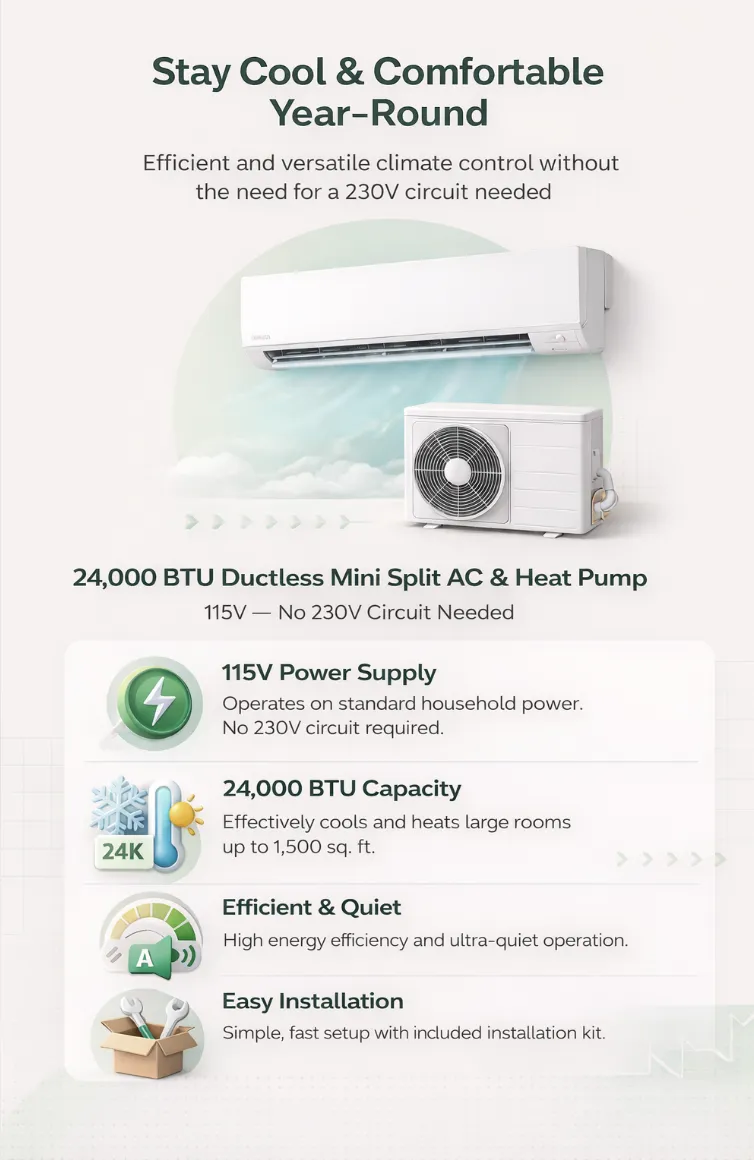
Yes — Filterbuy’s 24,000 BTU ductless mini split is the only 2-ton system that heats and cools on standard 115V household power, with no 230V circuit required. A variable speed DC inverter manages power draw, so you get full 2-ton capacity from the outlets you already have — and skip the $500 to $2,000 a 230V circuit usually adds. It still needs a dedicated 115V circuit and a licensed installer.
- Every other 24,000 BTU mini split needs a 230V dedicated circuit.
- This one runs on standard 115V — no 230V upgrade in most homes.
- Covers 450–550 sq ft: large rooms, basements, garages, and additions.

Find your match — and be first to know when the 115V model ships.
The 115V model isn’t available to order just yet. Answer a few quick questions and we’ll match you to the right 24,000 BTU system — and let you know the moment the 115V model is available.
Ready to buy now? Browse the 24,000 BTU systems available today.
See available 24,000 BTU systemsAsk any licensed HVAC contractor what voltage a 24,000 BTU mini split requires, and the answer never changes: 230V. It's been the industry rule since ductless systems entered the American market. No exceptions, no workarounds, no alternatives — until now.
That single fact reshapes the math on one of the largest hidden costs in residential HVAC: the electrical preparation that comes before the system even ships.
The median age of owner-occupied homes in the United States has climbed to 42 years old in 2024, up from 31 years in 2005, with roughly 47% of owner-occupied homes built before 1980. Millions of those homes were never wired for 230V in living spaces. Basements, living rooms, garages, and finished additions in older construction typically have whatever 115V outlets were roughed in decades ago — and little else. For those homeowners, every 24,000 BTU system on the market has carried an invisible price tag: $500 to $2,000 or more in electrical work before the first BTU of cooling gets delivered.
This page exists because that barrier is gone. What follows is everything you need to know about how a 24,000 BTU system works on 115V, who it's built for, what it costs, and why no other manufacturer has done it.
TL;DR Quick Answers
The Filterbuy 24,000 BTU ductless mini split is the only 2-ton mini split air conditioner and heat pump that runs on standard 115V household power. No 230V circuit required.
Key facts:
• BTU: 24,000 (2 ton)
• Function: Heating and cooling (heat pump)
• Voltage: 115V — standard US household power
• Coverage: up to 1,100 sq ft
• Circuit required: Dedicated 115V circuit (approx. 30 amps) — no 230V upgrade needed
• Compressor: Variable speed DC inverter
• SEER2: 17
• Warranty: 7-year compressor / 3-year parts (professional installation required)
• Shipping: Free 2-day delivery
• Installation: Licensed HVAC contractor required
• Electrical savings: Eliminates $500–$2,000+ in 230V circuit installation costs
Top Takeaways
• Variable speed DC inverter compressor technology makes 115V operation at 2-ton capacity possible by managing power draw continuously rather than pulling full load at startup.
• Up to 1,100 square feet— large living rooms, open floor plans, full basements, oversized garages, and converted spaces that have outgrown smaller systems.
• A dedicated 115V circuit is still required. It uses standard Romex wiring and costs significantly less than a 230V installation, but it does require a licensed electrician.
• Nearly half of all U.S. owner-occupied homes were built before 1980. Most were not wired for 230V in living spaces. This system is built for that reality.
• Backed by over a decade of air quality manufacturing experience and service to more than two million households.
What This Means for Your Installation
This unit still requires a dedicated 115V circuit. It cannot share a circuit with other appliances. But a dedicated 115V circuit uses standard Romex wiring, a single-pole breaker, and no disconnect box. Your electrician can handle it in a single visit, at a fraction of the cost of a 230V installation.
At the same time, honesty matters here. At 24,000 BTU on 115V, this system draws more amperage than a 230V unit producing the same output — same watts, lower voltage means higher current, per Ohm's Law. The wire gauge runs heavier than a 230V installation. Total project cost — unit plus all electrical work — is still potentially $500 to $2,000 less than any 230V competitor. But the full picture is worth having before you buy.
What Spaces This Is Built For
At 2 tons, up to 1,100 square feet. That includes large living rooms, open floor plans, full basements, oversized garages, loft spaces, and converted rooms that have outgrown smaller systems. According to the U.S. Department of Energy, ductless mini splits are an excellent option for retrofitting homes with non-ducted heating systems and for room additions where extending or installing ductwork is not feasible.
For spaces where 115V is all that's available and where 12K or 18K BTU isn't enough — this is the only system that answers both problems at once.
"After manufacturing air filters for over a decade and working directly with more than two million households, the one thing we kept hearing from homeowners in older homes was simple: they needed more capacity than their electrical panel could support — and the 24,000 BTU barrier at 115V was the wall nobody in the industry had any intention of taking down."
Essential Resources
Ductless Mini Split Heat Pumps — U.S. Department of Energy
The U.S. Department of Energy's official resource on ductless mini split heat pump technology covers how these systems work, where they perform best, efficiency ratings, and what to look for when selecting a unit and contractor. It's the most authoritative starting point for any homeowner evaluating a mini split for the first time — or comparing systems before a purchase decision.
Source: https://www.energy.gov/energysaver/ductless-minisplit-heat-pumps
Ductless Heating & Cooling — ENERGY STAR
The EPA's ENERGY STAR program certifies mini split systems that meet independent efficiency standards. This resource explains how certified mini splits compare to standard heating and cooling equipment, including the finding that ENERGY STAR certified mini splits use up to 60% less energy than standard home electric radiators, how to find rebates available through your local utility, and how to use the ENERGY STAR product finder to identify certified equipment. It's the right source for homeowners prioritizing long-term operating cost alongside upfront price.
Source: https://www.energystar.gov/products/ductless_heating_cooling
Home Electrical Panels — Rewiring America Electrification Planner
Before any mini split installation — 115V or 230V — you need to know your panel's capacity. Rewiring America's plain-language guide walks homeowners through locating their electrical panel, reading its amperage rating, and determining whether it can support a new dedicated circuit without a panel upgrade. Older homes might have 60 or 100 amp panels, while newer homes commonly have panels rated at 200 amps or larger. This resource helps you find that number before the contractor arrives.
How Old Is Today's Housing Stock? — National Association of Home Builders
Understanding the age of America's housing stock provides essential context for why the electrical limitation around 24K BTU mini splits affects so many homeowners. The median age of owner-occupied homes has climbed to 42 years old in 2024, with nearly half of all owner-occupied homes built before 1980. NAHB's analysis of American Community Survey data documents the scale of aging residential infrastructure — and why electrical limitations are increasingly common in the homes where people actually live.
Source: https://www.nahb.org/blog/2026/03/how-old-is-todays-housing-stock
ENERGY STAR Certified Mini Split Heat Pumps — EPA Fact Sheet
The EPA's official mini split fact sheet provides a concise overview of what ENERGY STAR certification means for ductless heat pump systems — including efficiency benchmarks, greenhouse gas reduction data, and guidance on identifying qualified products. It's a useful one-page reference for homeowners who want to verify efficiency claims before committing to a specific system or contractor quote.
Mini Split Heat Pump Installation Guide — What Homeowners Need to Know Before the Contractor Arrives
A smooth installation comes down to preparation. Before any HVAC contractor visit, homeowners should understand their panel capacity, have clear access to the installation wall, and know where the line set will route to the outdoor condenser. The U.S. Department of Energy's energy saver resources and ENERGY STAR's contractor guidance together provide the foundation for asking the right questions — and avoiding the change orders that drive up project cost.
Source: https://www.energystar.gov/products/ductless_heating_cooling
The National Electrical Code — NFPA 70 (National Fire Protection Association)
Every dedicated circuit installation — whether 115V or 230V — must comply with the National Electrical Code. The NEC governs how circuits are sized, wired, protected, and permitted in residential settings. Homeowners don't need to read the full code, but knowing it exists and that your licensed electrician is bound by it provides the assurance that your dedicated 115V circuit installation will be done to the same safety standard as any other residential electrical work.
Source: https://www.nfpa.org/codes-and-standards/nfpa-70-standard-development/70
Supporting Statistics
Nearly Half of All U.S. Owner-Occupied Homes Were Built Before Modern Electrical Standards
Around 47% of U.S. owner-occupied homes were built before 1980, and the median age of owner-occupied homes reached 42 years in 2024, up from 31 years in 2005, according to the latest American Community Survey data compiled by the National Association of Home Builders. Homes built before 1980 were designed with far fewer electrical demands than those of today. Most were not wired for 230V in living spaces — making a 115V-compatible 24,000 BTU mini split directly relevant to nearly half the owner-occupied housing stock in the United States.
Source: https://www.nahb.org/blog/2026/03/how-old-is-todays-housing-stock
Duct Losses Account for More Than 30% of a Home's Energy Use for Space Conditioning
According to the U.S. Department of Energy, duct losses can account for more than 30% of energy consumption for space conditioning, especially when ducts run through unconditioned spaces like attics. Ductless mini splits achieve efficiency ratings between 15.2 and 35 SEER2, compared to 15.2 to 25 SEER2 for ducted heat pumps. For homeowners in older homes without ductwork — or with ducts that are leaking, undersized, or inaccessible — a ductless system at any BTU capacity captures efficiency that a forced-air installation loses before it reaches the room.
Source: https://www.energy.gov/energysaver/ductless-minisplit-heat-pumps
ENERGY STAR Certified Mini Splits Use Up to 60% Less Energy Than Standard Electric Resistance Heating
ENERGY STAR certified mini split heat pumps use up to 60% less energy than standard home electric radiators, because they transfer heat rather than generate it. In a whole-house application, certified systems avoid more than 4,500 pounds of greenhouse gas emissions on average over the course of their lifespan compared to standard systems. For homeowners replacing baseboard heaters, electric space heaters, or window units in spaces that a new 24,000 BTU system will cover, the operating cost reduction is substantial — and compounds annually for the life of the equipment.
Source: https://www.energystar.gov/products/ductless_heating_cooling
Next Steps
Confirm Your Panel Can Support a Dedicated 115V Circuit
Before ordering, check your electrical panel's amperage rating. Use Rewiring America's panel guide at homes.rewiringamerica.org to locate your breaker box and read the rating. If your panel is 100 amps or above, you almost certainly have capacity for a dedicated 115V circuit. If it's below 100 amps, talk to a licensed electrician before proceeding.
Schedule a Pre-Installation Site Visit With a Licensed HVAC Contractor
A site visit before the unit ships answers the questions that matter: where the indoor head will mount, how the line set routes to the outdoor condenser, what the electrician will need to set up the dedicated circuit, and whether anything about your specific space changes the installation scope. Most HVAC contractors offer this at low or no cost.
Get an Electrical Quote Alongside Your HVAC Quote
Request both quotes at the same time. Know the full project cost — unit, HVAC installation, and dedicated 115V circuit — before you commit. For most homes, the dedicated 115V circuit adds a few hundred dollars to the project.
Order With Free 2-Day Shipping
Everything your contractor needs for a complete install ships in the box. Ordering before your installation date means your HVAC contractor isn't waiting on parts — and the job runs on schedule.
Register Your Warranty Immediately After Installation
A seven-year compressor and three-year parts warranty apply with professional installation by a licensed HVAC contractor. Register your unit and retain documentation of the professional install. Self-installation voids coverage.
Frequently Asked Questions
Already Have 230V? The 230V model offers the same 2-ton capacity. View the 230V Model.
Shop by BTU:
• 12,000 BTU — up to 550 sq ft (available 115V & 230V)
• 18,000 BTU — up to 850 sq ft (230V)
• 24,000 BTU — up to 1,100 sq ft (230V)
• Shop All Mini Split Systems