By Michelle Wan · Technically reviewed by David Clark, Licensed HVAC Technician · Published August 27, 2026 · Updated August 27, 2026
MRCOOL is the better pick if you are installing it yourself. Its DIY series ships pre-charged QuickConnect line sets you connect by hand, with no vacuum pump and no EPA certification, and self-installing keeps the warranty. Senville costs less per BTU, but a licensed technician has to release the charge, and doing it yourself voids coverage.
The equipment gap is roughly $1,150 to $1,560 on a 12,000 BTU system. Senville only costs less all in if an installer will finish the job for under that. Filterbuy sells a competing mini split, so read this knowing that.
Not sure which setup fits your room? Answer a few quick questions and we will point you in the right direction.
Want the third option on this shelf? Filterbuy publishes its price, ships in two days, and requires professional installation.
MRCOOL and Senville are the two budget ductless brands most DIY buyers shortlist, and one question separates them. MRCOOL DIY ships a pre-charged QuickConnect line set a homeowner can connect without a vacuum pump or an EPA refrigerant license, and self-installing keeps the warranty intact. Senville costs far less per BTU, but a licensed technician has to release the charge, so doing it yourself voids coverage. Filterbuy sells a competing mini split, so read this knowing that.
MRCOOL DIY is the only one of the two a homeowner may legally install start to finish, because pre-charged line sets remove the EPA Section 608 requirement.
The Senville LETO SENL-12CD is rated 21.2 SEER2 at $799.99 direct, against 23.5 SEER2 and $1,950 to $2,359 at Home Depot for the MRCOOL DIY 12,000 BTU system. That gap is what an installer has to beat for Senville to be the cheaper buy.
Neither brand cleans your air, and self-installing a Senville voids its warranty while MRCOOL's coverage survives.
Filterbuy sells a competing mini split and services ductless systems in the field. This comparison names where that costs us.
MRCOOL is the better buy for a do-it-yourself installation. Its DIY series ships pre-charged QuickConnect line sets a homeowner connects by hand, with no vacuum pump and no EPA certification. Senville sells more rated efficiency per dollar, but its warranty hands the refrigerant work to a licensed technician.
That verdict holds for the buyer who has nobody to call. Senville’s price sits far enough below MRCOOL’s that a buyer with contractor access can still come out ahead after paying for a startup visit.
Filterbuy is not neutral here. We manufacture pleated filters in the United States, we sell a competing ductless mini split system, and Filterbuy HVAC Solutions services ductless equipment in Florida and Texas, so our technicians perform the commissioning visits that decide which brand is cheaper to own. Our MRCOOL mini split review covers the DIY series on its own. Filterbuy is not affiliated with or endorsed by MRCOOL or Senville.
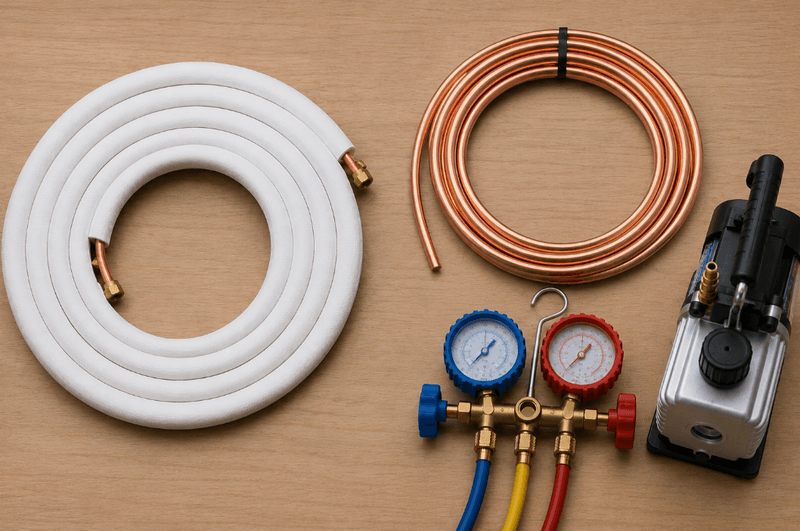
Only MRCOOL, and the reason is mechanical. MRCOOL DIY line sets arrive sealed and pre-charged with push-together fittings, so the homeowner never opens the refrigerant circuit. Senville condensers also ship pre-charged, but the installer still has to vacuum and pressure-test the line set before releasing that charge.
The EPA defines a technician as anyone who attaches gauges to an appliance or adds refrigerant to one, so EPA Section 608 certification is required to do it. “Pre-charged” describes where the refrigerant sits at delivery rather than who may let it into the lines.
Neither brand is DIY on the electrical side. Both need a dedicated circuit, which for most homes means an electrician and a permit. A DIY kit still leaves you the circuit, the wall penetration, and the condensate drain, while a professional install sets the refrigerant charge and keeps coverage intact.
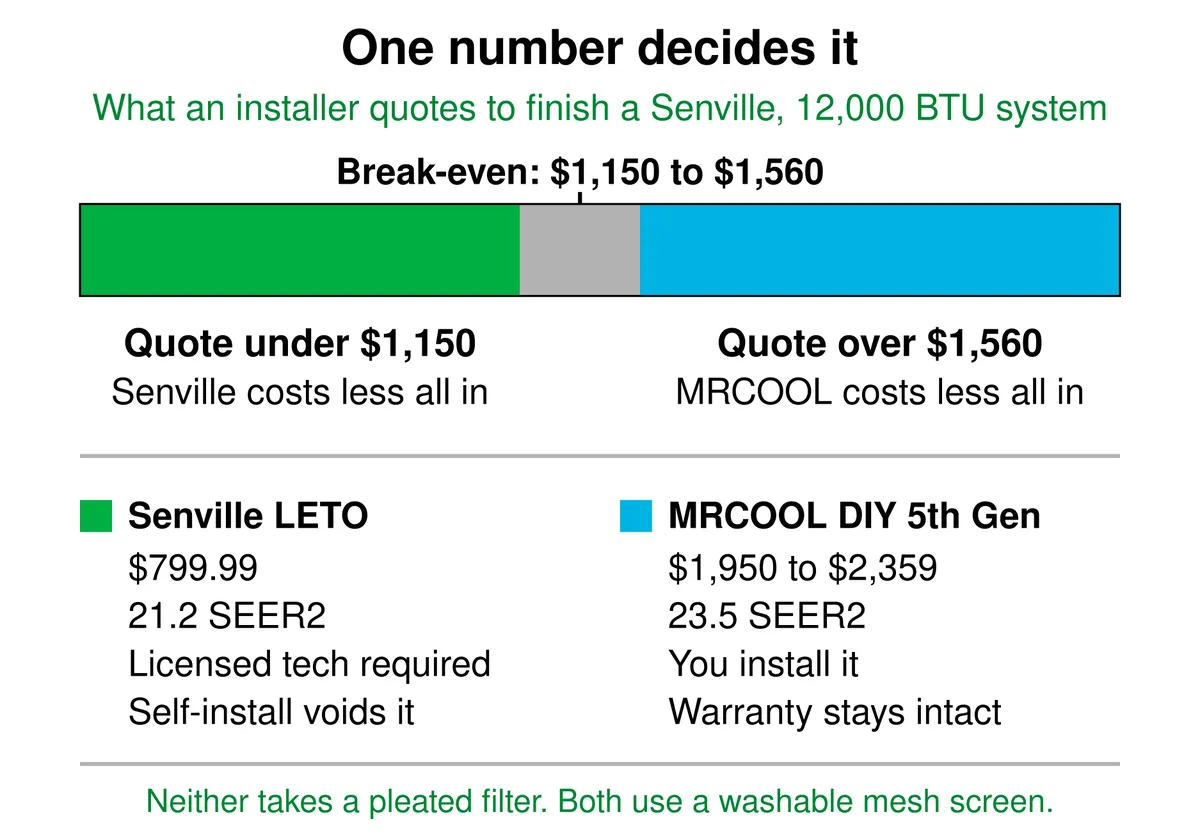
Senville is cheaper as equipment and can be more expensive as a project. The LETO SENL-12CD lists at $799.99 direct, while the MRCOOL DIY 5th Gen 12,000 BTU complete system listed between $1,950 and $2,359 at Home Depot in August 2026. That puts the equipment gap at roughly $1,150 to $1,560 for the same nominal capacity.
Labor is where the two swap places. Professional ductless installation runs about $1,000 to $3,500. A homeowner installing a MRCOOL pays none of it, and a Senville buyer pays some or all.
Budget separately for the circuit, the permit, a condenser pad, and line set beyond the 25 feet each brand includes. MRCOOL’s arrives sealed, so a different length later means a whole new set. Senville’s can be cut to fit.
Senville wins on total cost when a licensed installer will finish the job for less than the equipment gap, roughly $1,150 to $1,560 on a 12,000 BTU system. Above that quote MRCOOL costs less all in, and below it Senville does. That threshold is the entire decision, and no comparison we found publishes it.
We can describe the cheap end precisely because Filterbuy HVAC Solutions sells it. A commissioning call is a nitrogen pressure test, a vacuum below 500 microns, a charge release, and a run through every mode, priced as labor.
So the number to get before ordering is what a technician near you charges for that visit on owner-supplied equipment, in writing. Many decline owner-supplied equipment. Our DIY mini split installation guide covers the prep that decides whether self-install is realistic.
MRCOOL rates higher on the size most people buy. The MRCOOL DIY 5th Gen 12,000 BTU condenser is rated 23.5 SEER2 with ENERGY STAR certification, against 21.2 SEER2 for the Senville LETO. AURA rates higher still across a narrower offering. Confirm any rating in the AHRI Directory, since ratings certify matched pairs.
Cold weather separates the product lines more than the brands. Senville LETO heats to roughly 5°F, which rules it out as a primary heat source across much of the northern United States, while AURA reaches -22°F. MRCOOL’s 5th Gen runs to -13°F or -22°F by model, though the 36,000 BTU unit stops at 5°F. On sound the two are tied at 54 dBA outdoors.
Not with a Senville LETO, and not with a Filterbuy either, since both are single-zone only. A second room means a second complete system, outdoor unit included. Senville’s AURA line and MRCOOL’s DIY line both offer multi-zone, so the constraint decides the brand before price does for a two-room buyer.
Multi-zone is easier to get wrong than buyers expect. Pacific Northwest National Laboratory advises against connecting more than three heads to one outdoor unit, and warns that shutting heads off can produce negative savings when the load drops below the condenser’s minimum.
MRCOOL covers the homeowner who installs it, and Senville does not. MRCOOL’s standard 5th Gen terms run 7 years on the compressor and 5 on parts with no registration required, and self-installation does not void them. Senville LETO carries 5 and 5, while AURA carries 5 on parts and 10 on the compressor.
Several review sites report the 10-year compressor figure for LETO, and that number belongs to AURA. Our Senville mini split review documents the split. The clause that costs real money is the labor exclusion, since Senville ships parts free and never pays the technician who fits them. Filterbuy requires professional installation too and voids coverage if you self-install, so MRCOOL is the outlier here.
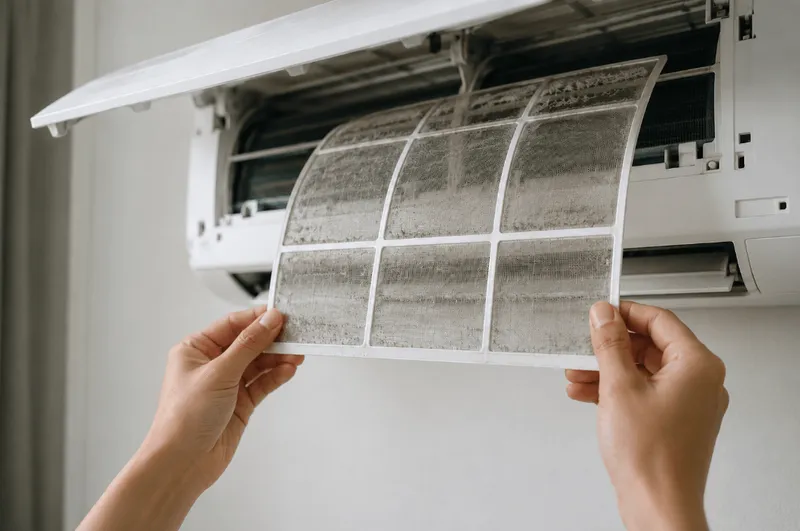
Neither one cleans the air in your home. MRCOOL DIY and Senville LETO heads both use a washable mesh pre-filter, and the U.S. Environmental Protection Agency states that ductless mini split heat pumps generally do not filter fine particles, because the filter inside the head is built to keep pet hair and lint off the equipment.
The EPA sets one test for any filtration claim, a documented MERV 13 rating or higher, and neither stock screen carries one. Both ask you to clean it every two to four weeks in homes with pets or allergies. Our comparison of a mini split versus an air purifier covers what fills the gap.
Filterbuy sees both ends of this. Our plants make the pleated filters that go into ducted returns, and our technicians open ductless heads that have run on a mesh screen for years, which is why this comparison covers filtration when no competing head-to-head does.
You run a filter factory. What made you decide to build a ductless system rather than just sell filters to people who already own one?
"We were already in these houses, making the filter in the return and servicing the equipment. Building a system of our own let us put the airflow side and the comfort side under one roof, and say plainly what each part actually does." — David Heacock, Filterbuy CEO
Our own unit is the third option on this shelf. The Filterbuy 12,000 BTU mini split is $799 with free 2-day delivery and a 7-year compressor warranty, at a published price with no quote form. It is 17 SEER2 with 3-year parts coverage, so both brands above beat it on efficiency. Professional installation is required and self-installing voids the warranty.
Add a mini split to a garage and the ducted system serving the house still does the real filtration. The EPA recommends MERV 13 or the highest rating your system’s fan and filter slot can accommodate, so confirm airflow before you put a MERV 13 air filter in the return.
1. Improper installation can raise a home’s heating and cooling energy use by roughly 30 percent.
NIST tested seven installation faults across five climate zones. Duct leakage ranked first and refrigerant undercharge next. A ductless system has no ducts, which leaves refrigerant charge as the largest remaining risk.
Source: NIST, Sensitivity Analysis of Installation Faults on Heat Pump Performance. That is the step Senville requires a technician for.
2. A U.S. Department of Energy national laboratory rates ductless mesh filters as very low particulate capture.
Mesh screens are cleaned every two weeks against three months for a ducted filter, and PNNL recommends a professional deep clean of wall-hung heads every one to three years, which it states is not a DIY job.
Source: Building America Solution Center, Ductless (Mini-Split) Heat Pumps. Neither sticker price includes it.
3. Any new residential split system installed after January 1, 2026 must use a refrigerant with a global warming potential below 700.
The AIM Act phases hydrofluorocarbons down 85 percent by 2036. R-410A sits above the threshold and R-454B below it. Installed systems are unaffected and may still be repaired.
Source: EPA, Frequent Questions on the Phasedown of Hydrofluorocarbons. MRCOOL 4th Gen and older Senville stock run R-410A and are not cross-compatible with R-454B parts.
Not without voiding the warranty. Senville requires a licensed technician to evacuate and pressure-test the line set and release the charge, and federal refrigerant rules apply on top.
No. The DIY series is built for homeowner installation, and MRCOOL’s terms keep the standard coverage intact when you follow the instructions and local electrical code.
No. Wall-mounted ductless heads from both brands use an OEM washable mesh pre-filter with no rack for a pleated filter. Pleated MERV filters fit ducted systems only.
Clean the mesh screen every two to four weeks in a home with pets or heavy dust, and budget a professional deep clean of the indoor head every one to three years. Neither brand covers either job.
No. The IRS states that the Section 25C credit is not allowed for any property placed in service after December 31, 2025. State and utility rebates may still apply. Confirm eligibility with a tax professional.
MRCOOL: HVAC manufacturer in Hickory, Kentucky, and maker of the DIY series of homeowner-installable ductless mini splits.
Senville: Direct-to-consumer ductless brand selling the LETO and AURA lines, produced by contract manufacturers in China.
Filterbuy: U.S. air filter manufacturer in Talladega, Alabama, publisher of this comparison, seller of a competing ductless mini split, and operator of Filterbuy HVAC Solutions.
EPA Section 608: The federal certification required to handle refrigerants. A Senville installation requires it and a MRCOOL DIY installation does not.