Mini Split AC in Tucson, AZ
Installation, Costs & Filter Guide (AZ Climate)
Author: Michelle Wan, Brand Manager and Air Quality Writer · Reviewer: David Clark, Licensed HVAC Technician, Filterbuy HVAC Solutions
Published: August 23, 2026 · Updated: August 23, 2026
A single-zone mini split in Tucson costs $3,000 to $7,000 installed when the contractor supplies the equipment, or $1,399 to $2,849 when you buy the system and hire the labor separately. Running it costs about $20 to $40 a month through a Tucson summer.
The federal tax credit expired December 31, 2025. Tucson Electric Power still pays up to $100 per ton, applied by a participating contractor.
Filterbuy builds three sizes:
- 12,000 BTU covers up to 550 sq ft. $799
- 18,000 BTU covers up to 850 sq ft. $899
- 24,000 BTU covers up to 1,200 sq ft. $1,349
See the mini split systems Filterbuy builds, or answer three quick questions below and we will match you to a size.

Answer 3 quick questions and we will match you to your mini split.
A ductless mini split installed in Tucson runs $3,000–$7,000 for a single zone and $6,500–$14,500 for multi-zone. Equipment is a smaller share of that than most homeowners expect. Our systems start at $799, and the rest is labor, electrical, and permits. Tucson Electric Power pays up to $100 per ton. The federal tax credit is gone.
TL;DR
A single-zone ductless AC installation in Tucson runs $3,000 to $7,000, then about $20–$40 a month to operate. Filterbuy calculated that operating figure from TEP's tariff because no local source publishes it. The federal 25C tax credit expired December 31, 2025, so TEP's rebate is the only incentive left. The filter inside the head is washable mesh, not an allergen filter, so monsoon dust still needs a MERV 13 elsewhere in the house.
Key Takeaways
Installed cost splits two ways. Expect $3,000–$7,000 through a contractor who supplies the equipment, or $1,399–$2,849 if you buy the system direct and hire labor separately.
The federal 25C tax credit is gone. It expired December 31, 2025 under the One Big Beautiful Bill Act, so 2026 installs do not qualify. TEP's rebate, up to $100 per ton plus $160 in tune-up rebates, is what remains.
Running cost is about $20–$40 a month for a single 12,000 BTU zone through a Tucson summer, billed at your top tier rather than your average rate.
Tucson's sizing trap is the monsoon. Zone 2B forgives an oversized system for nine months a year. From mid-June through September it does not.
Mini split filters are washable mesh, roughly MERV 4 equivalent. After a decade of building filters, this is the correction Filterbuy makes most often: that mesh protects the coil, not your lungs.
A ductless mini split, also sold as a ductless AC or a mini split heat pump, is a heat pump system pairing one outdoor compressor with one or more indoor heads mounted on a wall, floor, or ceiling. It delivers cooling and heating without ductwork.
Where this guide comes from, and what we have to gain. Filterbuy has built air filters in the United States since 2013, we make the replacement filters for every major mini split brand, and Filterbuy HVAC Solutions is our licensed contracting business. That is three views of one decision: the quote, the equipment on the wall, and the filter that comes out six months later caked in desert dust.
One disclosure shapes everything below. We sell the equipment. We do not sell the labor. So when this page tells you labor is the half of the quote that actually moves, that is the half we make nothing on.
How Much Does Mini Split Installation Cost in Tucson, AZ in 2026?
A single-zone mini split installed in Tucson costs $3,000–$7,000. Multi-zone runs $6,500–$14,500 depending on head count. Local contractors publish overlapping ranges: Cummings Plumbing $3,000–$7,000, ACS Air & Plumbing $3,000–$8,000.
Ranges cover equipment, line set, mounting, refrigerant charge, and labor. Electrical upgrades are quoted separately.
Three Tucson line items push quotes upward. Evaporative cooler conversions are the big one: many older homes across midtown, Sam Hughes, and the west side were built around swamp coolers, and switching to refrigerated air means new electrical and roof patching. Panel capacity in pre-1980 homes frequently forces a service upgrade. And R-454B and R-32 refrigerant raised 2026 prices across every brand.
A second number is worth knowing. That range assumes the contractor supplies the equipment. Buy direct and hire labor separately and our installation cost breakdown puts a fully installed Filterbuy single zone at $1,399–$2,849. That gap is not a discount. It is the same job, priced from the other side of the invoice.
"The quotes homeowners forward to us all split the same way: a fixed equipment number and a labor number that swings by thousands. Almost everyone spends their research time comparing brands. The brand is the part that barely moves."
Michelle Wan, Brand Manager and Air Quality Writer, Filterbuy
Most mini splits need a dedicated 208/230V circuit, which is exactly what triggers that panel upgrade. Some run on standard 115V power instead, including the 115V model we build, removing a trade from the job.
What Rebates Apply to a Tucson Mini Split in 2026?
There is no federal tax credit for a mini split installed in 2026. The Section 25C credit, worth up to $2,000 toward a qualifying heat pump, expired December 31, 2025 under the One Big Beautiful Bill Act (P.L. 119-21). The IRS credit page limits it to property placed in service before that date. Any page still promising 30% back is out of date.
What remains is your utility. Tucson Electric Power's Efficient Home Program pays up to $100 per ton on a mini split. It is an instant rebate taken off the price by a participating contractor, not a check you chase afterward.
Rebates are instant, applied by a participating contractor. Amounts change by program cycle -- confirm with TEP before signing.
The tune-up line is the one Tucson homeowners overlook. TEP will help pay to clean the coils on a system you already own. It is the cheapest efficiency work available in a city where the outdoor coil spends nine months collecting dust. Filterbuy does not administer this rebate and earns nothing from it. The table is here because the figures are scattered across TEP's site and nobody had put them in one place. Use a participating contractor from TEP's rebates page and confirm current amounts at 866-473-8761 before you sign.
What Does a Mini Split Cost to Run in Tucson?
A 12,000 BTU mini split at 17 SEER2 averages about 0.7 kW while running, or roughly 11 cents an hour on TEP's top summer rate. Across a Tucson July, budget $20–$40 a month for a single zone. Install price is what everyone asks about. This is the number that arrives every month, and nobody publishes it for Tucson, so Filterbuy ran the math against TEP's published tariff.
The math, so you can redo it for your own unit:
BTU divided by SEER2 gives average watts while running. 12,000 / 17 = 706 W. (SEER2 is a seasonal average, so this is a running average, not a peak draw.)
Multiply by hours run, divide by 1,000, and you have kWh.
Multiply by your marginal rate, not your average one.
That third step is where most estimates go wrong. TEP's Basic plan is tiered: summer power costs 13.04 cents up to 500 kWh, but 15.73 cents past 1,000 kWh. Median summer usage in Tucson is already 823 kWh. Your new mini split does not get billed at the cheap tier. It stacks on top, at the highest one.
And one trap specific to west-facing rooms. On TEP's time-of-use and peak demand plans, summer on-peak is 3–7 p.m. weekdays, exactly when a west-facing room needs the most cooling. Pre-cool before 3 p.m. and let it coast through the window.
How Do You Size a Mini Split for Tucson's Desert Climate?
Tucson sits in IECC Climate Zone 2B, hot and dry, with an ASHRAE summer design temperature of 108°F and a winter design temperature of 31°F. Those two numbers, not square footage, are what a Manual J load calculation solves against. Ask for it in writing; our BTU sizing guide covers the room-by-room math. Per NWS Tucson records, a normal year brings 68 days at or above 100°F. 2024 delivered 112.
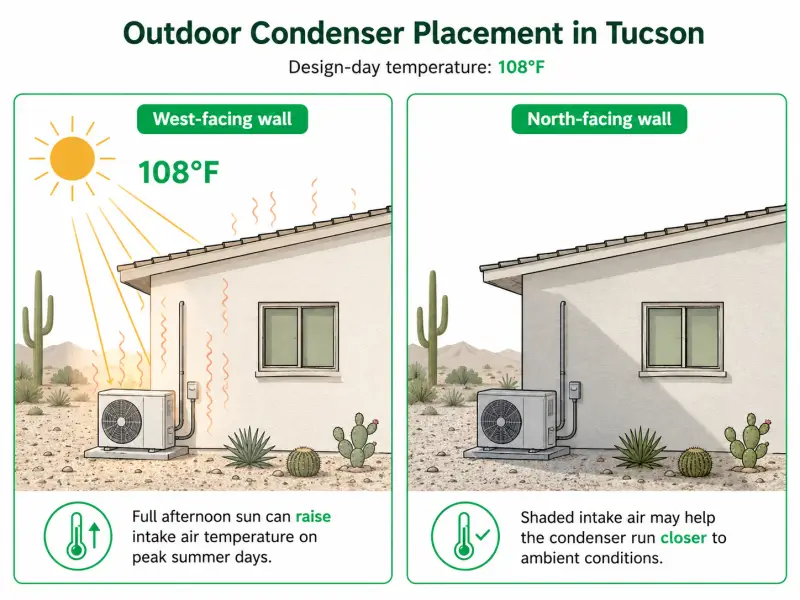
Here is the check almost nobody runs, and Filterbuy runs it because we spec this equipment ourselves. Ask for the maximum outdoor operating temperature from the manufacturer's expanded performance table, not the brochure. The margin between Tucson's design day and that limit is thinner than the sticker suggests. And a condenser on a west wall in full sun ingests air hotter than the forecast.
"In a dry climate everybody wants the bigger unit, because oversizing does not punish you the way it does in Houston. Then the monsoon arrives in July, the dew point climbs, and that oversized head short-cycles and never pulls moisture out of the room. Right-size it and you get both seasons."
David Clark, Licensed HVAC Technician, Filterbuy HVAC Solutions
Ductless units are already weaker at moisture removal than ducted ones. The DOE's Building America Solution Center documents it. Size for the design day, not the afternoon that scared you.
How Do You Choose a Mini Split Contractor in Tucson?
Verify the license and the permit before you compare prices. Arizona HVAC contractors are licensed by the Arizona Registrar of Contractors: R-39R residential, C-39 commercial, CR-39 both. The license belongs to the company, not the technician, and any job over $1,000 requires one.
This is the checklist Filterbuy HVAC Solutions is held to on its own installs. You do not have to hire us to hold a Tucson contractor to it.
Run this checklist on every bid:
ROC license number, verified free at roc.az.gov. A logo on a truck is not verification.
Mechanical permit pulled by the contractor. Unpermitted work complicates a future sale.
TEP participating contractor status, if you want the rebate at the point of sale.
Written Manual J, attached to the quote.
Line-item pricing: equipment, labor, electrical, permit fee, warranty terms.
Warranty registration handled for you. Most manufacturers require it within 60–90 days or the parts warranty drops to 5 years.
Get three bids. One that lands dramatically low usually means an undersized unit, a skipped permit, or an unregistered warranty.
Desert Dust, Juniper Season, and What Your Mini Split Filter Actually Does
The filter in your mini split head is a washable mesh screen built to protect the coil, not to clean your air. It runs at roughly a MERV 4 equivalent: hair, lint, visible dust, not the fine particles a Tucson home deals with. Filterbuy builds the replacement filters for those heads, so this is not a guess about someone else's product.
Juniper and cypress pollinate February into April, mulberry and olive follow, mesquite and palo verde carry into late May. Then dry season and monsoon dust take over through September.
Never fit pleated media into a ductless head. Mini splits use low-static blower wheels.
Never force a pleated MERV 13 filter into a ductless head. Low-static blower wheels cannot pull air through dense media; you will freeze the coil and shorten the fan motor's life. Clean the mesh instead. See how to clean a mini split filter and our service schedule.
On Valley fever we are deliberately underselling ourselves. CDC surveillance data attributes roughly 15–30% of community-acquired pneumonias in the Phoenix and Tucson metros to coccidioidomycosis. We sell filters and could leave it there. But the dust-storm link is contested, and no filter is a proven preventive. Take symptoms to your doctor.
"The mini split calls we get out of Tucson start in April, when someone finally connects the head in the casita to how badly they still feel indoors. The head is not broken. Filtering your air was never on its list of jobs."
Michelle Wan, Brand Manager and Air Quality Writer, Filterbuy
Tucson's Filtration Calendar
Replace before a season starts rather than reacting to symptoms.

Most Tucson homes run a mini split alongside a central system. Your central filter is doing the real air-quality work. A MERV 13 filter in the central return, changed on schedule, is the single most effective step you can take.
Supporting Statistics
Three findings from federal and national research underpin the advice above.
Sources: U.S. Department of Energy (energy.gov), U.S. Energy Information Administration (eia.gov), and the Asthma and Allergy Foundation of America (aafa.org). EIA figure is from the Arizona residential brief; AAFA rank is from the 2026 Allergy Capitals report.
What each means for a Tucson home:
Attic ducts leak money. Tucson attics run brutally hot. A ductless head has no ducts to lose energy through.
Cooling dominates the Arizona power bill. Heating is a minor load here. That is why a heat pump beats a furnace in Zone 2B.
Tucson's pollen burden is low, not high. The case for MERV 13 here rests on desert dust and fine particulate.
One caveat, stated plainly. That third finding cuts against Filterbuy's own emphasis on juniper season. Juniper is real for anyone sensitized to it. It is not why most Tucson homes need better filtration. Dust is.
Frequently Asked Questions
Ready to breathe easier? Whatever system you install, your filter decides what your family actually breathes. Find your filter size and set up Filterbuy auto-delivery so the February filter arrives before juniper season does. Better Air For All™, at the level of one house in Tucson.
Glossary
Terms are defined as used on this page and in TEP Efficient Home Program paperwork.