
Akron, OH Live Wildfire Smoke Map
Get Alerts For Wildfires In Your Area
The moment a wildfire starts near you, you'll get an instant alert and simple tips to reduce your smoke exposure.
What's In The Smoke
30xSmaller than a human hair
Fine enough to reach deep into the lungs. A MERV 13 is built to capture it.
How Far It Travels


It Doesn't Stay Local
Smoke rides the wind far downwind — you can get smoky air with no fire nearby.
What To Do During A Smoke Event
Simple steps to reduce indoor exposure.
- Stay In, Close UpShut windows and doors to keep smoke out.
- Set Fan To "On"Keeps air cycling through your filter, not just when heating or cooling.
- Recirculate AirSwitch off fresh-air intake so you're not pulling smoke in.
- Run A MERV 13Built to capture the fine PM2.5 in smoke.
- Add A PurifierExtra filtration for the room you use most.
- Wear an N95 if OutsideFits snug to block fine particles — a cloth mask won't.


The Best Air Filter For Wildfire Smoke
During smoke events, the EPA recommends upgrading to a MERV 13 filter — or the highest-rated filter your system can handle — to help reduce the fine particles smoke brings indoors. MERV 13 is the level most home HVAC systems can run while still capturing PM2.5, the fine particulate that makes up the bulk of wildfire smoke.
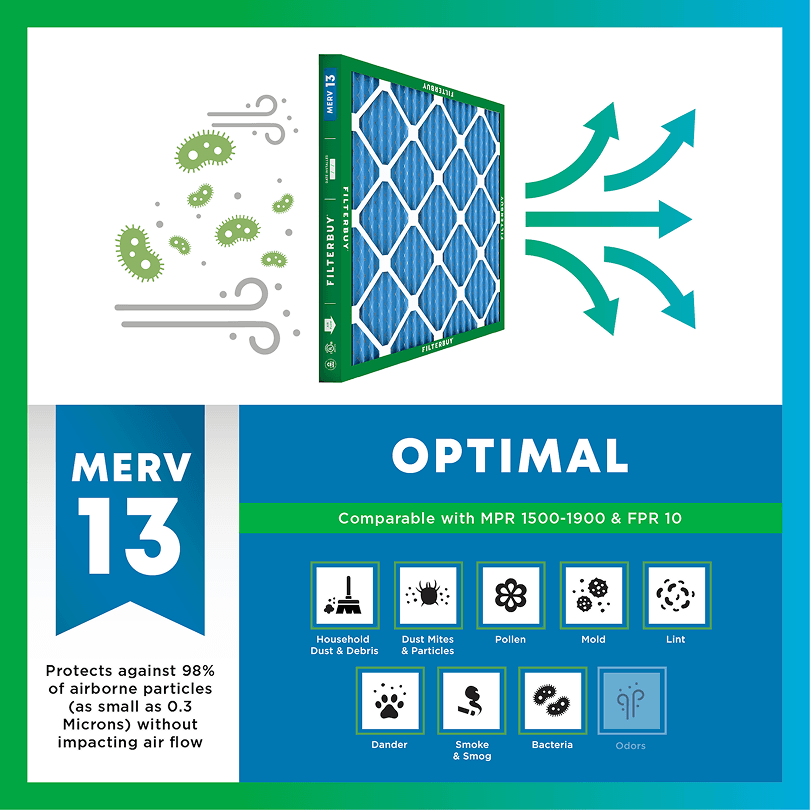
- Captures PM2.5 particles
- Blocks ash, soot, and smoke odor
- Keeps your indoor air safe—even when the outdoor air is dangerous
- Meets the EPA's recommended rating for filtering fine wildfire smoke particles.

Wildfire Smoke FAQs
Hundreds to thousands of miles. Smoke rides the wind, so your area can get hazy, smoky air even when the nearest fire is in another state.
Downwind areas can still see elevated PM2.5, the fine particles that are the main concern in smoke. Check your local AQI and follow guidance from local health officials; if you have a heart or lung condition, talk to your doctor about a plan.
The EPA recommends MERV 13, or the highest rating your system can safely handle. It captures fine particles including PM2.5.
More often than usual. Check it frequently and replace it when the media looks gray or dark — heavy smoke loads a filter faster than normal use.
Yes. Keep windows and doors closed, set the HVAC fan to "On," and close the fresh-air intake or run recirculate so you're filtering indoor air instead of pulling smoke in. In the car, use recirculate.
Fine particulate matter 2.5 microns or smaller. It's small enough to reach deep into the lungs, which is why it's the pollutant of greatest concern in wildfire smoke.
It can hang in the air for days, sometimes weeks, until rain or strong wind clears it.
Right on this page, or the AirNow Fire and Smoke Map shows current smoke plumes, fires, and air quality.
The EPA suggests adding a portable air cleaner — sized to the room and ozone-free — alongside HVAC filtration, especially in a bedroom or main living area.
Facts About Wildfires
Over 70,000 wildfires burn in the U.S. every year.
Wildfire smoke can travel 1,000+ miles, affecting states that aren't even near the blaze.
Exposure to wildfire smoke can worsen asthma, trigger heart issues, and lead to ER visits.
Indoor air can hold more fine particles during wildfire events unless it's properly filtered.
The EPA advises using MERV 13 filters or portable HEPA air cleaners during wildfire smoke events.
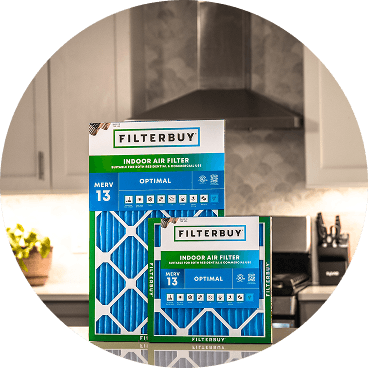
Don't Wait Until The Smoke's Inside.
Use the live wildfire smoke tracker and upgrade your air filters today to protect your lungs and your home.
Shop Filters For Smoke Protection
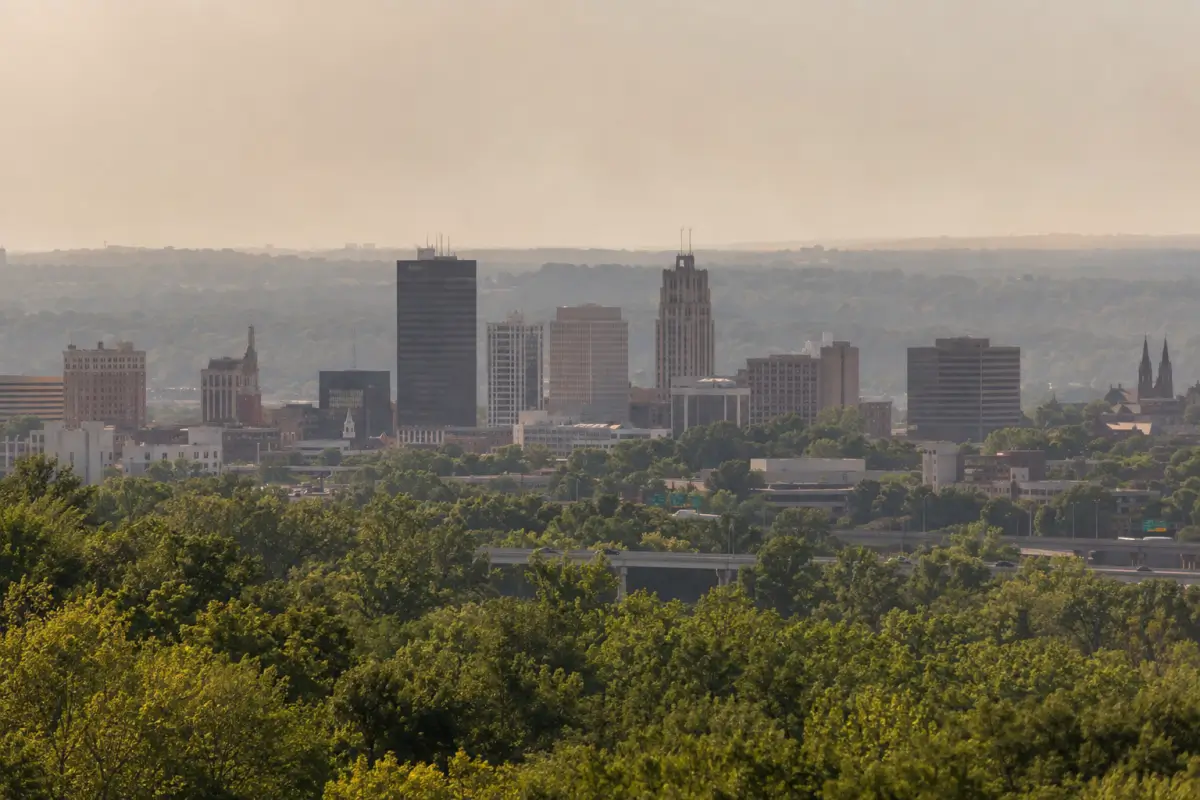
Live Akron, OH Forest Wildfire & Smoke Map Today: Local Air Quality Tracking & Indoor Protection Solutions
By Michelle Wan, Brand Manager & Air Quality Writer, Filterbuy · Technically reviewed by David Clark, Licensed HVAC Technician · Published: September 7, 2026 · Last updated: September 7, 2026
The Filterbuy wildfire and smoke map above shows two things at once, and in Akron they rarely agree. Local fire activity in Summit County is small and stays small. The smoke that turns Akron's air orange comes from fires hundreds or thousands of miles away. No fire icons but a loaded smoke layer is normal here.
TL;DR
Akron, Ohio has almost no local wildfire risk and a real, recurring wildfire smoke problem. Summit County reported 56 wildfires between 2018 and 2022, burning 34 acres total. Every unhealthy smoke day Akron has recorded came from fires in Canada or the western United States. Track the smoke layer, not the fire layer, and upgrade to MERV 13 before the next plume arrives.
Key Takeaways
Summit County recorded 56 wildfire incidents from 2018 through 2022, burning 34 acres and averaging 0.61 acres each.
Akron sits outside the ODNR Forest Fire Protection Area, so Summit County fire data flows through the National Fire Incident Reporting System.
Long-range smoke transport, not local fire, is the only thing that has pushed Akron's air into the Unhealthy range.
Fire icons near Akron in November are usually prescribed burns. The National Park Service burns about 182 acres across three Cuyahoga Valley sites each fall.
Ohio bans outdoor debris burning from 6 a.m. to 6 p.m. in March, April, May, October, and November.
Author's Note
I check fire and smoke maps for a living, and Akron is the city that taught me to stop looking at the fire layer first.
Every other Akron fire page I opened said the same thing: nothing is burning near you. True, and useless. So I went looking for the number underneath it and found Table 2.7.b of Ohio's hazard mitigation plan, where the state counts Summit County's wildfires one at a time. Fifty-six in five years. Thirty-four acres. I have not seen that on another Akron page.
That is the whole local fire risk, and it is not what should worry you. So this page answers what the fire layer cannot: where Akron's smoke comes from, how much warning you get, and what to install first.
Michelle Wan, Brand Manager & Air Quality Writer, Filterbuy
What Is Actually Burning Near Akron, OH Right Now
Summit County wildfires are small and frequent, and almost never a health event. Fifty-six incidents burned 34 acres from 2018 through 2022. Southern Ohio tells a different story.
Source: State of Ohio Enhanced Hazard Mitigation Plan, Rev. 2/2024, Section 2.7 Wildfire, Tables 2.7.b and 2.7.c.
Geography explains the gap. Ohio's wildfire country is the unglaciated hill country of the south and east, where the ODNR Division of Forestry fire management program runs its Forest Fire Protection Area. Summit County sits outside that boundary in glaciated, developed northeast Ohio.
A fire near Akron large enough to affect your indoor air has not happened in the modern record. The smoke that affects it has, repeatedly.
The calendars do not line up either. Ohio's fire seasons are spring and fall, when leaves are down and humidity drops. Akron's smoke arrives in June and July, when Canada burns. Two risks, two months, and only one is on your street.
Why The Akron Fire Map And The Akron Smoke Map Disagree
The Filterbuy map stacks a fire layer and a smoke layer, and in Akron the two diverge almost every time. Akron can show zero nearby fires and heavy overhead smoke on one screen, because the fires making that smoke sit off the edge of your view.
Fire data from WFIGS (Wildland Fire Interagency Geospatial Services) in the U.S. and CWFIS in Canada. Smoke from NOAA/NESDIS HMS. As published on the Filterbuy map legend.
Smoke particles stay airborne for days and ride prevailing winds across the Great Lakes. The smoke layer is the one Akron households should watch. A stalled low can hold a Canadian wildfire smoke plume over northeast Ohio for days. Plumes hit the lakeshore first, so the Cleveland wildfire and smoke map works as Akron's early warning.
The Fire Icons Near Akron In November Are Usually Prescribed Burns
Prescribed fire is set on purpose by trained crews working under permit, and near Akron it is the most likely fire icon you will see. The National Park Service burns habitat in Cuyahoga Valley National Park, which spans 33,000 acres between Akron and Cleveland, mostly inside Summit County. A typical fall program covers about 182 acres across three sites: the former Richfield Coliseum site on Route 303, Terra Vista Natural Study Area in Valley View, and a tract in Boston Township.
The National Park Service sets these burns only when temperature, wind, and humidity fall inside a defined window, and says smoke may drift over park lands and roads. If you smell smoke in Peninsula, Richfield, or Boston Heights in late fall, check the prescribed fire layer first.
What The July 2026 Smoke Event Looked Like In Akron
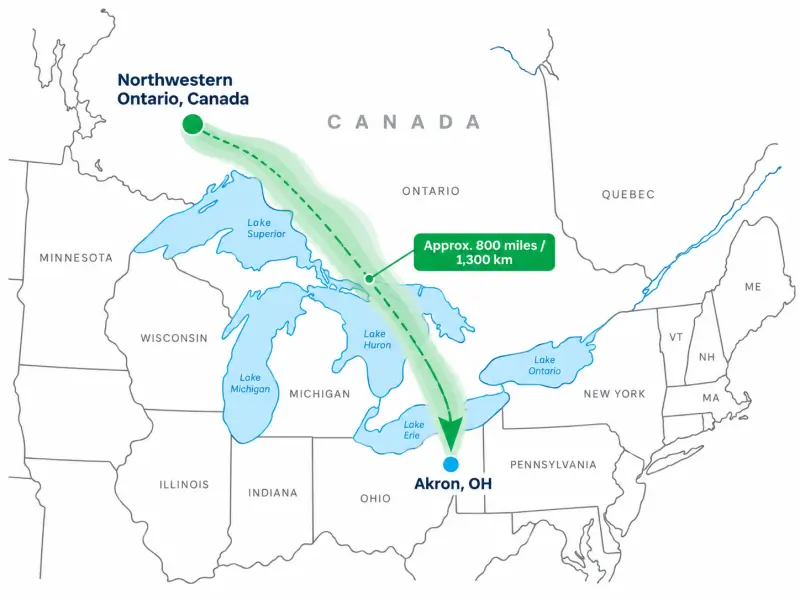
Ohio EPA issued a statewide Air Quality Advisory effective 7 a.m. on July 16, 2026, as smoke from northwestern Ontario moved into the state. By July 17, Akron was rated Unhealthy and the Akron Zoo closed early. The advisory arrived about a day before the worst air did. That is the window you get.
This was not a one-time event. Canadian smoke reached northeast Ohio in June 2023, and Ohio EPA later petitioned the U.S. EPA to strike three wildfire-influenced days from the Cleveland area's ozone record. Those days were real. They stopped counting.
Filterbuy tracks the same conditions on our live Akron air quality index map.
What To Do When Smoke Reaches Akron
Check official guidance first, then work the list. AirNow and ARAQMD tell you what the air is doing. The steps below are what to do about it indoors.
Check the AirNow Fire and Smoke Map and the ARAQMD forecast before you plan the day. Local guidance comes first.
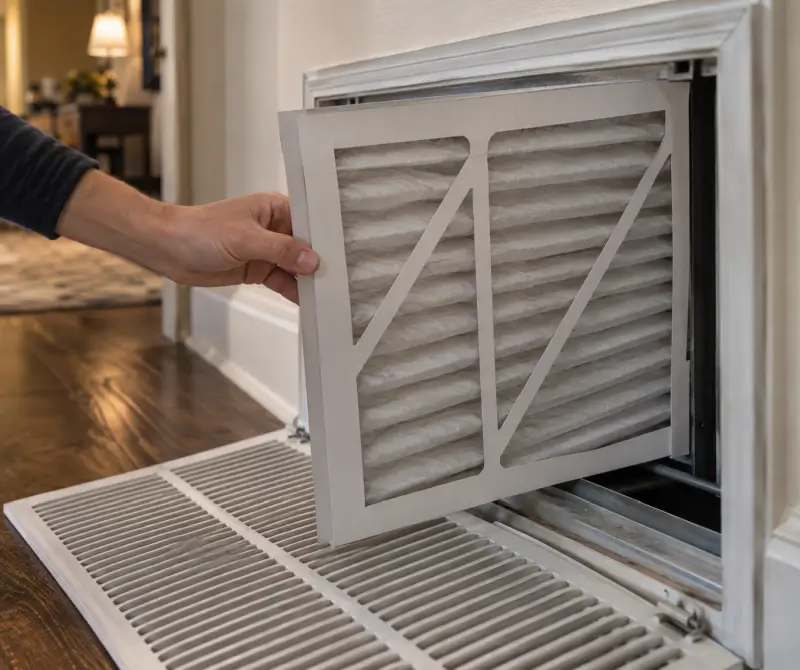
Put a MERV 13 in the HVAC if the system runs a lower tier. The central system moves far more air than any portable unit, so this is the whole-home layer.
Set the thermostat fan to On rather than Auto. Auto only filters while the system is heating or cooling. On filters continuously.
Run a portable HEPA air cleaner in each occupied room, bedrooms first. Size it so the smoke CADR is at least two-thirds of the room square footage. A 300 square foot bedroom wants a smoke CADR around 200. Skip anything that makes ozone, which EPA advises against.
Close the house up. Windows and doors shut, and do not add indoor pollution while smoke is in. No candles, no frying, no vacuuming without a sealed unit.
Check the filter while smoke is around and replace it when it looks dirty, dark brown or black. That can come well before the normal interval, so keep spares on hand.
Wear a properly fitted N95 outside. A cloth or surgical mask will not filter fine particles.
Two recommendations sit side by side there, so keep them straight. EPA recommends a high-efficiency filter rated MERV 13 or higher in a central system during smoke events. AQI 100 is where Filterbuy tells customers to act, which is a house call, not an EPA category change.
No Ductwork In Your Akron Home? Start With A Portable Unit
Everything above assumes a furnace with a filter slot. Plenty of Akron homes run on radiators or window units with no ductwork, so there is no whole-home layer to upgrade. For those readers a portable HEPA air cleaner is the primary defense, not a supplement. Size it by the same rule: smoke CADR at least two-thirds of the room square footage.
If a certified unit is out of reach today, EPA research found a box fan built with MERV 13 filters reduces smoke concentrations. Treat it as a reasonable stopgap rather than a replacement for a certified air cleaner.
A cardboard shroud raises clean air delivery 40 percent and costs nothing.
A 4-inch filter instead of a 1-inch more than doubles it again.
Use a certified box fan made in 2012 or later, carrying a UL or ETL mark.
Do not leave the unit running unattended.
Check the filter daily. EPA found these builds almost useless once loaded.
On a window air conditioner, close the fresh-air vent.
Filterbuy sells the filter, not the fan, and we would still tell you to build this. On a bad smoke day, cheap and working beats expensive and still shipping. EPA publishes the designs and safety testing.
What A MERV 13 Filter Can And Cannot Do About Akron Smoke
MERV 13 is the tier Filterbuy recommends for smoke. EPA notes that most furnaces and HVAC systems accommodate MERV 13 without equipment problems, provided the filter is replaced often. Check the size the same way you would confirm any replacement.
MERV rates particle capture only, not gases or odors. Most furnaces and HVAC systems accommodate MERV 13 without equipment problems when the filter is replaced often.
What the page can say without that figure: the whole-home layer only works while air is moving, which is why the fan setting matters as much as the filter tier.
MERV 13 is not the same thing as True HEPA. Wildfire smoke is particles and gases, and a pleated filter captures particles. Smoke odor is gas-phase, so it routes to the Odor Eliminator line. HEPA belongs in a portable air cleaner in the room, never in a furnace slot.
Filterbuy manufactures pleated MERV 13 air filters at our Talladega, Alabama plant in more than 600 sizes. Making them is also why we point you to EPA's own numbers rather than the ones that circulate online. Our guide to MERV 8 vs MERV 11 vs MERV 13 walks through the airflow tradeoff.
“Akron does not have a wildfire problem. Akron has a smoke problem, and those are not the same thing. We have made filters long enough to know how this goes: nobody upgrades a filter in the middle of a bad air day. They do it the week after, once they have already breathed it.”
David Heacock, Founder and CEO, Filterbuy
Where To Check Akron Smoke Conditions And Who To Call
The Akron Regional Air Quality Management District is Ohio EPA's local air agency here. It posts the daily AQI and next-day forecast, runs a recorded line at (330) 375-2545, and takes open burning complaints at (330) 375-2480. The AirNow Fire and Smoke Map adds sensor data between regulatory monitors.
For statewide context, see our Ohio wildfire and smoke map.
Supporting Statistics
1. Asthma ER Visits Ran 17 Percent Above Normal On Smoke Days
Wildfire smoke sends people to the emergency room. The CDC measured it.
17 percent more asthma ER visits than expected, nationwide.
Across 19 smoke days in 2023, each at AQI 101 or higher.
Ohio sits in HHS Region 5, one of three hardest-hit regions.
Region 5 logged four smoke days and 172 excess asthma visits in one.
Why it matters in Akron: Anyone managing asthma, COPD, or a heart condition should follow their clinician and official guidance on smoke days, not a filter page.
Source. https://www.cdc.gov/mmwr/volumes/72/wr/mm7234a5.htm CDC, Morbidity and Mortality Weekly Report, Vol. 72, No. 34, August 25, 2023. HHS Region 5 covers Ohio, Illinois, Indiana, Michigan, Minnesota, and Wisconsin.
2. Fires Started Inside Ohio Burned 11,057 Acres In Five Years
Ohio has wildfires. They are small, and people start them.
4,885 wildfires statewide, 2018 through 2022.
11,057 acres burned across the ODNR forestry protection area.
Nearly all human caused, with escaped debris burning the leading cause.
One large western fire often burns more than Ohio does in five years.
Why it matters in Akron: Ohio's fire problem is small and preventable. Its smoke problem is neither.
Source. https://dam.assets.ohio.gov/image/upload/ema.ohio.gov/mip/links/2023/ema-sohmp-Section-2.7.pdf State of Ohio Enhanced Hazard Mitigation Plan, Rev. 2/2024, Section 2.7 Wildfire.
3. A Closed-Up House Still Holds 55 To 60 Percent Of The Outdoor Smoke
Closing the windows helps. It does not finish the job.
Indoor PM2.5, the fine particles in smoke, runs 55 to 60 percent of outdoor levels during an event.
That assumes windows and doors closed, no air cleaner running.
Why it matters in Akron: Sealing the house is the first move, not the last. Filtration is one layer on top of it.
Source. https://www.epa.gov/wildfire-smoke-course/strategies-reduce-exposure-indoors U.S. EPA, Wildfire Smoke and Your Patients' Health: Strategies to Reduce Exposure Indoors.
Frequently Asked Questions
Glossary
AQI, or Air Quality Index: The U.S. EPA's 0 to 500 health scale for air pollution. Above 100 affects sensitive groups. Above 150, everyone.
PM2.5: Fine particulate matter under 2.5 micrometers. The main health hazard in wildfire smoke, small enough to reach deep lung tissue.
MERV, or Minimum Efficiency Reporting Value: The ASHRAE scale rating how well a filter captures particles. Covers particles only, not gases or odors.
ARAQMD, or Akron Regional Air Quality Management District: Ohio EPA's local air agency for Summit, Medina, and Portage counties, run by Summit County Public Health.
WFIGS, or Wildland Fire Interagency Geospatial Services: The U.S. interagency source supplying active fire locations to public maps.
Prescribed fire: A planned, permitted fire set by trained crews under set weather conditions to manage habitat. Distinct from wildfire.
Exceptional event: A U.S. EPA designation letting wildfire-influenced data be excluded from attainment calculations.
Air Quality Advisory: A public notice from Ohio EPA when pollution is forecast to reach unhealthy levels.
Sources
Every figure on this page traces to a primary source below. All links were fetch-verified for rendered content on September 7, 2026.
Summit and Scioto County wildfire data. https://dam.assets.ohio.gov/image/upload/ema.ohio.gov/mip/links/2023/ema-sohmp-Section-2.7.pdf State of Ohio Enhanced Hazard Mitigation Plan, Rev. 2/2024, Section 2.7, Tables 2.7.b and 2.7.c.
Ohio Forest Fire Protection Area and burn seasons. https://ohiodnr.gov/discover-and-learn/safety-conservation/about-ODNR/forestry/fire-management-program ODNR Division of Forestry, Fire Management Program.
Akron air agency, daily AQI, and forecast. https://www.scph.org/air-quality Akron Regional Air Quality Management District, Summit County Public Health.
Open burning rules and the air-alert prohibition. https://www.scph.org/air-quality/open-burning ARAQMD open burning guidance, enforcing Ohio EPA rules.
Cuyahoga Valley National Park prescribed fire program. https://www.nps.gov/cuva/learn/news/20241105-national-park-service-to-conduct-prescribed-fires.htm National Park Service news release, 182 acres across three named sites.
July 2026 statewide Air Quality Advisory. https://epa.ohio.gov/about/media-center/news/statewide-air-quality-advisory-update Ohio EPA media center.
Live fire and smoke tracking during an event. https://fire.airnow.gov/ AirNow Fire and Smoke Map, U.S. EPA and U.S. Forest Service.
DIY box fan air cleaner designs, CADR test results, and UL safety testing. https://www.epa.gov/air-research/research-diy-air-cleaners-reduce-wildfire-smoke-indoors U.S. EPA Office of Research and Development, updated July 6, 2026.
Asthma emergency department visits during smoke days. https://www.cdc.gov/mmwr/volumes/72/wr/mm7234a5.htm CDC, MMWR Vol. 72 No. 34, August 25, 2023.
Indoor PM2.5 reduction figures, the 55 to 60 percent infiltration figure, and MERV 13 recommendation. https://www.epa.gov/wildfire-smoke-course/strategies-reduce-exposure-indoors U.S. EPA, Strategies to Reduce Exposure Indoors.