
North Carolina Live Wildfire Smoke Map
Get Alerts For Wildfires In Your Area
The moment a wildfire starts near you, you'll get an instant alert and simple tips to reduce your smoke exposure.
What's In The Smoke
30xSmaller than a human hair
Fine enough to reach deep into the lungs. A MERV 13 is built to capture it.
How Far It Travels


It Doesn't Stay Local
Smoke rides the wind far downwind — you can get smoky air with no fire nearby.
What To Do During A Smoke Event
Simple steps to reduce indoor exposure.
- Stay In, Close UpShut windows and doors to keep smoke out.
- Set Fan To "On"Keeps air cycling through your filter, not just when heating or cooling.
- Recirculate AirSwitch off fresh-air intake so you're not pulling smoke in.
- Run A MERV 13Built to capture the fine PM2.5 in smoke.
- Add A PurifierExtra filtration for the room you use most.
- Wear an N95 if OutsideFits snug to block fine particles — a cloth mask won't.


The Best Air Filter For Wildfire Smoke
During smoke events, the EPA recommends upgrading to a MERV 13 filter — or the highest-rated filter your system can handle — to help reduce the fine particles smoke brings indoors. MERV 13 is the level most home HVAC systems can run while still capturing PM2.5, the fine particulate that makes up the bulk of wildfire smoke.
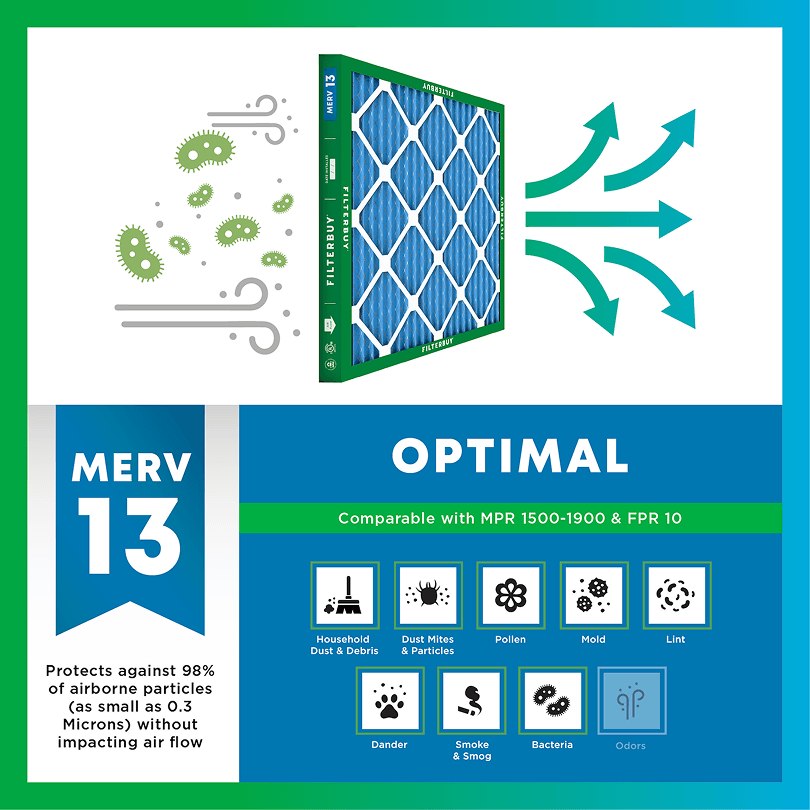
- Captures PM2.5 particles
- Blocks ash, soot, and smoke odor
- Keeps your indoor air safe—even when the outdoor air is dangerous
- Meets the EPA's recommended rating for filtering fine wildfire smoke particles.

Wildfire Smoke FAQs
Facts About Wildfires
Over 70,000 wildfires burn in the U.S. every year.
Wildfire smoke can travel 1,000+ miles, affecting states that aren't even near the blaze.
Exposure to wildfire smoke can worsen asthma, trigger heart issues, and lead to ER visits.
Indoor air can hold more fine particles during wildfire events unless it's properly filtered.
The EPA advises using MERV 13 filters or portable HEPA air cleaners during wildfire smoke events.
Don't Wait Until The Smoke's Inside.
Use the live wildfire smoke tracker and upgrade your air filters today to protect your lungs and your home.
Shop Filters For Smoke Protection

Current Live Wildfire And Smoke Map North Carolina Today From Filterbuy.com
Author: Michelle Wan, filterbuy.com/author/michelle-wan/
Reviewer: David Clark, Licensed HVAC Technician
Published: July 22, 2026
Updated: July 22, 2026
Several wildfires are burning across North Carolina today, with the heaviest smoke lingering along the coast in Brunswick, Hyde, and Onslow/Duplin counties. Use the live map below to check fire locations and your local Air Quality Index, then read on for the right air filter to keep smoke out of your indoor air.
TL;DR
North Carolina has three active wildfires today in the coastal counties of Brunswick, Hyde, and Onslow/Duplin, each with partial to majority containment. Smoldering organic soils mean hazy conditions can persist even after a fire is mostly contained. Check the live map above for your county's AQI, and set up a clean-air room with a high-efficiency air filter if smoke reaches your neighborhood.
Key Takeaways
Quarry Road Fire, Brunswick County: 283 acres, 50% contained as of July 13, 2026.
Rose Bay Canal Fire, Hyde County: 667 acres, 83% contained, with soils smoldering underground and producing regional haze.
Chicken Farm Lane Fire, Onslow/Duplin line: 164 acres, 75% contained, with hotspots near Cypress Creek and Chinquapin.
PM2.5, wildfire smoke's main health hazard, reaches deep into the lungs and bloodstream.
A high-efficiency filter rated MERV 13, where your HVAC system supports it, is among the most effective at-home tools for reducing indoor PM2.5.
Containment changes daily, so the live map above is the authoritative source, not any single date on this page.
Live Wildfire And Smoke Map For North Carolina
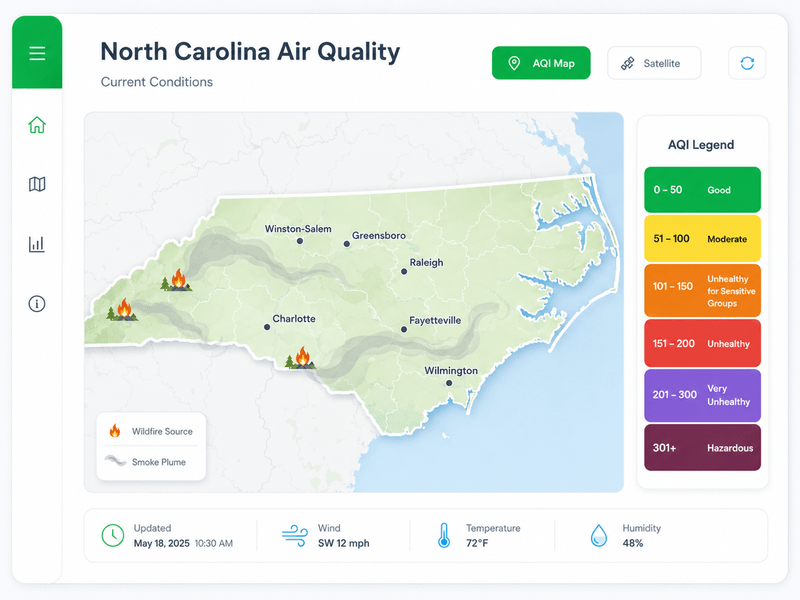
This map layers live satellite fire detections, N.C. Forest Service ground reports, and real-time AQI readings from monitoring stations statewide. Zoom into your county to see active fire perimeters, drifting smoke plumes, and today's AQI color code, from Green (Good) through Maroon (Hazardous). For conditions outside North Carolina, see Filterbuy's national wildfire and smoke map.
How This Map Works
The map combines three live sources: heat-sensing satellites that flag hot spots within hours, the N.C. Forest Service's Signal 14 database of confirmed acreage and containment, and sensors that measure PM2.5 and convert it into the color-coded AQI shown on the map. For a full walkthrough, see our guide on how to read a wildfire smoke map.
Current Wildfire Activity In North Carolina Today
North Carolina's active wildfire activity is concentrated along the coastal plain today, not the mountains most people picture. Extreme summer heat and dry fuels are driving three fires right now.
Quarry Road Fire, Brunswick County: Burning near Shallotte since July 10, this fire held at approximately 283 acres and 50% containment as of Monday, July 13. Crews are mopping up smoldering fuels, and light to moderate smoke may continue underground.
Rose Bay Canal Fire, Hyde County: Southwest of the state prison, this fire has burned about 667 acres and reached 83% containment. Deep organic soils are smoldering below the surface, generating persistent haze even as the fire line shrinks.
Chicken Farm Lane Fire, Onslow/Duplin County Line: This fire has scorched about 164 acres and is roughly 75% contained. Residents near Cypress Creek and Chinquapin should expect lingering smoke with no active threat to the public.
Conditions can shift with wind and weather in hours, so rely on the live map for the current picture.
Table 1: Current North Carolina Wildfire Activity
Figures reflect the most recently reported status as of each source date and change daily. Check the live map above for current conditions.
Why North Carolina's Coastal Wildfires Burn Differently
The Rose Bay Canal Fire burns through pocosin, the dense peat wetlands of North Carolina's coastal plain, rather than the timber and brush that fuel most Western wildfires. Once drought dries this peat out, it can smolder several feet underground for weeks after the surface fire looks contained. The Evans Road Fire burned inside the Pocosin Lakes National Wildlife Refuge for roughly three months in 2008, consuming more than 41,000 acres of peat, and a study in Environmental Health Perspectives linked that smoke event to a real rise in emergency room visits for heart and lung problems in surrounding counties. Containment percentage alone doesn't tell the full story here, since the ground underneath can keep burning for weeks, as is happening in Hyde County now.
How Today Compares To A Typical Fire Day
The N.C. Forest Service's Signal 14 database also tracks the state's baseline: a typical day sees about a dozen small fires burning a few acres statewide. Month to date, 247 fires have burned 1,601.6 acres, and year to date, 5,565 fires have burned 15,322.2 acres. Today's three coastal fires alone have burned roughly 1,114 acres, well above a typical day's total, though smaller than the multi-thousand-acre fires that burned in the western mountains during spring 2025.
What If You Don't Live Near These Fires?
Smoke doesn't stop at a county line. Wind can carry PM2.5 from a coastal fire into the Triangle or Piedmont within a day, so zoom the map to your own city before assuming your air is clear. Haze with no nearby fire on the map usually means the smoke traveled a long way, often from Canadian wildfires drifting hundreds of miles on upper-level winds.
Quick County Lookup For Major North Carolina Cities
Wildfire and air quality alerts go out by county. Find yours below.
Charlotte (Mecklenburg County)
Raleigh (Wake County)
Durham (Durham County)
Greensboro (Guilford County)
Winston-Salem (Forsyth County)
Wilmington (New Hanover County)
Asheville (Buncombe County)
Fayetteville (Cumberland County)
Greenville (Pitt County)
Jacksonville (Onslow County)
New Bern (Craven County)
How Wildfire Smoke Affects Your Health
The component of wildfire smoke that matters most for your health is PM2.5, particulate matter roughly 2.5 microns or smaller, about 30 times thinner than a human hair. These particles bypass your body's natural filters and reach deep into the lungs and bloodstream, commonly causing eye and throat irritation, coughing, and shortness of breath. People with asthma, COPD, or heart disease, along with pregnant women, children, and older adults, face a higher risk of serious symptoms.
How To Protect Your Home's Indoor Air During Wildfire Smoke
Homeowners who set up a clean-air room before smoke arrives stay far more comfortable than those scrambling once the AQI spikes.
Check your county's real-time AQI above before deciding whether to keep windows and doors closed.
Set up a clean-air room with a well-sealed space and a high-efficiency air filter or portable air cleaner sized for it.
Run your HVAC system on recirculate rather than pulling in outside air.
Avoid frying food, burning candles, or vacuuming without a HEPA filter while smoke is elevated.
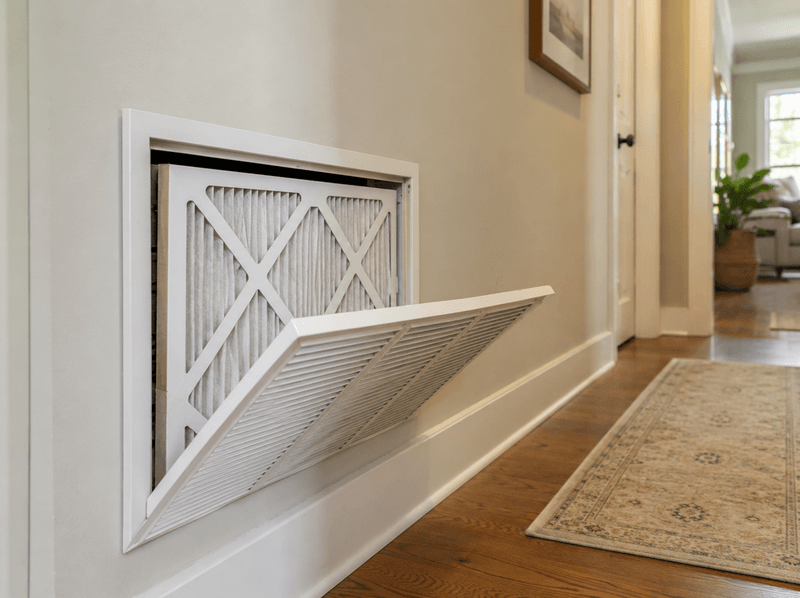
A pleated air filter is the first line of defense for whole-home filtration. Filterbuy's MERV 13 filters are built for the higher dust-holding capacity wildfire smoke demands, and they fit standard residential HVAC systems without the airflow restriction of true HEPA media. For background on how any air filter works, see the glossary below.
When wildfire smoke rolls into a coastal county, most homeowners are watching the sky outside, but the real exposure risk is what keeps getting pulled indoors every time the HVAC system runs. We build every filter size by hand at our plant in Talladega, Alabama, and a properly rated filter is one of the simplest, most affordable ways to cut that exposure.
David Heacock, Founder and CEO, Filterbuy
Essential Resources
Seven trusted sources checked against the live map above.
Satellite fire detections layered with county-level AQI. Source: AirNow Fire and Smoke Map
What each AQI color means for your health. Source: EPA Wildland Fires and Smoke
Which groups face the highest health risk from smoke. Source: CDC How Wildfire Smoke Affects Your Body
Daily statewide acreage and containment figures. Source: N.C. Forest Service Wildfire Situation Report
How to build an evacuation plan and go-bag. Source: Ready.gov Wildfire Preparedness Guide
How wind, humidity, and drought raise fire danger. Source: National Weather Service Wildfire Ready
N.C.'s Code Orange, Red, and Purple alerts by county. Source: N.C. DEQ Smoke, Wildfires & Prescribed Burns
3 Supporting Statistics
National Interagency Fire Center: 3.59 million acres burned nationwide, year-to-date as of July 13, 2026, the national backdrop for the fires above. Source: National Interagency Fire Center Statistics
Aguilera et al., 2021 (PMC7935892): Wildfire PM2.5 drives a much larger jump in respiratory hospital admissions than PM2.5 from other sources. Source: Aguilera et al., 2021 Study (PMC7935892)
American Lung Association "State of the Air" 2026: 152.3 million people, 44% of the U.S. population, live in counties with failing grades for ozone or particle pollution. Source: American Lung Association "State of the Air" 2026 Key Findings
Final Thoughts & Opinion
A wildfire map tells you what's burning, not what to do about the smoke already drifting toward a coastal neighborhood that never sees flame. Three fires behind today's conditions in Brunswick, Hyde, and Duplin counties each read as mostly contained on paper while still breathing haze into communities miles from the fire line. Families who check the live map daily tend to get through smoke events with less stress than those who wait until the sky turns orange. Bookmark this page on a clear afternoon, not during the panic search.
Frequently Asked Questions
Keep Today's North Carolina Wildfire Smoke Out Of Your Home
You've checked today's map, so put that information to work indoors. Shop Filterbuy's MERV 13 filters for fine-particle protection before the next smoke event reaches your county.
Glossary
AQI (Air Quality Index): EPA's color-coded scale, Green through Maroon, indicating daily health risk from pollution.
PM2.5: Fine particulate matter 2.5 microns or smaller, the primary harmful component of wildfire smoke.
MERV (Minimum Efficiency Reporting Value): A 1-16 scale rating how effectively an air filter captures particles.
Air Filter: Pleated media inside an HVAC system that removes particles from air as it passes through.
Containment: The percentage of a wildfire's perimeter with a control line stopping it from spreading further. It does not mean the fire is out.
Code Orange / Red / Purple: N.C. Division of Air Quality alert levels for Unhealthy for Sensitive Groups, Unhealthy, and Very Unhealthy conditions.
Pocosin: A dense, peat-based wetland across North Carolina's coastal plain, whose deep soil can smolder underground for weeks after drought.
Related Filterbuy Resources
Each link below was verified live and rendering on July 14, 2026.
Real-Time Air Quality Index and Live Wildfire and Smoke Maps: Filterbuy's national AQI and wildfire tracking hub with ZIP-code lookup.
The Complete Mini Split Ductless HVAC Buying Guide: Sizing and filtration guidance for homes without central HVAC.
Subscribe to wildfire smoke alerts for North Carolina to get a heads-up before the next event reaches your area.