
Worcester Real-Time AQI Tracker


Get Alerts For Unhealthy AQI In Your Area
When air quality in your area reaches unhealthy levels, we'll send you a quick alert, along with expert tips on how to reduce your exposure.
What's Actually In Worcester Air Today?
What High AQI Means for Your Lungs in Worcester
How to Read AQI
The Air Quality Index (AQI) measures how polluted the air is and how it may affect your health.
0–50 (Good): Air quality is satisfactory.
51–100 (Moderate): Acceptable, but some pollutants may pose minor concerns.
101–150 (Unhealthy for Sensitive Groups)
151–200 (Unhealthy)
201–300 (Very Unhealthy)
301+ (Hazardous)
Moderate
Still okay for most, but if you have asthma or allergies, take it easy and avoid long outdoor workouts.
Shop MERV 11 filters→What's the Right Filter for Your AQI Level?
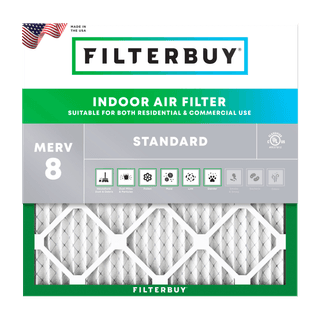
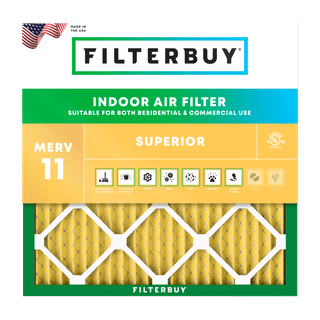
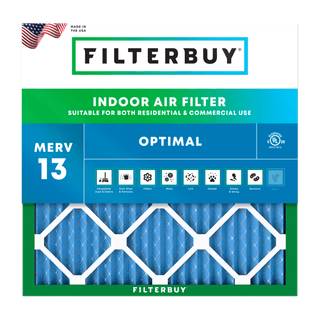


Check Today's Live Real Time Air Quality Index AQI Map in Worcester, MA Now
By Michelle Wan, Filterbuy's Brand Manager and Air Quality Writer | Reviewed by David Clark, Licensed HVAC Technician | Published July 21, 2026 | Updated July 21, 2026
TL;DR
Worcester's air quality index changes throughout the day based on ground level ozone, fine particle pollution (PM2.5), and smoke drifting in from wildfires as far away as Canada. Two Massachusetts DEP monitoring stations, one near downtown Summer Street and one near Worcester Regional Airport, feed the live map above with real time readings. Check the map before spending time outdoors, and move to a MERV 13 filter once readings climb into the Moderate range or higher.
Key Takeaways
Worcester's air quality is measured by two Massachusetts DEP monitoring stations, one downtown near Summer Street and one near Worcester Regional Airport.
The Boston Worcester Providence metro area earned an F for daily fine particle pollution, ranking 53rd worst nationally in the Lung Association's latest report.
Worcester County improved to its best ever result for year round fine particle pollution in the same report.
Wildfire smoke drifting in from Canada is a recurring driver of Worcester's worst air days, most recently from fires burning across Ontario and Minnesota.
A MERV 13 filter captures far more wildfire smoke particles than a standard MERV 8 filter, though it is still not a substitute for true HEPA.
Worcester's status as the second largest city in Massachusetts means a single bad air day touches a large number of households at once.
Our Filterbuy team hears the same question every smoke season. Is it safe to be outside in Worcester today? Checking the live map above takes ten seconds, but knowing what the number means takes more context. Worcester's AQI moves for local and imported reasons, from summer ozone along Route 290 to fine particle smoke that started in a Canadian forest days earlier. This page covers what today's number means, why Worcester's air behaves this way, and what to do next.
What Worcester's Live AQI Map Shows You Right Now
The map above pulls current readings from EPA AirNow and Massachusetts's air quality program, whose ambient monitoring network converts raw pollutant concentrations into the familiar 0 to 500 AQI scale. Worcester's two DEP stations, one along Summer Street across from St. Vincent Hospital and one near Worcester Regional Airport, report ozone and PM2.5 concentrations that AirNow's NowCast calculation blends into the current reading you see. Six color coded categories run from Good (green) through Hazardous (maroon), and it updates as new monitor data arrives. Because Worcester spreads across seven hills with valleys in between, these two valley-level monitors can read differently than conditions on higher ground, so treat the map as a citywide guide rather than a block-by-block one.
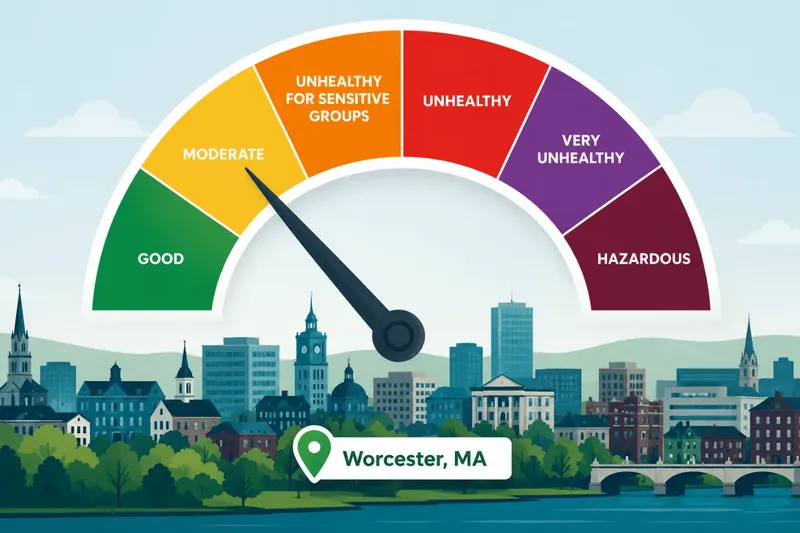
AQI categories and ranges follow the U.S. EPA Air Quality Index scale (airnow.gov).
How Worcester's Air Quality Compares To The Rest Of Massachusetts
Worcester does not sit apart from the rest of the state's air quality story. The American Lung Association's most recent State of the Air report found the Boston Worcester Providence metro area's daily fine particle pollution grade slipped from a C to an F, a ranking of 53rd worst in the nation, while ozone pollution ranked the metro area 57th worst. Worcester County also posted its best ever result for year round fine particle levels in the same report. Much of Worcester is also mapped as a Massachusetts Environmental Justice community, giving residents in those neighborhoods added regulatory protection when new sources of air pollution are proposed nearby. For the full statewide picture, our statewide Massachusetts AQI map breaks down conditions by county.
What's Behind Worcester's Worst Air Days
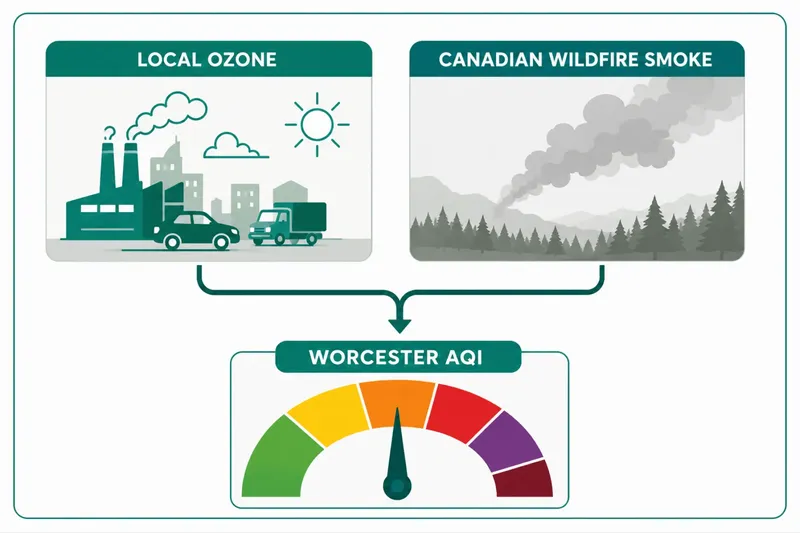
Two forces tend to drive Worcester's AQI into the Moderate range or higher. The first is homegrown summer ozone, forming when sunlight reacts with vehicle and industrial emissions along corridors like I-290 during hot, stagnant afternoons. The second arrives from hundreds of miles away. Canadian wildfire smoke has repeatedly pushed fine particle levels across Worcester County into unhealthy territory. When MassDEP issues a fine particle advisory for Central Massachusetts, a fire burning in Ontario or Quebec is frequently the reason. Our Massachusetts wildfire and smoke map tracks plume movement and active fires across the Commonwealth in real time.
At Filterbuy, we saw this firsthand during the June 2023 Canadian wildfire event. Filters returned to our Talladega, Alabama facility from Massachusetts customers came back with the same gray-brown discoloration in under two weeks, physical proof that cross-border smoke ends up filtered inside homes across the Commonwealth, Worcester included.
How To Protect Your Family When Worcester's AQI Turns Unhealthy
Once the map shows Moderate or higher, a few habits help. Check it each morning, since levels can shift overnight. Sensitive groups should shorten outdoor exertion on Orange days and above, and AirNow's activity guide for particle pollution has exact steps for each level. Indoors, close windows and doors, run your HVAC fan on the On setting, and confirm your filter is MERV 13 or higher if smoke is the driver.
MERV Rating and Wildfire Smoke Protection
True HEPA filtration is not the same as a MERV 13 HVAC filter and typically requires a standalone air purifier rather than a standard ducted system.
Expert Quote
After manufacturing filters for over a decade and serving more than two million households, we’ve learned that outdoor air quality and indoor air quality are never separate problems. When Worcester’s AQI climbs into the Moderate range or higher, that same air works its way into your home through doors, windows, and your HVAC system. A MERV 13 filter is one of the simplest ways to keep what’s happening outside from following you indoors.
David Heacock, Founder and CEO of Filterbuy
Reviewer's Note
In my service calls across Central Massachusetts, the households that call about sudden coughing or allergy flare-ups are almost always running a filter well past its replacement date once regional air quality drops.
David Clark, Licensed HVAC Technician
Frequently Asked Questions
Ready Your Home For Worcester's Next Air Quality Advisory
Ready your HVAC system before Worcester's next Moderate or Unhealthy air day. Shop Filterbuy's MERV 13 air filters.
Glossary
AQI (Air Quality Index): EPA's 0 to 500 scale for outdoor air pollution and its health risk.
PM2.5: Fine particulate matter 2.5 microns or smaller, small enough to reach deep lung tissue.
Ozone: A gas formed when sunlight reacts with vehicle and industrial emissions, concentrated on hot afternoons.
MERV: Minimum Efficiency Reporting Value, the 1 to 16 scale rating how well a filter captures airborne particles.
NowCast: AirNow's current-conditions calculation, blending recent monitor data to reflect fast changing air quality.
Sensitive Groups: People at higher risk from air pollution, including older adults, children, and those with asthma or heart disease.
Air Quality Advisory: A MassDEP notice issued when pollutants are expected to reach Moderate or Unhealthy for Sensitive Groups levels.