
Air Quality in Massachusetts
Air quality index (AQI⁺) and PM2.5 air pollution in Massachusetts •


Get Alerts For Unhealthy AQI In Your Area
When air quality in your area reaches unhealthy levels, we'll send you a quick alert, along with expert tips on how to reduce your exposure.
Live Air Quality Ratings in Massachusetts
Live Most Polluted City Ranking
Real-time most polluted cities in Massachusetts
Live Cleanest City Ranking
Real-time cleanest cities in Massachusetts
The Right Air Filter For High AQI Days
When outdoor air quality drops, the EPA recommends upgrading to a MERV 13 filter — or the highest-rated filter your HVAC system can handle — to help capture more of the fine particulate (PM2.5) that comes with poor air quality. MERV 13 is the highest rating most residential systems can run without restricting airflow.
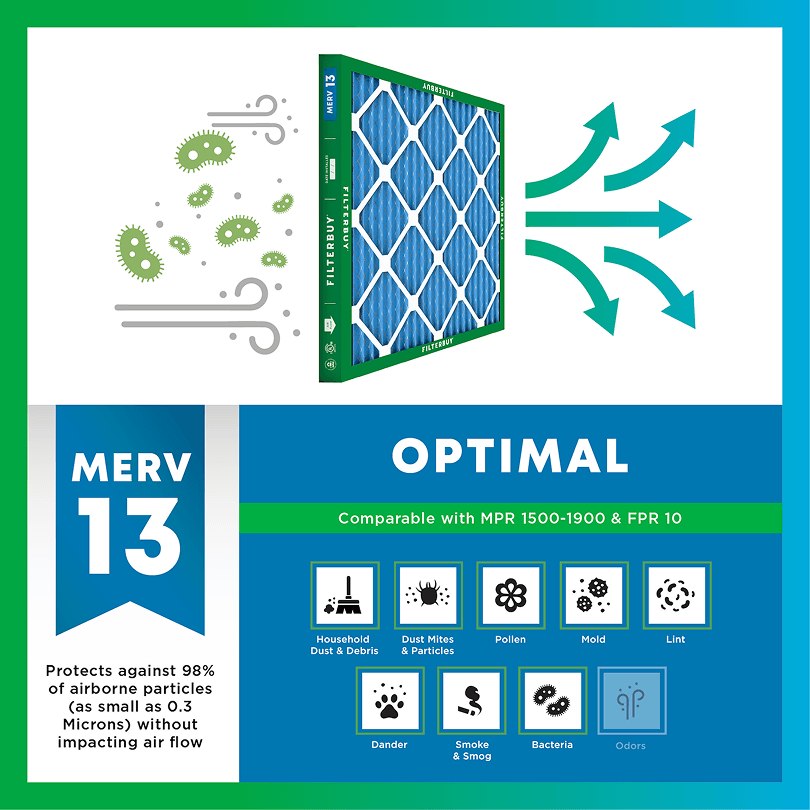

- Captures PM2.5 and other fine particulates
- Filters ash, soot, and smoke particles
- Rated to capture particles as small as 0.3 microns
- Matches the filter rating the EPA suggests during high-AQI and smoke events

AQI FAQs
What is AQI?
AQI stands for Air Quality Index, the EPA's scale for reporting daily air quality. It runs from 0 to 500. The higher the number, the greater the level of air pollution. Values at or below 100 are generally considered satisfactory; values above 100 mean air quality is unhealthy, first for sensitive groups, then for everyone as numbers climb.
What does AQI measure?
The AQI tracks five major pollutants regulated by the Clean Air Act: ground-level ozone, particle pollution (PM2.5 and PM10), carbon monoxide, sulfur dioxide, and nitrogen dioxide. The reported AQI value reflects whichever pollutant is highest at that time — most often ozone or fine particles (PM2.5).
How is AQI calculated?
Monitoring stations measure pollutant concentrations, and the EPA converts each into a standardized 0–500 score using set breakpoints. Each pollutant gets its own sub-index, and the highest sub-index becomes the reported AQI. That's why a single number can represent different pollutants on different days.
What is a good AQI?
An AQI of 0–50 is rated "Good" — air quality poses little or no risk. 51–100 is "Moderate," acceptable for most people though unusually sensitive individuals may want to limit prolonged outdoor exertion. Anything at or below 100 is generally considered satisfactory air quality.
What does an AQI of 100 (or 150) mean?
100 is the dividing line: at or below it, air quality is satisfactory for the general public. From 101–150, air is "Unhealthy for Sensitive Groups" — people with respiratory conditions, older adults, and children. From 151–200, it's "Unhealthy" and everyone may begin to feel effects.
Why is the AQI bad today?
Short-term AQI spikes usually come from wildfire smoke, temperature inversions that trap pollutants near the ground, high-ozone weather (hot, sunny, stagnant days), or heavy traffic and industrial activity. Check a real-time source like the map on this page to see which pollutant is driving today's reading in your area.
What AQI is bad for running or exercise?
Many runners follow the EPA category lines: below 50, no adjustment needed; 51–100, unusually sensitive people may shorten intense workouts; above 100, sensitive groups are advised to reduce prolonged or heavy outdoor exertion; above 150, that advice extends to everyone. Exercise increases how much air you breathe in, which is why thresholds matter more during workouts.
What AQI is safe to open windows?
A common rule of thumb is to keep windows open when the AQI is under 100 and close them when it climbs above, especially during wildfire smoke events when fine particles are elevated. When windows are closed, running your HVAC system with a fresh filter helps capture particles circulating indoors.
Should I wear a mask based on AQI?
Public health agencies generally suggest considering a well-fitted N95-style respirator outdoors when the AQI exceeds 150, particularly during smoke events. Cloth and surgical masks don't filter fine particles effectively. Follow guidance from your local health department, which may adjust recommendations during severe episodes.
Live Air Quality Index AQI Map Massachusetts Today | Filterbuy.com
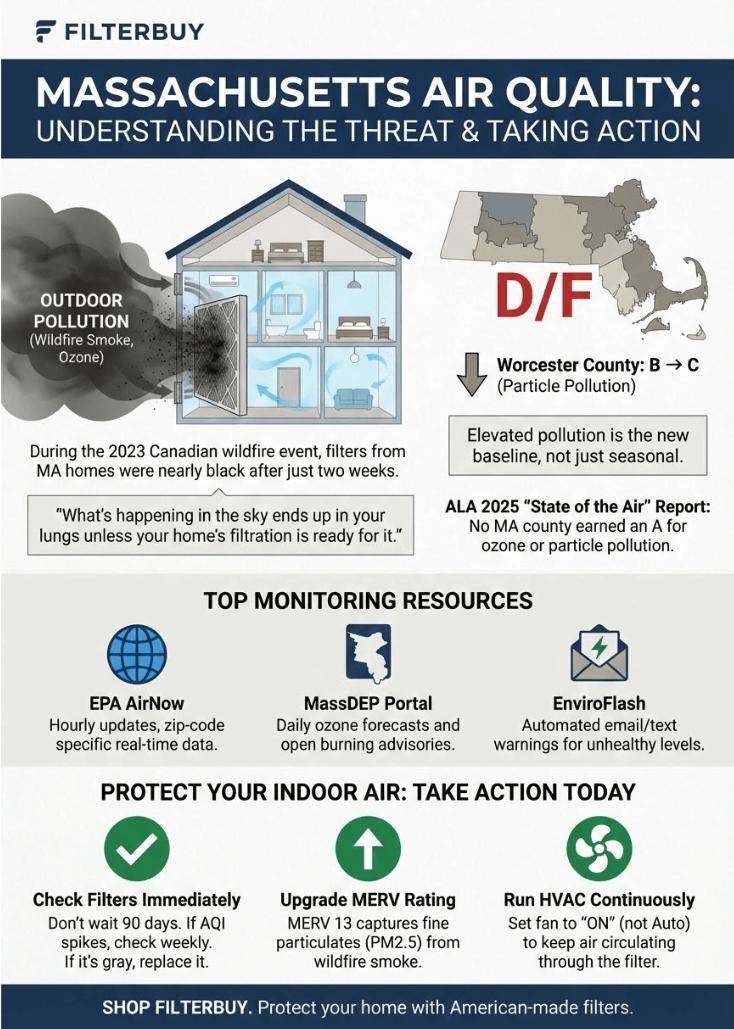
Here's what most pages won't tell you: After manufacturing over 10 million filters and analyzing thousands of used filters from homes in the region, we've seen firsthand how outdoor AQI spikes translate into what you collect on your filter. During the Canadian wildfire event of last summer, filters from customers in the area returned nearly black after just two weeks - a reminder that outdoor air impacts indoor air before most people realize it.
Use the live map below to get the current conditions, then scroll down for readings specific to your city, and our recommendations based on what we've actually seen in homes like yours.
TL;DR Quick Answers
Where can I find a live air quality index AQI map for Massachusetts today?
Best Resources for Real-Time Massachusetts AQI:
EPA AirNow: Official source with 20+ monitoring stations, hourly updates, zip code search
MassDEP Portal: State-specific data, daily forecasts, hotline at 1-800-882-1497
EPA Fire and Smoke Map: 15,000+ sensors for wildfire smoke tracking
What We've Learned After Serving Over Two Million Households:
Outdoor AQI directly impacts indoor air. During the June 2023 wildfire event, Massachusetts filters returned to our facilities nearly black in just two weeks. Monitor outdoor conditions daily. Check your filter when AQI reaches orange or higher. Your HVAC filter is the barrier between outdoor pollution and your family's lungs.
Pro Tip: Bookmark EPA AirNow and check it each morning. Sign up for EnviroFlash alerts to receive automatic notifications when Massachusetts air quality deteriorates.
Top 5 Takeaways
Monitor the Massachusetts AQI daily. Use EPA AirNow, MassDEP, or the EPA Fire and Smoke Map. Bookmark one source. Check it each morning.
Outdoor air affects indoor air. During the June 2023 wildfire event, Massachusetts filters returned to our facilities nearly black after just two weeks. Outdoor pollution enters through doors, windows, and your HVAC system.
No Massachusetts county earned an A grade. The American Lung Association's 2025 report confirms elevated pollution is the baseline. Year-round vigilance matters.
Replace filters based on conditions, not calendars. Skip the 90-day generic recommendation. For Massachusetts homes: 60 to 75 days maximum. During elevated AQI events: check weekly.
Your filter is your home's primary defense. Outdoor monitoring tells you when to be concerned. Your filter tells you what actually entered—both matter.
Understanding the AQI Scale: What the Numbers Mean for Your Family
The Air Quality Index ranges from 0 to 500, with lower numbers indicating cleaner air. But here's what the EPA scale doesn't take into account - your home's specific vulnerabilities.
0-50 (Good): Air quality is satisfactory. Normal filter maintenance is applicable - monthly check, replace every 90 days.
51-100 (Moderate): Acceptable for most people. If anyone in your household has respiratory sensitivities, consider checking filters more frequently.
101-150 (Unhealthy for Sensitive Groups): Sensitive people - children, old family members, those who suffer from asthma or heart diseases - should avoid spending too long outside.
151-200 (Unhealthy): Everyone is at risk. Keep windows shut and install your heating and air-conditioning system, and let it run to filter the air.
201+ (Very Unhealthy to Hazardous): Stay indoors with windows and doors sealed. Your filter will work overtime.

How Outdoor AQI Affects Your Indoor Air in Massachusetts
Here's a reality most people don't consider: outdoor air constantly infiltrates your home. Through gaps around windows and doors, through your HVAC system's fresh air intake, even through the building materials themselves—outdoor pollutants find their way inside.
When outdoor level spikes, your filter takes the hit. During the June 2023 Canadian wildfire smoke event, we witnessed many households in that region that needed immediate replacement. From the used filters, you can have a glimpse of what you would’ve breathed in if they were not working efficiently.
Protecting Your Indoor Air When AQI Spikes
Based on more than 10 years of manufacturing experience, as well as the direct feedback of our Massachusetts customers, here's what actually works:
Check your current filter immediately. If it's already loaded with debris, it can't effectively capture new pollutants.
Run your HVAC system continuously. Set the fan to "on" rather than "auto" to keep air circulating through your filter even when heating or cooling isn't actively running. This passes the air in your home through the filter more often.
Seal obvious air leaks temporarily. During severe air quality index events, consider placing rolled towels under doors to exterior spaces and closing fireplace dampers.
Consider your filter's MERV rating. MERV 13 filters capture the fine particulates (PM2.5) that wildfire smoke and vehicle emissions - the particles with the most association with respiratory and cardiovascular health effects.
Keep replacement filters on hand. During widespread air quality events, filter demand spikes, and shipping can be delayed. Having a backup filter ready means you're never caught without protection when you need it most.
"After analyzing thousands of filter returns from Massachusetts homes during the 2023 Canadian wildfire event, we saw filters come back nearly black in just two weeks—a visible reminder that what's happening in the sky ends up in your lungs unless your home's filtration is ready for it."
— Filterbuy Air Quality Team
Essential Resources for Tracking Massachusetts Air Quality
The following seven resources give Massachusetts residents the tools to monitor conditions, receive timely alerts, and make confident decisions about protecting their family's health.
1. EPA AirNow Massachusetts: Official Real-Time AQI Data from 20 plus State Monitors
This is where the official numbers come from. The U.S. Environmental Protection Agency's AirNow platform pulls data from monitoring stations across Massachusetts and updates readings hourly, giving you current AQI values, next-day forecasts, and straightforward health guidance based on the color-coded system you've seen on local news.
Resource: https://www.airnow.gov/state/?name=massachusetts
2. MassDEP Air Monitoring Portal: State-Level Forecasts and Burn Advisories
Your state's own environmental protection team operates more than 20 monitoring stations and issues daily ozone forecasts from April through October, year-round particle pollution predictions, and open burning advisories when conditions warrant caution.
Resource: https://www.mass.gov/air-monitoring-in-massachusetts
3. EPA Fire and Smoke Map: Real-Time Wildfire Smoke Tracking with 15,000+ Sensors
This EPA and U.S. Forest Service tool combines official monitor data with readings from thousands of crowd-sourced sensors to track smoke plumes, active fires, and particle pollution in near real-time—exactly the kind of early warning that helps you get ahead of the problem.
Resource: https://fire.airnow.gov/
4. AirNow Mobile App: Push Notifications and On-the-Go AQI Monitoring
Available for both iOS and Android, it sends push notifications when AQI reaches whatever threshold you set—so you'll know before you head out for that morning run or send the kids to outdoor practice.
Resource: https://www.airnow.gov/airnow-mobile-app/
5. EnviroFlash Alerts: Automated Email and Text Warnings for Your Zip Code
Sign up once with your Massachusetts zip code, and you'll receive free email or text alerts whenever pollution levels are forecast to reach unhealthy categories in your specific area.
Resource: https://www.enviroflash.info/signup.cfm
6. American Lung Association State of the Air: Massachusetts County Report Cards
Here's the reality check: the 2025 report found that not a single Massachusetts county earned an A grade for ozone or particle pollution. Understanding these long-term trends helps you recognize that protecting your family's air quality isn't a one-time decision—it's an ongoing commitment.
Resource: https://www.lung.org/research/sota/city-rankings/states/massachusetts
7. EPA Air Quality Health Guide: Protection Strategies for Sensitive Groups
The EPA's health resource breaks down exactly how ozone and particle pollution affect breathing, what activity modifications make sense at each AQI level, and specific protective steps for children, older adults, and anyone with heart or lung concerns. Knowledge is power—and in this case, it's also protection.
Resource: https://www.epa.gov/air-quality/asthma-and-your-health
Supporting Statistics: What the Research Confirms—And What Our Filters Reveal
Government agencies and health organizations have spent decades studying air quality. Their findings align precisely with what we observe every day at Filterbuy.
Here's where the research meets reality:
The 90% Reality: Why Your Home Isn't the Safe Haven You Think It Is
The Research: Americans spend approximately 90 percent of their time indoors, where pollutant concentrations are often 2 to 5 times higher than outdoors.
Source: U.S. Environmental Protection Agency, Report on the Environment
Link: EPA Indoor Air Quality Report
What We've Learned After Producing Over 10 Million Filters:
During the June 2023 Canadian wildfire event, filters from Massachusetts homes came back with distinctive gray-brown discoloration after just two to three weeks of use. These weren't filters that had been installed for months. They were nearly saturated in a fraction of their expected lifespan.
4.7 Million Children with Asthma: The Stakes Behind Every Filter Change
The Research: Asthma affects approximately 1 in 15 U.S. children—4.7 million total. Children with asthma miss more than 7.9 million school days annually due to symptoms.
Source: Centers for Disease Control and Prevention, National Asthma Data
Link: CDC Most Recent National Asthma Data
What Our Customer Interactions Have Taught Us:
Parents of children with asthma don't call asking about technical specifications for casual reasons. They call because:
Their child had an emergency room visit last month
Allergy season hit early, and the rescue inhaler is getting overused
They moved into an older home, andtheir breathing symptoms have worsened
They noticed improvement after upgrading their filter's MERV rating
What Massachusetts Air Quality Report Cards Mean for Your Family
The Research: The 2025 "State of the Air" report found that not a single Massachusetts county earned an A grade for ozone or particle pollution. The Boston-Worcester-Providence metro area ranks 61st worst nationally for ozone pollution.
Source: American Lung Association, 2025 State of the Air Report
Link: American Lung Association Massachusetts Report
Key findings from the report:
Widespread wildfire smoke in 2023 worsened grades across the region
Worcester County's particle pollution grade dropped from B to C
156 million Americans (46% of the population) live in areas with failing grades
The metro area is now among the three worst in the Northeast for ozone
What Our Regional Data Patterns Reveal:
Our shipment records show distinct signatures that align with these findings:
Coastal communities order differently from inland areas
Urban Suffolk County customers replace filters on different schedules than rural Berkshire County customers
Massachusetts orders increased 40%+ during the 2023 wildfire event compared to previous years
Year-round elevated particle accumulation has become the baseline, with seasonal peaks layered on top
Final Thoughts and Opinion
After more than a decade of manufacturing air filters and serving over two million households, we've developed strong opinions about indoor air quality. These opinions weren't shaped by marketing trends. They come from what we've observed in our facilities, heard in customer conversations, and seen in the physical evidence of returned filters.
Here's what we believe, and why.
The Cheapest Filter Is Rarely the Smartest Choice
This might sound self-serving from a filter manufacturer. But we've earned the right to say it through years of evidence.
What customers tell us after switching to appropriate MERV-rated products:
Allergy symptoms that had become "normal" suddenly improved
HVAC systems that ran constantly began cycling properly
Dust accumulation on furniture noticeably decreased
Children with asthma had fewer nighttime episodes
Replacement Schedules Should Reflect Reality, Not Convenience
The 90-day recommendation printed on most packaging assumes average conditions. Massachusetts households don't live in average conditions.
Our actual recommendations for Massachusetts homes: During elevated AQI events, check your filter weekly and replace it when visibly loaded. During wildfire smoke periods, expect 50 percent or less of the normal filter lifespan.
Our position: Checking your filter takes 30 seconds. Waiting an extra month because the calendar says you can risk inadequate filtration when conditions demand more protection.
Monitoring Outdoor Air Is Only Half the Equation
The seven resources we've outlined for tracking Massachusetts air quality are genuinely valuable. But here's what those tools can't tell you: what's actually happening inside your home.
Outdoor monitoring stations measure ambient conditions across broad areas. They don't account for your home's specific characteristics, like your HVAC system and pre-existing conditions, in your household.
Next Steps: Protect Your Massachusetts Home Starting Today
Understanding air quality is important. Taking action is what actually protects your family. Here's exactly what to do next, starting with steps you can complete in the next five minutes.
Immediate Actions (Complete Today)
1. Check your current filter right now.
Pull out your filter and hold it up to a light source. If light doesn't pass through easily, or if you see gray or brown discoloration, it's time for a replacement—regardless of when you installed it.
2. Write down your filter size.
Look at the frame for the printed dimensions. You'll see three numbers: length, width, and depth. Common Massachusetts sizes include 16x25x1, 20x20x1, and 20x25x4. Save this in your phone notes.
3. Bookmark one air quality monitoring resource.
Start with EPA AirNow. Enter your zip code and save the page. Check it whenever you see haze or hear about air quality concerns.
This Week's Actions
4. Sign up for EnviroFlash alerts.
Register your email with your zip code
Choose alerts for sensitive group levels
5. Download the AirNow mobile app.
Free for iOS and Android
Enable push notifications
6. Assess your household's specific needs.
Ask yourself:
Does anyone have asthma, allergies, or respiratory conditions?
Do you have pets that shed dander?
Is your home older with potential air sealing issues?
Do you live near major roads, industrial areas, or wooded regions?
Your answers determine whether you need higher MERV ratings and more frequent replacements.
This Month's Actions
7. Evaluate your current filter's MERV rating.
Check the packaging or filter frame for the MERV number.
MERV 8: Basic protection for homes without specific concerns
MERV 11: Better capture for mild allergies or pet owners
MERV 13: Optimal protection for asthma, severe allergies, or elevated AQI periods
If you're using fiberglass panel filters or anything below MERV 8, consider upgrading.
8. Establish a filter check routine.
Set a recurring phone reminder for the first of each month
Label it "Check HVAC Filter."
Takes 30 seconds
Respond to actual conditions, not arbitrary schedules
9. Stock replacement filters.
Keep at least two replacements on hand
Replace immediately when conditions demand
Don't wait for shipping during air quality emergencies
Ongoing Commitment
10. Monitor conditions seasonally.
Massachusetts challenges shift throughout the year:
Spring: Tree pollen peaks March through May
Summer: Ozone rises on hot, sunny days
Late Summer/Fall: Ragweed and potential wildfire smoke
Winter: Indoor air recirculates more with closed windows
Adjust your filter check frequency accordingly.
11. Review the American Lung Association's annual report.
Released each spring
Provides updated grades for Massachusetts counties
Bookmark and check annually
12. Trust what your filter tells you.
No monitoring station shows exactly what's entering your specific home. When you see heavy particle loading after just a few weeks, that's direct evidence. Respond accordingly.
Frequently Asked Questions
Q: Where can I find a live air quality index map for Massachusetts right now?
A: After years of tracking how air quality events affect our Massachusetts customers, we consistently recommend these resources:
EPA AirNow (Primary Recommendation)
Pulls data from over 20 official monitoring stations across Massachusetts
Updates hourly
Enter your zip code for localized readings
Viewthe full regional map for statewide conditions
EPA Fire and Smoke Map (Wildfire Events)
Combines official monitoring with over 15,000 low-cost sensors
Provides more granular coverage during smoke events
Our order data shows wildfire impacts have increased significantly in recent years
MassDEP Air Monitoring Portal
State-specific data and daily forecasts
Hotline at 1-800-882-1497
Customers tell us this provides faster answers than websites during active emergencies.
Q: What do the AQI numbers and colors mean for my health?
A: The Air Quality Index runs from 0 to 500 across six color-coded categories.
AQI Categories:
Green (0-50): Good. Minimal concern for anyone.
Yellow (51-100): Moderate. Acceptable for most people.
Orange (101-150): Unhealthy for sensitive groups. This is where we start hearing from customers with respiratory sensitivities.
Red (151-200): Unhealthy for everyone, not just sensitive groups.
Purple (201-300): Very unhealthy. Significant health effects for all.
Maroon (301-500): Hazardous. Emergency conditions.
What We Observed During June 2023:
Parts of Massachusetts reached red and purple levels during the Canadian wildfire event. We saw the direct impact in our facilities:
Filters returned nearly black after just two weeks
Customer service calls about "saturated filters" spiked within 48 hours
Visible discoloration appeared in a fraction ofthe normal filter lifespan
Q: Why does the AQI reading differ between websites and apps?
A: This question comes up frequently in customer calls. The differences involve data sources and update timing.
Official Sources (EPA AirNow, MassDEP):
Use regulatory monitors meeting strict federal standards
Stations spaced miles apart
Highly accurate but less granular
Sensor-Based Apps (IQAir, PurpleAir):
Incorporate low-cost sensor networks
More locations available
Potential accuracy variations
Update Frequency Varies:
Some platforms refresh hourly
Others update every few minutes
Time lag can cause discrepancies
Our Practical Advice:
Pick one primary source and stick with it for consistency. Jumping between platforms during an air quality event creates confusion. The trends matter more than exact numbers. When readings climb into orange or red on any reputable platform, it's time to check your filter and limit outdoor exposure.
Q: How often should I check the AQI in Massachusetts?
A: Our recommendation comes from observing customer behavior patterns over more than a decade.
Normal Conditions:
Check once daily
Morning works best for planning outdoor activities
Elevated Conditions or Air Quality Alerts:
Check every few hours
Levels can shift rapidly
Automate Your Monitoring:
Sign up for EnviroFlash alerts
Receive notifications when AQI reaches concerning levels
Takes less than two minutes to set up
Check Massachusetts Air Quality Today—Then Protect What's Inside
Now that you know how to monitor live AQI conditions across Massachusetts, take the next step by ensuring your home's HVAC filter can handle what outdoor air brings in. Shop Filterbuy's selection of American-made filters in over 600 sizes and give your family the protection they deserve.