
Air Quality in Rhode Island
Air quality index (AQI⁺) and PM2.5 air pollution in Rhode Island •


Get Alerts For Unhealthy AQI In Your Area
When air quality in your area reaches unhealthy levels, we'll send you a quick alert, along with expert tips on how to reduce your exposure.
Live Air Quality Ratings in Rhode Island
Live Most Polluted City Ranking
Real-time most polluted cities in Rhode Island
Live Cleanest City Ranking
Real-time cleanest cities in Rhode Island
The Right Air Filter For High AQI Days
When outdoor air quality drops, the EPA recommends upgrading to a MERV 13 filter — or the highest-rated filter your HVAC system can handle — to help capture more of the fine particulate (PM2.5) that comes with poor air quality. MERV 13 is the highest rating most residential systems can run without restricting airflow.
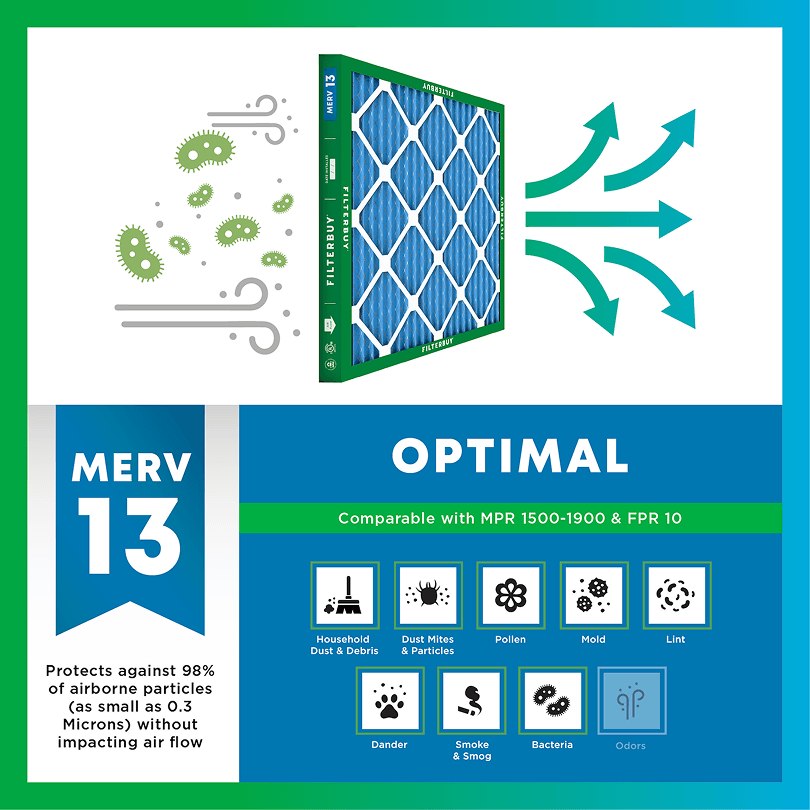
- Captures PM2.5 and other fine particulates
- Filters ash, soot, and smoke particles
- Rated to capture particles as small as 0.3 microns
- Matches the filter rating the EPA suggests during high-AQI and smoke events

AQI FAQs
What is AQI?
AQI stands for Air Quality Index, the EPA's scale for reporting daily air quality. It runs from 0 to 500. The higher the number, the greater the level of air pollution. Values at or below 100 are generally considered satisfactory; values above 100 mean air quality is unhealthy, first for sensitive groups, then for everyone as numbers climb.
What does AQI measure?
The AQI tracks five major pollutants regulated by the Clean Air Act: ground-level ozone, particle pollution (PM2.5 and PM10), carbon monoxide, sulfur dioxide, and nitrogen dioxide. The reported AQI value reflects whichever pollutant is highest at that time — most often ozone or fine particles (PM2.5).
How is AQI calculated?
Monitoring stations measure pollutant concentrations, and the EPA converts each into a standardized 0–500 score using set breakpoints. Each pollutant gets its own sub-index, and the highest sub-index becomes the reported AQI. That's why a single number can represent different pollutants on different days.
What is a good AQI?
An AQI of 0–50 is rated "Good" — air quality poses little or no risk. 51–100 is "Moderate," acceptable for most people though unusually sensitive individuals may want to limit prolonged outdoor exertion. Anything at or below 100 is generally considered satisfactory air quality.
What does an AQI of 100 (or 150) mean?
100 is the dividing line: at or below it, air quality is satisfactory for the general public. From 101–150, air is "Unhealthy for Sensitive Groups" — people with respiratory conditions, older adults, and children. From 151–200, it's "Unhealthy" and everyone may begin to feel effects.
Why is the AQI bad today?
Short-term AQI spikes usually come from wildfire smoke, temperature inversions that trap pollutants near the ground, high-ozone weather (hot, sunny, stagnant days), or heavy traffic and industrial activity. Check a real-time source like the map on this page to see which pollutant is driving today's reading in your area.
What AQI is bad for running or exercise?
Many runners follow the EPA category lines: below 50, no adjustment needed; 51–100, unusually sensitive people may shorten intense workouts; above 100, sensitive groups are advised to reduce prolonged or heavy outdoor exertion; above 150, that advice extends to everyone. Exercise increases how much air you breathe in, which is why thresholds matter more during workouts.
What AQI is safe to open windows?
A common rule of thumb is to keep windows open when the AQI is under 100 and close them when it climbs above, especially during wildfire smoke events when fine particles are elevated. When windows are closed, running your HVAC system with a fresh filter helps capture particles circulating indoors.
Should I wear a mask based on AQI?
Public health agencies generally suggest considering a well-fitted N95-style respirator outdoors when the AQI exceeds 150, particularly during smoke events. Cloth and surgical masks don't filter fine particles effectively. Follow guidance from your local health department, which may adjust recommendations during severe episodes.

Check Today's Live Real Time Air Quality Index AQI Map in Rhode Island Now
Author: Michelle Wan | Reviewer: David Clark, Licensed HVAC Technician | Publish Date: July 23, 2026 | Updated Date: July 23, 2026
Wondering if it's safe to be outside in Rhode Island today? Check the live Air Quality Index (AQI) map below for real-time conditions across the Ocean State. The map updates hourly and shows whether ozone or fine particles are driving today's number.
TL;DR
Rhode Island's air quality shifts throughout the day, driven mostly by ground-level ozone in the warmer months and by fine particles carried in from other regions. Use the live map below to see today's AQI, then check the color band guide to understand what that number means for your health. When the AQI climbs into the orange range or higher, running your HVAC fan on Circulate with a Filterbuy MERV 13 filter keeps outdoor particles from building up inside your home.
Key Takeaways
Rhode Island's live AQI map updates hourly and reflects whichever pollutant, ozone or PM2.5, is highest at that moment.
Most air pollution here forms locally in summer heat or travels in from upwind states, not heavy local industry.
RIDEM's monitoring rarely records PM2.5 above Moderate, but ozone regularly reaches Unhealthy levels in summer.
Homes near highways face added exposure to near-road particles, even on Good AQI days.
A Filterbuy MERV 13 filter captures more fine particles than a standard MERV 8 filter.
Rhode Island has one of the highest adult asthma rates in the country.
A Note From Our Air Quality Writer
Most air quality write-ups treat every state the same, telling you to check the AQI and upgrade to MERV 13. Rhode Island doesn’t quite work that way. The state’s monitoring almost never flags PM2.5, so the real story here is ozone, and how much of it blows in from somewhere else. Readers who write in about Rhode Island are often surprised an AQI spike can happen on a clear, calm day with nothing local to blame. Once you understand the difference between an ozone day and a wildfire smoke day, the response to each makes more sense.
Michelle Wan, Brand Manager & Air Quality Writer, Filterbuy
Live AQI Map For Rhode Island
Filterbuy built this page to pair that outdoor reading with the one thing you actually control, what's filtering the air inside your home.
Enter your city or ZIP code above to see the current AQI, the forecast for the rest of the day, and which pollutant is behind today's number.
What Today's AQI Number Means
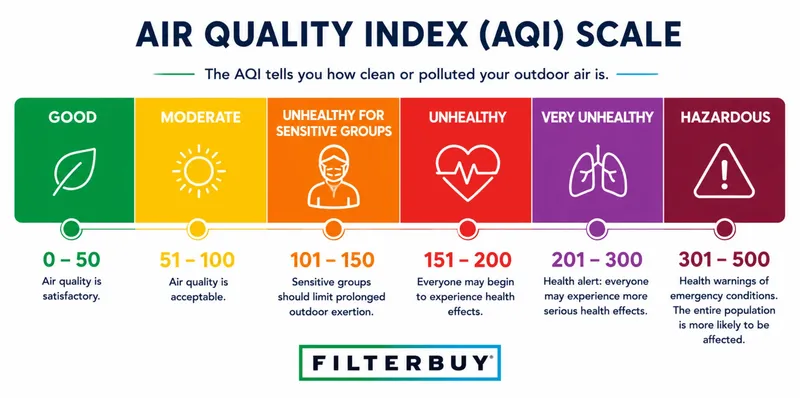
The Air Quality Index runs from 0 to 500. Lower numbers mean cleaner air. The scale breaks into six color bands, and each one comes with a different level of health precaution.
AQI categories and health guidance follow the EPA's Air Quality Index scale.
Rhode Island's air most often sits in the Good or Moderate range. Ozone is the pollutant that pushes the state into Unhealthy for Sensitive Groups territory, usually on hot, sunny afternoons between May and September.
Why Rhode Island's Air Quality Moves The Way It Does
Rhode Island's pollution pattern looks different from a state with heavy local industry. RIDEM's monitoring rarely finds PM2.5 above the daily standard, yet ozone regularly climbs into Unhealthy levels each summer as pollution travels in from upwind regions and reacts in Rhode Island's own sunlight and heat. Neighboring Massachusetts sees a similar pattern, pointing to shared New England exposure. Homes near major highways face a second, more localized risk from higher near-road particle levels, even when the official AQI reads Good.
Sourced from RIDEM air monitoring notes and EPA guidance on particle pollution.
The AQI Number Doesn't Show You This: Rhode Island's Near-Road And Port Communities
Rhode Island's statewide AQI reading is a real number, but it's an average. It doesn't capture what RIDEM's Port of Providence air toxics monitoring project has found happening block by block in parts of Providence.
RIDEM received a $263,502 EPA grant to install air toxics monitors at five locations around the Port of Providence, where diesel trucks, marine vessels, and asphalt and cement processing add pollution sources a statewide reading doesn't isolate.
Interstate 95 runs directly through Providence neighborhoods that RIDEM identifies as having among the highest poverty and childhood asthma rates in the state.
RIDEM's data shows the east side of Providence has a lower rate of childhood asthma than the rest of the city, a documented gap that a single statewide AQI figure can't show.
Rhode Island maintains a dedicated Near Road monitoring site on Park and Hayes Street in Providence specifically because pollution levels next to major highways consistently run higher than general ambient readings.
If you live near I-95, near the Port of Providence, or along another major roadway, a Good statewide AQI reading may still understate what's reaching your home. The near-road guidance already covered on this page, running your fan on Circulate and considering a Filterbuy MERV 13 filter, matters more, not less, on days when the statewide number looks fine.
What To Do Indoors When Rhode Island's AQI Rises
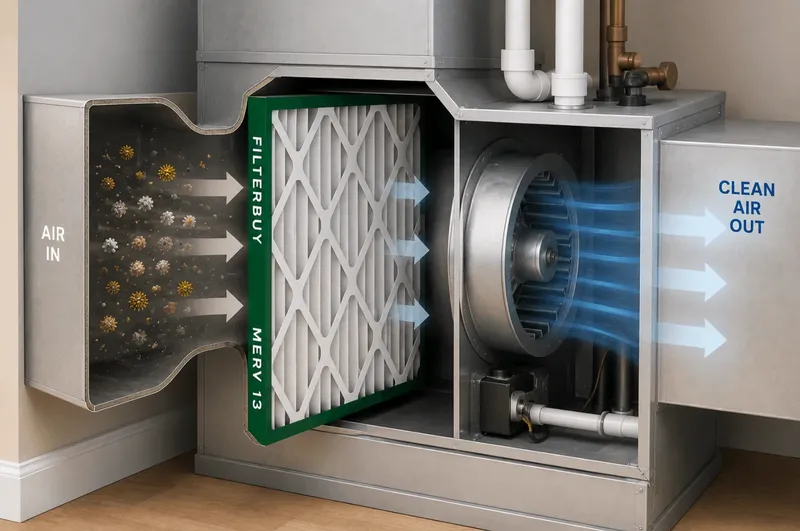
When the AQI moves into the orange range or higher, keep windows closed and run your HVAC fan on "On" or "Circulate" instead of "Auto." A MERV 13 filter captures more fine particles than a MERV 8, and it's the level the EPA recommends when outdoor particle pollution is high (see Essential Resources below). Not sure MERV 13 fits your household? Compare MERV 8 and MERV 11 first.
Ready to upgrade? Shop MERV 13 Air Filters. Confirm your system can handle the added resistance first, since not every system is built for it.
Expert Quote
Most of what shows up in Rhode Island’s air started somewhere else. That means the AQI can spike on a day when nothing changed at your house. The best defense is having a filter already in place that’s rated to catch what blows in.
David Clark, Licensed HVAC Technician
After manufacturing filters for over a decade and serving more than two million households, Filterbuy has seen how quickly outdoor air quality swings can affect what's circulating inside a home.
Frequently Asked Questions
Essential Resources For Tracking Rhode Island's Air Quality
Check Rhode Island's Live AQI Reading Anytime
AirNow's Rhode Island state page pulls current conditions from the state's official monitoring network, updated hourly.
Get Rhode Island's Own Daily Forecast And Alerts
RIDEM's air quality forecast publishes the state's daily outlook and any active air quality alerts.
Know Which Filter Rating Actually Stops Outdoor Particles
the EPA's guide to air cleaners in the home explains MERV ratings and states directly when a MERV 13 upgrade is worth it.
Recognize When Outdoor Air Is Triggering Your Asthma
the CDC's guidance on controlling asthma covers how outdoor pollution ranks among the most common asthma triggers.
Understand What's Actually In Rhode Island's Air
NOAA's explainer on ozone and particulate matter breaks down how these two pollutants form and why they behave differently.
See Who Faces The Greatest Risk From Ozone
the American Lung Association's ozone health page lists which groups face the greatest risk, from children to people with asthma or heart disease.
Learn How Often To Actually Check Your Filter
ENERGY STAR's HVAC filter guidance covers how often to check and change a filter, not just the generic 90-day rule.
Supporting Statistics Behind Rhode Island's Air Quality Picture
Rhode Island Ranks Among The Nation's Toughest Places To Manage Asthma
AAFA's 2025 Asthma Capitals report:
Providence metro ranks 9th nationally for asthma prevalence among the 100 largest U.S. metro areas
More than 28 million Americans, about 1 in 12 people, currently live with asthma
Takeaway: check the AQI before extended outdoor time in Rhode Island
Half Of New England Homes Rely On Window Units, Not Central Air
EIA's residential air-conditioning data:
About 50 percent of Northeast households primarily use individual window or wall AC units
A whole-home filter only cleans air pulled through the HVAC system
Takeaway: homes without central air get less benefit from a MERV upgrade
Ozone Exposure Is Linked To Long-Term Respiratory And Heart Risk
NIH-published research on ozone pollution:
Short-term ozone exposure is linked to increased respiratory risk
Long-term ozone exposure is linked to increased cardiovascular mortality risk
Takeaway: ozone is Rhode Island's most frequent AQI driver each summer
Glossary
AQI (Air Quality Index): A 0 to 500 scale the EPA uses to show how clean or polluted outdoor air is, based on the highest pollutant reading.
Ground-Level Ozone: A gas that forms when pollution reacts in sunlight and heat, usually peaking on hot summer afternoons.
PM2.5: Fine particles 2.5 micrometers or smaller that travel deep into the lungs, from sources ranging from traffic to wildfire smoke.
Near-Road Monitoring: Air quality measurements taken close to highways, where particle levels typically run higher than the surrounding area.
MERV Rating: A scale that measures how well an air filter captures particles. MERV 13 is not the same as True HEPA.
RIDEM: The Rhode Island Department of Environmental Management, the state agency that monitors air quality and issues forecasts and alerts.
AAFA: The Asthma and Allergy Foundation of America, a nonprofit that publishes annual research on asthma prevalence and outcomes by U.S. metro area.