
Rockford Real-Time AQI Tracker


Get Alerts For Unhealthy AQI In Your Area
When air quality in your area reaches unhealthy levels, we'll send you a quick alert, along with expert tips on how to reduce your exposure.
What's Actually In Rockford Air Today?
What High AQI Means for Your Lungs in Rockford
How to Read AQI
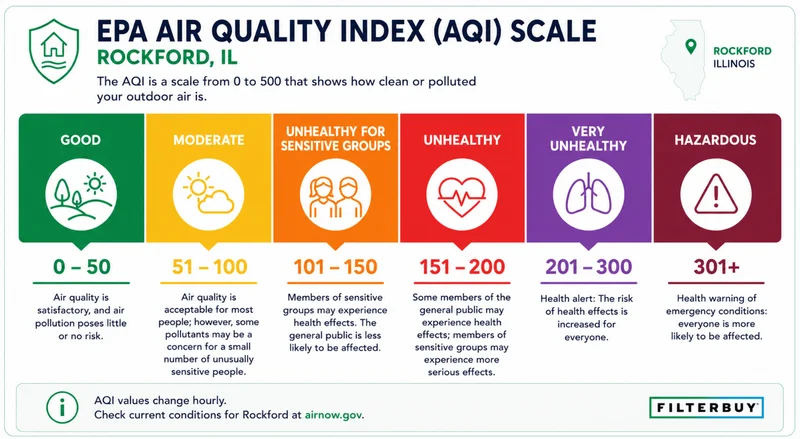
The Air Quality Index (AQI) measures how polluted the air is and how it may affect your health.
0–50 (Good): Air quality is satisfactory.
51–100 (Moderate): Acceptable, but some pollutants may pose minor concerns.
101–150 (Unhealthy for Sensitive Groups)
151–200 (Unhealthy)
201–300 (Very Unhealthy)
301+ (Hazardous)
Moderate
Still okay for most, but if you have asthma or allergies, take it easy and avoid long outdoor workouts.
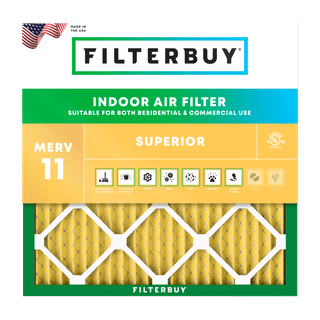
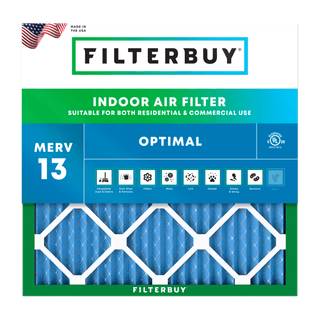
Shop MERV 11 filters→What's the Right Filter for Your AQI Level?
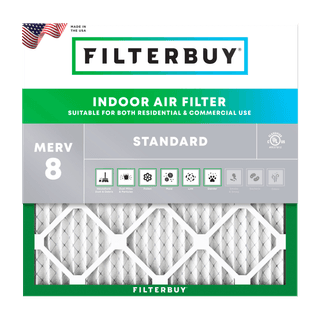


Check Today's Live Real Time Air Quality Index AQI Map in Rockford, IL Now
By Michelle Wan, Brand Manager and Air Quality Writer, Filterbuy. Technically reviewed by David Clark, Licensed HVAC Technician. Published August 12, 2026. Updated August 12, 2026.
TL;DR
Rockford’s air quality changes hour by hour, so the live map above is the fastest answer to what you’re breathing right now. Most days Winnebago County sits in the Good or Moderate range, but Canadian wildfire smoke can push Rockford into Unhealthy or Very Unhealthy territory in a matter of hours. It hit an AQI of 268 on July 16, 2026. When the number climbs past 100, close the windows and let your HVAC filter do the work.
Key Takeaways
The AQI is a 0–500 scale, and 100 is the line that matters. Anything above 100 is unhealthy for sensitive groups; above 150 is unhealthy for everyone.
Wildfire smoke is now Rockford’s biggest air quality wildcard. On July 16, 2026, smoke from Canadian wildfires pushed the Rockford area to an AQI of 268, and the Rockford Park District canceled outdoor programming.
Winnebago County is not designated nonattainment for any pollutant. Illinois’ nonattainment areas are metro Chicago and Metro East St. Louis, so Rockford’s day-to-day baseline is cleaner than the state’s problem regions.
Outdoor air becomes indoor air. The EPA reports indoor pollutant levels commonly run two to five times higher than outdoor levels, which makes your furnace filter the last line of defense.
A MERV 13 filter plus a continuously running fan is the EPA’s smoke-day playbook. The EPA reports that combination can cut indoor PM2.5 by roughly half.
What Is the Air Quality in Rockford Today?
The live map at the top of this page shows Rockford’s current Air Quality Index in real time, pulled from U.S. EPA AirNow and Illinois EPA monitoring data. Find your reading, note the color, and check the dominant pollutant. In Rockford that is almost always PM2.5 (fine particles) in summer and fall. A number under 50 is Good. Between 51 and 100 is Moderate. Above 100 means sensitive groups should start adjusting their day.
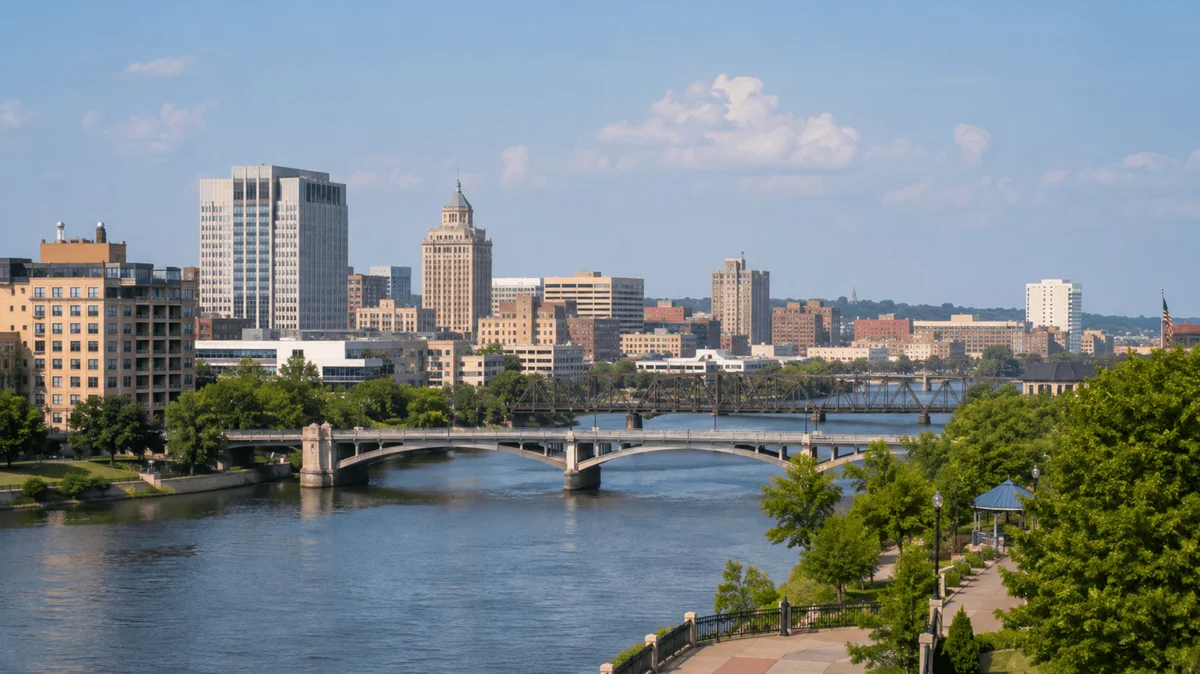
The Illinois Environmental Protection Agency operates the monitoring sites that feed this reading. Per the Illinois EPA 2026 Ambient Air Monitoring Network Plan, two sit in Winnebago County: one at the Rockford Fire Department administration building at 204 South 1st Street, and one at Maple Elementary School at 1405 Maple Avenue in Loves Park. That matters for interpretation. A single reading represents a neighborhood-scale sample, not your exact block. If you live near I-90, I-39, or an active construction corridor, your immediate air can be worse than the citywide number suggests. To see the same data statewide, check Illinois air quality now.
What the Live Map Cannot Tell You
A live AQI reading is a neighborhood estimate, not a measurement of your street. Winnebago County has about 285,000 residents and two Illinois EPA monitoring sites. That works out to roughly one per 140,000 people, both inside the Rockford and Loves Park urban core. That is normal for a mid-sized county. Factor it in before you treat a green reading as permission.
Three situations where your air is likely worse than the number shows: within a few hundred feet of I-90 or I-39 during rush hour, downwind of active construction or an industrial corridor, and inside your own home while someone is frying, vacuuming without a HEPA machine, or running a wood stove. The first two the map cannot see. The third the map is not even looking at.
During smoke events, the AirNow Fire and Smoke Map fills some of that gap by adding low-cost community sensors between official monitors. It is the better tool when smoke is the story. This map is the better tool the rest of the year.
What Each AQI Level Means for Rockford Residents
Use this table to translate the number on the map into a decision. The categories are set by the U.S. EPA and apply nationwide; the guidance is written for a typical Rockford household with a central forced-air HVAC system.
Categories set by the U.S. EPA and applied nationwide. Guidance written for a Rockford household with a central forced-air HVAC system.
What to Do When Rockford’s AQI Goes Above 100
When the map shows a number over 100, work through this list in order. It takes about ten minutes and it’s the difference between filtering the smoke and circulating it.
Close windows and doors, including the ones you opened for the breeze last night.
Switch the thermostat fan from Auto to On. Continuous circulation pushes more air through the filter per hour.
Check the filter you have in right now. If it’s gray, loaded or older than 60 days, replace it before the smoke peaks. A clogged filter restricts airflow and strains the blower.
Upgrade to MERV 13 if your system supports it. Check your equipment manual or ask your HVAC tech. If it doesn’t, MERV 11 is the next-best step up from a standard MERV 8.
Skip the indoor particle sources: no candles, no wood stove, no frying, no vacuuming without a HEPA-filtered machine.
Set up one clean room, usually the bedroom, with a portable HEPA unit sized for the space.
Recheck the map before evening, and cross-check the AirNow Fire and Smoke Map if smoke is the driver. Rockford conditions can improve as fast as they degrade.
Why timing matters more than most people expect. On July 16, 2026 the Illinois EPA alert went out just after midnight, Rockford was already very unhealthy by mid-morning, and the Park District had cancelled programming the same day. Alert to closed fields took under twelve hours. A filter you order once the sky turns brown arrives days late. Buy the spare before the season, not during the event.
Why Rockford’s Air Quality Changes So Fast
Rockford’s air quality is driven by four things: wildfire smoke drifting in from Canada and the upper Midwest, summer ground-level ozone, seasonal agricultural and pollen activity from surrounding Winnebago and Ogle county farmland, and vehicle emissions along the I-90 and I-39 corridors. Of those, long-range wildfire smoke is the one that changes the number fastest, often within a single morning.
The July 2026 event is the clearest example. On July 16, 2026, smoke from hundreds of Canadian wildfires descended on northern Illinois and pushed Rockford’s AQI to 268, the high end of the very unhealthy range. The Illinois EPA issued an air quality alert covering Winnebago, Boone, McHenry and Ogle counties, declaring a Purple (Very Unhealthy) Air Pollution Action Day and following it with a Red (Unhealthy) day. The Rockford Park District canceled concerts, softball leagues and soccer rentals at Mercyhealth Sportscore One.
Here’s the honest counterweight: Rockford’s baseline air is not a problem area by federal standards. The EPA Green Book listing for Illinois names every county in the state that fails a national standard: Cook, DuPage, Lake, Will, McHenry, Kane, Madison, St. Clair and a handful of others. Winnebago County appears nowhere on it, for any pollutant. So the pattern to plan around in Rockford isn’t chronic pollution. It’s episodic spikes.
That distinction explains something confusing. The American Lung Association State of the Air report has given the Rockford area failing and near-failing grades in recent editions, even though the county is not designated nonattainment. Both are correct. The Lung Association counts every unhealthy air day recorded by official monitors, including days the EPA sets aside as wildfire "exceptional events." The EPA excludes those days when deciding attainment status. Wildfire smoke is exempt from the regulatory record, but it is not exempt from your lungs. That is exactly why a Rockford household should plan around smoke days rather than annual averages.
How Outdoor AQI Becomes Your Indoor Air
When Rockford’s outdoor AQI climbs, indoor air follows within an hour or two. The EPA reports that indoor pollutant levels commonly run two to five times higher than outdoor levels, which means your HVAC filter, not the outdoor reading, sets your family’s exposure. Fine particles slip through window frames, door gaps and worn weatherstripping. The EPA calls that process infiltration.
Rockford’s housing stock makes that matter more here than in a newer metro. The median Rockford home was built in 1963. Roughly one in five predates 1940, and fewer than one in fourteen went up after 2000, per U.S. Census American Community Survey data. Older houses breathe more. That is not a flaw to fix before smoke season. It is the reason the filter in your return duct is doing more work than most homeowners realize.
Your furnace filter is the whole-home tool that responds to this fastest. Your central system moves far more air than any portable purifier, which is why filtration at the HVAC level is the baseline and a portable unit is the supplement. If you want the full comparison, we cover MERV 13 vs. HEPA for wildfire smoke separately.
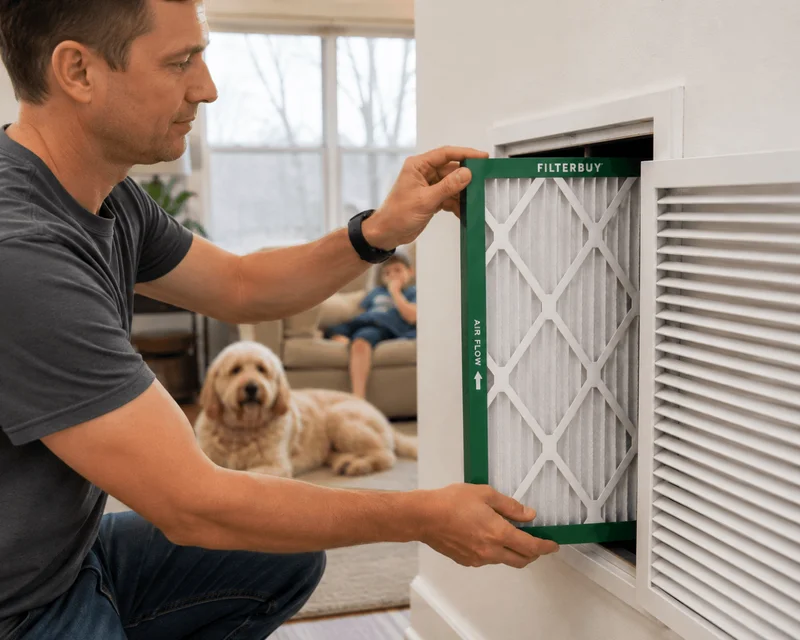
Two things determine whether that works: the filter’s MERV rating and whether it’s actually clean. The EPA’s guidance is specific. Choose a filter rated MERV 13 or as high as your system will accommodate, and set the fan to On instead of Auto so more air passes through it. The EPA also advises replacing that filter more often than the manufacturer recommends during heavy smoke: check it every two to four weeks rather than waiting out the usual 90-day cycle. Not sure which rating fits your system? Start with the best MERV filter for wildfire smoke, then find your exact filter size.
When You Should Not Upgrade to MERV 13
Filterbuy sells filters, so read this as the advice we have the least incentive to give. MERV 13 is the right target for smoke, but it is not automatically right for your system. The EPA’s own wording is MERV 13 or as high a rating as your system fan and filter slot can accommodate, and it recommends consulting an HVAC technician to find that ceiling.
Skip the upgrade if your equipment manual caps the rating below 13, if you have an older blower already struggling to move air, or if you know you will not check the filter for six months. A MERV 11 replaced on schedule moves more clean air than a MERV 13 left in until it is grey. During a smoke week the EPA advises replacing filters more often than the manufacturer says, so the honest question is not which rating you can buy. It is which rating you will actually maintain.
Our Take: In Rockford, Clean Air Is a Filtration Problem, Not a Pollution Problem
For a Rockford household, indoor filtration matters more than regional air policy. Winnebago County is not designated nonattainment for any pollutant, its worst days are imported and brief, and residents spend roughly 90% of their time indoors. That makes the filter a bigger lever than the forecast.
Most city air quality pages push you toward a different conclusion: the air outside is bad, and someone should fix it. The evidence for Rockford points somewhere more useful.
That combination changes what actually helps. Waiting on regional policy does nothing for the Thursday when Canadian smoke arrives before breakfast. A clean filter and a fan switched to On does something that afternoon. It is why the map at the top of this page is paired with a decision rather than a health lecture.
The honest limit: filtration handles particles. It does nothing for carbon monoxide or radon, and it is no substitute for evacuating if a fire is close. Filterbuy has manufactured air filters in the United States since 2013, so treat that boundary as the one we are least likely to overstate.
Filterbuy has built air filters in the United States since 2013, and the question we get after every smoke event is some version of: the app says the air is bad, so now what? Nobody hands you the second half of that sentence. For a Rockford household the answer is unglamorous. Your county already passes the federal standards. Your problem is a handful of days a year when smoke arrives faster than you can react, in a city where the median house was built in 1963 and leaks like it. Buy the filter in May. Check the map in July.
Michelle Wan, Brand Manager and Air Quality Writer, Filterbuy
Supporting Statistics
Three findings back up the guidance above. All come from federal or national health authorities.
Asthma ER visits climb once AQI passes 100.
CDC logged 172 excess asthma ER visits in a single day across Illinois and five neighbouring states during the June 27 to 29, 2023 smoke episode.
Nationwide, asthma ER visits ran 17% above expected on 19 smoke days.
CDC defined a smoke day as AQI 101 or higher. That is the same line this page tells you to act on.
Source: CDC, Morbidity and Mortality Weekly Report, August 2023.
Hazardous air days are rising sharply.
The 2022 to 2024 window recorded 26 maroon Hazardous days nationally.
Every report from 2004 through 2019 recorded between zero and eight.
145.0 million people lived through at least one Unhealthy day or worse, up from 133.4 million.
Source: American Lung Association, State of the Air 2026.
Your filter matters more than the map reading.
People spend roughly 90% of their time indoors.
Indoor pollutant levels commonly run two to five times outdoor levels.
So indoor filtration, not the outdoor number, sets what your family actually breathes.
Source: U.S. EPA, The Inside Story: A Guide to Indoor Air Quality.
Primary sources: CDC MMWR on asthma and wildfire smoke; ALA State of the Air 2026; EPA, The Inside Story.
Sources verified August 11, 2026.