
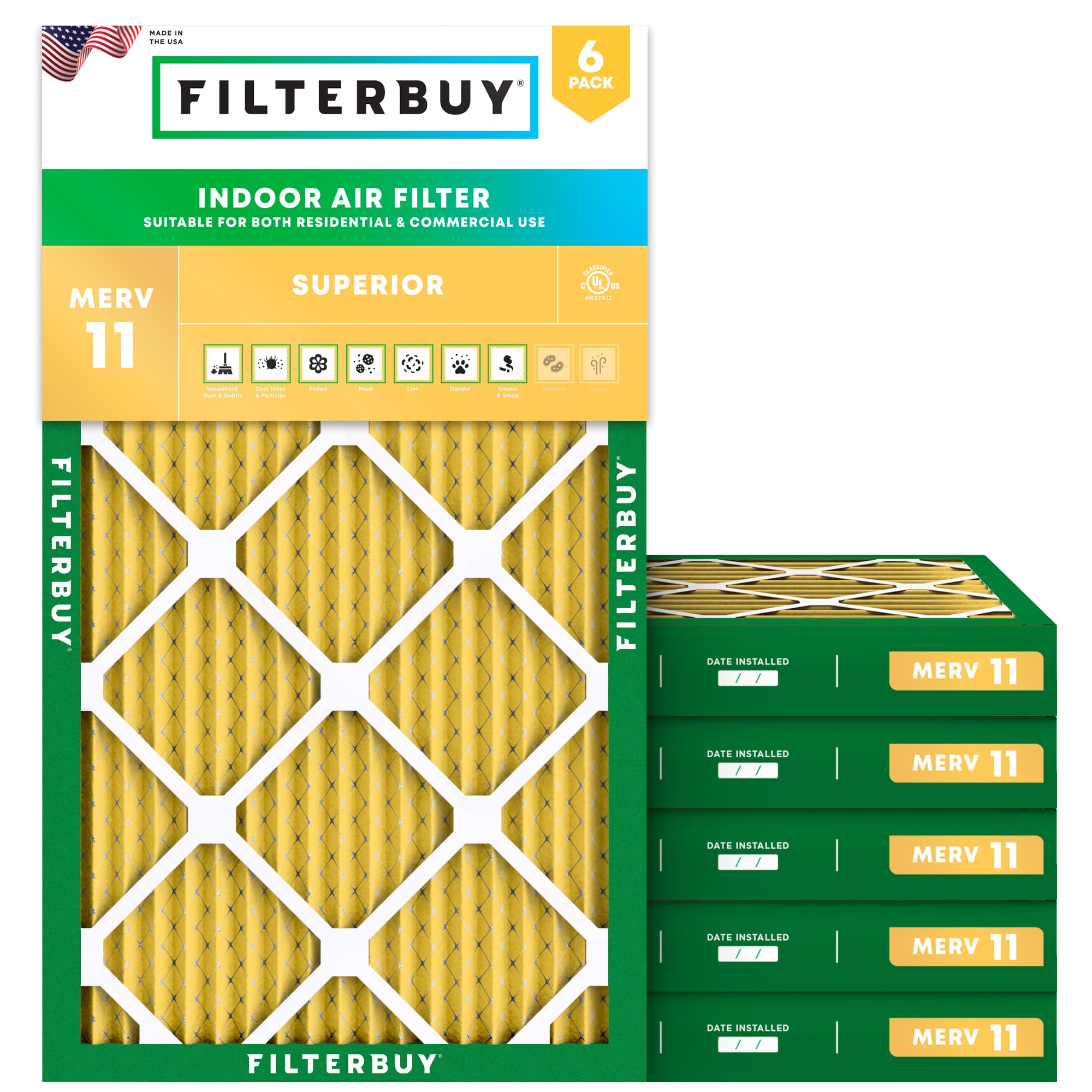
16x36x2 MERV 11 Pleated Air Filter
Actual Size: 15.5x35.5x1.75
 Free Delivery
  Factory-Direct Low Prices, Made in the USA
 Hassle-Free Returns & Free Exchanges
RESIDENTIAL AND/OR COMMERCIAL USE
Change Every 3 Months
16x36x2 MERV 11 Pleated Air Filter
Actual Size: 15.5x35.5x1.75
Free Delivery Factory-Direct Low Prices, Made in the USAHassle-Free Returns & Free ExchangesRESIDENTIAL AND/OR COMMERCIAL USE
Change Every 3 Months
16x36x2 MERV 11 Pleated Air Filter
Actual Size: 15.5x35.5x1.75
Free Delivery Factory-Direct Low Prices, Made in the USAHassle-Free Returns & Free ExchangesRESIDENTIAL AND/OR COMMERCIAL USE
Change Every 3 Months
About
- This is a list 16x36x2 MERV 11 air filter replacement for your furnace, air conditioner, heat pump, or HVAC system
- Actual air filter size: 15.5x35.5x1.75
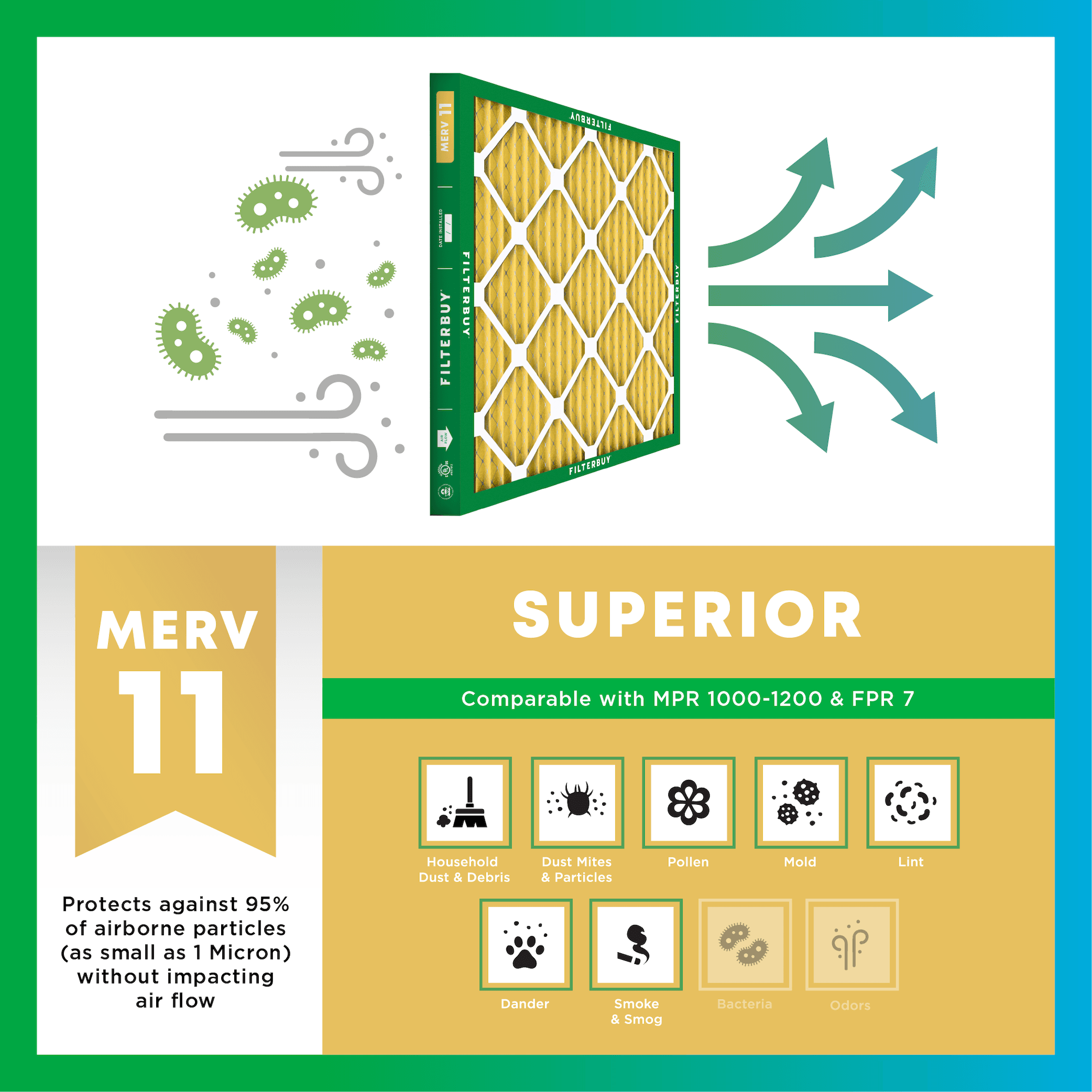
- MERV 11 synthetic media (comparable with MPR 1000/1200 and FPR 7) offers superior protection from dust, pollen, pet dander, mold, smog and more by trapping 95% of airborne particles without impacting air flow
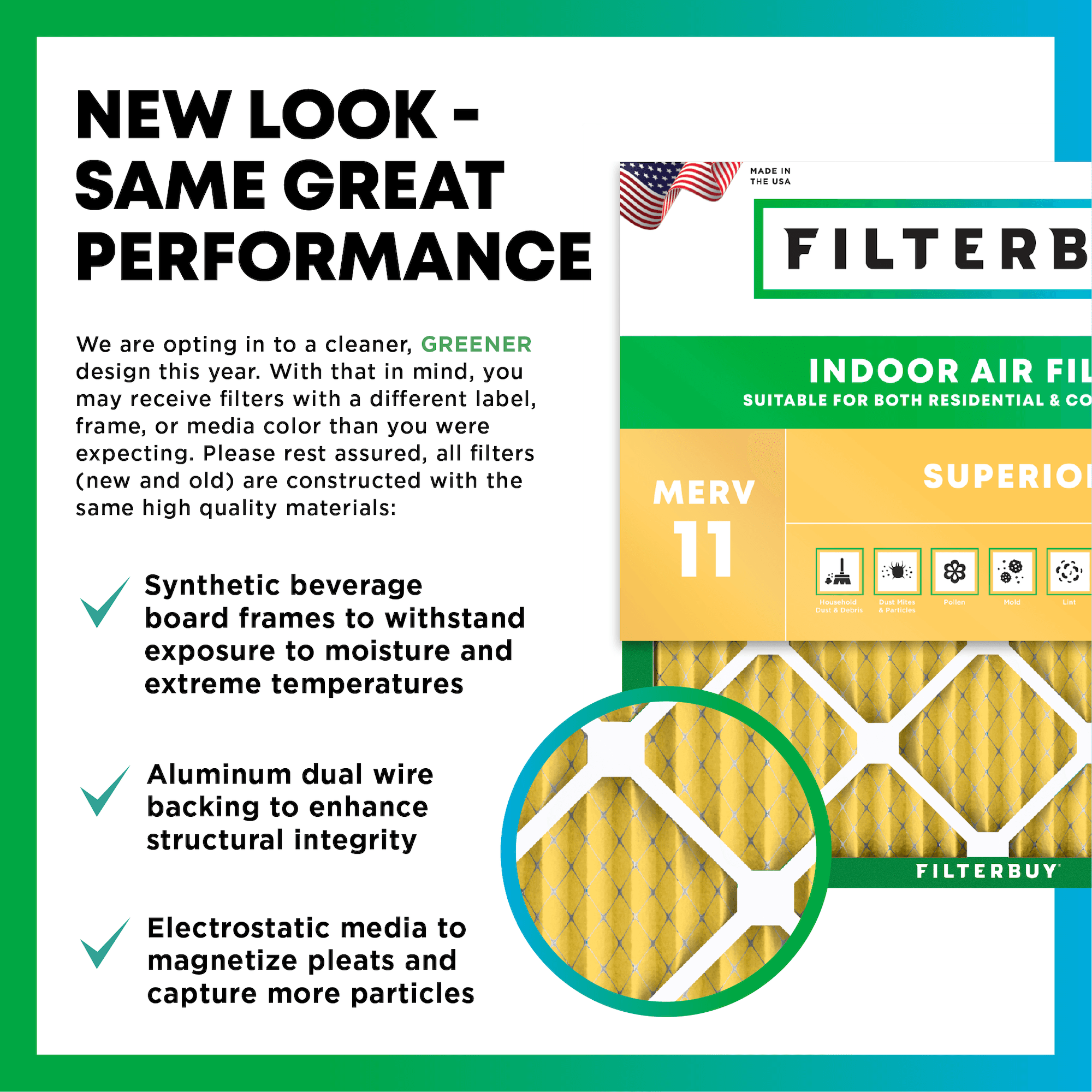
- High-quality construction means electrostatically charged pleated filter media, reinforced wire backing for structural integrity, and a durable frame to resist heat and humidity
- Built to last 3 months. 300% longer than fiberglass models
- 100% manufactured in the United States and designed with recyclable materials
- Learn more about 16x36x2 Air Filters
Top-Rated Filters. American Made. Delivered Free.
At Filterbuy, we don't cut corners—we craft high-quality air filters right here in the USA and ship them to your doorstep for free. No delays, no gimmicks—just clean air, made easy. With thousands of five-star reviews and filters built for real life & every HVAC system, it's no wonder why over 4 million families trust Filterbuy.

Proudly Made In The USA

Fast, Free Shipping on Every Order

Premium Materials That Go The Distance

85,000+ 5-Star Reviews From Happy Customers

Save Up to 70% Per Filter with Packs
Things to Know About Filter Sizes

Nominal Size
- The rounded size printed on your filter or HVAC unit (e.g., 16x36x2).
- Usually whole numbers to make identifying and ordering easier.
- A label for compatibility—not the exact measurement.

Actual Size
- The true, trimmed dimensions of the filter (e.g., 15.5x35.5x1.75 inches).
- Filters are manufactured slightly smaller so they slide into the filter slot without forcing.
- If you don't know your nominal size, measure your filter to get the actual size, then round up to find the nominal size to search on our site.

Why the difference?
- Nominal sizes simplify shopping and standardize categories.
- Actual sizes ensure the filter fits properly inside your HVAC's filter rack.
How To Find Your Nominal Size When You Don't Know It


Measure length × width × depth with a tape measure to find the actual size.

Round up each dimension to the nearest whole number to get the nominal size. Example: 15.5x35.5x1.75 in → 16x36x2 nominal.

Search by nominal size on our site for the best fit.

Why Getting the Right Size Matters
- Too small? Air can bypass the filter, reducing air quality and efficiency.
- Too big? It won't fit—risking bent frames and airflow issues.
- Just right? You get maximum performance, better filtration, and cleaner air.

Free Exchange Policy
If the filter you buy doesn't fit, we'll send you a better size.

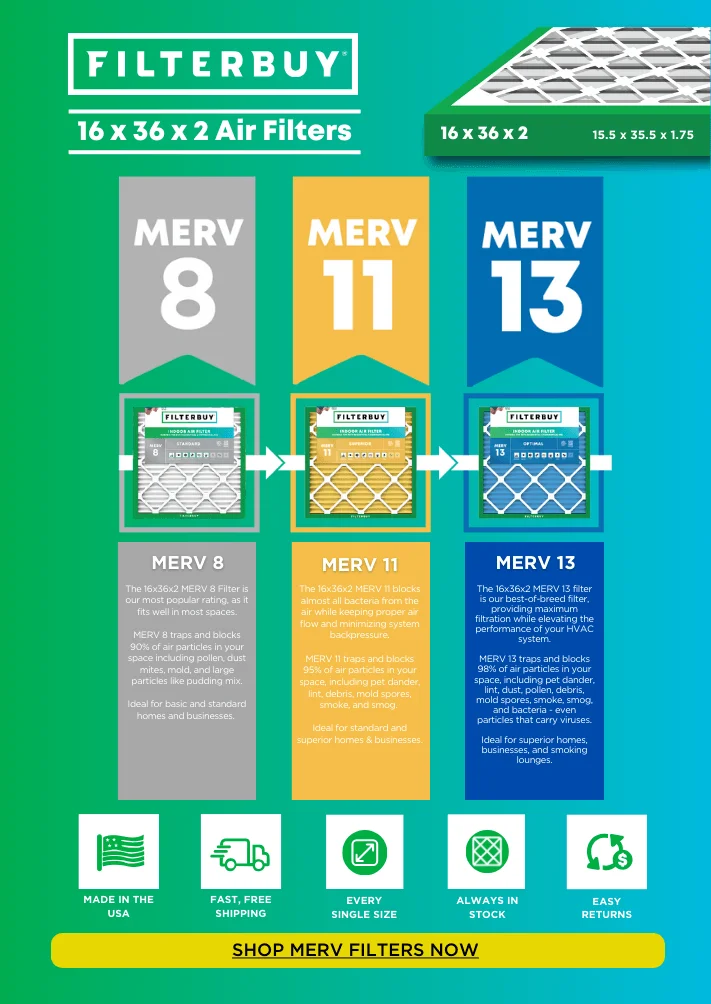
What's a MERV Rating?
MERV stands for Minimum Efficiency Reporting Value—but don't let the technical name fool you. It's just a way to rate how well an air filter traps stuff like dust, pollen, pet dander, and smoke. The higher the MERV number, the more particles it catches—and the cleaner your air will be.

Merv 8
Comparable to:FPR: 4-7
MPR: 600-1000
 Dust & Debris
 Dust Mites & Particles
 Pollen
 Mold
Mold Lint
Lint Dander
Merv 11
Comparable to:FPR: 6-9
MPR: 1200-1550
Dust & DebrisDust Mites & ParticlesPollenMoldLintDander Smoke & Smog
Merv 13
Comparable to:FPR: 10
MPR: 1900-2800
Dust & DebrisDust Mites & ParticlesPollenMoldLintDanderSmoke & Smog Bacteria
MERV 8
Comparable to:FPR: 4-7MPR: 600-1000


MERV 11
Comparable to:FPR: 6-9MPR: 1200-1550

MERV 13
Comparable to:FPR: 10MPR: 1900-2800
What Makes Our Filters Last 90 Days? Quality, From the Inside Out
We build every Filterbuy filter to deliver reliable 90-day performance—thanks to smart design and premium materials that do the heavy lifting. Here's what makes the difference:
Pleated Design
More pleats = more surface area to capture dust and debris, keeping your air cleaner longer.
Electrostatically Charged Media
Pleats are magnetized to attract and trap microscopic particles—like pet dander, pollen, and smoke.
Synthetic Beverage Board Frame
Engineered to resist warping in extreme temperatures and high humidity.

Aluminum Dual Wire Backing
A layer of metal reinforcement keeps pleats evenly spaced and structurally sound—no sagging, even at high airflow.
Made in the USA
Assembled with care. Built to perform. Ships fast, free, and reliably from our U.S. facilities.
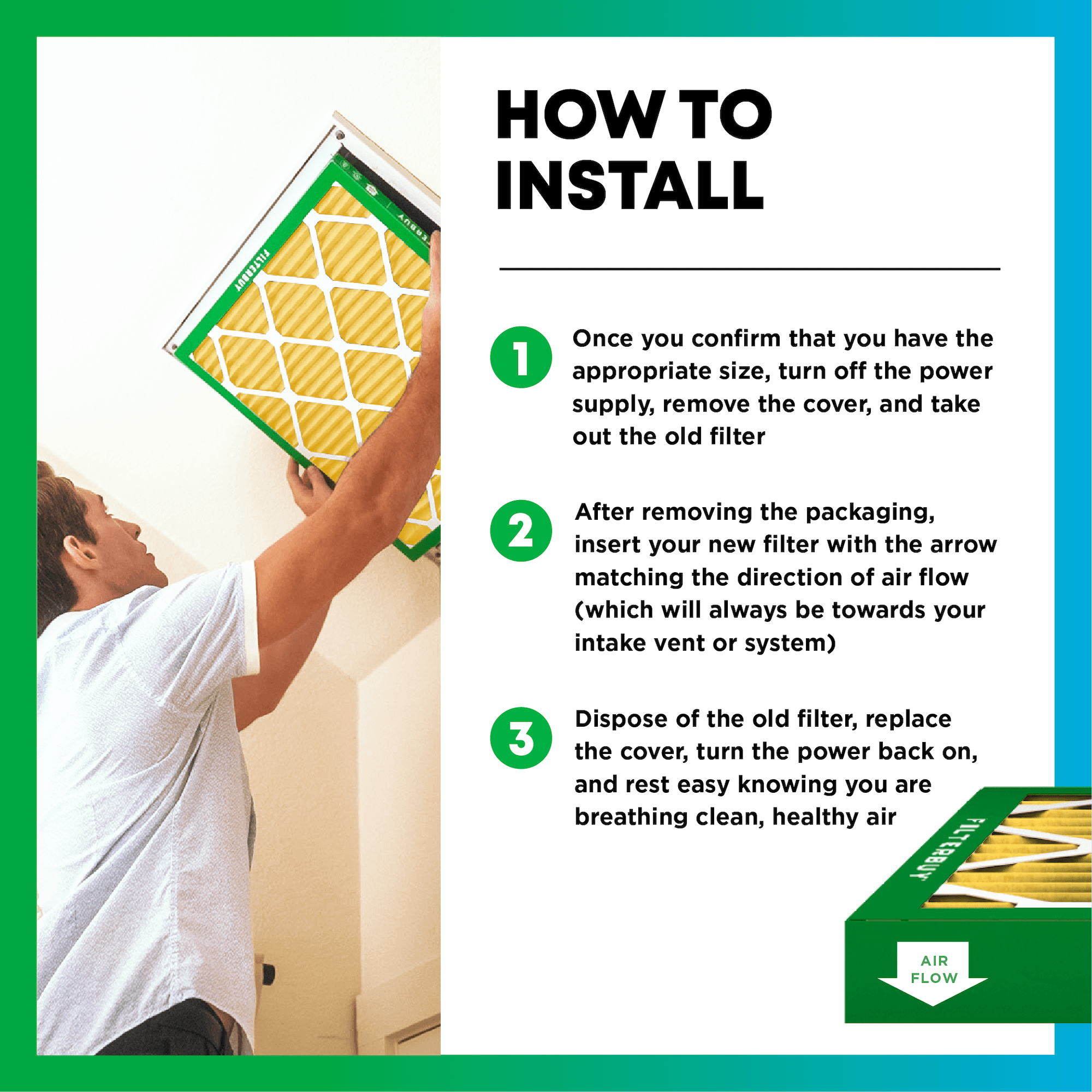
How to Install Your Filter in 4 Simple Steps

Turn Off Your HVAC SystemSafety first.

Remove The Old FilterLook for the airflow arrow and make note of the direction.

Slide In Your New FilterArrow should point toward the system (same direction as before).

Turn Your System Back OnAnd enjoy the fresh, clean air.

Never forget to replace your air filter again.
- Save 5% on every order
- Choose Your Delivery Schedule
- Edit, Skip, or Cancel Anytime.
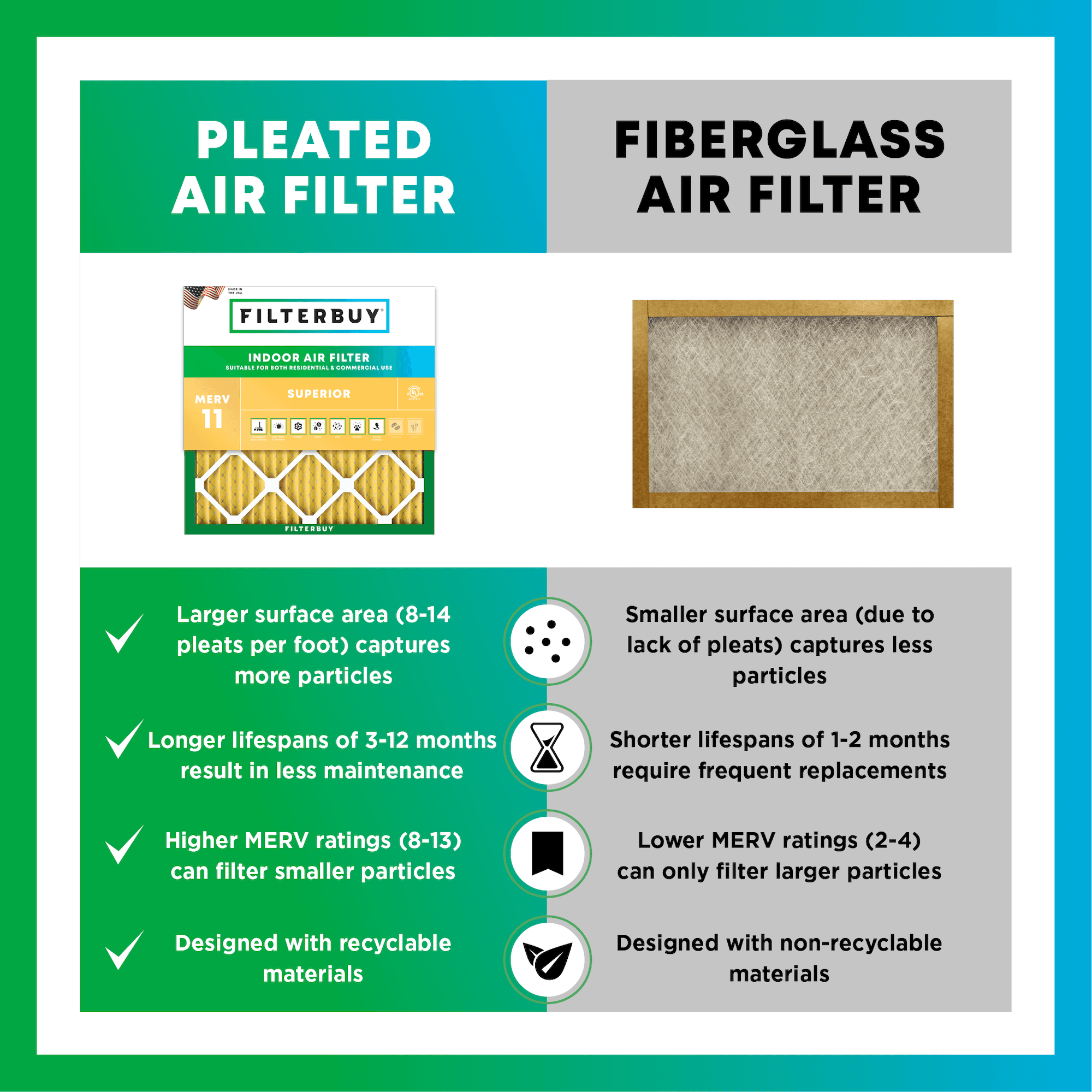
Pleated Filters vs. Fiberglass—What's the Difference?
Not all air filters are created equal. Pleated filters don't just last longer—they actually clean your air better. Here's how they stack up:

Pleated Filters
Efficiency:
High (MERV 8–13) – Traps more particles
Lifespan:
90 days – Long-lasting performance
Air Quality:
Excellent – Cleaner, healthier air
Materials:
Recyclable and durable

Fiberglass Filters
Efficiency:
Low (MERV 4 or less) – Misses small stuff
Lifespan:
30 days or less – Replace often
Air Quality:
Minimal – Basic protection only
Materials:
Thin, flimsy, and not recyclable
Pleated filters are a no-brainer—more protection, less hassle, and better air for your home.
How Often Should You Change Your Filter?
Changing your filter on time keeps your HVAC system running efficiently—and helps protect your lungs from dust, allergens, and airborne irritants. Here's how often to swap it out based on your needs:

Every 90 Days
Standard ScheduleFor most homes without pets or special air quality concerns. Great for general upkeep and energy efficiency.

Every 60 Days
If You Have Pets or AllergiesShedding fur, dander, and allergy triggers can build up fast. Changing your filter every two months helps keep the air fresher and symptoms at bay.

Every 30 Days
If You Have Respiratory Concerns or Live in Smog/Wildfire ZonesFor households affected by smoke, pollution, or respiratory conditions, monthly changes ensure maximum protection.

Want to stay on track? Set a reminder—or skip the stress with auto-delivery so fresh filters show up right when you need them.
Don't Just Take Our Word For It...
Got More Questions? We've Got Answers.
Product Specifications
| Nominal Size | 16 x 36 x 2 inches |
| Actual Size | 15.5 x 35.5 x 1.75 inches |
| Filter Type | Pleated |
| Media | Electrostatically Charged |
| Frame | Beverage Board |
| MERV Ratings Available | 8, 11, 13 |
| Lifespan | Up to 90 Days |
| Origin | Made in USA |
Best 16x36x2 MERV 11 Furnace & HVAC Air Conditioner Filters
Author: Michelle Wan, Brand Manager and Air Quality Writer, Filterbuy I Technically reviewed by: David Clark, Licensed HVAC Technician, Filterbuy HVAC Solutions I Published: August 27, 2026 I Updated: August 27, 2026
TL;DR
A 16x36x2 MERV 11 air filter is a two-inch-deep pleated HVAC filter with a nominal size of 16" x 36" x 2" and an actual size of 15.50" x 35.50" x 1.75". It captures at least 85% of particles from 3.0 to 10 microns and at least 65% of the 1.0 to 3.0 range carrying pollen, pet dander, and mold spores. Stores rarely stock a filter this long, so Filterbuy builds it to order in the USA and ships free in 24 hours.
Key Takeaways
Actual size is 15.50" x 35.50" x 1.75", since Filterbuy cuts a half-inch under nominal so it seats without forcing.
MERV 11 captures ≥85% of 3.0–10 micron particles, ≥65% of 1.0–3.0, and ≥20% of 0.30–1.0, per the EPA's MERV chart built on ASHRAE Standard 52.2.
A 16x36 filter has 4.0 square feet of face area, about 15% more than a 20x25, spreading airflow across more media and keeping pressure drop low.
A 4-pack covers a standard year and a 6-pack a pet or allergy year, at four filters annually on 90-day intervals, six on 60.
A 16x36 spans 35.5 inches unsupported, roughly 45% more than a 20x25, which is why frame rigidity matters here.
The rating upgrade is nearly free here, with MERV 8 to MERV 11 costing about $4 more a year and MERV 13 about $22.
What Is the Actual Size of a 16x36x2 Air Filter?
The actual size of a Filterbuy 16x36x2 air filter is 15.50 by 35.50 by 1.75 inches. The 16x36x2 on the label is the nominal size, the rounded name the industry uses for the slot, and Filterbuy cuts every filter a half-inch under it so the panel seats without forcing.
The rule worth remembering is to measure the slot, not the old filter. If your return opening comes out around 16 by 36 inches, a 16x36x2 is your size, even though the filter you pulled measures 15.5 by 35.5. Our guide on how to measure your air filter covers all three dimensions, and if what you order doesn't seat right, our free exchange policy sends the right one.
What Does a MERV 11 Filter Actually Capture?
MERV 11 sits in the mid-to-high range of the 1-to-16 scale defined by ASHRAE Standard 52.2. Per the EPA's MERV chart, it captures at least 85% of particles between 3.0 and 10 microns, at least 65% between 1.0 and 3.0, and at least 20% between 0.30 and 1.0.
Translated into things you can picture, the 3.0 to 10 band is pollen, dust, lint, and dust mite debris. The finer 1.0 to 3.0 band holds pet dander, mold spores, and road dust, where MERV 11 pulls ahead of MERV 8. It is why we point allergy and pet homes here. See our MERV ratings guide or the MERV 8 vs MERV 11 head-to-head.
The Filterbuy 16x36x2 MERV 11 uses electrostatically charged synthetic media with 10 pleats per foot, comparable to MPR 1200–1550 and FPR 6–9. That pleating packs square feet of media into a two-inch frame, so the filter can be efficient and still breathe, which flat fiberglass never manages. See why pleated filters aren't bad for airflow.
Will MERV 11 Restrict Airflow in a 16x36x2 System?
For a properly sized system, a 2-inch MERV 11 is very unlikely to cause airflow problems. Depth is part of it, since 1.75 inches holds far more media than a 1-inch panel, and more media means lower resistance. Face area does even more of the work.
A 16x36 filter presents 576 square inches of face area, exactly 4.0 square feet, where a 20x25 presents 500, or 3.47. Your filter gives the same air about 15% more surface to move through, so it passes more slowly and pressure drop stays lower. At the face velocity technicians design for, 4.0 square feet works out to roughly 1,200 to 1,400 CFM, the range of a three to three-and-a-half ton system.
The honest caveat is that airflow trouble usually comes from a filter left in too long, not the MERV number on the box. A loaded MERV 8 restricts more than a fresh MERV 11. If your system struggles with static pressure, talk to your technician before going above MERV 11, and see whether MERV 11 is too restrictive.
Why the 16x36 Shape Puts Extra Stress on the Frame
A 16x36 filter has to hold its shape across a 35.5-inch unsupported span, where a 20x25 spans only 24.5. No spec sheet spells that out. It is roughly 45% more distance, and the pressure on the media does not ease off because the panel got longer.
Long, narrow filters are where cheap construction shows. A weak frame bows inward at the center under airflow, opening gaps along the edges where air slips past unfiltered. On a compact filter you can get away with less.
Should You Buy a 4-Pack, a 6-Pack, or Bulk?
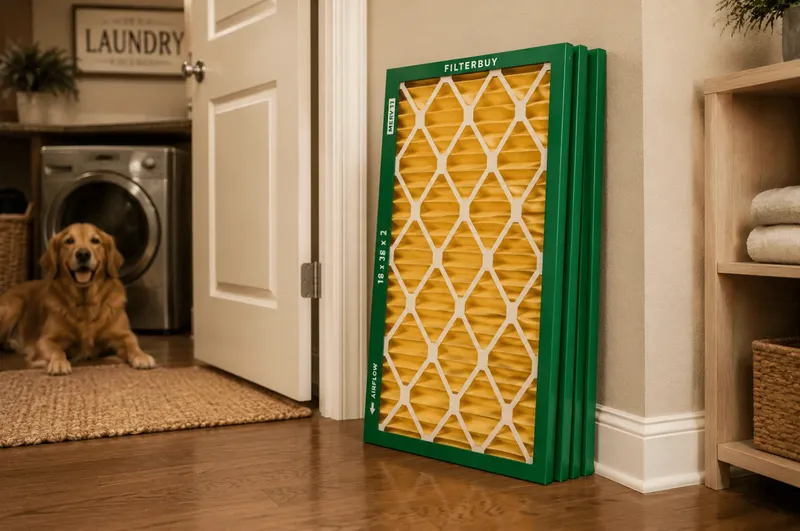
The right 16x36x2 pack matches your change schedule, not the lowest sticker price. Filterbuy builds this filter to last up to 90 days, and the EPA puts the manufacturer norm at 60 to 90, shortening whenever one comes out heavily soiled.
4-pack: one year at the standard 90-day interval.
6-pack: one year for a pet or allergy household changing every 60 days, or 18 months on the standard schedule.
Bulk (12+): the lowest per-filter cost, right for rentals or small commercial use.
Pets, remodeling, and smoke season shorten that window, and a second return doubles the count. Our guide on how often to change your filter has the full schedule.
On price, the pack tier does most of the work. As of August 2026 a single 16x36x2 MERV 11 lists at $43.99, a six-pack $24.33 each, roughly 45% less. Auto-delivery takes another 5% off and handles the hard part: remembering.
The arithmetic across ratings is worth doing too. A Filterbuy six-pack in this size runs $23.33 per filter at MERV 8, $24.33 at MERV 11, and $29.83 at MERV 13. At four changes a year, stepping from MERV 8 up to MERV 11 costs about $4 more annually, and MERV 13 adds about $22. Against a utility bill those are rounding errors, so let price stay out of it. Choose on what your household breathes and what your system handles.
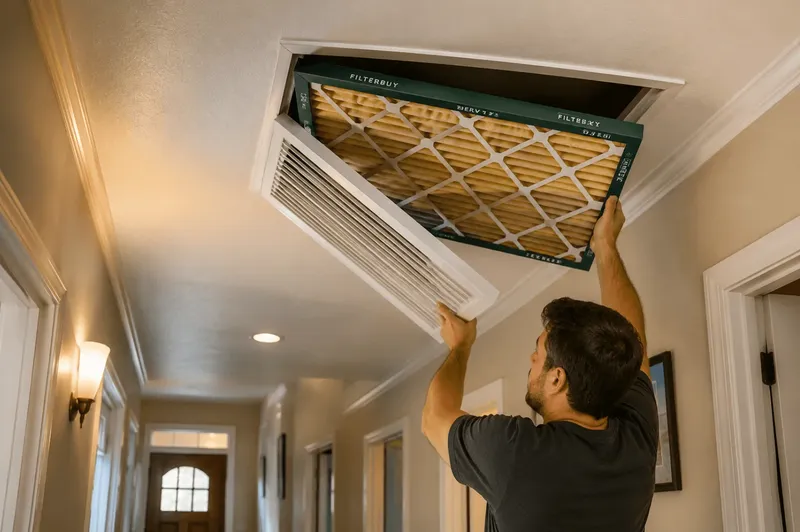
How to Replace a 16x36x2 MERV 11 Filter
Swapping a 16x36x2 MERV 11 filter takes two minutes, no tools.
Turn the system off at the thermostat.
Open the return grille, usually held by two latches or screws on the hinge side.
Note the airflow arrow on the old filter, pointing toward the ductwork, away from the room.
Slide the new one in with the arrow facing the same way. It should clear without force, and if you are forcing it, re-measure.
Close up, restore power, and date the frame in marker, then check at 30 days to find your real interval.
Where Can You Buy a 16x36x2 MERV 11 Filter Near You?
Big-box stores rarely stock 16x36x2, because shelf space goes to the highest-turnover sizes. Your system is not unusual, though. This is the dimension builders reach for when a home has one large central return rather than several small ones. Instead of driving store to store, order it directly: Filterbuy cuts and pleats every 16x36x2 air filter in our own U.S. plants and ships free nationwide within 24 hours.
For a different rating in the same size, we build 16x36x2 MERV 8 for basic dust and lint and 16x36x2 MERV 13 for smoke and finer particles, and our custom filter builder can match an unusual slot. The EPA recommends MERV 13, or as high as your system will accommodate, advice worth respecting on an older system.
Supporting Statistics
Three federal findings on why the particles MERV 11 captures matter indoors.
1. One in four U.S. adults has a seasonal allergy.
25.2% of adults in 2024.
20.6% of children.
31.7% had an allergy of some kind.
Why it matters: MERV 11 targets the allergens behind those symptoms.
Source: CDC/NCHS, Diagnosed Allergic Conditions in Adults, 2024. Published January 8, 2026.
2. Pet allergens are in nearly every U.S. home.
Dog and cat allergens turn up in almost all U.S. homes.
That includes homes with no pet at all.
More than half of households have a dog, a cat, or both.
Why it matters: pet dander sits in the band MERV 11 captures at 65% or better.
Source: NIEHS, Pet Allergens.
3. 8.6% of U.S. adults have current asthma.
8.6% of adults in 2024.
6.5% of children.
1.4 million ED visits list asthma as primary diagnosis.
Why it matters: this household should go past MERV 11. The EPA recommends MERV 13, or as high as the system allows.
Source: CDC/NCHS FastStats, Asthma. Reviewed February 20, 2026.
Frequently Asked Questions
Is a 16x36x2 the same as a 16x36x1?
No. The face matches, but a 2-inch filter will not fit a 1-inch slot, so measure your track's depth first. Browse all 2-inch air filters for other sizes.
My old filter measures 15.5 x 35.5. Did I order the wrong size?
No, that is the correct actual size. Order by the nominal one: 16x36x2.
Is MERV 11 good enough for allergies?
For most allergy households, yes, since it captures at least 65% of the particles that include pet dander and mold spores. Severe asthma or heavy smoke makes the case for MERV 13.
How long does a 16x36x2 MERV 11 last?
Up to 90 days, or 60 with pets, allergies, or remodeling dust.
Glossary
MERV (Minimum Efficiency Reporting Value): The 1–16 ASHRAE 52.2 scale rating how well a filter removes particles from 0.3 to 10 microns.
MERV 11: A mid-to-high residential rating capturing ≥85% of 3.0–10 micron particles, ≥65% of 1.0–3.0, and ≥20% of 0.30–1.0.
Nominal size: The rounded label size you order by, in this case 16x36x2.
Actual size: The filter's true measured dimensions, in this case 15.50" x 35.50" x 1.75".
Micron (µm): One millionth of a meter. A human hair is about 70 microns wide.
Face area: The filter surface air passes through, or 4.0 square feet for a 16x36.
Unsupported span: The distance media must hold its shape unaided, or 35.5 inches for a 16x36.
Pressure drop: The resistance a filter adds to airflow, which rises as the filter loads.
Electrostatic media: Synthetic material carrying a static charge that attracts and holds particles.
Return-air grille: The vent that pulls room air back into the system, where the filter sits.
MPR and FPR: Proprietary rating systems from 3M and Home Depot. MERV 11 compares to MPR 1200–1550 and FPR 6–9.
ASHRAE Standard 52.2: The test method behind every MERV rating.
Filterbuy: A family-owned U.S. manufacturer of pleated HVAC filters in 600+ sizes, factory-direct.
About the author. Michelle Wan is Brand Manager and Air Quality Writer at Filterbuy, where she works directly with the U.S. manufacturing team. Technically reviewed by David Clark, a Licensed HVAC Technician with Filterbuy HVAC Solutions, who reviews Filterbuy's maintenance and system-compatibility guidance for accuracy. Questions about fit? Our customer service team can help.
Sources
U.S. EPA, What is a MERV rating?. MERV 11 particle-size capture thresholds. Updated January 14, 2026.
U.S. EPA, Guide to Air Cleaners in the Home. Replacement intervals, MERV selection, filter fit. Updated February 17, 2026.
ANSI/ASHRAE Standard 52.2 defines MERV and its E1/E2/E3 particle-size groups.