
Wildfire Smoke Eyes: What It’s Doing & How to Stop the Burn
August 20, 2026
By Michelle Wan, Brand Manager and Air Quality Writer at Filterbuy · Published August 21, 2026 · Updated August 21, 2026
How to Relieve Burning Eyes From Wildfire Smoke
Chilled artificial tears, a cold compress, and glasses instead of contacts are the fastest relief for eyes burning from wildfire smoke. Smoke breaks down the tear film, the thin layer that keeps your eye surface smooth, and the exposed surface underneath answers with burning, redness, and grit.
Those first moves treat what you can reach. The air in the room is the layer you set up ahead of time, and the EPA recommends a MERV 13 or higher HVAC filter during smoky periods. MERV 13 captures microscopic particles and is the highest level of residential filtration.
Already know your size? Shop Filterbuy air filters.
TL;DR
Wildfire smoke burns your eyes because fine particles and irritant gases settle on the tear film, the thin layer that keeps your eye surface smooth and protected. Once that layer breaks down, the exposed surface underneath responds the only way it can: burning, redness, watering, and grit. The fastest relief comes from chilled artificial tears, a cold compress, glasses instead of contacts, and cutting the smoke in the room you’re actually sitting in.
Key Takeaways
Your eyes have no filter upstream. Your nose traps particles before air ever reaches your lungs, but your eye surface meets room air directly, with nothing between the two but a tear film about 3 microns thick.
Watery eyes and dry eyes are the same problem. Reflex tearing is your eye reacting to a destabilized tear film, not a sign that you have enough moisture.
Chilled artificial tears are the first move. The American Academy of Ophthalmology recommends refrigerating them for added cooling relief.
Redness-relief drops are the wrong tool. The AAO warns decongestant drops cause rebound redness once they wear off.
The EPA recommends a MERV 13 or higher HVAC filter during smoky periods. The fewer particles circulating indoors, the fewer that end up on your eyes. EPA guidance.
Symptoms outlast the smoke. In fire-devastated areas barely visible ash can linger up to two weeks.
Why a Filter Company Is Writing About Your Eyes
Almost every piece of wildfire smoke guidance is written for lungs. Eyes get one line near the bottom, usually "may cause irritation," and that’s backwards for a homeowner. Eyes complain first, and they’re the only exposed tissue you can’t protect by breathing differently. Your eyes are the cheapest air quality monitor in your house. They register a bad indoor air day before an app does, and well before you smell anything.
So here’s our stake in it, stated plainly: we make air filters, not eye drops. Filterbuy is a U.S. air filter manufacturer, and we’ve been building pleated HVAC filters for over a decade across four American factories in Alabama, Florida, Pennsylvania, and Utah. Nothing we sell will treat an irritated cornea. The relief steps below aren’t ours either; they come from ophthalmologists and optometrists, and every one of them is cited. What we do know is the air side, and that turns out to be half the answer.
I live in the Bay Area, so smoke season isn’t theoretical for me. What I didn’t understand until I started working alongside our factory teams is how fast the indoor number moves. People treat the burning as something to wait out. It’s actually a signal that the air in the room you’re standing in has already changed.
— Michelle Wan, Brand Manager and Air Quality Writer, Filterbuy
Why Does Wildfire Smoke Make Your Eyes Burn?
Wildfire smoke burns your eyes because it disrupts the tear film, the thin three-layered coating that keeps your eye surface smooth and shielded. Smoke carries fine particles (PM2.5) along with irritant gases, and the EPA notes that these particles get into your eyes and cause burning. They break the film apart and leave the nerve-rich cornea underneath exposed, which is why the stinging, redness, and watering can start within minutes of stepping outside.
Dr. Nishika Reddy, a cornea specialist at the John A. Moran Eye Center at the University of Utah, describes tears as "a balance of water, oil, mucus, and proteins." Upset that balance and ordinary air starts to sting.
Here’s the part most people miss: your eyes are the only exposed mucous membrane with nothing filtering the air in front of them. Your nose has turbinates and cilia to catch the larger stuff on its way in. Your eye has a tear film measured in microns and a blink reflex, and that is the whole defense. It’s why your eyes tend to complain before you even register the smell.
You don’t have to be anywhere near a fire for this. Robert N. Weinreb, MD, of UC San Diego, put it plainly for the AAO: "Even a healthy person’s eyes can be bothered by prolonged exposure to smoke." Plumes travel hundreds of miles, so it pays to track smoke in your area before your eyes start telling you about it.
What Wildfire Smoke Eye Symptoms Look Like
Wildfire smoke eye irritation usually shows up as burning, redness, watering, grittiness, and mild light sensitivity, and it settles down once exposure drops. Eye doctors report the same cluster, along with flare-ups of dry eye, allergies, and blepharitis. If wildfire smoke has left you with red eyes and nothing worse, you are in ordinary territory. What doesn’t belong on that list is real pain, changing vision, or discharge; those warrant an exam rather than a bottle of drops.
Sources: American Academy of Ophthalmology; John A. Moran Eye Center, University of Utah. Educational only – not a substitute for a diagnosis from your own eye care provider.
A note on "smoke conjunctivitis": conjunctivitis simply means inflammation of the conjunctiva, the membrane over the white of the eye. Smoke does inflame it, so the term isn’t wrong. It just isn’t the contagious pink eye most people picture, and it won’t spread to anyone else in the house.
7 Relief Tips for Burning Eyes During Smoke Season
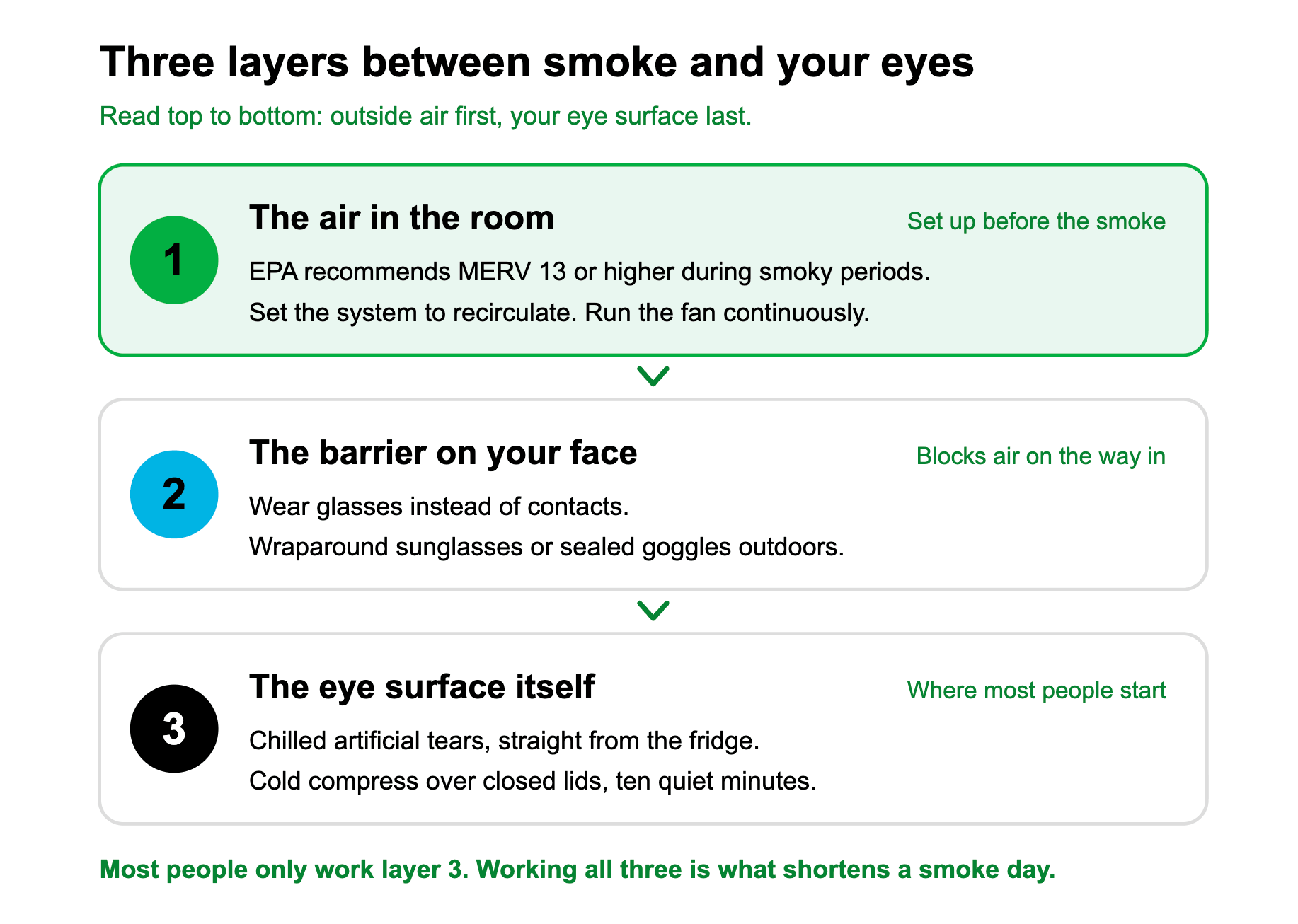
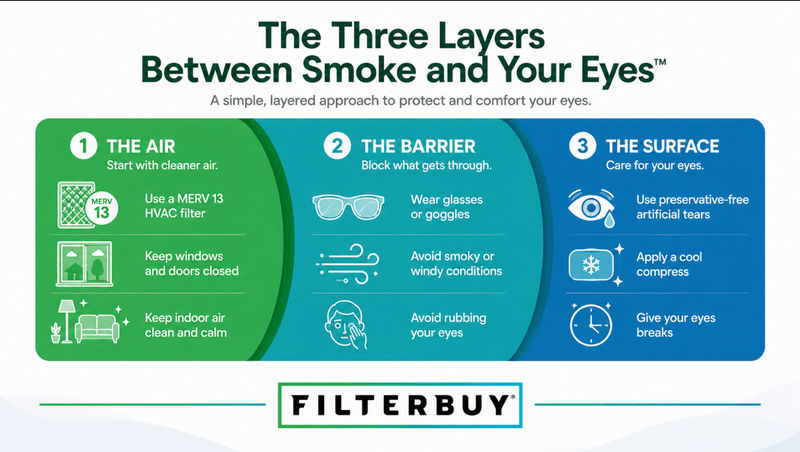
The steps themselves come from published guidance by the American Academy of Ophthalmology, from eye doctors at UCLA and UCSF, and from the University of Utah. The way we’ve organized them is ours. Read enough smoke-season advice and it arrives as a flat list of six or seven things, which is exactly why people do the two easy ones and skip the one that actually moves the needle. So we’ve grouped them into three layers: the air in the room, the barrier on your face, and the eye surface itself. Most people only ever work that third layer. Work all three and relief arrives a good deal faster.
1. Reach for Artificial Tears, and Keep Them Cold
Artificial tears do two jobs at once: they rinse particles off the surface and rebuild the moisture layer the smoke stripped away. The AAO recommends keeping the bottle in the fridge, since the cold adds a bit of relief on its own. If you find yourself reaching for them more than four times a day, switch to preservative-free single-use vials, because the preservatives start to irritate with heavy use.
2. Lie Down With a Cold Compress
A cool washcloth over closed eyelids calms the inflammation and, just as usefully, gives your tear film ten uninterrupted minutes to rebuild itself. That’s long enough to feel the difference, and both the AAO and the Moran Eye Center recommend it.
3. Wear Glasses, Not Contacts
Contacts work against you twice over during a smoke event: they trap particles against your cornea, and they float on the very tear film the smoke is busy destabilizing. Vivian Shibayama, OD, of UCLA’s Stein Eye Institute, advises skipping them until the air clears. Glasses have the side benefit of putting a small physical barrier in front of your eyes.
4. Put Something Between Your Eyes and the Air Outside
Wraparound sunglasses or dry-eye goggles slow the stream of particle-laden air reaching your eyes, and the AAO points out that even ordinary close-fitting sunglasses do some of that work. If you’re heading out to clear ash, step up to sealed goggles, because disturbed ash is considerably worse than settled ash. An N95 will protect your lungs on the same trip.
5. Upgrade the Filter in the System You’re Already Running
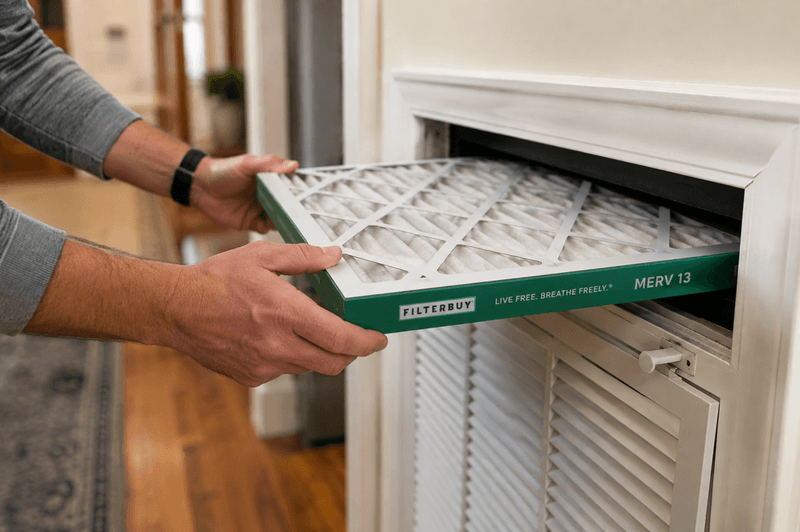
This is the step almost everyone skips, and it’s the only one on the list that keeps working while you sleep. The EPA recommends an HVAC filter rated MERV 13 or higher during smoky periods. Set the system to recirculate, close the fresh-air intake, and leave the fan running continuously rather than on "Auto." The EPA reports that doing all three together cuts indoor PM2.5 by roughly 50%. That halves the particle load reaching your eyes for the eight to twelve hours a day you spend at home, which is more than any drop can manage.
One caution from David Clark, the licensed HVAC technician who reviews our filtration guidance: check that your system can handle MERV 13 before you buy. Most modern ones can, though older units with PSC blower motors sometimes can’t. Our guide to the best MERV rating for wildfire smoke walks through how to tell, and how a central AC handles smoke covers recirculate mode in more detail.
The other thing that stops people is size, and it stops them for a whole season. Filterbuy makes MERV 8, 11, 13, and activated-carbon Odor Eliminator filters in more than 600 standard sizes, plus custom cuts for the awkward slots, so an unusual measurement is no reason to leave a MERV 8 sitting in the return through fire season.
The calls come in after the smoke does. A filter is a before decision. Once your eyes are stinging, the particles are already in the room, and you’re asking the system to catch up on air that’s standing right next to you.
— David Clark, Licensed HVAC Technician and CEO, Filterbuy HVAC Solutions
6. Build One Clean-Air Room
Whole-house filtration is the baseline, but one room can be cleaner than the rest. Close up the room where you sleep and add a portable HEPA air cleaner; the EPA calls this a clean room and has also studied a much cheaper version, a box fan with MERV 13 filters taped into a cube. Make it the bedroom if you have to choose, since that’s your longest uninterrupted stretch with your eyes closed in one place. The standard build uses four 20x20 Filterbuy MERV 13 panels. If you’re weighing the options, MERV 13 vs. HEPA for smoke explains what each one is good for, and our step-by-step Corsi-Rosenthal box build takes you through the assembly.
7. Keep It up After the Sky Clears
Smoke keeps irritating eyes for days after a fire, and the AAO has warned that in fire-devastated areas barely visible ash can linger for up to two weeks. Most people stop the drops the day the haze lifts and then wonder why their eyes still feel raw a week later. Hold the routine a little longer than feels necessary, and check the filter while you’re at it: the EPA advises replacing it whenever it looks dirty rather than on the usual schedule, which in heavy smoke can mean weeks rather than months. The easiest fix is to have the next one already sitting on the shelf when you need it, which is what Filterbuy auto-delivery is for.
Supporting Statistics
Three findings from federal and national health sources put numbers behind all of this.
1. Eyes Are the Symptom People Report Most.
When Cornell researchers surveyed 609 New York State residents after the 2023 Canadian wildfire smoke episodes, 63% reported itchy, irritated, or watery eyes. That put eyes ahead of every other complaint, including sore throat (50%) and headache (49%), and 87% reported at least one symptom in a group that was largely healthy to begin with. Barrera et al., Int. J. Environ. Res. Public Health, 2025, via NIH PMC.
2. Roughly 16 Million American Adults Start Smoke Season Already Vulnerable.
A weighted analysis of 75,000 survey participants estimates that 6.8% of US adults, about 16.4 million people, have diagnosed dry eye disease, rising to 18.6% of those aged 75 and over, and affecting women at roughly twice the rate of men. Smoke goes after the same tear film these people are already short on, which is why they tend to feel it first and recover last. Farrand et al., American Journal of Ophthalmology, indexed at PubMed.
3. Smoke-Grade Particle Spikes Now Reach Tens of Millions of Americans.
The American Lung Association’s "State of the Air" 2026 report finds 61.5 million people live in US counties that earned a failing grade for short-term particle pollution spikes, the measure that captures wildfire smoke events. Widen the criteria to any failing measure and the figure reaches 152.3 million, or 44% of Americans. The report attributes part of that trend to wildfires with an expanding geographic reach.
These are population-level figures rather than a diagnosis, but they explain why smoke-season eye irritation gets reported so widely, and who tends to feel it hardest.
Which Eye Drops to Actually Buy
For smoke irritation, the drops you want are plain lubricating drops, sold as artificial tears. The pharmacy shelf makes that harder than it sounds, and it’s not really the shopper’s fault: four very different products sit side by side in near-identical bottles, all promising relief. Telling them apart takes about ten seconds, as long as you read the active ingredient rather than the front of the box.
Sources: American Academy of Ophthalmology; All About Vision (medically reviewed). If you wear contacts, check the bottle is approved for lens wear – many are not.
The practical version: one bottle of preservative-free artificial tears, kept in the fridge, covers almost everyone on almost every smoke day. Everything else on that shelf is built to solve a different problem.
What Does Not Work (And What Makes It Worse)
Five common instincts backfire, and avoiding them matters about as much as doing the seven steps above. John Bosetti, MD, who practices near the site of the largest wildfire in California history, told the AAO that his patients that day complained "almost without exception" of stinging, burning, red eyes. By the time anyone books an appointment they have usually tried something at home already, and a few of those somethings actively make matters worse.
EPA recommends MERV 13 or higher during smoky periods. Confirm your system supports it before upgrading.
When to See a Doctor
See an eye doctor if symptoms persist beyond a few days, if artificial tears stop helping, or if you develop pain, blurry vision, light sensitivity, or worsening redness. An ophthalmologist may use a slit lamp to rule out an abrasion and can prescribe a short anti-inflammatory course. Dr. Reddy notes severe dryness can damage the conjunctiva and corneal cells, so raise blurriness rather than waiting it out.
Move faster if you have dry eye disease, blepharitis, or allergic conjunctivitis, wear contacts, or have had recent eye surgery. This article is educational, not a substitute for a diagnosis from your own eye care provider.
Frequently Asked Questions
Why Are My Eyes Watering if Smoke Dries Them Out?
Watering is reflex tearing. When the tear film breaks down, corneal nerves trigger low-quality tears that drain away without restoring the oily layer that prevents evaporation. Watery and dry eyes are the same problem.
How Long Do Smoke-Irritated Eyes Take to Recover?
Most irritation eases within a day or two of reduced exposure. Because ash lingers after visible smoke clears, symptoms can outlast the haze.
Can Wildfire Smoke Permanently Damage My Eyes?
Wildfire smoke rarely causes lasting vision problems in healthy eyes, but it worsens dry eye disease, allergies, and blepharitis, which is why persistent symptoms deserve an exam.
Does an Air Purifier or Air Filter Help With Eye Symptoms?
Yes, though indirectly. Neither one treats your eyes; what they do is cut the number of smoke particles reaching your eye surface in the first place. The AAO recommends a HEPA air purifier as one of five ways to cope with burning eyes, and our MERV 13 versus HEPA comparison explains where each one fits.
Glossary
Conjunctivitis. Inflammation of the conjunctiva, the clear membrane over the white of the eye. Smoke-caused (irritant) conjunctivitis is not contagious.
Cornea. The clear front surface of the eye, densely supplied with nerves, which is why surface irritation feels so sharp.
Dry eye disease. A chronic condition in which the eyes do not make enough quality tears to stay comfortable. Smoke worsens it.
HEPA. A filter standard capturing at least 99.97% of 0.3-micron particles. Used in portable air cleaners, not typically residential HVAC.
MERV (Minimum Efficiency Reporting Value). The 1–20 scale rating how well an HVAC filter captures airborne particles. MERV 13 is the EPA’s recommended minimum during smoke events.
Tear film. The thin three-layered coating (oil, water, mucus) that keeps the eye surface smooth. Roughly 3 microns thick.
Artificial tears. Over-the-counter lubricating eye drops that supplement the tear film. The first-line choice for smoke irritation; preservative-free versions suit heavy use.
Rebound redness. The worsening of eye redness after decongestant "redness relief" drops wear off. The reason eye doctors point to artificial tears instead.
AQI (Air Quality Index). The EPA’s 0–500 air pollution scale. Above 100 is unhealthy for sensitive groups; above 150, for everyone. Check the live AQI and smoke map, or what a hazardous reading above 300 means.
PM2.5. Fine particulate matter 2.5 microns or smaller, the fraction of wildfire smoke that irritates the eye surface. See which MERV rating to run at a given AQI.
The Bottom Line
For most people, wildfire smoke eyes aren’t dangerous. They are, however, miserable, and they tend to outlast the smoke that caused them. Treat the surface with chilled artificial tears and a cold compress, put a barrier between your eyes and the air, and cut the particle load in the room you’re actually sitting in.
One honest note on the order of operations. The first two layers are what you reach for once your eyes are already burning; the third is the only one you can put in place beforehand. We happen to sell that third one, so weigh the recommendation with that in mind. For what it’s worth, the EPA says the same thing, and so does every eye doctor cited on this page.
Check live air quality in your area, find the right MERV rating for today’s AQI, then let a fresh filter show up on schedule.
Shop Filterbuy MERV 13 filters. 600+ sizes, made in the USA, shipped factory-direct.
Set up auto-delivery so a fresh filter arrives before the next smoke event.
About the Author
Michelle Wan is Brand Manager and Air Quality Writer at Filterbuy, working directly with the company’s U.S. manufacturing teams across factories in Alabama, Florida, Pennsylvania, and Utah. She writes from how filters are built, tested, and used in real homes rather than from spec sheets. She lives in the San Francisco Bay Area. Filtration guidance reviewed by David Clark, Licensed HVAC Technician and CEO of Filterbuy HVAC Solutions
Sources
American Academy of Ophthalmology: How To Cope When Smoke Gets in Your Eyes (John Bosetti, MD)
American Academy of Ophthalmology: Redness-Relieving Eye Drops (reviewed by J. Kevin McKinney, MD)
U.S. EPA: Wildfires and Indoor Air Quality (IAQ) · updated August 18, 2026
U.S. EPA: Strategies to Reduce Exposure Indoors (the ~50% PM2.5 reduction figure)
U.S. EPA: Preparing for Smoke and Heat and Create a Clean Room
U.S. EPA: Research on DIY Air Cleaners to Reduce Wildfire Smoke Indoors
University of Utah Health, John A. Moran Eye Center. Nishika Reddy, MD: Wildfire Smoke Irritating Your Eyes? Here’s What to Do · updated March 2, 2026
Ophthalmology Times / AAO. Robert N. Weinreb, MD: Smoke from wildfire can take its toll on eyes · originally published 2007; cite for the two-week ash figure only
All About Vision: Wildfire Smoke and Your Eyes · medically reviewed by Michael S. Cooper, OD; updated August 3, 2026
Barrera E.I., Hayden A., Meredith G., Noel C.A. (2025). Perceptions of and Responses to Wildfire Smoke Among New York State Residents. Int. J. Environ. Res. Public Health 22(2):277. NIH PMC PMC11855130
Farrand K.F., Fridman M., Stillman I.Ö., Schaumberg D.A. (2017). Prevalence of Diagnosed Dry Eye Disease in the United States Among Adults Aged 18 Years and Older. Am J Ophthalmol 182:90–98. PubMed PMID 28705660
American Lung Association: "State of the Air" 2026: Key Findings and Short-Term Particle Pollution Trends