Mini Split Freezing Up? Why Ice Forms and How to Fix It
September 2, 2026
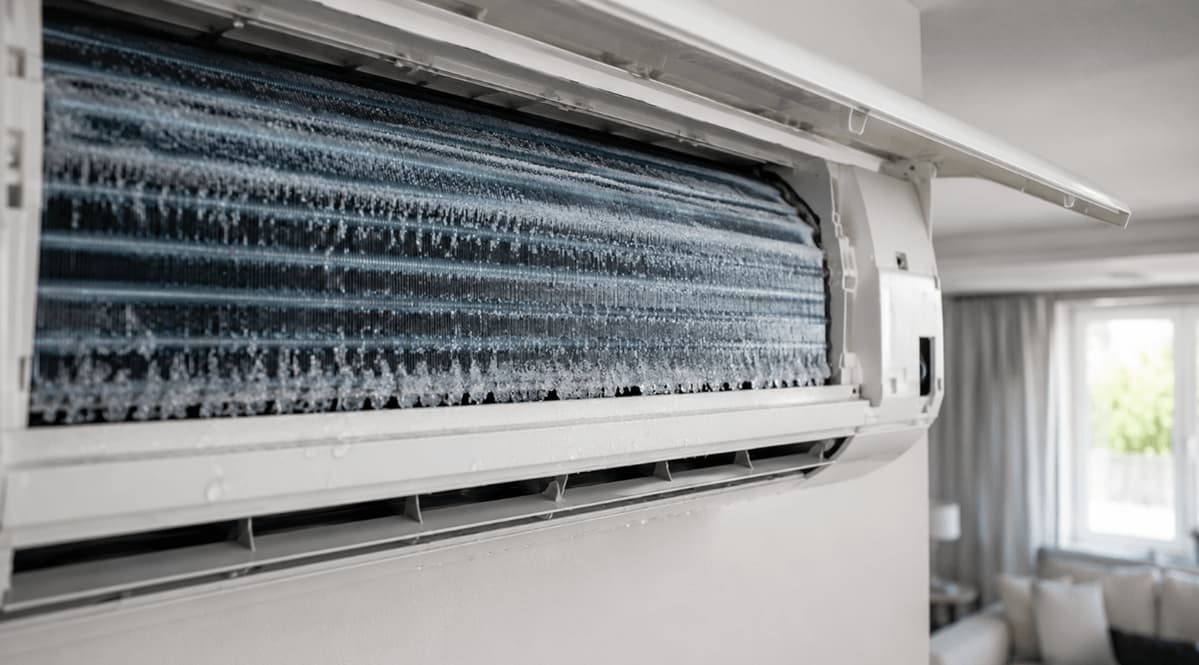
Mini Split Freezing Up? Why Ice Forms and What to Do First
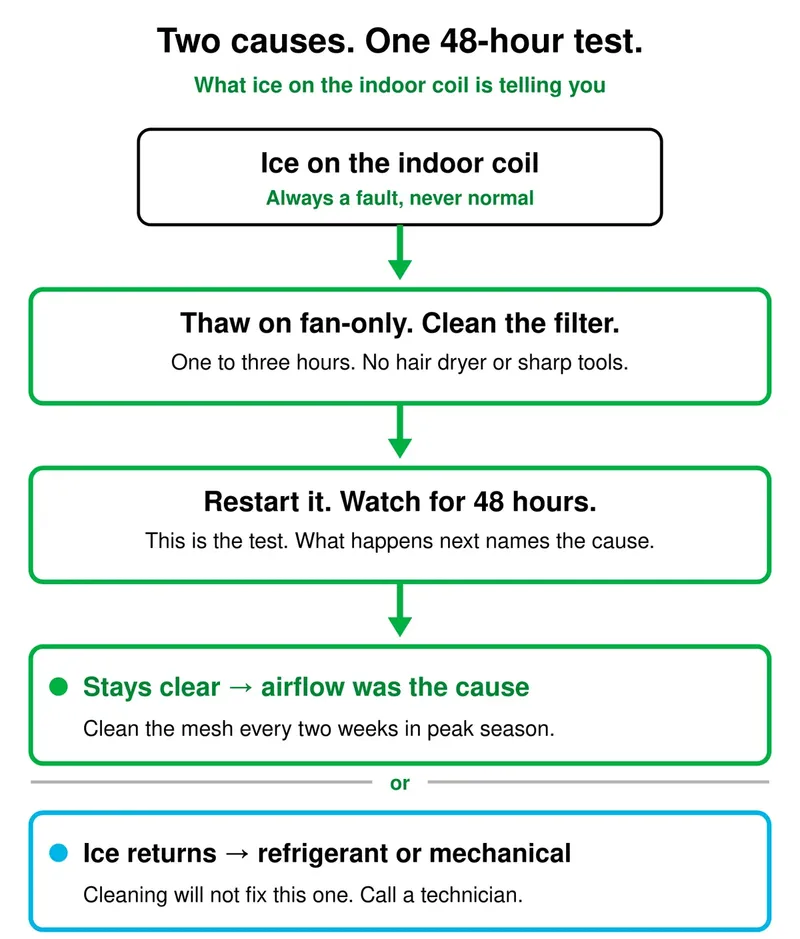
Ice on a mini split's indoor coil is always a fault, and it has only two root causes: not enough warm air reaching the coil, or not enough refrigerant inside it. Switch the system to fan-only to thaw it, and clean the mesh filter while you wait. Then restart it and watch for two days.
- Stays clear for 48 hours: airflow was the cause, and you have already fixed it.
- Ice returns within 48 hours: the cause is refrigerant or mechanical, and it needs a certified technician.
Never chip at the ice or aim a hair dryer at it. The fins wrap pressurized refrigerant tubing, and a puncture turns a cleanup into a repair.
Not sure whether you are looking at a filter job, a service call, or a system near the end of its life? Answer a few quick questions and we will point you the right way.
Replacing the unit instead of repairing it? Filterbuy builds single-zone ductless systems in 12,000, 18,000, and 24,000 BTU, with free 2-day delivery. They require professional installation.
Ice on your mini split's indoor coil isn't normal, and it isn't something to run through. Frost forms when the coil drops below 32°F, which happens when too little air reaches it or the refrigerant charge is low. Switch to fan-only to thaw, check the filter while you wait, and never chip at the ice.
TL;DR: A mini split freezes when its coil drops below 32°F and the moisture it pulls from the air turns to ice instead of draining. Usually that's restricted airflow, most often a clogged filter; low refrigerant causes most of the rest. Thaw on fan-only, clean the filter, and if it ices again within two days call a technician.
Key Takeaways
Ice on the indoor unit is always a fault. Light frost on the outdoor unit in winter is normal.
Airflow is the most common cause. A clogged mesh filter, dusty coil, or weak blower starves the coil of warm air.
Running it frozen can damage the compressor. Liquid refrigerant that fails to boil off returns to the compressor, the priciest part.
Why We Can Tell You This
Filterbuy makes replacement filters for every major mini split brand, and our HVAC Solutions team services ductless systems in Florida and Texas. We also sell single-zone ductless systems, so read any mention of our own equipment as that.
From that vantage point, ice is rarely the expensive refrigerant failure people brace for. Far more often it's the filter nobody checked, and that mesh clogs faster than a central-system filter because it sits inches from the coil. In our own service data, a dirty filter cuts a mini split's efficiency by 5–30%.
First, Figure Out Which Unit Is Frozen
Check two things first: where the ice is, and which mode the system was running. Ice on the indoor air handler is always a malfunction. Frost on the outdoor unit in heating season is usually the defrost cycle at work. The two look alike but call for opposite responses.
Frost on a heat pump's outdoor coil in winter is expected. That coil runs 10–20°F colder than the outdoor air and clears during the defrost cycle.
How to Safely Thaw a Frozen Mini Split
Set the system to fan-only, put a towel underneath, and wait one to three hours. Fan-only melts ice far faster than shutting down.
Switch to fan-only at the remote, highest speed. No fan-only setting? Cut power at the breaker.
Put down towels or a pan. A frozen coil holds more water than the drain takes at once.
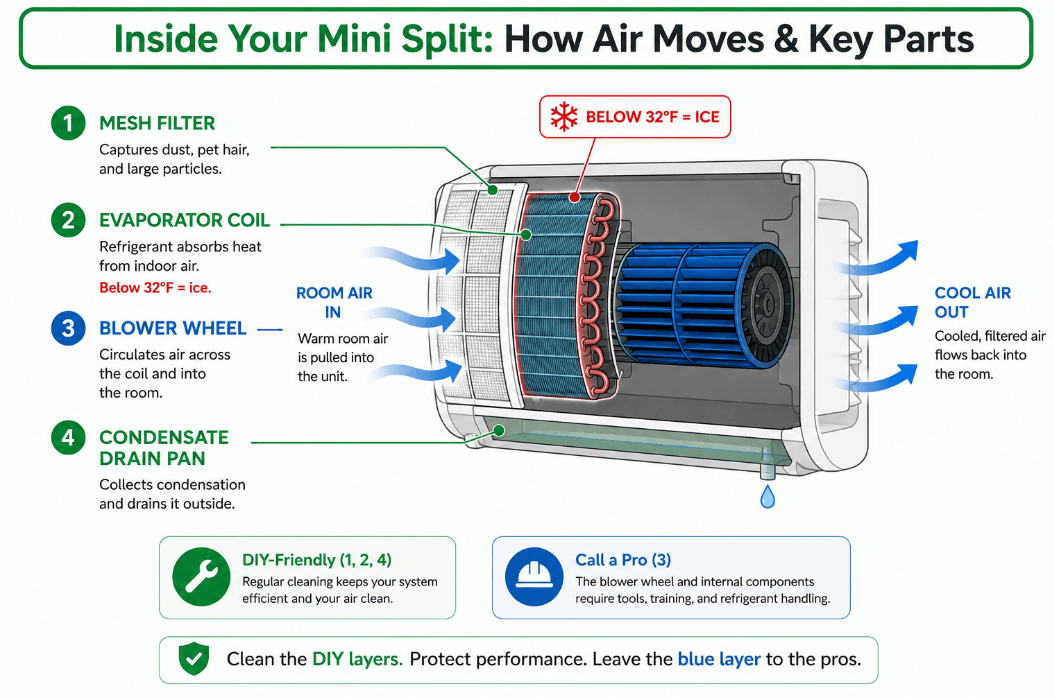
Slide out the mesh filters and hold one to white paper. If it looks gray, that's likely your cause. Wash in lukewarm water with mild soap and dry fully; our guide to clean your mini split filter has brand details.
Check the coil behind the filter. Gray dust matted on the fins needs professional cleaning, not just a filter wash.
Clear the outdoor unit, then wait until the coil is bone dry before restoring cooling. Restart on a partly frozen coil and it re-ices within minutes.
No hair dryer, heat gun, hot water, or sharp tools. The fins wrap around pressurized refrigerant tubing, and a puncture is a repair, not a cleanup.
Rush the drying and you've traded ice for a mold problem.
“The number-one callback we could prevent is the damp-filter mold call. A mesh that goes back in even slightly wet is how mold gets started inside the head. Give it the full drying time. A few extra minutes beats a service visit.”
— David Clark · Licensed HVAC Technician, Filterbuy
Why Mini Splits Freeze Up: 6 Causes, Ranked by How Often We See Them
A coil falls below freezing for only two reasons: not enough warm air reaching it, or not enough refrigerant inside it. Everything below is a version of one, ordered the way our HVAC Solutions team runs into them. The Department of Energy estimates a clean filter cuts energy use by 5–15%.
Ordered by how often Filterbuy's HVAC Solutions team finds each cause on ductless service calls. Verify against service records before publishing.
Low refrigerant means a leak, not consumption. A sealed system doesn't consume it, so if the charge is down it went somewhere, and the coil then runs below freezing even with perfect airflow. Frost along the copper line set is the sign.
Cooling in cold conditions freezes coils too, but the real limit is indoors. Published ranges vary far more by model than the usual "never cool below 60°F" advice suggests: Mitsubishi Electric's MUZ-FS cools to 14°F outdoors, while Daikin's ENTRA lists 50°F. The spec sheets turn up what most guides miss: the temperature that predicts icing is the one inside the room. Mitsubishi puts the minimum indoor intake air at 67°F dry bulb, and a room below that can ice the coil whatever the weather.
Is It Airflow or Refrigerant? The 48-Hour Rule
Thaw the unit, clean the filter, restart it, and watch for two days. If it stays clear, you had an airflow problem and you've fixed it. If ice returns within 48 hours, the cause is refrigerant or mechanical, and cleaning won't help.
That test spares most homeowners a needless service call, or two weeks of quietly damaging the compressor.
Two Patterns That Narrow It Down Fast
When the ice forms tells you as much as where. Each pattern below rules out an expensive cause.
Only one head is frozen and the others are fine
On a multi-zone system, every head shares one outdoor unit and one refrigerant charge. A low charge starves all of them at once, so it can't ice one head and leave the others running. If a single head freezes while its neighbors are fine, the fault is local to that head: its filter, coil, blower wheel, or drain. Check that unit and you've ruled out the priciest cause. (Multi-zone systems come from other makers; Filterbuy's line is single-zone.)
It freezes overnight but runs fine in the afternoon
Overnight icing is usually the room getting too cold, not the weather. After dark the load drops, the room drifts toward the setpoint, and return air can fall below that 67°F minimum. The unit keeps cooling against a load that's gone and you find frost at breakfast. Raise the overnight setpoint two or three degrees, or switch to fan or dry mode.
When to Call a Licensed HVAC Technician
Call a technician when ice returns after a proper thaw and a clean filter, when frost appears on the copper line set, or when the coil is matted with dust. No homeowner maintenance fixes those. Also call if:
Frost on the outdoor unit in cooling, or solid ice on it in heating
It short-cycles, throws an error code, or never completes a defrost cycle
You suspect a leak: hissing, oily residue, or cooling that faded over weeks
If you've been running it iced for weeks, say so when you book and ask them to check the compressor, not just the charge. Liquid refrigerant returning through a frozen coil wears it down gradually, so a running unit isn't proof it came through clean.
Refrigerant work is regulated: EPA Section 608 of the Clean Air Act requires certification and prohibits venting, so automotive recharge kits aren't an option. Expect a repair, not a top-up. Angi puts leak repair at $250 to $1,600. Our guide to vetting an installer covers licensing.
How to Keep It From Freezing Again
Prevention is almost entirely a filter habit. Clean the mesh every two weeks in peak season and monthly otherwise, and keep furniture, curtains, and outdoor debris clear of both units. Beyond that, have a technician check the coil, blower wheel, and charge once a year.
One distinction a decade of building these filters has taught us: the mesh inside a mini split is a comfort filter, not a health filter. Its job is keeping dust off the coil, not scrubbing fine particles from your air.
Shopping a replacement? Filterbuy mini split systems are single-zone units with a filter-cleaning reminder, leak detection, and a 55°C self-clean cycle. They require professional installation; self-installing voids the warranty.
That mesh is washable, so there's nothing here for us to sell you. If your home also runs a central system, our custom-size air filters ship free, factory-direct, with auto-delivery.
Supporting Statistics
Three findings from the National Institute of Standards and Technology (NIST) show why airflow and refrigerant dominate this list.
57% of systems had the wrong refrigerant charge. A field survey of 13,000 air conditioners found improper charge in 57%, and 65% of the residential units needed repairs. Source: NIST Technical Note 1848, citing Downey and Proctor (2002).
Halving airflow cost over 30% of efficiency. Cutting indoor airflow across the coil by 50% degraded a heat pump's COP by more than 30% and raised power draw over 20%. Source: NIST TN 1848, Section 3.3.2.
Improper installation adds about 30% to heating and cooling energy, with refrigerant undercharge and low indoor airflow among the biggest faults. Source: NIST.
Frequently Asked Questions
Can I run my mini split while it's frozen?
No. An iced coil risks sending liquid refrigerant back to the compressor. Switch to fan-only to thaw it, or shut it off.
How long does it take to thaw?
One to three hours on fan-only at high speed. Powered off entirely, a heavily iced coil can take six hours or more.
Is frost on the outdoor unit normal?
In heating season, light even frost is normal: that coil runs 10–20°F colder than outdoor air and the defrost cycle clears it. Thick ice, or ice at the base, is not.
Why is it freezing with a clean filter?
Usually a dust-matted coil, a low charge from a leak, or a failing blower wheel. Check the timing and the zone next.
Can low refrigerant cause freezing?
Yes. A low charge drops coil pressure and the boiling point, so the coil runs below 32°F even with good airflow. Only a Section 608 certified technician can correct it.
Filterbuy manufactures air filters and sells single-zone ductless systems. Mitsubishi Electric, Daikin, and other brands named here are referenced for factual comparison only; Filterbuy is not affiliated with or endorsed by them.
Written by Michelle Wan, Brand Manager & Air Quality Writer at Filterbuy. Reviewed by David Clark, Licensed HVAC Technician. Published September 2, 2026.
Related reading: How to clean a mini split · All Filterbuy mini split resources
Glossary
Evaporator coil: The finned aluminum component inside the indoor unit that absorbs heat from room air. This is the part that ices over.
Mesh filter: The washable screen in front of the evaporator coil. Rinsed and reused, not replaced.
Low-ambient cooling limit: The minimum outdoor temperature a manufacturer permits for cooling. Model-specific, from about 14°F to 50°F.
Intake air temperature: The temperature of room air entering the indoor unit. Manufacturers publish a cooling minimum (67°F dry bulb on Mitsubishi M-Series), below which icing becomes likely.