How to Winterize Your Mini Split: Protect Your System From Cold Weather Damage
August 13, 2026
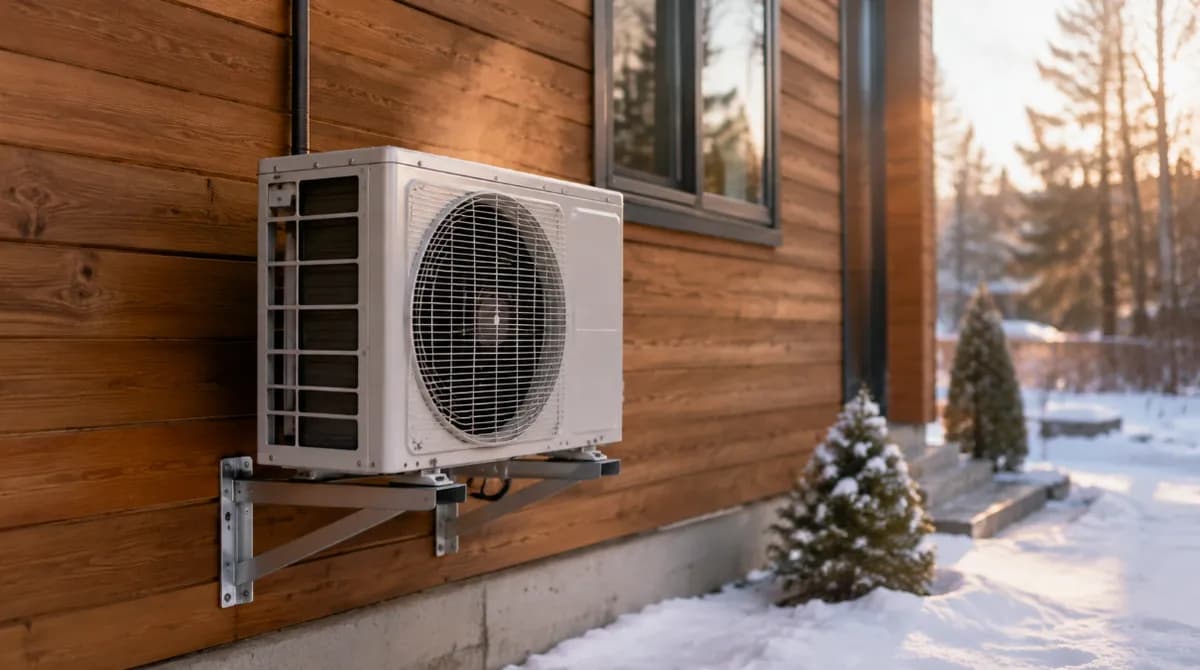
How to Winterize a Mini Split
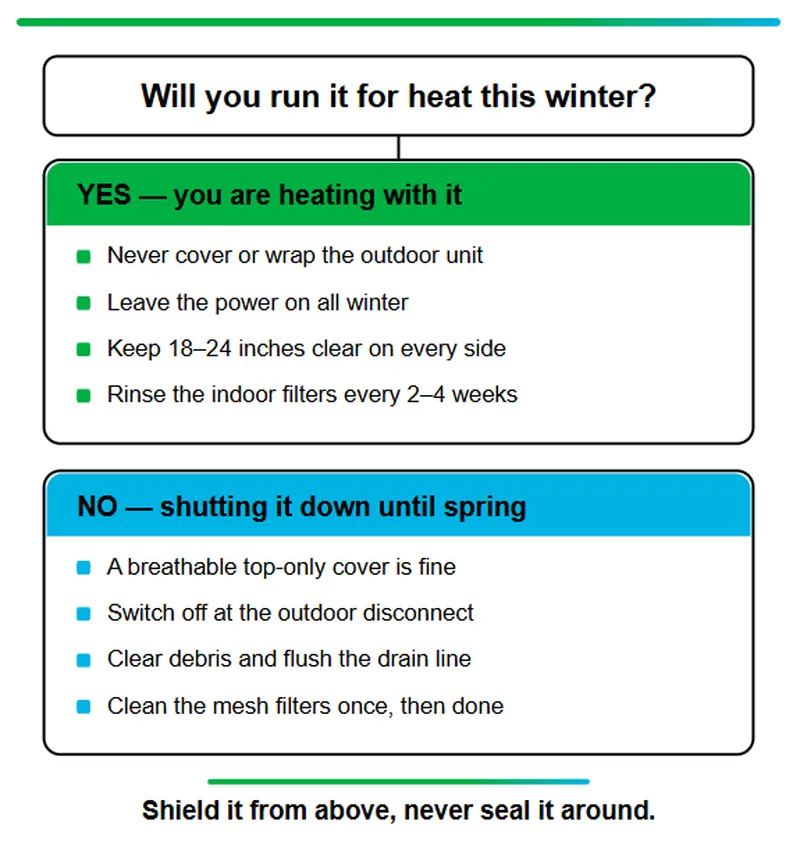
Whether you cover your mini split comes down to one question: are you running it for heat this winter? If yes, never wrap or cover the outdoor unit, because a heat pump pulls outdoor air all winter and blocking it can damage the compressor. If the system is cooling-only and shutting down until spring, a breathable top-only cover is fine.
Either way, clean the filters and clear 18 to 24 inches of space around the outdoor unit before the first freeze.
Heating with it: leave it powered and uncovered, keep every side clear, rinse the indoor filters every 2 to 4 weeks.
Shutting it down: clean the filters, cut power at the outdoor disconnect, flush the drain, then fit a breathable top-only cover.
Not sure your unit can carry the winter? Every Filterbuy mini split system is rated to heat down to 5°F, with an intelligent defrost cycle, a chassis heating belt, and a base pan heater built into the chassis. Take the quick match below to find the right setup for your home.
Answer a few quick questions and we will match you to the right mini split for your space.
Shop Filterbuy Mini Split Systems
TL;DR
A mini split is a heat pump, so winterizing one depends on a single question: will you run it for heat this winter? If yes, never wrap or cover the outdoor unit. Doing so blocks the airflow its defrost cycle needs and can damage the compressor. If it’s cooling-only and shutting down until spring, a breathable top cover is fine. Either way, clean the filters and clear 18 to 24 inches of airflow space around it before the first freeze.
Key Takeaways
Never wrap the outdoor unit of a mini split you plan to heat with. A heat pump pulls outdoor air all winter. Covering the cabinet can cause compressor damage.
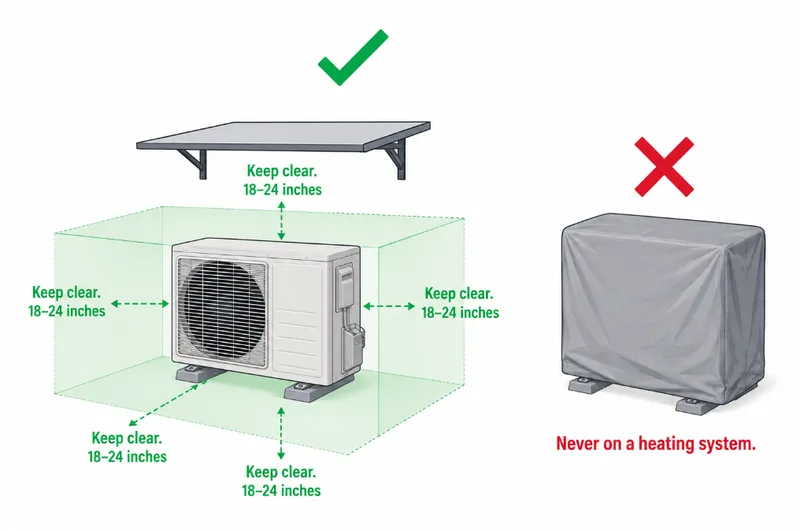
Keep 18–24 inches of clearance on every side of the outdoor unit, and mount it at least 24 inches above grade anywhere snow accumulates.
Meltwater that can’t drain is the most expensive winter mini split failure. Check the base pan and drain path, not just the cabinet top.
The U.S. Department of Energy estimates a clean filter lowers HVAC energy consumption by 5% to 15%. Rinse mini split mesh filters every 2–4 weeks; replace your whole-home HVAC filter before heating season starts.
Where this comes from: Filterbuy has built air filters in the USA since 2013, and now builds ductless mini split systems too. We see the filter side of this problem and the equipment side of it.
Start Here: Are You Heating with It This Winter?
Winterizing a mini split is really two different jobs, and one question sorts them: will you run the system for heat? If you will, it stays powered, uncovered and clear all winter. If you won’t, and you are shutting it down until spring, it gets cleaned, switched off at the disconnect and topped with a breathable cover. Applying that second checklist to a system on the first path is how units get destroyed.
Most homeowners with a ductless system in a cold climate are on Path A.
The exception the fork does not cover: multi-zone systems
If one outdoor unit feeds several indoor heads, you cannot put the system on two paths at once. Because the outdoor unit follows whichever head is still running. So if you are closing off a guest room for the winter while still heating the living room, the outdoor unit is on Path A: powered, uncovered and clear, with no exceptions.
What you can do per room: shut off the unused head at its own remote, clean and dry its filters, and wipe it down. Leave the breaker and the outdoor unit alone. Also remember each head has its own filters, so a three-room system means three sets on the same two-to-four-week schedule, not one.
Not sure which category your system falls into? See heat pump vs. mini split, because the two terms overlap more than most people realize.
Can Your Mini Split Actually Heat Your Winter?
Path A assumes something worth checking, which is that your mini split makes useful heat at your coldest temperatures. Not all of them do. A standard model is built for roughly 25°F and up, and it loses capacity quickly once the temperature drops below freezing, while a cold-climate model holds most of its capacity far lower. The two look identical sitting against the wall, but they behave like different machines in January.
You can check yours for free in about five minutes:
Find the model number. It is on the data plate on the side of the outdoor unit, usually a silver or white sticker.
Search the NEEP ccASHP Product List. Northeast Energy Efficiency Partnerships, a nonprofit, maintains a free public database of heat pumps verified to perform in cold climates. If your model is listed, it met a standard well above the federal minimum. NEEP ccASHP Product List
Act on the answer. Listed means winterize it as a heating system and keep it running. Not listed, in a cold region, means confirm your backup heat works before the first freeze, and expect the unit to lean on it.
This is the part we can speak to directly. Every Filterbuy mini split system is rated to heat down to 5°F, with an intelligent defrost cycle and a chassis heating belt. If yours turns out not to be cold-climate rated, that is the spec line worth checking on a replacement, ahead of the SEER number.
Most competing guides skip this step and hand every reader the same checklist, which matters because the wrong answer changes the whole plan. If you want the performance curves behind it, our guide to whether mini splits work in cold weather has the capacity data by temperature.
Why Should You Never Cover a Mini Split You Heat With?
A mini split in heating mode pulls thermal energy from cold outdoor air, so the outdoor coil has to be colder than the air around it. Frost forms as a matter of physics. The system clears it by briefly reversing into cooling mode, which is the defrost cycle. Wrapping the cabinet blocks the airflow both processes depend on, and the compressor pays for it.
HVAC contractors are blunt on this point, since covering a working heat pump risks catastrophic compressor damage and a badly shortened equipment life. The outdoor unit was built for freezing weather in the first place, and cold-climate models hold most of their heating capacity well below 0°F, as our guide to whether mini splits work in cold weather explains. It does not need protecting from the cold. It needs air.
A solid tarp causes a second problem: it traps humidity against metal and creates the sheltered cavity rodents look for in November. Chewed wiring found in April is a more common spring service call than any cold-weather failure.
The Cover Rule
The rule in one sentence: shield it from above, never seal it around.
Every Filterbuy mini split system ships with a base pan heater built into the chassis, because freezing meltwater is a problem manufacturers solve with a heating element and an intelligent defrost cycle rather than a tarp. When we build our own equipment, we design the ice out.
When Should You Winterize a Mini Split?
Every guide says “before the first hard freeze” and then leaves you to work out when that is, so here is the concrete answer.
Do the work about three to four weeks before your area’s median first freeze. That gap matters: you want a dry, above-freezing weekend to work in, and you want any problem you find, whether a cracked line set sleeve, a drain that will not clear or a unit sitting too low, to have time for a contractor before the season turns. NOAA’s National Centers for Environmental Information publishes first fall freeze dates by region from 30 years of climate normals.
Source: NOAA National Centers for Environmental Information, 1991–2020 U.S. Climate Normals.
Two things shift those dates more than latitude does: altitude and distance from water, which is why a mountain town freezes well before a coastal city on the same line of the map. And if the window has already passed, do the work anyway, since a late clear-and-check still beats a covered unit going into January.
Use the same window for the indoor half of the job. Order the whole-home filter now, not in December with the furnace already running through a loaded one. That is what Filterbuy auto-delivery is for. The right size arrives on your schedule, so heating season does not start on a filter you meant to change in October.
How to Winterize a Mini Split You’ll Run for Heat
Seven steps, ideally done before the first hard freeze, and about an hour of your time.
Clean the indoor filters. Lift the front panel of each indoor head, slide out the mesh screens, rinse in lukewarm water, and dry completely before reinstalling. A loaded screen chokes airflow across the coil and forces longer run times. Step-by-step for every brand
Clear the outdoor unit and its airflow zone. Remove leaves, mulch, seed pods, and summer growth. Cut back shrubs and keep 18–24 inches of open space on every side and above the cabinet.
Check your height above the snow line. Outdoor units should sit at least 24 inches above grade wherever snow accumulates. If yours is on a ground pad in a snow belt, a wall bracket or riser stand is the highest-value upgrade you can make.
Inspect the line set insulation. Walk the refrigerant lines from the outdoor unit to the wall. UV exposure cracks foam insulation within a few summers. Replace split or crumbling sections and re-tape the seams.
Confirm the condensate drain runs free. Find where the drain line exits and make sure it discharges downhill, away from the pad. This matters more than any cover. See the next section.
Add a roof, not a wrap. If the unit sits under a dripping eave or a roofline that sheds snow, mount a raised hood above the cabinet with clear space beneath. Never let the cover contact the unit.
Set it and leave it. Switch to heat mode and pick one target temperature. Avoid “auto” changeover and constant setpoint adjustments, because inverter compressors run most efficiently at a steady state. Then replace your whole-home HVAC filter before heating season peaks.
How to Winterize a Mini Split You Won’t Use Until Spring
If the system is cooling-only or serves a seasonal space you’re closing up, the list is shorter and a cover is appropriate.
Run the unit in fan mode for two to three hours to dry the coil and drain pan, preventing mold over the off-season. Why mini splits grow mold
Clean the mesh filters and wipe down the indoor heads.
Cut power at the outdoor disconnect box, not just the remote.
Clear debris from the outdoor cabinet and flush the drain line.
Fit a breathable top-only cover sized for the unit. Never a sealed wrap.
Come spring, reverse this list. Our mini split summer preparation checklist covers the restart in detail.
The Ice Collar: Winter’s Most Expensive Mini Split Failure
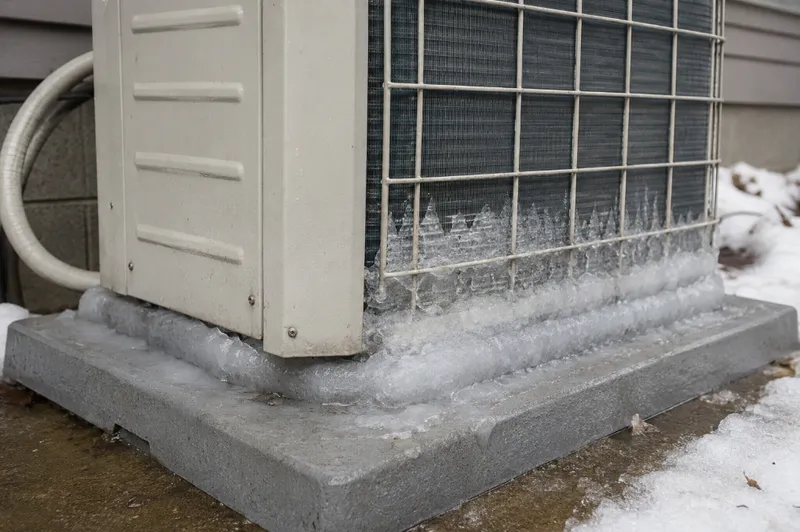
What does the damage in cold weather is not snow on top of the cabinet, it is meltwater with nowhere to go. Every defrost cycle sends water down through the base pan and out the drain. When the ground below has frozen, that water pools and refreezes into a collar of ice that creeps up around the base, engulfs the lower coil, and reaches the fan blade.
By the time that ice is visible it is usually load-bearing, so homeowners go at it with whatever is nearby. A screwdriver punctures a coil fin or bends the fan, and a drainage problem becomes a refrigerant leak.
Three things prevent the ice collar, and none of them is a cover:
Raise the unit on a wall bracket or riser so 12–18 inches of open air sits beneath the base pan.
Put drainage under it. A gravel bed under a ground-mounted unit lets meltwater disperse instead of pooling.
Ask about a base pan heater. In climates with extended stretches below 20°F, this low-wattage element keeps the drain path open. It is standard practice in northern installations. How cold-climate models handle ice
If ice has already formed, don’t chip it. Switch the system to fan mode or off and let it thaw, or call a technician.
How Do You Clear Snow Off a Mini Split?
In a snow region this is not a one-time task. The outdoor unit needs a two-minute check after every significant snowfall, and technique matters more than most people expect. Aluminum coil fins bend under almost no force, and a bent fin block is a permanent efficiency loss.
Use a soft brush or broom. Never a shovel, scraper, or anything with an edge. Never chip at ice.
Clear all four sides, not just the top. Drifting closes off the back and sides first, and that is the air the coil is actually pulling.
Never pour hot water on it. It refreezes within the hour, usually into a worse shape than you started with, and thermal shock is hard on a cold coil.
Find where the drain discharges. If that point is buried in a drift or a plow bank, the meltwater has nowhere to go, and the ice collar starts.
Look up. Check whether snow slides off the roof onto the unit, or an eave drips on it. That is the one case where a hood earns its keep.
If snow is packed against the unit and you are unsure, run the system in fan mode first. The airflow loosens light accumulation on its own.
Winter Filter Maintenance: You Have Two Filters, Not One
Homes with a mini split almost always have a second filtered system serving the rest of the house, and the two need entirely different care. Winter is the season when neglecting either one costs you the most.
The U.S. Department of Energy puts the figure at 5% to 15%: routinely replacing or cleaning your filters lowers a system’s energy consumption by that much. ENERGY STAR recommends checking the filter every month during heavy-use months, meaning winter and summer, and replacing it at least every three months.
Source: U.S. Department of Energy, Energy Saver. Replacing a dirty, clogged filter with a clean one can lower energy consumption by 5% to 15%.
We make filters for a living, so this is the part we are least willing to oversell. A mini split’s mesh screen protects the equipment, not your lungs. The U.S. Environmental Protection Agency states it plainly: ductless mini split heat pumps generally do not filter fine particles, because those mesh screens are designed to stop large debris like pet hair and lint from clogging the equipment. The EPA’s threshold for genuine fine-particle capture is a documented rating of MERV 13 or higher.
Supporting Statistics
50%
Half of Northeast households cool with individual units, the category that includes mini splits.
Central systems dominate nationally. The Northeast is the exception.
Drawn from 18,496 households, the largest sample in the survey’s history.
Why it matters: the snowiest region has the most of this equipment.
Source: U.S. Energy Information Administration, 2020 Residential Energy Consumption Survey
5–8%
Defrost costs a heat pump only 5% to 8% of its energy between 5°F and 35°F, when airflow is clear.
22 cold-climate heat pumps monitored in occupied homes for the Department of Energy.
898 to 3,099 hours of heating data collected per site.
One outlier site spent 16% of its time in defrost below 40°F, against a 5% average, and used significantly more energy.
The same testing confirmed 100% of nominal heating capacity at 5°F.
Why it matters: defrost is cheap when the coil can breathe. Blocking it is what costs you.
2–5x
Indoor levels of some pollutants run 2 to 5 times higher than outdoors. Americans spend about 90% of their time inside.
The people most vulnerable to air pollution spend even more time indoors.
Winter concentrates it: windows stay shut and air exchange drops.
Why it matters: the mini split mesh does not capture fine particles. Your central filter carries that load.
Source: U.S. Environmental Protection Agency, Report on the Environment: Indoor Air Quality
Frequently Asked Questions
Should i cover my mini split in the winter?
Only if you are not using it for heat. A mini split running in heating mode must stay uncovered, because covering the outdoor unit blocks the airflow the defrost cycle depends on and can damage the compressor. If the system is cooling-only and powered off for the season, a breathable top-only cover is appropriate.
Can a mini split be left on all winter?
Yes. Mini split heat pumps are built for continuous year-round operation in freezing weather, and cold-climate models are rated to produce heat well below 0°F. One steady setpoint is more efficient than cycling on and off.
Do i need a different filter for winter?
Not a different type, but a fresh one. Mini split mesh screens keep the same 2-to-4-week rinse schedule year-round. The filter that changes is the pleated one in your central system, which works harder once the heat runs daily. Replace it before heating season, and match the MERV rating to your household rather than the season.
Why is my mini split covered in frost or steaming outside?
Both are normal. Frost forms on the outdoor coil during heating, and the defrost cycle melts it by briefly reversing refrigerant flow, which produces visible vapor. That steam is water vapor, not smoke, and signals the system is working correctly.
How high off the ground should a mini split outdoor unit be?
At least 24 inches above grade in any region with meaningful snowfall, on a wall bracket or riser stand. Elevation keeps the coil above drifting snow and gives meltwater room to drain instead of refreezing at the base.
Glossary
Mini split. A ductless system: one outdoor condenser connected by refrigerant lines to one or more indoor heads. Also called a ductless AC.
Heat pump. Equipment that moves heat rather than generating it. Nearly all residential mini splits sold in the U.S. are heat pumps.
Defrost cycle. An automatic sequence that briefly reverses refrigerant flow to warm the outdoor coil and melt frost. Typically runs every 30 to 90 minutes in cold, humid conditions.
Line set. The insulated pair of copper refrigerant lines between the outdoor unit and each indoor head.
Base pan. The floor of the outdoor cabinet where defrost meltwater collects. Origin point of most winter icing failures.
Base pan heater. A low-wattage element keeping the base pan drain path open in severe cold. Standard on cold-climate units.
MERV. Minimum Efficiency Reporting Value, the 1–16 scale rating particle capture. MERV 8, 11, and 13 are the common residential grades.
ccASHP. Cold Climate Air Source Heat Pump. A NEEP specification identifying units verified to hold heating capacity at 5°F and below.
Michelle Wan is Filterbuy’s Brand Manager and Air Quality Writer. She works directly with Filterbuy’s U.S. manufacturing team across facilities in Alabama, Florida, Pennsylvania, and Utah, and writes from how filters are actually built and how they hold up in real homes. Reviewed for technical accuracy by David Clark, CEO of Filterbuy HVAC Solutions and a licensed HVAC technician.