
Should You Close Vents in Unused Rooms? Why It Rarely Saves Money
October 21, 2026
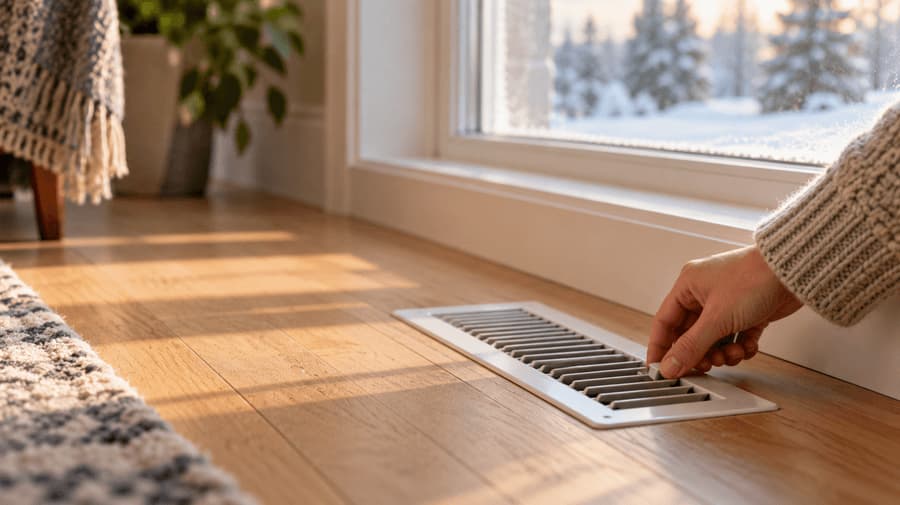
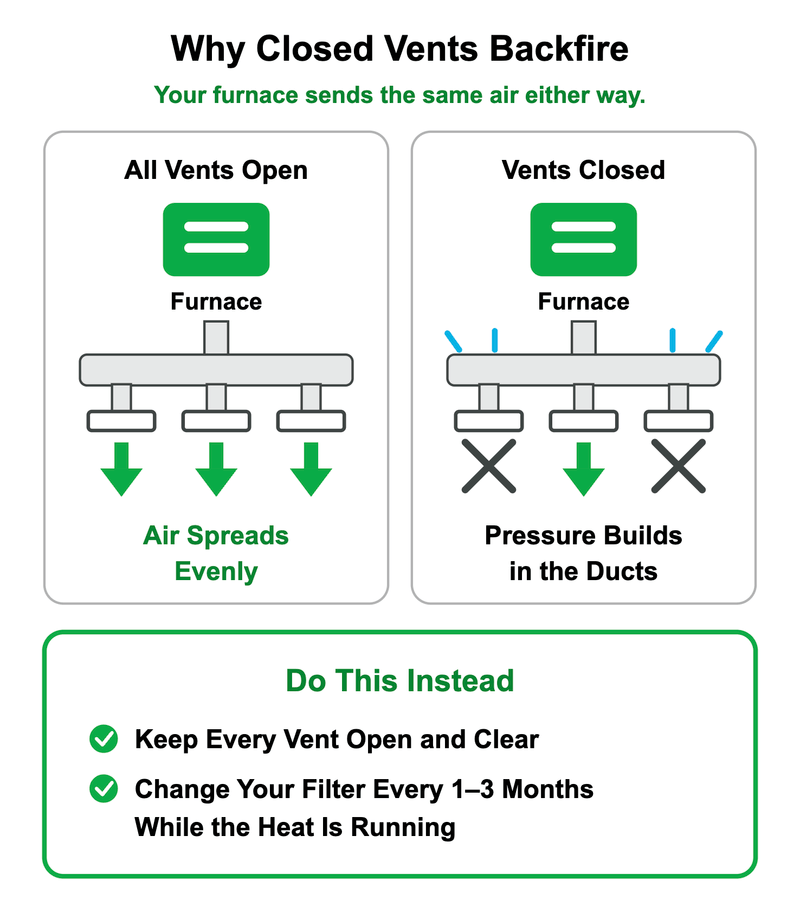
No — keep the vents in unused rooms open. Closing them doesn’t make your furnace produce less heat. It pushes the same air through fewer openings, which builds pressure in the ducts and adds strain to your system.
The better winter move: keep every vent clear and change your filter every 1–3 months while the heat is running. Take the quick quiz below to find the filter that fits your system.
Have a zoned system? That’s the exception — it’s designed to close dampers on purpose.
MERV 8 captures larger debris, dust, and dust mites for everyday filtration.
Find Your Filter Match
Answer a few quick questions and we’ll match you to the right filter for your home.
TL;DR
No, closing vents in unused rooms rarely lowers your winter heating bill. Your furnace makes the same heat either way, so the blocked air escapes through duct leaks, and a Lawrence Berkeley National Laboratory study found energy use actually went up. From Filterbuy's side of the filter slot, closed vents and dirty filters are the same problem: both choke airflow. A thermostat setback and a clean filter save more, with far less risk.
Key Takeaways
Lawrence Berkeley National Laboratory (LBNL) found that closing registers raised energy use in a typical home with ducts outside the living space.
Filterbuy lab data shows a clean 1-inch MERV 13 filter can use about half of a typical system's static pressure budget before a single vent is closed.
Filterbuy recommends keeping at least 75% of supply vents open, while LBNL flags closing more than 60% as a safety concern.
A closed-off room can get cold enough for frozen pipes and mold.
Does Closing Vents Save Money in Winter?
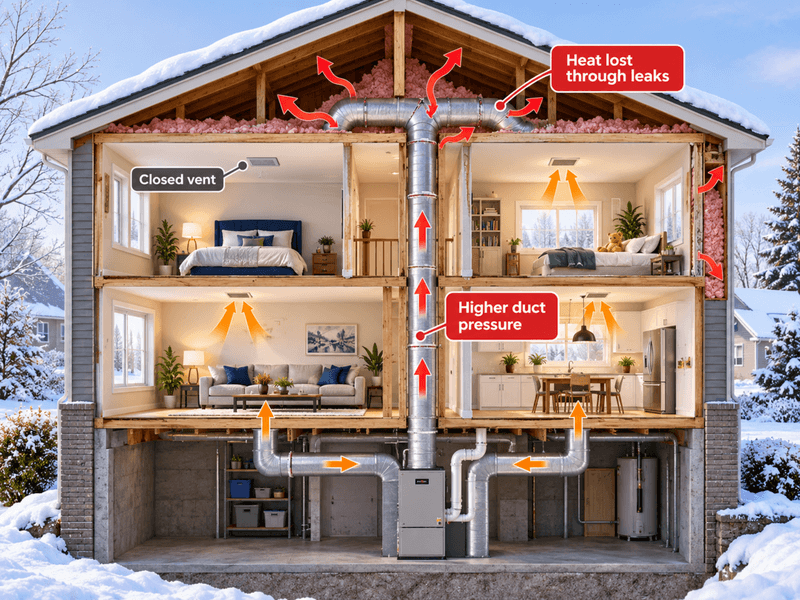
In most homes, it doesn't. A forced-air furnace pushes a set volume of air through the whole duct system, and shutting a register doesn't make it produce less heat. That air still has to go somewhere, so it leaks out through gaps in the ductwork into attics and crawlspaces.
Iain Walker, a staff scientist at Lawrence Berkeley National Laboratory, tested this. His study found that closing registers led to increased energy use for a typical California house across a wide range of climates, duct leakage levels, and numbers of closed registers. The rooms you stop heating save a little, but extra duct losses cancel it out.
ENERGY STAR, the U.S. EPA's efficiency program, estimates that about 20 to 30 percent of the air moving through a typical home's ducts is lost to leaks, holes, and poor connections, and the Department of Energy says those leaks can add hundreds of dollars a year to bills. Closing registers pushes even more heated air through those gaps.
The honest exception. LBNL modeled California homes with ducts in an attic or crawlspace, though the physics applies anywhere ducts leak. If every duct runs through heated rooms, leaked air stays indoors and the energy penalty is probably smaller, though the pressure and safety problems below still apply.
The Static Pressure Budget: Why Closed Vents and Your Filter Compete
Think of your system's airflow as a budget. Most homes are designed for about 0.5 inches of water gauge (in. w.g.) of total external static pressure, shared by the filter, coil, ducts, and registers. Every closed vent spends some of it.
So does your filter. In Filterbuy's pressure drop testing, a clean 1-inch MERV 8 filter starts at about 0.08–0.12 in. w.g., while a clean 1-inch MERV 13 starts at about 0.22–0.28 in. w.g. That MERV 13 uses roughly half the budget on day one, and the number climbs as winter dust builds up.
That's why Filterbuy treats vents and filters as one decision. Closing registers behind a dense, dusty 1-inch filter can push a system past its limit. Our rule is stricter than the research: keep at least 75% of supply vents open. And if you want MERV 13 filtration, look at a 4-inch filter, which our testing shows can create less resistance than a 1-inch MERV 11.
What Happens to Your HVAC System When You Close Vents?
Closing vents raises static pressure, which forces more air out of duct leaks, cuts airflow across the furnace, and makes the blower work harder. That combination can trip safety switches and wear out parts.
More duct leakage. Higher pressure drives more heated air out of seams and joints, especially in unheated spaces.
Less airflow across the furnace. The heat exchanger runs hotter, and LBNL notes furnaces may end up operating on the high-limit switch. The resulting on-off cycling is a classic furnace overheating symptom, and Filterbuy's support team hears about it most when a cold snap hits.
A harder-working blower. Variable-speed blowers ramp up, using more electricity.
Over time, overheating wears down the heat exchanger, and a cracked one can leak carbon monoxide. The CDC's furnace safety fact sheet explains the risk, and Filterbuy's guide to carbon monoxide warning signs walks you through what to do if an alarm sounds.
We make filters, and a better filter doesn't solve everything. What a filter change does is put you in front of your furnace every month, so take one more minute to check the flame and test your alarm.
Michelle Wan, Brand Manager & Copywriter, Filterbuy
Heat pumps are even more sensitive. Restricted airflow raises refrigerant pressures and cuts efficiency, so keep every register open.
Why a Closed-Off Room Is Riskier in Winter
A closed-off room can get cold enough to freeze pipes, grow mold, and trap stale air, and those problems often cost more than any heating savings.
Frozen pipes. The American Red Cross lists pipes that run against poorly insulated exterior walls among those that freeze most often, and it recommends keeping the heat no lower than 55°F when you travel in cold weather.
Condensation and mold. Warm, moist air from the rest of the house drifts into the cold room, and the EPA explains that in cold weather, moisture condenses on cold surfaces and can encourage mold.
Stale air. Dust and odors settle in a closed room and recirculate when you reopen it, one more reason indoor air quality gets worse in winter.
When Is It OK to Adjust a Vent?
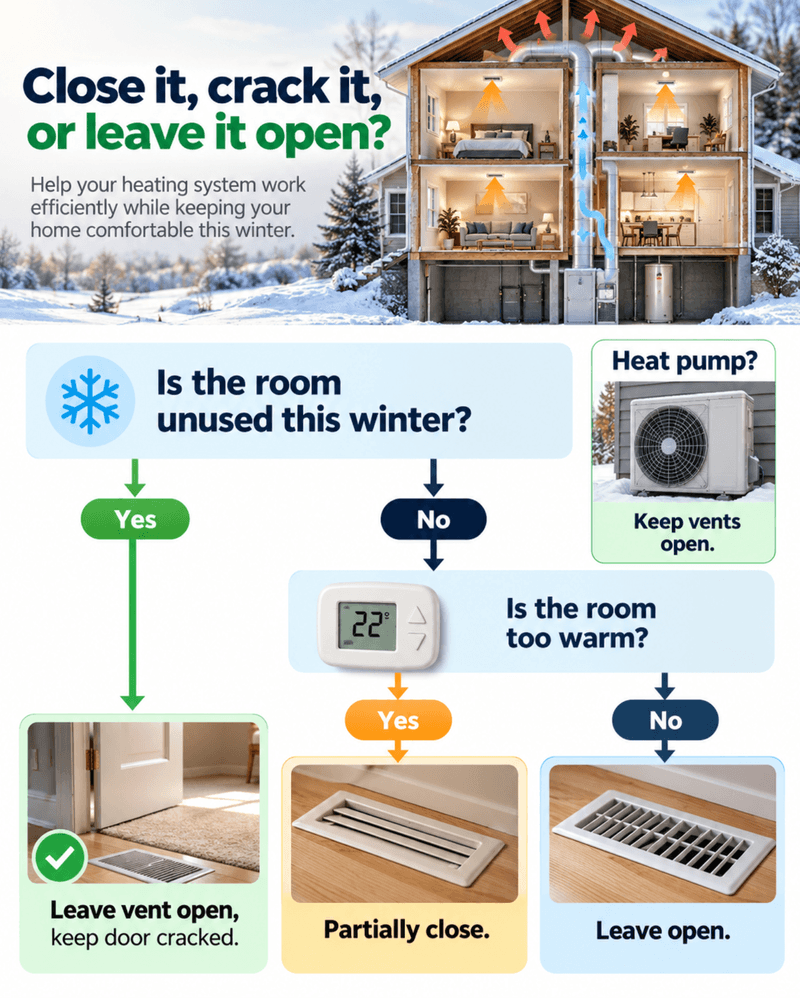
Nudging a vent to balance comfort is fine. Shutting one to close off a room is where trouble starts.
Close it, crack it, or leave it open
Source: Lawrence Berkeley National Laboratory (2003).
If you do close a vent, start with the one farthest from the furnace, which LBNL found kept the energy penalty smallest. Find your register count below to see how many you can close.
How many vents can you close? (Filterbuy 75% rule)
Keeps at least 75% of supply registers open. Close the ones farthest from the furnace first, and never close return grilles. Heat pump homes: keep all registers open.
Filterbuy's 5-Minute Winter Airflow Check
Before the first cold snap, walk through your home with these one-minute checks.
Count your supply registers. Use the table above to find the most you should ever close.
Clear every return grille. Returns pull air back to the furnace, so never close or cover one, even in a room you don't use.
Hold your filter up to a light. If light barely passes through, replace it before you close anything.
Listen and look. Whistling registers, a furnace that shuts off minutes after starting, or a hot, dusty smell all point to restricted airflow.
Check the coldest room. Leave a thermometer in any closed-off room overnight. If it reads below 55°F, open the vent.
What to Do Instead to Lower Your Winter Heating Bill
For a smaller bill, these steps work better. Filterbuy lists them easiest first.
Set back your thermostat. The U.S. Department of Energy says you can save as much as 10% a year by turning your thermostat back 7–10°F for 8 hours a day. Heat pumps are the exception: deep setbacks can trigger costly backup heat, so keep their setbacks small.
Change your air filter on schedule. A clogged filter drains the same pressure budget as closed vents. Check it monthly, and see Filterbuy's guide on how often to change your furnace filter in winter.
Match MERV to your system. Most homes do well with MERV 8 to MERV 11. If you want MERV 13, go thicker before you go denser.
Seal the ducts you can reach. ENERGY STAR recommends mastic or metal tape, never cloth duct tape.
Crack the door and draw the curtains. Curtains cut heat loss, but leave the door slightly open, because the Department of Energy notes that closed interior doors can restrict return airflow.
Ask about zoning. A zoned system uses dampers and pressure controls to do safely what closing vents by hand can't.
On winter service calls, I check the air filter first, because a clogged one keeps the system running longer and takes five minutes to replace.
David Clark, Licensed HVAC Technician, Filterbuy
Supporting Statistics: What the Research Shows
1. Space heating is the largest energy use in U.S. homes, at 42% of residential energy consumption.
The U.S. Energy Information Administration's Residential Energy Consumption Survey ranks heating above every other household use.
Source: U.S. EIA, RECS (June 2023)
2. U.S. households are projected to spend an average of $1,030 on heating in winter 2026–27, up $82 (8.7%).
The National Energy Assistance Directors Association (NEADA) says that increase is more than 2.5 times the rate of inflation.
Source: NEADA, Winter 2026–27 Heating Costs (Sept. 2026)
3. Water damage and freezing claims average $15,400, and about 1 in 60 insured homes files one each year.
The Insurance Information Institute (Triple-I) bases these figures on ISO homeowners claims data, with the average claim covering 2019–2023. One frozen pipe can wipe out years of imagined vent savings.
Source: Triple-I, Homeowners Insurance Facts + Statistics
Frequently Asked Questions
Should I Close Basement Vents in Winter?
Usually not, since basements need heat to protect pipes. If a finished basement runs warm, close its registers partway.
How Many Vents Can I Safely Close?
As few as possible. Filterbuy's rule is to keep at least 75% of supply vents open (see the table above), and LBNL flags closing more than 60% as a safety concern.
Do Magnetic Vent Covers Save Energy?
No. They block a register the same way closed louvers do, so they cause the same pressure and leakage problems.
Is It Better to Close the Door or the Vent of an Unused Room?
Neither, fully. Leave the vent open and the door cracked so air keeps moving and pipes stay protected.
Glossary
Register (vent): A supply grille where heated air enters a room.
Total external static pressure (TESP): The combined resistance of a system's filter, coil, ducts, and registers, measured in inches of water gauge (in. w.g.).
Heat exchanger: The furnace part that heats air while keeping combustion gases separate.
High-limit switch: A furnace safety sensor that shuts off the burners when the heat exchanger gets too hot.
MERV: Minimum Efficiency Reporting Value, a 1–16 scale that rates how well an air filter captures particles.
LBNL: Lawrence Berkeley National Laboratory, a U.S. Department of Energy national lab in Berkeley, California.
Filterbuy: A family-owned U.S. manufacturer of HVAC air filters, founded in 2013, with plants in Alabama, Florida, Pennsylvania, and Utah.
The Bottom Line
Leaving your vents open is the cheapest winter fix, and the safest. Keep air moving through a clean filter and let the thermostat do the saving. Filterbuy makes every filter to order in its U.S. plants, so find your exact size and set up auto-delivery to keep a fresh one arriving right on schedule.