
What Does Ozone Smell Like, And When Should You Worry About It?
June 12, 2026
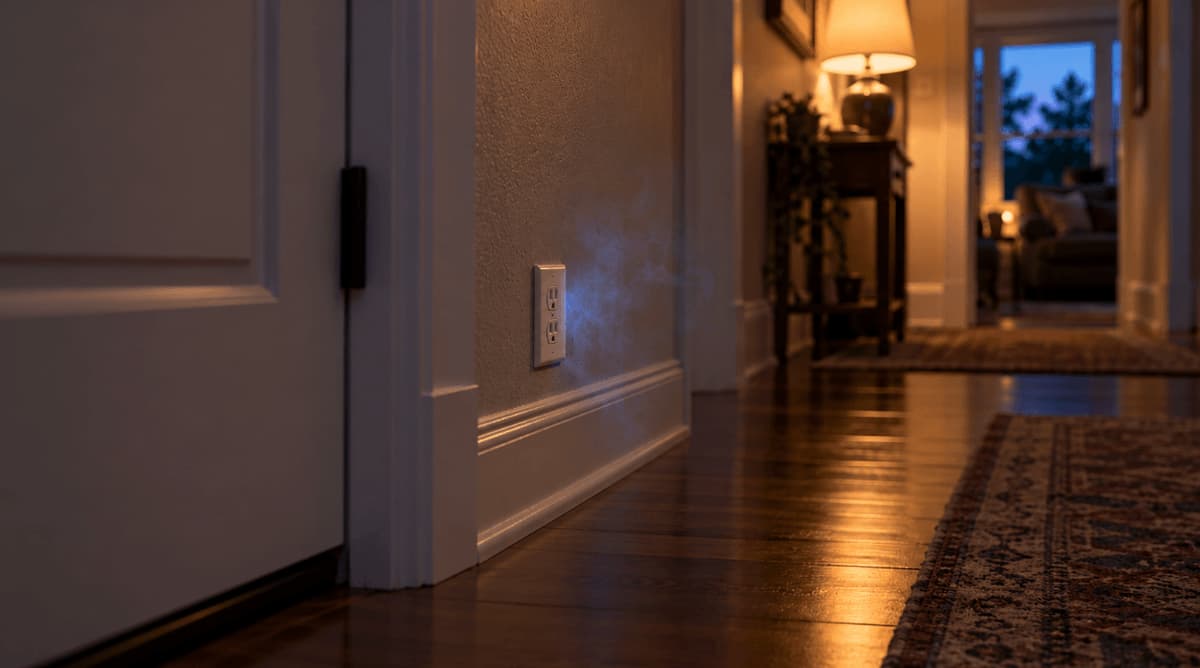
Ozone smells sharp and metallic, like chlorine bleach or the air during a thunderstorm. Outdoors, that scent is normal. Indoors, it usually means something in your home is producing it. If you smell it near an outlet or appliance, cut power to that circuit and call an electrician.
Air filters capture particles, not ozone gas. Once the source is handled, take the quick quiz below to match your home to the right Filterbuy air filter.
Find your filter match
Answer a few quick questions and we'll match you to the MERV rating that fits your home.
TL;DR
Ozone smells like chlorine bleach with a sharp metallic edge, or like the air during a thunderstorm. Outdoors that scent is harmless, but indoors it usually means something in your home is producing it. The case that needs attention today is an ozone or burning smell near wiring or appliances, which can signal electrical arcing and a fire risk.
Key Takeaways
An ozone or burning smell near an outlet or appliance can mean electrical arcing. Cut power to that circuit and call an electrician.
Indoor ozone has a half-life of roughly 7 to 10 minutes, so a room clears within an hour once the source stops.
Pleated and HEPA filters capture particles, not ozone gas. Carbon filters, the kind Filterbuy builds, removed roughly 60% to 70% of ozone in a Lawrence Berkeley National Laboratory study.
What Does Ozone Smell Like?
Ozone smells sharp, pungent, and slightly metallic. Most people reach for chlorine or bleach, though others describe it as electric, closer to a hot wire.
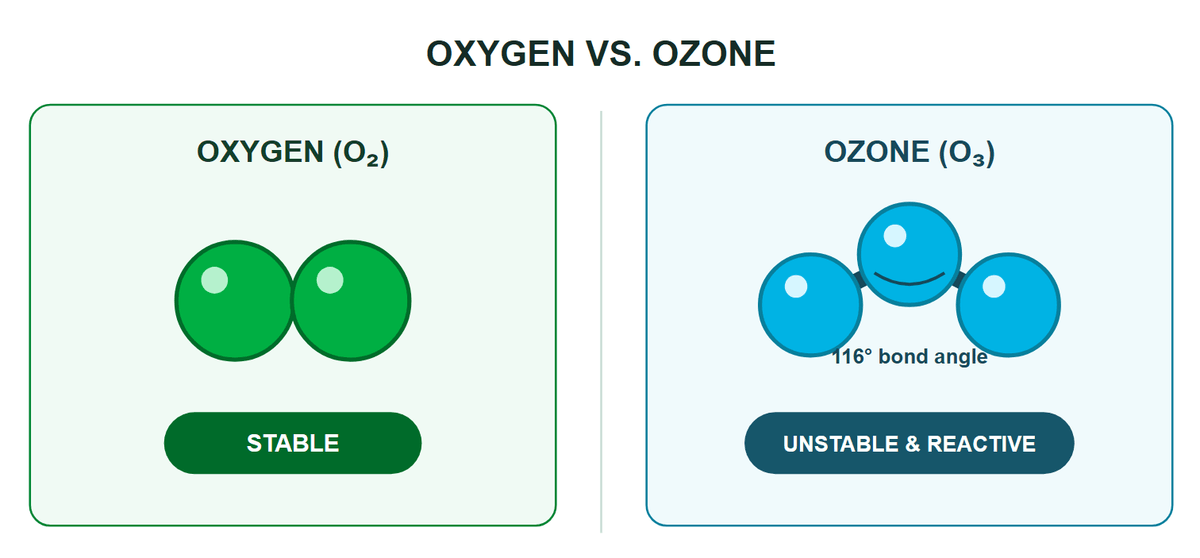
Ozone is the reactive form of oxygen. The oxygen you breathe is two atoms bonded together (O2), while ozone carries a third (O3), and that extra atom leaves the molecule unstable and quick to react.
Does ozone smell like chlorine? Yes, and both are strong oxidizers, though ozone reads thinner and sharper. The California Air Resources Board reports that some people detect ozone at levels as low as 0.05 parts per million. If you can smell ozone indoors, your nose has told you it is worth acting on.
What Causes An Ozone Smell In Your House?
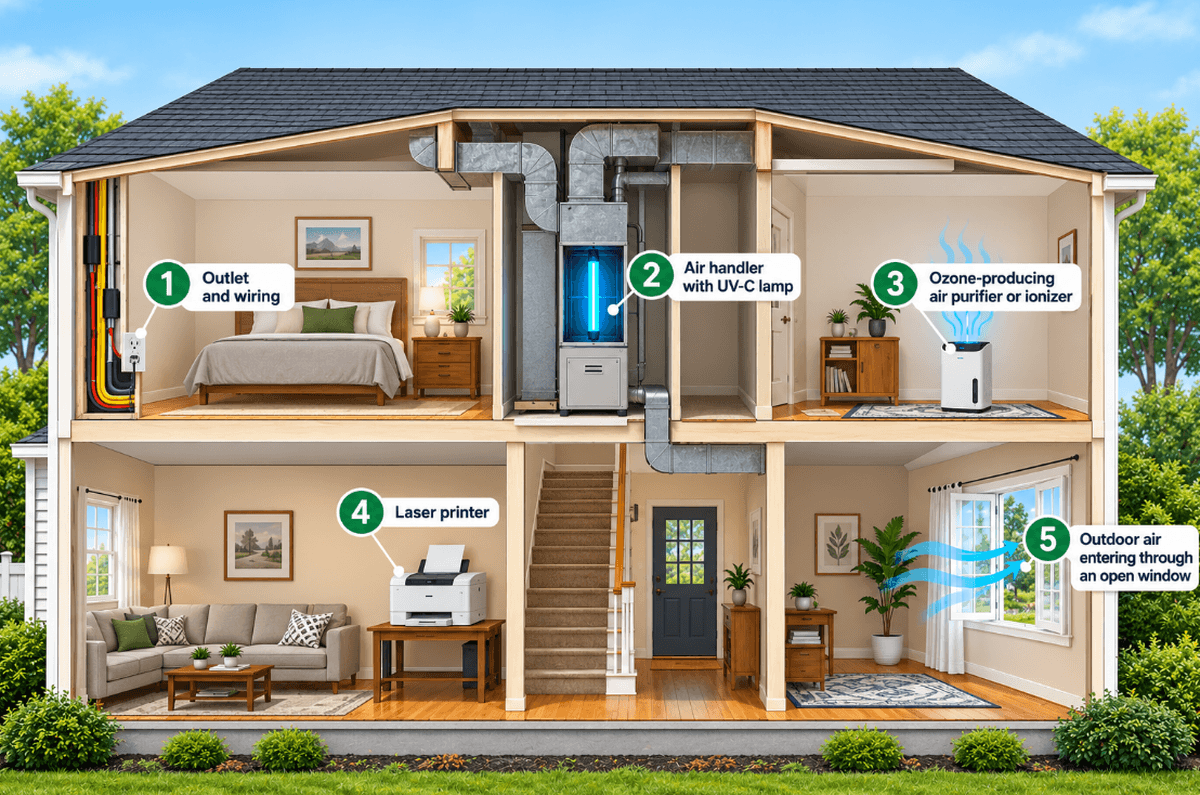
Five sources account for nearly every ozone smell in a house. Match what you are noticing to the row below. Only the first needs attention the same day.
Indoor Ozone Sources
Is It Actually Ozone, Or Something Else?
Sharp and metallic describes more than one household smell, and telling them apart changes what you do next. Work down the table until a row matches what you are smelling.
Smell Differentiation
Two of those rows cannot wait. Sulfur means leaving the building, burning plastic means reading the section below.
Ozone Smell Electrical: The Case That Cannot Wait
A sharp ozone or burning smell near an outlet, switch, panel, or appliance points to electrical arcing, which splits oxygen in the surrounding air into ozone. Stop using that outlet and kill the circuit at the breaker. The Electrical Safety Foundation International, a nonprofit focused on electrical safety, identifies arcing faults as a major cause of U.S. home electrical fires.
Buzzing sounds, a warm outlet cover, or flickering lights all strengthen the case. This is also the one source Filterbuy cannot help with, since no filter touches it and it sits outside what our technicians handle.
Ozone Smell From Your AC Or Furnace
An ozone smell from AC or furnace equipment usually means an electrical fault inside the unit. On a furnace the culprit is most often a worn blower motor, while on an AC or heat pump it tends to be a failing capacitor or pitted contactor. Shut the system off at the breaker and call a licensed HVAC professional.
Filterbuy runs an HVAC service company alongside the filter plants, so equipment that smells wrong is day work here, not a research topic.
Ozone Smell From A Furnace
As the bearings wear, the motor binds and draws more current to turn the same wheel. That current becomes heat, the heat degrades the insulation on the windings, and the degraded insulation lets small discharges form. Those are what you smell.
One furnace odor gets confused with this and is not an emergency. The first time you run heat after a long off season, dust burns off the heat exchanger, which smells dusty rather than sharp and clears within the hour.
Ozone Smell From An AC Or Heat Pump
A failing run capacitor makes the motor it serves run hotter, and a pitted contactor chatters instead of closing cleanly, with every chatter a small arc. Either one produces an ozone smell the moment the system starts. A UV-C lamp in the air handler is the other possibility, since some make ozone by design. In Florida, Filterbuy HVAC Solutions can inspect the equipment.
Ozone Generator Smell, And Why Your Car Smells Like Ozone
An ozone generator smell is the machine doing exactly what it was built to do, which is why these devices should not run in occupied spaces. Filterbuy has nothing riding on the answer, since we make air filters and have never sold an ozone generator. The U.S. Environmental Protection Agency notes that these machines do not remove particles, and that vendors use terms like "energized oxygen" to make ozone sound healthy. The California Air Resources Board advises against running them in occupied spaces.1
If a treatment has already happened, ventilate rather than waiting in a sealed room, and do not go back in while you can smell it.
A car that smells like ozone has one of three causes: a failing blower motor resistor or relay behind the dash arcs as it would in a house, many vehicles carry an ionizer that makes ozone deliberately, and the third is outdoor air pulled through the intake. Recirculate tests that last one, and an activated carbon cabin air filter handles what arrives with it.
Is An Ozone Smell Dangerous?
That depends on the source and the concentration. Ozone is a lung irritant rather than fresh air, whatever the box on an ionizer says. The EPA reports that breathing it can cause chest pain, coughing, shortness of breath, and throat irritation, and that it aggravates asthma. Sensitivity varies widely.
Sensitive groups deserve more caution: children, older adults, anyone with a respiratory condition, and pets. If someone develops symptoms, move them to fresh air and seek medical advice. The outdoor version is covered in our guide to ground-level ozone and its health effects.
Smell After Lightning, And Why The Smell After Rain Is Different
The smell after lightning is ozone. A strike splits oxygen molecules in the surrounding air, the loose atoms recombine into O3, and downdrafts carry it to ground level. That is the sharp tang people notice during a storm.
The earthy smell that arrives after the rain stops is not ozone at all. That one is petrichor, produced mainly by geosmin, a compound made by soil bacteria and released when raindrops hit dry ground. Nearly everyone has the two backwards.
How Long Does An Ozone Smell Last?
Once the source stops, ozone clears on its own. Research hosted by the National Institutes of Health puts the indoor half-life at roughly 7 to 10 minutes, governed by air exchange and surface reactions. A closed room is clear within about an hour.
Ozone Decay Timeline
Assumes a closed, furnished room with no active source and no added ventilation, using the slower end of the 7-10 minute half-life range.
That decay curve also gives you a free diagnostic. Air the room out for 30 minutes with a window open and a fan running, then close it up and leave. Come back an hour later. If the smell is gone, the source has stopped. If it is back, something in there is still running, and you have turned "what is this smell" into "what is still on."
How To Get Rid Of An Ozone Smell
Removing the source is the actual fix, ventilation clears whatever is left, and air cleaning comes last because it solves a different problem.
Find and stop the source, using the table above to work out which you have.
Ventilate. Air exchange clears ozone, so open windows and run fans rather than sealing the room.
Escalate the urgent cases. Electrical goes to an electrician, a gas leak means leaving and calling 911.
Check before reopening. On hot afternoons the local air quality index tells you whether open windows help or bring in more ozone.
Can An Air Filter Remove Ozone?
A standard air filter captures particles, not ozone gas. Pleated filters, high-MERV media, and True HEPA trap particles as air passes through, and ozone goes through with it. Filters with an activated carbon layer differ, because carbon adsorbs gas molecules and breaks ozone down.
A Lawrence Berkeley National Laboratory pilot study found that carbon-containing HVAC filters removed roughly 60% to 70% of the ozone passing through them, while filters without carbon removed essentially none.
Two limits are worth stating plainly. Carbon capacity fades as the filter loads, so removal drops off before the filter looks dirty, and a filter only treats the air that reaches your return. The same physics holds outdoors, where no mask rating filters ozone either, because particulate respirators do not capture gases.
We build the media in question, which is why this is worth saying out loud. Filterbuy manufactures activated carbon filters in its own plants in Alabama, Florida, Pennsylvania, and Utah, and we still call carbon a partial answer rather than a fix. The chemistry does not cooperate.
"We build the carbon media that actually does something about ozone, and I will still tell you the filter is the last step rather than the first. Find what is making the smell and shut it off, because nothing in our catalog fixes a source that is still running."
— Michelle Wan, Brand Manager and Air Quality Writer, Filterbuy
Where a filter earns its keep is everything ozone does not announce. Dust, pollen, dander, and smoke are particle problems, which is what the right MERV rating is for, and for odor control that is the case for activated carbon air filters.
Frequently Asked Questions
Is it safe to sleep in a room that smells like ozone?
Not until you know what is causing it. If the source is electrical, the fire risk matters more than the breathing. If it is a device, switch it off and ventilate first.
Can an ozone smell damage anything in my home?
It can. Ozone is an oxidizer, and the California Air Resources Board notes that indoor ozone damages materials as well as health. Rubber and latex degrade first.
Can I run an ozone generator while nobody is home?
An empty house removes the exposure, though not the reason to avoid the machine. These devices capture no particles, and Filterbuy does not sell them. Ventilate before anyone returns.
Is the smell after rain ozone?
No, and most people have this backwards. The earthy after-rain smell is petrichor, from geosmin produced by soil bacteria. The sharp smell during the storm is ozone.
Supporting Statistics
Each figure below sits underneath a claim made above.
23,700 residential electrical fires in one year. The U.S. Fire Administration counted 23,700 residential electrical malfunction fires in 2023, causing 305 deaths and $1.5 billion in loss. Source: Residential Building Electrical Malfunction Fire Trends, USFA
The workplace ozone limit is 0.1 ppm. OSHA caps workplace ozone at 0.1 parts per million over an 8-hour average, under 29 CFR 1910.1000. Most people smell it at 0.05 ppm. Source: OSHA regulations for ozone
About 25 million lightning flashes hit the U.S. each year. NOAA reports roughly 25 million lightning flashes a year across the United States. Each splits oxygen into ozone. Source: New Lightning Tool Tells a Striking Story, NOAA
Glossary
Ozone (O3): A gas of three oxygen atoms. Unstable, highly reactive, and a lung irritant at ground level. The EPA regulates it as an air pollutant.
Electrical arcing: An unintended discharge across a gap in wiring. It splits oxygen into ozone and is a recognized cause of home fires.
Activated carbon: A porous material used in some air filters to adsorb gases and odors. The only common medium shown to reduce ozone.
MERV: Minimum Efficiency Reporting Value, the ASHRAE 1 to 16 scale for how well a filter captures particles. It says nothing about gases.
Sources
1. California Air Resources Board, What Is Ozone? arb.ca.gov
2. Electrical Safety Foundation International, Arc-Fault Circuit Interrupters (AFCIs). esfi.org
3. U.S. Environmental Protection Agency, Ozone Generators That Are Sold as Air Cleaners. epa.gov
4. Lawrence Berkeley National Laboratory (Fisk et al., 2009), Ozone Removal by Filters Containing Activated Carbon: A Pilot Study. osti.gov
5. Indoor ozone half-life, from Weschler (2000), Indoor Air. Hosted by the National Institutes of Health: pmc.ncbi.nlm.nih.gov/articles/PMC6678623/