Adding a Mini Split AC System in New Hampshire
Installation, Costs & Rebates (NH Guide)
By Michelle Wan · Reviewed for technical accuracy by David Clark, Licensed HVAC Technician · Published July 6, 2026 · Updated July 9, 2026
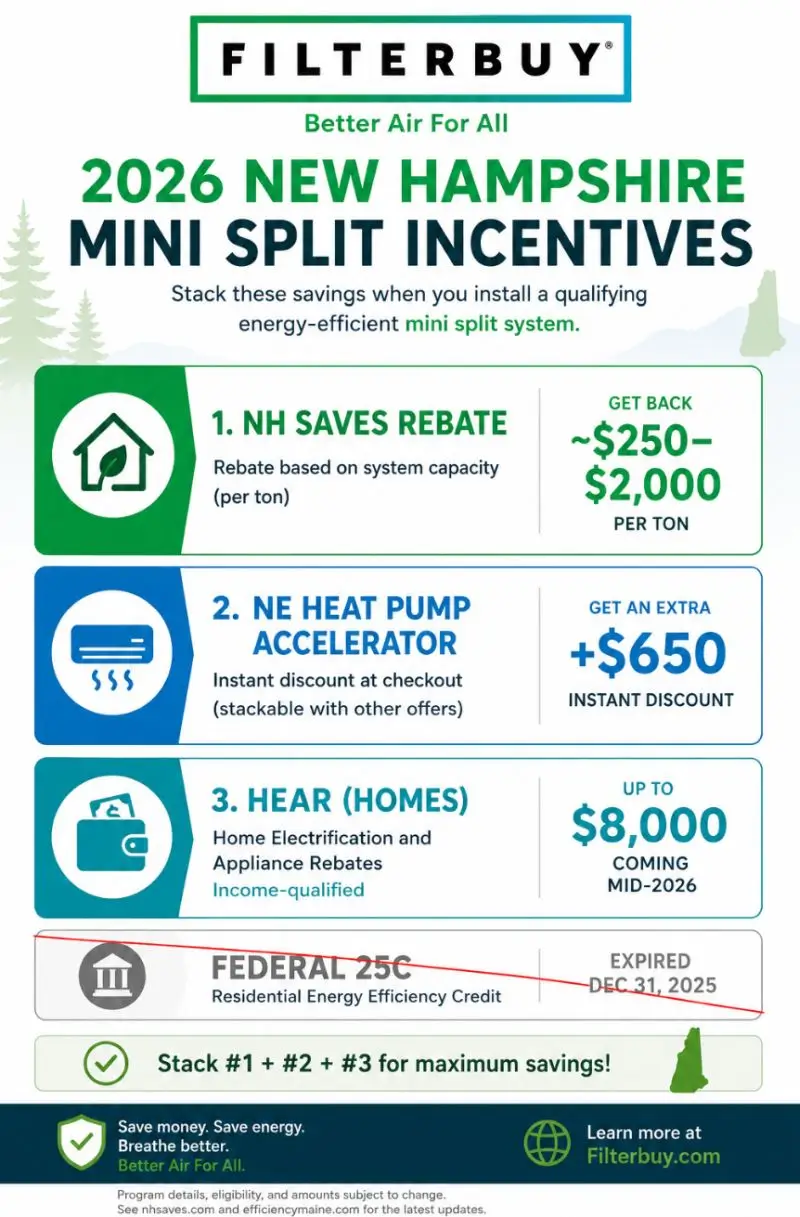
Adding a mini split in New Hampshire runs about $3,500–$7,000 installed for a single zone, and the federal 25C tax credit no longer applies in 2026. NHSaves rebates of about $250 to $2,000 per ton and a $650 instant discount from the NE Heat Pump Accelerator are still available, and they stack. What you get back depends on the heat you replace and on choosing a system with R-32 or R-454B refrigerant.
Not sure which size fits your space? Take the quick match quiz below, or shop Filterbuy mini split systems.

Answer 3 quick questions and we’ll match you to the right mini split for your space.
TL;DR
Adding a ductless mini split in New Hampshire typically runs about $3,500–$7,000 installed for a single-zone system, or roughly $8,000–$18,000 for a multi-zone whole-home setup. A cold-climate model keeps heating a NH home well below zero, so one system handles both summer cooling and most of winter's heat. The federal 25C tax credit expired December 31, 2025, so it no longer applies in 2026, but NHSaves utility rebates (about $250–$2,000 per ton) and the new $650 NE Heat Pump Accelerator can still cut thousands off the price. Once it's running, the right Filterbuy filter keeps your air clean and the system working at its best.
Key Takeaways
A single-zone mini split installed in New Hampshire runs about $3,500–$7,000; multi-zone whole-home systems run about $8,000–$18,000, installed as of early 2026.
The federal 25C tax credit ($2,000 for heat pumps) expired December 31, 2025 and does not apply to 2026 installations.
NHSaves utility rebates are the primary 2026 incentive: roughly $250 per ton when you replace oil, gas, or propane, and up to about $1,250–$2,000 per ton when you replace electric-resistance heat (pre-verification required).
The new NE Heat Pump Accelerator adds a $650 instant discount per cold-climate outdoor unit, and it stacks on top of NHSaves.
Cold-climate mini splits keep heating down to −13°F to −22°F, so a correctly sized system can be your main heat source across most of a New Hampshire winter.
Only systems using R-32 or R-454B refrigerant qualify for NHSaves rebates in 2026. R-410A is off the list.
A mini split's built-in filter protects the unit but isn't a whole-home air cleaner; if you keep a ducted system, a quality pleated filter still does the real air-quality work.
FROM THE AUTHOR
“We build the air filters that go inside these systems, and our HVAC Solutions team works on them in the field, so we see what actually keeps a mini split running years after the install. After more than a decade making filters for millions of homes, here’s the pattern nobody puts on a spec sheet: a cold-climate mini split lives or dies on right-sizing and a clean filter, far more than the badge on the box. That’s why this guide spends as much time on airflow and filtration as it does on rebates.”
Michelle Wan, Brand Manager, Filterbuy
Can a Mini Split Really Heat a New Hampshire Home in Winter?
Yes. A cold-climate ductless mini split keeps producing usable heat down to roughly −13°F to −22°F, and the strongest 2026 models run to −31°F. Because New Hampshire sits in IECC climate zones 5 through 7, a correctly sized cold-climate unit can serve as a home's primary heat source through most of the winter, with backup heat reserved for the coldest snaps.
A heat pump doesn't burn fuel. It moves heat. Even air that feels frigid still holds thermal energy, and an inverter-driven compressor extracts it and pumps it indoors. Older heat pumps faded around freezing and leaned on electric backup. Modern cold-climate models use variable-speed compressors and low-GWP refrigerants (R-32 or R-454B) to hold their output far lower. As a reference point, Mitsubishi's Hyper-Heat line holds close to 100% of rated capacity at 5°F and still delivers roughly three-quarters of it near −13°F, while Fujitsu's cold-climate units are rated to operate at −15°F and below.
In our field experience at Filterbuy, the cold-climate mini splits that disappoint in a hard winter are almost never poorly built. They are undersized or starved for airflow. Two things matter more than the brand on the box: sizing and your home's heat loss. A unit matched to your design load in a reasonably tight house will ride through long cold stretches; the same unit fighting a drafty, high-ceiling space will run constantly and still fall short. That's why we push homeowners to insist on a load calculation, not a rule of thumb, before anyone quotes equipment.
David Clark, Licensed HVAC Technician
Expect brief defrost cycles in heating mode: the outdoor coil frosts, the system reverses for a few minutes to melt it, and indoor output dips. That's normal, not a fault. For homes that see repeated sub-zero nights, plan for a backup heat source or a dual-fuel setup.
What Does Adding a Mini Split Cost in New Hampshire in 2026?
Adding a mini split in New Hampshire costs about $3,500–$7,000 installed for a single-zone system and about $8,000–$18,000 for a multi-zone whole-home system, based on early-2026 New Hampshire installer pricing. A ducted air-source heat pump that replaces a whole central system runs higher, roughly $12,000–$22,000. Those figures include equipment, labor, electrical work, and permits, before any rebates.
Installed costs include equipment, labor, electrical, and permits, before rebates. New Hampshire, early 2026.
*Enhanced per-ton amounts vary by utility (Eversource, Liberty, Unitil, and NH Electric Cooperative each run the program a little differently), and NHEC uses an adder system instead of a single enhanced rate. Rebates are capped at five tons per account and funded while money lasts. Confirm your exact rebate on NHSaves before you sign a contract.
How the NHSaves Rebate Is Calculated
NHSaves sizes the rebate by system tonnage, not a flat amount. The formula is simple:
Rebate = (AHRI cooling capacity in BTU ÷ 12,000) × per-ton rate
Worked example: A 24,000 BTU system is 2 tons (24,000 ÷ 12,000). At the $250-per-ton standard rate, that's a $500 rebate for replacing oil, gas, or propane. Replace electric-resistance heat instead and qualify for the enhanced tier ($2,000 per ton for Eversource, Liberty, and Unitil customers in 2026), and the same 2-ton system earns $4,000, before the $650 Accelerator stacks on top.
What You'll Actually Pay After Rebates
So what does that mean out of pocket? Here are three realistic New Hampshire scenarios: sticker price, the rebates stacked on top, and the net cost you would actually pay.
Illustrative examples, not quotes. Installed prices are mid-range for each system type. Enhanced figures assume an Eversource, Liberty, or Unitil customer with pre-verification (NHEC uses adders).
Before You Sign: How NH Homeowners Lose the Rebate
The rebate is easy to forfeit on a technicality. These are the misses we see most, and each one is avoidable:
Buying a cooling-only unit. NHSaves rebates go to heat pumps, not air conditioners. A heat-pump mini split cools in summer and heats in winter, so choosing the heat-pump version (nearly every modern ductless system) gets you the AC you wanted plus the rebate.
The wrong refrigerant. R-410A is off the 2026 qualified list. Only R-32 or R-454B systems earn a rebate, so confirm the exact model in writing before you sign.
Skipping pre-verification. The higher enhanced rate for replacing electric-resistance heat only pays out if you pre-verify with your utility before installation, not after.
Missing the deadline. For the 2026 program year, the system must be installed by December 30, 2026, with the rebate form postmarked by January 30, 2027.
Skipping the qualified list. The equipment must appear on the NHSaves Heat Pump Qualified Product List, and rebates cap at five tons per account.
Starting too early on HEAR. If you are income-qualified and waiting on the up-to-$8,000 HEAR rebate, remember it is not retroactive. A project finished before the program launches will not qualify.
Comparing options across New England? See our companion guides to adding a mini split in Massachusetts and Connecticut, or read how mini split tax credits and rebates changed for 2026.
Before You Sign: How NH Homeowners Lose the Rebate
The rebate is easy to forfeit on a technicality. These are the misses we see most, and each one is avoidable:
Buying a cooling-only unit. NHSaves rebates go to heat pumps, not air conditioners. A heat-pump mini split cools in summer and heats in winter, so choosing the heat-pump version (nearly every modern ductless system) gets you the AC you wanted plus the rebate.
The wrong refrigerant. R-410A is off the 2026 qualified list. Only R-32 or R-454B systems earn a rebate, so confirm the exact model in writing before you sign.
Skipping pre-verification. The higher enhanced rate for replacing electric-resistance heat only pays out if you pre-verify with your utility before installation, not after.
Missing the deadline. For the 2026 program year, the system must be installed by December 30, 2026, with the rebate form postmarked by January 30, 2027.
Skipping the qualified list. The equipment must appear on the NHSaves Heat Pump Qualified Product List, and rebates cap at five tons per account.
Starting too early on HEAR. If you are income-qualified and waiting on the up-to-$8,000 HEAR rebate, remember it is not retroactive. A project finished before the program launches will not qualify.
Comparing options across New England? See our companion guides to adding a mini split in Massachusetts and Connecticut, or read how mini split tax credits and rebates changed for 2026.
Frequently Asked Questions
Glossary
Ductless mini split: an electric heating and cooling system with an outdoor compressor linked by refrigerant lines to one or more indoor heads, requiring no ductwork.
Air-source heat pump: a system that heats and cools by moving heat between indoor and outdoor air rather than burning fuel; a mini split is one type.
Cold-climate heat pump: a heat pump engineered to hold heating capacity at low outdoor temperatures, typically rated to −13°F or below.
HSPF2: Heating Seasonal Performance Factor 2, the current DOE measure of seasonal heating efficiency; higher is better, with 10+ preferred for cold climates.
SEER2: Seasonal Energy Efficiency Ratio 2, the current measure of cooling efficiency; higher is better.
Ton: a unit of HVAC capacity equal to 12,000 BTU per hour; NHSaves rebates are calculated per ton.
NHSaves: the energy-efficiency program run jointly by New Hampshire's electric and gas utilities (Eversource, Liberty, Unitil, and NH Electric Cooperative) that pays heat-pump rebates.
NE Heat Pump Accelerator: a regional program launched in 2026 giving an instant $650 point-of-sale discount per cold-climate outdoor unit across CT, ME, MA, NH, and RI.
HEAR: the federal Home Electrification and Appliance Rebates program, offering up to $8,000 for income-qualified households; approved for New Hampshire but not yet launched as of mid-2026.
Section 25C: the federal Energy Efficient Home Improvement Tax Credit that covered up to $2,000 for heat pumps; expired December 31, 2025.
R-32 / R-454B: lower-GWP refrigerants required on NHSaves-qualified 2026 heat pumps, replacing the phased-out R-410A.
MERV: Minimum Efficiency Reporting Value, the rating that shows how effectively an air filter captures particles; higher numbers capture finer particles.
About the Author & Reviewer
Michelle Wan is Brand Manager and air quality writer at Filterbuy, where she turns MERV ratings, filtration, and HVAC efficiency into plain-English advice and fronts much of the brand's educational video content (B.A., University of California, Santa Cruz). This guide was reviewed for technical accuracy by David Clark, a Licensed HVAC Technician. Filterbuy has manufactured air filters in the USA for over a decade and shipped millions of them directly to homeowners.
Sources
NHSaves: Heat Pumps & Electric Heating and Cooling Equipment
NH Department of Energy: Home Electrification and Appliance Rebates (HEAR) program
One Big Beautiful Bill Act, Public Law 119-21 (July 4, 2025); manufacturer specifications from Mitsubishi (Hyper-Heat) and Fujitsu, and AHRI-certified ratings.
U.S. EPA ENERGY STAR: Air-Source Heat Pumps (efficiency and home energy-bill data)
New Hampshire Department of Energy: Energy in New Hampshire (heating-fuel data)
U.S. Department of Energy / Oak Ridge National Laboratory: cold-climate heat pump field research