Adding a Mini Split AC System in Connecticut | Costs, Rebates & 2026 Guide
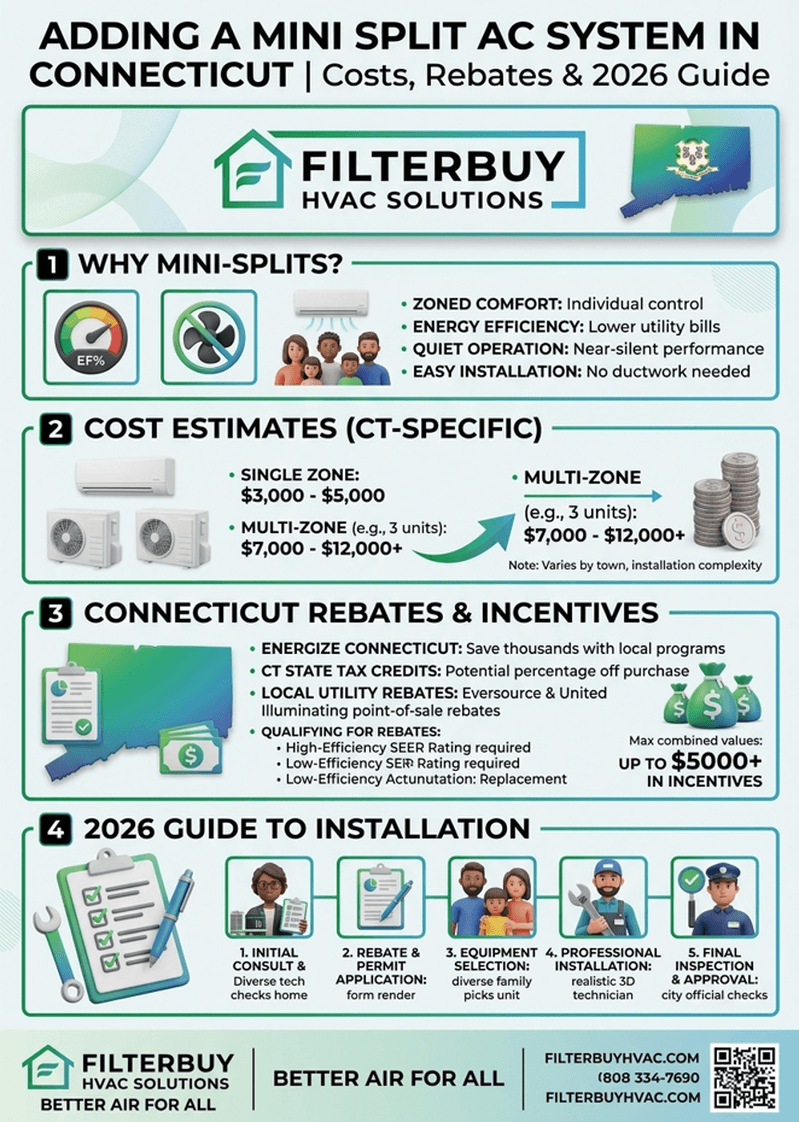
To add a mini split in Connecticut and capture the rebates: choose an installer from the Energize CT Heat Pump Installer Network, pre-register your rebate online before the work starts, then claim one of two per-ton rebate tiers. A single-zone install runs $3,500 to $6,500 before rebates, and a multi-zone whole-home system runs $7,500 to $18,000+. One ton equals 12,000 BTU/h, and the tier you qualify for depends on what your mini split replaces.
- $250 per ton — standard rebate for cooling-only installs, new conditioned space, or replacing an existing heat pump.
- $1,000 per ton — when the mini split fully replaces oil, propane, natural gas, or electric-resistance heat. Combined cap: $15,000 per home.
- Stack a Smart-E Loan at 0.99% APR through June 30, 2026 (Eversource and United Illuminating customers).
- The federal 25C tax credit expired December 31, 2025 — systems installed in 2026 do not qualify.
Not sure which system size or rebate tier fits your home? Take the quick match quiz below.

Answer a few quick questions and we'll match you to the right mini split system for your Connecticut home.
Connecticut homeowners who heat with oil or propane can earn $1,000 per ton from Energize CT for installing a ductless mini split in 2026. That's four times the standard heat pump rebate, and it's the top tier of a state program that kept growing the same month the federal tax credit went away. Most rebate guides online still reference that expired federal credit as if it's active. If you've been reading those, you're budgeting off bad numbers.
At Filterbuy, we build filters in the U.S. and have shipped millions of them. This guide covers what a CT mini split install actually costs in 2026, every rebate layer you can stack, the Smart-E Loan deadline worth putting on your calendar, and which filter to pair with your new system so the air is genuinely clean, not just cold.
TL;DR Quick Answers
How do I add a mini split AC system, including rebates, in Connecticut?
Here's the 2026 playbook:
Choose a contractor from the Energize CT Heat Pump Installer Network. Only installers on this list qualify you for state rebates.
Pre-register your project online at EnergizeCT.com/rebates before installation starts if you plan to qualify for the Smart-E Loan special offer. Since July 1, 2024, pre-registration has been required for the Smart-E Loan special rate but remains optional for rebate eligibility. Registration stays valid for 60 days.
Budget $3,500 to $6,500 for a single-zone install, or $7,500 to $18,000+ for a multi-zone whole-home system, before rebates.
Claim one of two Energize CT rebates:
$250 per ton. Standard Air Source Heat Pump rebate for cooling-only installs, new conditioned space, or replacing an existing heat pump.
$1,000 per ton. Energy Optimization rebate when the mini split fully replaces oil, propane, natural gas, or electric-resistance heat. Combined rebate cap: up to $12,500 per home.
Stack a Smart-E Loan at 0.99% APR through June 30, 2026. Eversource and United Illuminating customers only.
Skip the federal 25C tax credit. It expired December 31, 2025. Systems installed in 2026 don't qualify.
Submit your paid invoice and AHRI certificate after installation. Rebate checks typically arrive in 6 to 8 weeks.
Top Takeaways
The federal 25C tax credit is gone. Section 25C expired December 31, 2025, under OBBBA. If you're installing in 2026, build your budget around Connecticut state incentives. The old $2,000 federal credit isn't coming back for the 2026 tax year.
Energize CT pays per ton, and the phrase that unlocks the bigger rebate is "fully displacing fossil heat." You earn $250 per ton if you're adding cooling or replacing an existing heat pump. You earn $1,000 per ton — four times more — if the mini split fully replaces oil, propane, natural gas, or electric-resistance heat.
Pre-registration is mandatory. Since July 2024, you must register the rebate online before your installer starts. Skip this step, and the rebate is off the table.
The 0.99% Smart-E Loan expires June 30, 2026. Eversource and United Illuminating customers get the cheapest HVAC financing in the state right now. Municipal utility customers aren't eligible.
Your mini split's internal filter and your central-system air filter do different jobs. Wash the indoor head's mesh filter every 4 to 6 weeks. Pair it with a MERV 11 or MERV 13 filter on your central HVAC for the particle sizes that actually matter in Connecticut: pollen, mold spores, and wildfire smoke drift.
Why Connecticut Homes Are Built for Mini Splits
Roughly 41% of Connecticut homes still run on heating oil. That's the fourth-highest share in the country, and plenty of those homes were built before central ductwork was standard. Add humid summers that drive up indoor mold and dust-mite pressure, and you have a state where ductless mini splits make unusual sense. Energize CT's rebate structure mirrors that reality: the program pays you more when your mini split replaces fossil-fuel heat, not just when it adds cooling.
If you want a quick technical primer on how split-system air conditioning actually moves heat, the Wikipedia overview of air conditioning is a solid two-minute read.
Here's where we see the best ROI on Connecticut installs:
Oil- or propane-heated homes are replacing their primary heat source. This is the $1,000-per-ton rebate tier.
Upstairs bedrooms, finished attics, bonus rooms, and sunrooms, your central system can't cool evenly.
Older homes without any ductwork, common in Hartford, New Haven, and Fairfield County neighborhoods built before 1940.
Additions and converted garages where running ducts isn't practical or affordable.
Is a mini split worth it in Connecticut? For all four of those scenarios, yes. The one case where we'd steer a homeowner toward a ducted heat pump instead is a larger home with existing ductwork in good condition and a whole-home load too big for a practical multi-zone design.
What Connecticut Mini Split Installation Actually Costs in 2026
Connecticut installs typically sit above the national median because Fairfield County labor rates push up, pre-war housing stock makes retrofits trickier, and permit fees run $100 to $500, depending on your town.
What moves the total cost:
Zone count. Each additional indoor head adds roughly $1,500 to $3,000 installed.
BTU size per zone. A 9,000 BTU head for a bedroom starts around $700 to $1,500 for the unit alone. A 24,000 BTU head for a larger open space runs $1,800 to $3,500 for the unit.
Electrical work. Many pre-1980 Connecticut homes need a new 240V dedicated circuit. Budget $300 to $800 per outdoor condenser.
Line-set length. Every additional 10 feet of refrigerant line adds about $50 to $150.
Wall penetrations. Brick, stone, and field-stone exteriors need core drilling. Plan $150 to $400 per penetration.
Your 2026 Rebate Stack: Energize CT, Eversource, Smart-E Loan
Connecticut homeowners have several rebate layers available in 2026. The core of it is Energize CT, which runs two rebate tiers depending on what your mini split is replacing. You can stack the Smart-E Loan on top of either tier for low-interest financing. Income-qualified homeowners have an even deeper program called HES-IE. If you're a municipal utility customer, you're on a separate track entirely.
Energize CT Residential Air Source Heat Pump Rebate
$250 per ton. This is the baseline rebate. It applies when you're adding a mini split for cooling only, installing in a previously unconditioned space, or replacing an existing heat pump. A ton equals 12,000 BTU/h. A typical 36,000 BTU multi-zone system is 3 tons, which at the baseline earns a $750 rebate.
Eversource and United Illuminating Run the Same Program
Both utilities administer heat pump rebates jointly through Energize CT. Neither runs a separate mini split rebate with different dollar amounts. The electric rate is the only practical difference between them. Eversource averaged around $0.27 per kWh in early 2026, and United Illuminating ran closer to $0.28 per kWh.
Smart-E Loan: 0.99% APR Through June 30, 2026
The Connecticut Green Bank offers Smart-E Loan financing at 0.99% APR through June 30, 2026. Eversource and United Illuminating customers can borrow $500 to $40,000 for energy improvements, including mini split installs, with terms up to 20 years. Municipal utility customers (Norwich Public Utilities, Wallingford Electric, Bozrah Light & Power, South Norwalk Electric & Water, Groton Utilities, Jewett City Department of Utilities) are not eligible for Smart-E. Each of those utilities runs its own rebate program.
Home Energy Solutions – Income Eligible (HES-IE)
For households at or below roughly 60% of the area median income, HES-IE can cover up to 100% of heat pump installation costs and includes no-cost weatherization. It's worth a call even if you're not sure whether you qualify.
Municipal Utility Rebates
Customers of Groton Utilities, Norwich Public Utilities, Bozrah Light & Power, South Norwalk Electric & Water, Wallingford Electric, and Jewett City Department of Utilities run on separate programs. Groton Utilities, for example, rebates up to $4,000 to $5,000 per condenser in 2026. If you're on any of these utilities, contact them directly for program details.
Can I Still Get the Federal Mini Split Tax Credit in 2026?
No. The Section 25C Energy Efficient Home Improvement Credit, which previously covered 30% of qualified heat pump costs up to $2,000, expired on December 31, 2025, under the One Big Beautiful Bill Act signed July 4, 2025. Air-source heat pumps and mini splits installed in 2026 do not qualify for a federal tax credit. If your system was installed on or before December 31, 2025, you can still claim the credit on your 2025 tax return using IRS Form 5695.
How to Apply
Schedule a Home Energy Solutions assessment. Optional but recommended, because it also surfaces weatherization rebates.
Pick a contractor from the Energize CT Heat Pump Installer Network.
Pre-register your rebate online at EnergizeCT.com/rebates before installation starts. Mandatory since July 2024.
Wait for registration approval. Valid 60 days.
Complete the installation inside that 60-day window.
Upload your final paid invoice plus AHRI certificate.
Receive your rebate, typically 6 to 8 weeks after submission.
Two specs matter most for Connecticut: HSPF2 of 8.1 or higher for heating efficiency, and SEER2 of 17 or higher for cooling efficiency. Both should be paired with a variable-speed inverter compressor. Variable-speed is what lets the system run long, low cycles that actually pull humidity out of the air instead of short-cycling a room cold and clammy.
Then there's the air-quality layer, which most HVAC guides skip and where Filterbuy lives.
Your mini split's internal mesh filter catches large particles like lint and pet hair. It's washable, not disposable. Rinse it every 4 to 6 weeks during heavy use.
That's where your central HVAC filter earns its keep. Our field recommendation for Connecticut homes:
MERV 11 for most households. Balances particle capture with good airflow.
MERV 13 for homes with allergies, asthma, pets, or a family member sensitive to wildfire smoke drift.
Odor eliminator (carbon) upgrade if you're in an oil-heat home mid-transition, where residual fuel odors can linger during the first heating season on the new heat pump.
"The mistake we see most often in Connecticut installs is oversizing. Homeowners ask for more BTUs than the space needs because they want it 'really cold, really fast.' An oversized mini split short-cycles, leaves rooms humid, and costs more up front and per month. After years of installing ductless across New England, we'd rather lose a bid on BTU count than install a system that's going to disappoint in August."
— Filterbuy Team
Essential Resources
If you're researching a Connecticut mini split install, these seven sources are the ones worth bookmarking. Between them, you can verify every rebate figure, confirm your equipment qualifies, and estimate your total incentive stack in under 30 minutes.
1. The Official Federal Tax Credit Status Check
Before you budget any federal credit, confirm it directly with the IRS. The Energy Efficient Home Improvement Credit page walks through what expired, what's still active, and how Form 5695 works for 2025 filings.
Source: IRS Energy Efficient Home Improvement Credit
2. The Master Database of Every Connecticut Incentive
DSIRE is the gold standard for U.S. energy incentive research, managed by the North Carolina Clean Energy Technology Center at NC State. Filter by Connecticut and "heat pump" to see every state, utility, and municipal program in one view.
Source: DSIRE Database
3. The Rebate Calculator That Does the Math for You
Rewiring America's household incentive calculator takes your ZIP code, income, and home type, and stacks every federal, state, and utility rebate you're actually eligible for. Free to use, no account needed.
Source: Rewiring America Incentive Calculator
4. The Product Qualification Check
Your mini split has to be on the Energize CT Qualified Products List, which derives from AHRI's certified product directory. Look up your exact model number before signing any contract to confirm it qualifies. Skipping this step is one of the most common reasons rebates get denied.
Source: AHRI Directory of Certified Product Performance
5. The Connecticut Energy Policy Hub
The Connecticut Department of Energy and Environmental Protection (DEEP) publishes the state's long-term energy strategy, including why the heat pump push is central to Connecticut's decarbonization policy. It's a useful context for understanding where incentives are headed next.
Source: CT DEEP Energy
6. The ENERGY STAR Rebate Finder
ENERGY STAR's ZIP-code rebate finder catches utility-level rebates that DSIRE sometimes misses, especially municipal programs and limited-time manufacturer rebates. It's essential for Groton, Norwich, and Wallingford customers.
Source: ENERGY STAR Rebate Finder
7. The Efficiency Research That Drives the Policy
ACEEE (American Council for an Energy-Efficient Economy) publishes the research that shapes federal and state heat pump policy. Their buying guidance isn't funded by manufacturers, and their explanations of SEER2 and HSPF2 are the clearest in the industry.
Source: ACEEE Heat Pump Resource
Supporting Statistics
Three numbers that matter for a Connecticut homeowner weighing a mini split. Each is sourced from U.S. government research.
1. Connecticut Is the Fourth-Heaviest Heating Oil State in America
About 41% of Connecticut households use heating oil or other petroleum products as their primary heating fuel. That's the fourth-highest share of any state, behind Maine, New Hampshire, and Vermont. The U.S. average is roughly 4%. From what we see in the field, this single stat is the biggest predictor of mini split ROI: Connecticut oil-heated homes routinely qualify for the $1,000-per-ton Energy Optimization rebate and see meaningful fuel-cost savings in year one.
Source: U.S. Energy Information Administration — Connecticut State Energy Profile
2. Heat Pumps Cut Heating Electricity Use by Up to 75%
The U.S. Department of Energy reports that today's heat pumps reduce electricity use for heating by up to 75% compared to electric-resistance heating, the kind used in baseboards and furnace coils. For Connecticut homeowners currently on electric-resistance backup, which is common in older additions and converted garages, the operating-cost math flips from "maybe someday" to "why didn't I do this sooner."
Source: U.S. Department of Energy — Heat Pump Systems
3. Nine in Ten Homes Like Yours Save Money After a Heat Pump Install
NREL's 2024 research shows that for the 49 million U.S. homes using electricity, fuel oil, or propane for heat and that already have air conditioning, 92% to 100% of them will see energy bill savings after switching to a heat pump. Median annual savings run $300 to $650, depending on efficiency tier. Connecticut's housing stock lines up almost exactly with the profile in that study.
Source: National Renewable Energy Laboratory — Heat Pump Benefits Research
Final Thoughts and Opinion
Here's our honest take after installing ductless systems across New England for years.
2026 is a good year to move, not a bad one. Yes, the federal 25C credit is gone. But Connecticut's state rebate structure got more generous in the same window. The $1,000-per-ton Energy Optimization tier is a bigger per-system check than the old $2,000 federal cap was for most multi-zone installs.
Homeowners who win are the ones who plan before they shop. Pre-register the rebate. Get two or three line-item quotes, not three total-cost quotes. Right-size the system instead of oversizing. In that order.
The Smart-E Loan is the sleeper incentive. A 0.99% APR on a $20,000 project saves real money over the life of the loan. More than most homeowners realize until we run the numbers next to a 7% or 8% HVAC financing offer.
On the filter question: whatever mini split you pick, pair it with a MERV 11 or MERV 13 central filter and wash the indoor head's mesh filter on a 4-to-6-week cadence. That combination gets you the indoor air quality most homeowners assume they're buying when they buy a "high-efficiency" system. Most aren't.
Next Steps
Here's your action list if you're ready to move.
Check your rebate eligibility today. Go to EnergizeCT.com/rebates and pre-verify. It takes about 10 minutes and gives you a dollar estimate before you talk to a contractor.
Get two or three line-item quotes from contractors on the Energize CT Heat Pump Installer Network. Avoid any quote that doesn't break out unit cost, labor, line-set length, electrical, and permit fees separately.
Confirm your chosen model is on the Energize CT Qualified Products List. Look it up via AHRI. This is the single most common reason rebates get denied.
Pre-register the rebate online before your installer starts work. This step has been mandatory since July 2024.
Apply for the Smart-E Loan if financing makes sense for your budget. Do it before June 30, 2026, to lock in the 0.99% APR.
Upgrade your central HVAC filter at the same time. If you aren't already running a MERV 11 or MERV 13, order a 6-month supply or set up auto-delivery. A new mini split is the right moment to raise your whole-house air quality.
Schedule your first 4-to-6-week mini split filter wash on your calendar now. It's the single biggest maintenance lever on the system.
Frequently Asked Question
Get Your Mini Split Install Priced Out Today
Done right, with the rebate stack in place, adding a mini split AC in Connecticut is one of the best HVAC investments a homeowner can make this year. Explore Filterbuy's HVAC resources to learn more about rebate eligibility and how to choose the right air filter for your Connecticut conditions.