Adding a Mini Split AC System in Massachusetts
2026 Rebates and What Actually Qualifies
By Michelle Wan · Reviewed by David Clark, Licensed HVAC Technician
Published: June 26, 2026 · Updated: June 26, 2026
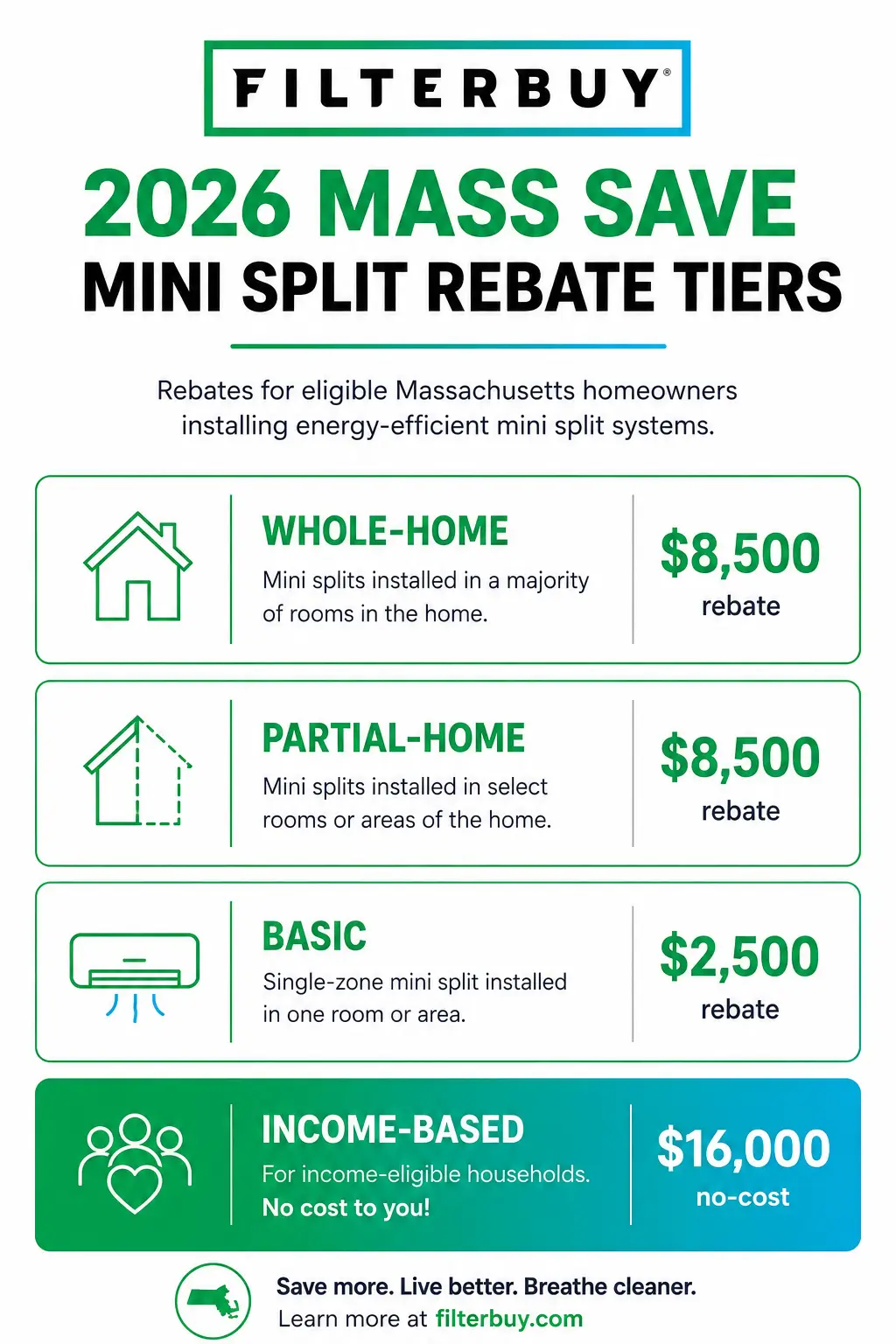
In Massachusetts, a heat-pump mini split can earn a Mass Save rebate of up to $8,500, and income-eligible households can get up to $16,000 or a no-cost system. The catch: the rebate is for heat pumps that both heat and cool, so a cooling-only AC unit does not qualify.
Federal heat-pump tax credits ended on December 31, 2025, so your 2026 savings come from Mass Save. Not sure which system fits your home? Take the 60-second match below.

Answer 3 quick questions and we’ll match you to the right Filterbuy mini split. Prefer to browse first? Shop mini split systems.
The short version: Adding a mini split in Massachusetts can earn a Mass Save rebate of $2,650 per ton, up to $8,500, but only if it's a heat pump that both heats and cools, not a cooling-only AC unit. Income-eligible households can qualify for up to $16,000 or a no-cost system. One thing that's changed: the federal heat pump tax credit expired on December 31, 2025, so 2026 savings come from Mass Save, not the IRS.
Below, we'll walk through exactly what qualifies, what you can expect to save, what it really costs, and the one catch most guides skip. It's the straight answer a good neighbor would give you over the fence.
The Catch Most Guides Skip: “AC Mini Split” Vs. “Heat Pump Mini Split”
This is the part that trips up a lot of homeowners. In Massachusetts, the headline rebates aren't for air conditioners at all. They're for heat pumps. A ductless mini split is a type of air-source heat pump, and the same unit that cools your home in July is what heats it in January. A true cooling-only mini split (no heating mode) generally won't qualify for the big Mass Save incentives.
So if your goal is “add AC and grab the rebate,” the move is to install a heat-pump mini split (which gives you cooling anyway) rather than a cooling-only model. You get summer comfort and the rebate, instead of one without the other. Almost every qualifying ductless system sold today is already a heat pump, but check the spec sheet before you buy.
The one-sentence takeaway: In Massachusetts, you don't rebate an “AC.” You rebate a heat pump that happens to cool, so choose a heat-pump mini split to get the savings.
2026 Mass Save Mini Split Rebates at a Glance
Mass Save has three rebate tiers for air-source heat pumps (including ductless mini splits), and which one you get depends on whether the system is your whole home's heating and cooling, a supplement to an existing furnace or boiler, or an add-on that isn't replacing fossil-fuel heat. Rebates are calculated by system size, measured in tons (one ton = 12,000 BTUs of capacity).
Source: Mass Save, 2026 Air Source Heat Pump Rebates.
How tons translate to real money: A single small bedroom unit (around 9,000 BTUs, or 0.75 ton) is a fraction of a ton, so its rebate is modest. A multi-zone whole-home system, with several indoor heads on one or two outdoor units, adds up in tonnage fast and is how most homeowners reach the $8,500 cap.
Do You Qualify? a Quick Decision Path
Most eligibility questions come down to four checks. Run through them in order:
Is it a heat pump (heats and cools)? If yes, keep going. If it's cooling-only, it likely won't qualify for the main rebates.
Is it on the approved list? The equipment must appear on the Mass Save Heat Pump Qualified Products List, and, new for 2026, must use a low-GWP refrigerant (R-32 or R-454B). Older R-410A systems no longer qualify. (Confirm current spec with your installer.)
Who's your utility? Rebates flow through the Mass Save sponsor utilities: Berkshire Gas, Cape Light Compact, Eversource, Liberty, National Grid, and Unitil. If you're served by a municipal light plant (more on that below), your program is different.
Whole-home or supplement? Going all-electric (removing fossil-fuel heat) and weatherizing your home puts you in the Whole-Home tier. Keeping your boiler points you to Partial-Home. Neither? You're likely in Basic territory.
A short call with a contractor in the Mass Save Heat Pump Installer Network will confirm your tier before you spend a dollar, and they handle the rebate paperwork.
Standalone answer: You qualify for Massachusetts mini split rebates if you install an approved heat-pump model through a Mass Save sponsor utility. Removing fossil-fuel heat and weatherizing qualifies you for the highest (Whole-Home) tier; supplementing an existing system puts you in Partial-Home.
How Much Does Adding a Mini Split Actually Cost in Massachusetts?
A whole-home ductless system in Massachusetts typically runs in the low-to-mid five figures before incentives, and the rebate takes a real bite out of that. Mass Save publishes this cost example for a whole-home install, which is a useful baseline:
Source: Mass Save (average install cost based on 2022 program data for whole-home installs).
Your real number depends on how many zones you need, your home's layout, electrical upgrades, and current labor rates. A single-zone install to cool one stubborn room costs far less than a five-head whole-home system. Get two to three quotes. Mass Save recommends it, and so do we.
Stacking Your Savings: HEAT Loan, Bonuses, and Point-Of-Sale Incentives
The rebate isn't the only lever. Massachusetts homeowners can layer several programs:
0% HEAT Loan. The Mass Save HEAT Loan is interest-free financing (up to $25,000 for most projects) so you can spread the out-of-pocket cost over several years and still take the rebate up front. (Confirm current loan cap and term with Mass Save.)
Partial-Home bonuses. If you're keeping a boiler or furnace, you can add a $500 weatherization bonus (for completing recommended insulation or air-sealing) and a $500 sizing bonus (for a system sized to your home's full heating load).
Point-of-sale instant incentives (NEHPA). Some distributors and contractors apply instant heat-pump discounts at purchase through the New England Heat Pump Accelerator, a separate state-led program not administered by Mass Save. Ask your installer whether it applies.
Standalone answer: Beyond the rebate, Massachusetts homeowners can stack a 0% Mass Save HEAT Loan, up to $1,000 in partial-home weatherization and sizing bonuses, and, separately, point-of-sale instant discounts through the NEHPA program.
What About the Federal Tax Credit?
If you read an older guide promising a 30% federal tax credit on your heat pump, that ship has sailed. The federal tax credits for heat pumps under the Inflation Reduction Act expired on December 31, 2025, as noted by Mass Save. Equipment installed in 2026 is no longer eligible for that credit. For this year, your savings come from Mass Save rebates, the HEAT Loan, and any NEHPA instant incentives, which still add up to real money when stacked.
This is exactly why install dates and paperwork deadlines matter. Mass Save rebate forms for 2026 installs are due by a set deadline (currently February 28, 2027). Your installer typically files for you, but don't let it slip.
Step-By-Step: How to Add a Mini Split and Claim Your Rebate
Adding a system and getting paid back follows a predictable path. The order of operations is simple:
Confirm eligibility. Check the Mass Save eligibility tab or complete a pre-verification form through the online portal to make sure your project qualifies before you commit.
Weatherize first (for Whole-Home). Heat pumps work best in a sufficiently weatherized home, and the Whole-Home rebate requires it. A no-cost Mass Save Home Energy Assessment tells you where you stand and can cover much of the insulation cost.
Find a qualifying contractor. Your installer must be in the Mass Save Heat Pump Installer Network. Get two to three proposals and ask each about sizing, refrigerant type, and who files the rebate.
Install approved equipment. Confirm the model is on the Qualified Products List. For a Partial-Home rebate, an approved integrated control may also be required.
Submit the rebate (or let your contractor do it). File online or by mail within the program deadline, and keep your invoices.
Standalone answer: To claim a Massachusetts mini split rebate: confirm eligibility, weatherize your home (required for the whole-home tier), hire a Mass Save Network installer, install an approved heat-pump model, and submit the rebate before the program deadline.
Municipal Utility Customers: Why Your Rebate May Be Different
One gap most guides miss: Mass Save doesn't cover everyone in Massachusetts. If your electricity comes from a municipal light plant, such as those serving towns like Reading (RMLD), Taunton (TMLP), Wellesley, and Concord, you're not in the Mass Save program. Many of these utilities run their own heat-pump rebates, and some are generous (a few offer flat rebates in the thousands), but the amounts, rules, and forms are different.
If you're not sure, check the utility name on your electric bill. If it isn't one of the Mass Save sponsors (Berkshire Gas, Cape Light Compact, Eversource, Liberty, National Grid, Unitil), search your town's municipal utility website for its specific heat-pump incentive.
Standalone answer: Homeowners served by a municipal light plant (e.g., RMLD, TMLP, Wellesley) are not part of Mass Save and must apply through their own utility's heat-pump rebate, which has separate amounts and rules.
Keeping Your New Mini Split and Your Air Clean
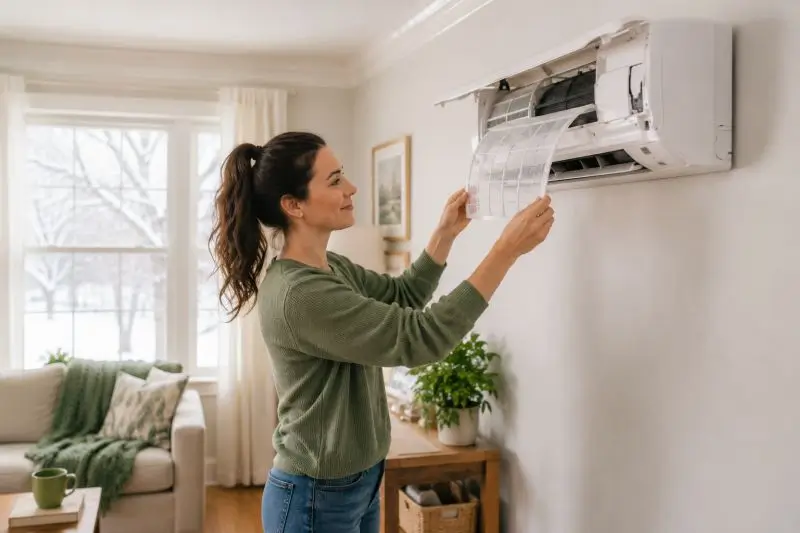
A mini split is only as healthy as the air it pushes around your home. Each indoor head has a washable filter that should be rinsed roughly once a month during heavy use. A clogged filter strains the system, raises your electric bill, and lets dust recirculate. It's a five-minute job that protects a five-figure investment.
Two things worth knowing as a new mini-split owner:
Your central system probably isn't going anywhere. Many Massachusetts homes add a mini split for specific rooms while keeping ducted heating or a furnace. That ducted system still needs a fresh, properly rated HVAC filter to protect your air and your equipment.
Cleaner air is the whole point. Whether you're filtering for allergies, pet dander, or wildfire-smoke season, the right filter does the heavy lifting your mini split's thin mesh screen can't.
If you've got a central or ducted system alongside your new mini split, find your exact filter size and set up auto-delivery so a fresh one shows up right when it's due. No store runs, no weird sizes, shipped factory-direct. That part, we keep simple.
Frequently Asked Questions
Ready to Add a Mini Split?
Pick a system that fits your home and your rebate plan, then keep it running clean with filters from the company that makes them. Shop mini split systems →
About this guide
This guide was written by Michelle Wan and reviewed for technical accuracy by David Clark, Licensed HVAC Technician. Rebate figures are drawn from official Mass Save program materials and were current as of the publish date; incentive programs change, so verify amounts and deadlines with Mass Save before you commit.