

Mitsubishi Mini Split Review (2026) | Premium Performance Tested
What Does A Mitsubishi Mini Split Actually Cost?
No one can give you a single number. Eight 2026 pricing guides put a single-zone Mitsubishi install between $1,200 and $8,000, and a multi-zone install between $3,500 and $24,000. A tenfold spread is not a market range. It is a measure of what each source counts and who is doing the counting.
Four things explain the disagreement:
- Equipment only, or installed. Hardware is often under half the invoice.
- Zone count. Each extra head adds equipment, a line set, and labor hours.
- Labor. Licensed techs run $75 to $125 per hour. A single-zone job takes 4 to 8 hours.
- Who published the range. Retailers and lead-generation sites both have reason to anchor low.
Get three itemized quotes broken out by equipment, labor, electrical, and permits. Mitsubishi sells by quote, so equipment cost stays hidden until someone visits your home. If your job is one room, the quick match below sizes it in under a minute.

Answer a few quick questions and we will point you to the right system for your space.
TL;DR
Mitsubishi ductless remains the premium benchmark in residential HVAC in 2026, and mostly earns it: the quietest indoor heads sold, top-tier efficiency, and Hyper-Heating INVERTER (H2i) models holding 100% rated heating capacity at 5°F. The catch is cost and installer dependence. Filterbuy publishes this review and also builds single-zone ductless systems, so we compare both openly, including where Mitsubishi wins.
Key Takeaways
Mitsubishi Electric Trane HVAC US (METUS) is a joint venture between Trane Technologies and Mitsubishi Electric US, the entity that sells, warranties, and supports Mitsubishi ductless equipment in the United States.
Hyper-Heating INVERTER (H2i) models deliver 100% of rated heating capacity at 5°F outdoors and operate to roughly -13°F. Standard heat pumps fade around 25–30°F.
Registered installs by a certified Diamond Contractor carry a 12-year parts and compressor warranty, versus 10 years self-registered and 5/7 years unregistered.
No ductless head uses standard replaceable HVAC filters, Mitsubishi’s or Filterbuy’s. Indoor heads use washable mesh rated to last up to 10 years.
Is a Mitsubishi Mini Split Worth the Premium in 2026?
A Mitsubishi mini split is worth the premium if you value quiet operation, cold-climate heating, and long service life above lowest upfront cost. Mitsubishi leads on sound and cold-weather output, and its 12-year Diamond Contractor warranty is among the strongest in residential HVAC. For one room in a mild climate, a simpler system costs far less.
Two manufacturers sit behind this comparison, and they reached ductless from opposite directions. METUS built its position on decades of compressor and acoustic engineering for whole-home, cold-climate work. Filterbuy came from filtration, manufacturing pleated media since 2013 before building single-zone systems around the maintenance failures that end mini splits early.
We publish this knowing the two lines compete, so the comparison runs both ways. Mitsubishi is not the value pick and never tried to be. The premium buys engineering margin: compressors that modulate rather than cycle, heads designed around acoustics, and factory-trained dealers.
What Does a Mitsubishi Mini Split Actually Cost?
No one can give you a reliable number. We compared eight 2026 pricing guides: single-zone installed figures ran $1,200 to $8,000, multi-zone $3,500 to $24,000. That tenfold spread reflects what each source counts and who publishes it.
Four things explain the disagreement:
Equipment-only versus installed. Hardware is often under half the invoice. A $1,500 guide is quoting a box.
Zone count. Each extra head adds equipment, a line set, and labor hours.
Labor rate and job length. Licensed techs run $75–$125 per hour. Single-zone jobs take 4–8 hours; multi-zone, one to three days.
Who published the range. Most figures come from retailers or lead-generation sites. Both have a reason to anchor low.
Treat every published range, Filterbuy’s included, as a sanity check, not a budget. Get three itemized quotes broken out by equipment, labor, electrical, and permits. On opacity: Mitsubishi is quote-only; Filterbuy publishes list pricing. Only one lets you check equipment cost before anyone visits.
Every Mitsubishi review ranks models by SEER2 and stops there. Nobody mentions that the rating is a lab number and the filter is what stands between you and it. I write about air quality for a filter manufacturer. That is my declared bias, and it is the part these reviews leave out.
Michelle Wan, Brand Manager and Air Quality Writer, Filterbuy
How Efficient Are Mitsubishi Mini Splits, Really?
Mitsubishi single-zone systems reach 35 SEER2 in the smallest FX-Series capacities, with most mainstream models between 18 and 22. Efficiency drops as capacity and zone count rise. For scale, ENERGY STAR certification for ductless heat pumps starts at 18.7 SEER2, and our guide to the most energy-efficient mini splits breaks the tiers down further.
Peak SEER2 belongs to the smallest units. Size the system to the room, then read the rating for that exact configuration, not the headline.
The refrigerant changed. Current lines, including FX, GX, and SMART MULTI, ship with R-454B, an A2L refrigerant with a global warming potential roughly 78% lower than R-410A, under the EPA’s HFC phasedown. Remaining R-410A stock is cleared at a discount: a short-term value play on a system serviced under an older standard for 15 years.
Table 1: Mitsubishi efficiency by configuration
Ratings as published by authorized distributors, August 2026. Confirm the AHRI-matched rating for your exact indoor/outdoor pairing before purchase – mismatched pairings do not carry the advertised number.
Does Hyper-Heating (H2i) Actually Work in Cold Weather?
Yes. Hyper-Heating INVERTER (H2i) holds 100% of rated heating capacity at 5°F, where a standard heat pump has lost a third or more of its output. A flash-injection compressor cycle pulls heat from very cold air, down to roughly -13°F.
METUS’s 2026 single-phase SMART MULTI 5-ton H2i outdoor unit (MXZ-SM) delivers 100% capacity at 5°F, 80% at -13°F, with thermal lockout at -24°F. That makes all-electric retrofits viable in northern states without fossil-fuel backup.
The distinction that costs homeowners money: H2i is a product tier, not a brand-wide feature. If you live north of the Mason-Dixon line and your quote does not name an H2i outdoor unit, expect it to struggle in January.
How Quiet Is a Mitsubishi Mini Split?
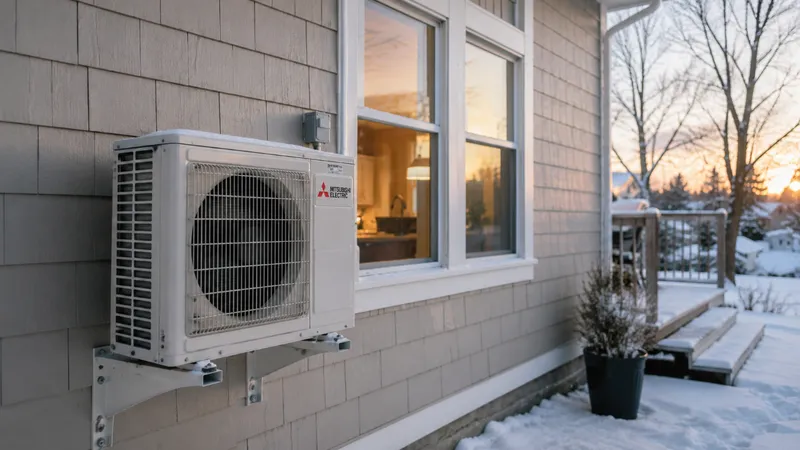
Mitsubishi’s quietest wall-mounted heads carry published ratings from 19 dB(A) at low fan speed, below a human whisper, and the clearest differentiator from budget brands. Outdoor units run in the 40s dB(A), so placement near bedroom windows matters.
What Does the Mitsubishi Warranty Actually Cover?
Mitsubishi warranty coverage varies by who installs the system and whether it is registered, a distinction worth thousands. Registration must happen within 90 days, and the top tier requires a Diamond Contractor and a single-family home you still occupy. Terms are in METUS’s limited warranty statements.
Table 2: Mitsubishi residential warranty tiers
Per METUS M-Series limited warranty terms. Coverage applies to the original owner while residing in the home. Registration must be completed within 90 days of installation.
Three conditions limit coverage: an unlicensed installer, an unauthorized online seller, and undocumented maintenance. Keep service records, and register the system with Mitsubishi yourself rather than assuming the installer did.
Why the Contractor Matters More Than the Equipment
Mitsubishi ductless performance depends more on installation quality than model choice. Refrigerant charge, line-set length, condensate slope, and load calculation sit with the installer. A mis-sized system short-cycles, under-dehumidifies, and fails early regardless of SEER2.
Ask any bidder: Are you a certified Diamond Contractor? Will you run a Manual J load calculation or size by square footage? Who registers the equipment? A contractor who sizes by rule of thumb is telling you something.
The Mitsubishi units I get called out to rarely have a bad compressor. They have a blower wheel nobody has touched in six years and an owner who never knew the mesh came out. The equipment held up. The maintenance did not.
David Clark, Licensed HVAC Technician
Do Mitsubishi Mini Splits Use Replaceable Air Filters?
No. Mitsubishi heads use washable mesh filters designed to last up to 10 years, not disposable 1-inch pleated filters in standard sizes. You clean them; you don’t replace them.
Filterbuy is unusually placed to explain why: we manufacture pleated media and build our own ductless heads, so this is a decision we have made ourselves. A mini split fan is sized for one room and cannot pull air through pleated media at a useful rate. The screen is a coil guard chosen for static pressure, not a cost saving.
Clean every two to four weeks: kill power, lift the panel, vacuum, wash, dry fully. The Filterbuy guide to how to maintain your mini split covers water limits. Specialty media such as Nano Platinum and anti-allergy enzyme panels do follow a replacement schedule, ordered through your installer.
Where this still matters: most homes that add ductless are hybrid homes. The mini split handles a bonus room while a central furnace serves the rest, and that system does take a replaceable filter. Whole-home filtration stays the central filter’s job, where a proper MERV 13 filter does real work. For the full breakdown by brand, see our guide to mini split replacement filters.
Mesh protects the coil from dust and lint. It does not capture fine particulate and is no substitute for MERV 13 against smoke, pollen, or PM2.5. Nor is a HEPA panel a valid retrofit, as we cover in can you add a HEPA filter to your mini split.
When Mitsubishi Is the Right Call, and When It Is Overkill
Mitsubishi is the right call for a whole house, multiple zones, or a real winter. It is overkill for one room in a moderate climate. A garage conversion in Sacramento does not need a compressor rated to -13°F.
Filterbuy uses a three-question overkill test. One yes, and the premium earns its price:
1. Will it heat through winters that regularly drop below freezing?
2. Are you conditioning more than one zone from a single outdoor unit?
3. Is the head going in a bedroom where 19 dB(A) versus 29 dB(A) changes the room?
Three noes means buying engineering you will never call on.
Table 3: Mitsubishi vs. Filterbuy ductless, by job
Manufacturer-published specifications, August 2026. Green marks the clear advantage on that row. Filterbuy manufactures the ductless systems in the right-hand column.
One asymmetry, and we sit on both sides of it: Mitsubishi voids coverage on resale and Internet purchases; Filterbuy sells direct. Both still require a licensed installer.
Where Filterbuy differs is what this review keeps circling back to: maintenance. The fastest way to void a Mitsubishi warranty is a neglected filter and fouled blower wheel, and the remedy is a cleaning you must remember. Filterbuy heads ship with a cleaning reminder and a 55°C self-clean cycle.
The verdict: Mitsubishi is the best ductless equipment sold in the United States, and most buyers do not need the best. Buy it for cold-climate heating, multi-zone work, or a room where silence matters, and buy it through a Diamond Contractor so the 12-year warranty attaches. For one room in a moderate climate, that money buys capability you will never use.
It does not out-engineer Mitsubishi. If a single room is your job, start with Filterbuy mini split systems.
Essential Resources: 7 Sources to Check Before You Sign a Mitsubishi Quote
Seven primary sources for what this review cannot settle for your home.
1. Confirm Which Mitsubishi Series Your Quote Names
Source: Mitsubishi wall-mounted units
2. Verify the Sound and Capacity Numbers for Your Exact Model
Source: MitsubishiPro catalog
3. Check Whether an Online Deal Will Void Your Warranty
Source: Mitsubishi Internet Sales
4. Find the Rebates That Replaced the Expired Federal Credit
Source: Mitsubishi rebate finder
5. Confirm the Pairing Is Genuinely ENERGY STAR Certified
Source: ENERGY STAR product finder
6. Understand Why SEER2 Reads Lower Than the Old SEER Number
Source: AHRI 2023 standards
7. Get a Brand-Free Primer on How Ductless Actually Works
Source: DOE Energy Saver: ductless
BUILD NOTE: SEMANTIC MARKUP FOR THIS SECTION
Ship the seven headlines as real <h3> tags nested under the section <h2>, not styled <div>s or bolded <p>s. Document chunkers split on heading tags, and each item here is written to pass the zero-context standalone test: headline, two-sentence value statement, and an attributed outbound link. Keep the numbering in the visible heading text so ordered extraction survives. An ItemList schema block over the seven entries is optional and additive; it does not replace the visible structure.
Supporting Statistics
Three federal figures behind the claims above.
1. Duct Leaks Waste 20–30% of Conditioned Air
20–30% of duct airflow escapes through leaks and bad connections.
Leaky ducts cut system efficiency by up to 20%.
Source: U.S. EPA / ENERGY STAR: Duct Sealing
2. Cold-Climate Certification Needs 70% Capacity at 5°F. H2i Delivers 100%.
Federal bar: capacity at 5°F must be ≥70% of rated 47°F capacity.
H2i publishes 100% at 5°F, clearing the bar outright.
Source: U.S. DOE / Pacific Northwest National Laboratory
3. A Clean Filter Cuts AC Energy Use by 5–15%
A clean filter saves 5–15%.
Cooling is about 6% of home energy use.
Frequently Asked Questions
Glossary
METUS (Mitsubishi Electric Trane HVAC US LLC): The Trane Technologies and Mitsubishi Electric US joint venture that supplies and warranties Mitsubishi ductless systems in the United States.
H2i (Hyper-Heating INVERTER): Mitsubishi Electric’s cold-climate compressor tier, holding 100% rated heating capacity at 5°F and heating to roughly -13°F.
MERV: Minimum Efficiency Reporting Value, the 1–16 scale rating a replaceable filter’s particle capture. Applies to central filters, not ductless mesh.