Mini Split Replacement Filters: How to Find the Right Filter for Your System
July 31, 2026
Mini Split Replacement Filters: What You Buy And What You Just Wash
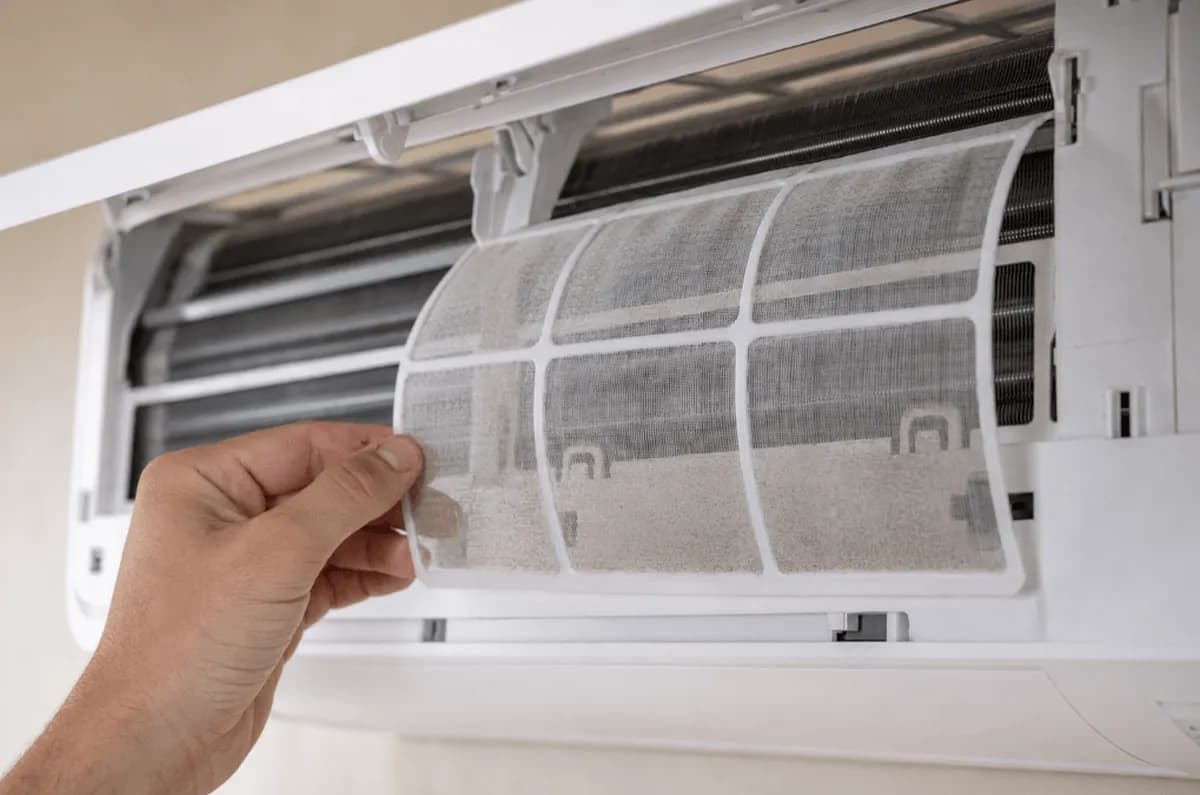
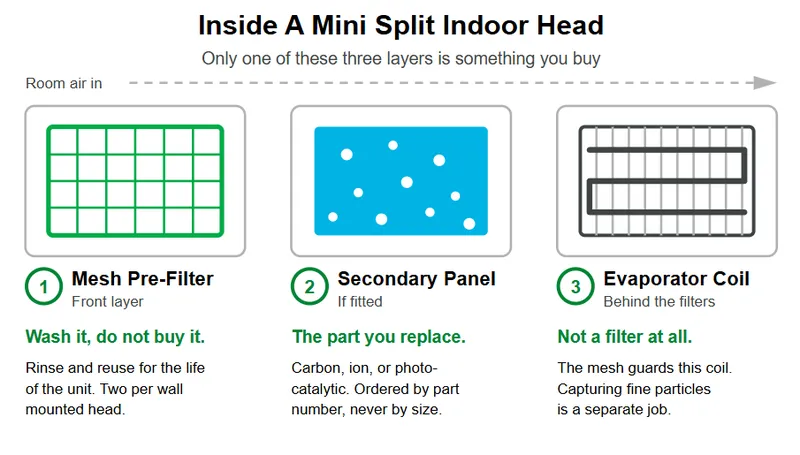
Most mini splits do not take a disposable filter. The mesh screen behind the front panel is washable and lasts the life of the unit, so routine care means rinsing it rather than buying anything. Ductless parts are also ordered by manufacturer part number, never by a nominal size like 20x20x1.
You need to buy a replacement in three cases:
- The mesh is torn, warped, brittle, or still gray after a full wash and dry.
- Your unit has a secondary carbon, ion, or photocatalytic panel behind the mesh.
- You also run a central system, which takes a real pleated filter.
Take the quick match below and we will point you to the right filter for the system you actually have.
Answer 3 quick questions and we will match you to your filter.
Shopping for the system itself rather than the filter? Filterbuy ductless heads use the same washable mesh, plus a filter-clean reminder and a 55C self-clean cycle that dries the evaporator coil after each use.
TL;DR
Most mini split systems do not take a disposable filter. The mesh screen behind the front panel is washable and lasts the life of the unit, so routine care means rinsing rather than buying. You need a replacement in three cases: the mesh is torn or permanently discolored, your unit has a secondary carbon or ion panel, or you run a central system of your own.
Key Takeaways
The mesh filter in a ductless mini split is washable and reusable. Mitsubishi Electric, Daikin, Fujitsu, LG, MRCOOL, and Senville all specify washing, not replacing.
A mini split uses mesh because its fan is too small to pull air through pleated media. The screen is a design choice, not a missing part.
Secondary filters are the replaceable ones. Carbon, silver ion, and photocatalytic panels degrade when soaked, on intervals of three months to three years.
Mini split filters are sourced by manufacturer part number, not nominal size. A 20x20x1 style code does not exist for ductless heads.
What Kind Of Filter Does A Mini Split Actually Use?
A mini split uses a rigid plastic framed mesh screen behind the hinged front panel. Manufacturers build it to be vacuumed, rinsed, and reinstalled for the life of the unit. Some models carry a thinner treated panel behind it. That second panel has an expiration date.
Why Your Mini Split Uses Mesh Instead Of Pleated Media
Filterbuy has manufactured pleated air filters in the United States since 2013, at plants in Alabama, Florida, Pennsylvania, and Utah. People who build both know the gap between them is a design decision, not a shortcut.
A pleated filter works by depth. Layers of fine fibers catch particles as air winds through, and the folds pack more surface into the frame so the media can be dense without choking airflow. That density stops fine particles, and it takes fan power to pull through.
A mini split runs a small, quiet fan sized for one room. It cannot move air through pleated media. So manufacturers fit an open woven screen that guards the coil, and make it washable because a screen that coarse does not wear out.
The filter is not missing. It is doing the job it was built for.
How To Identify The Right Replacement Filter For Your System
We built this sequence because the standard advice, measure your filter, fails on a ductless head.
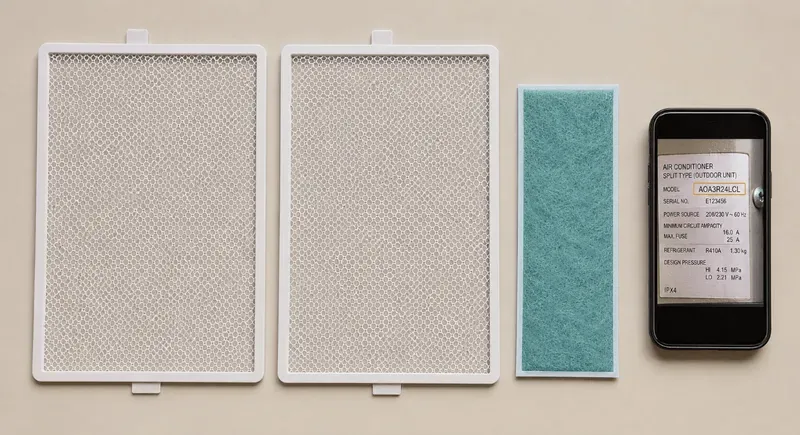
Read the model number off the indoor unit. Open the front panel. The label sits on the right side of the chassis or under the panel. Photograph it. This is the indoor head model, not the outdoor condenser.
Count the filter layers. Slide the mesh out. A thinner colored panel behind it means you have a secondary filter.
Find the part number, not the size. Ductless filters are model specific moldings. Mitsubishi, Daikin, and Fujitsu print a part number on the frame or in the manual.
Confirm the quantity. Wall mounted heads take two mesh screens. Cassettes, floor consoles, and duct units take one.
Which Mini Split Filters Are Replaceable, By Brand
The mesh is washable on every brand below. Only the secondary filter varies.
Consolidated from manufacturer owner's manuals and support pages, 2024–2026. Always confirm the part against your model's parts diagram.
When To Replace The Mesh Instead Of Washing It
Replace the mesh when it is torn, warped, brittle, or still gray after a full wash and dry. A damaged screen cannot seat, so unfiltered air slips around the frame onto the coil. Our walkthrough of how to clean mini split filters covers water limits and drying.
How To Tell If The Mesh Is Actually Worn Out
Gray does not mean finished. Run these after washing and drying.
Backlight it. Hold the screen to a window or lamp. A sound mesh shows an even grid. Stretched cells or blown out patches mean air is slipping through.
Flex a corner. Plastic gone brittle from heat cycling crackles or holds the bend. A frame that cannot hold shape cannot seal.
Judge color dry. A damp mesh looks darker. If it is still evenly gray once dry, the stain is in the fiber and washing will not lift it.
One failing check is not a verdict. Two or more usually is.
"Most of the filters people ask me about are dirty, not finished. The ones that genuinely need replacing are warped rather than discolored, and a frame that has lost its shape leaks air around the edge."
David Clark, Licensed HVAC Technician
Where To Buy Mini Split Replacement Filters
Order mini split replacement filters from the manufacturer or an authorized parts distributor, using the part number from your unit rather than a size. Mitsubishi, Daikin, LG, and Fujitsu all run parts channels. MRCOOL and Senville sell direct. Expect two mesh screens per wall mounted head, and check whether yours takes a secondary panel.
Here is what most retailers will not tell you. Filterbuy makes pleated filters in 600 sizes for central systems and builds its own ductless line, but we do not stock brand specific mini split mesh panels. That is exactly why we can be blunt. A parts retailer earns money when you buy a filter. We earn nothing here, so there is no reason to sell you a part you do not need.
What A Mini Split Filter Will Not Do For Your Air
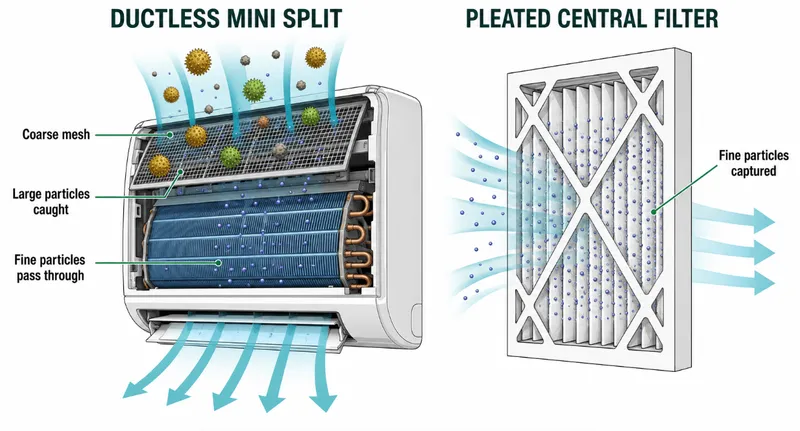
A ductless mesh screen is a coil guard. It stops hair and lint, not the fine particles that affect respiratory health.
If the mini split is the only system in the room, a portable HEPA unit fills that gap. If you run central heating and cooling too, that filter carries the whole house load, and its rating is where an upgrade shows up. Our MERV 13 filters capture fine particles including smoke. They ship free in 600 sizes, with custom size HVAC filters for odd sized returns. Auto delivery puts the next one at your door on schedule.
"After manufacturing filters for over a decade and serving more than two million households, the most common mistake with ductless owners is assuming the mesh works like a furnace filter. It does not. It protects the machine. Protecting the air is a separate job, and knowing the difference saves people money."
David Heacock, Founder and CEO, Filterbuy
Frequently Asked Questions
Do mini splits have replaceable filters?
The mesh filter is washable and reusable for the life of the unit, so it is never replaced on a schedule. Many models carry a secondary carbon, ion, or photocatalytic panel behind it, swapped every few months to a few years.
What size filter does a mini split take?
Ductless filters are not sold by nominal size. Each head takes a molded screen matched to a part number, printed on the frame or in the manual.
Can i put a hepa filter in my mini split?
No. A HEPA medium is too dense for a ductless fan. Forcing one in restricts airflow, ices the coil, and damages the blower. Use a portable purifier instead.
How much do mini split replacement filters cost?
The mesh screen is washable, so most owners spend nothing. Secondary carbon and photocatalytic panels are the recurring cost, sold in pairs through manufacturer parts channels at prices that vary by model.
Are universal mini split filters any good?
Trim to size universal mesh works as a stopgap when a part number is out of stock. It will not seat as precisely as the original, so air bypasses the screen. A bridge, not a fix.
The One Unit On That List Built By A Filter Company
Every other mini split above was designed by an HVAC manufacturer that treats filtration as one component. Filterbuy arrived from the other direction, building pleated media since 2013 and ductless systems after.
That shows up in small places rather than headline specs. Filterbuy mini split systems carry a filter-clean reminder and a 55C self-clean cycle that dries the evaporator coil after each use, which heads off the mold problem technicians are called out for most.
It does not change the physics. A Filterbuy head still uses a washable mesh, for the same fan pressure reasons as every other brand. What changes is how often you think about it.
Essential Resources For Mini Split Filter Selection
What Ductless Filtration Actually Handles
What a wall unit filter captures, and where it stops.
Source: https://www.epa.gov/indoor-air-quality-iaq/guide-air-cleaners-home
How Ductless Systems Are Built
Indoor head types that set your filter shape.
Source: https://www.energystar.gov/products/ductless_heating_cooling
The Engineering Behind The Indoor Head
How the air handler and coil work together.
Source: https://www.energy.gov/energysaver/ductless-minisplit-heat-pumps
Indoor Unit Configurations And Filter Access
Wall, cassette, and concealed duct indoor units.
Source: https://basc.pnnl.gov/resource-guides/ductless-mini-split-heat-pumps
Why Fine Particle Capture Matters At Home
A common trigger mesh screens do not capture.
Source: https://www.lung.org/clean-air/indoor-air/indoor-air-pollutants/dust-mites
Reducing Allergens Beyond The Filter
Source control alongside filtration.
Source: https://aafa.org/allergies/prevent-allergies/control-indoor-allergens/
Research On Air Conditioning Filters And Allergen Exposure
Links filter cleaning to lower allergen exposure.
Source: https://www.ncbi.nlm.nih.gov/pmc/articles/PMC9892137/
Supporting Statistics
88 Percent Of United States Households Use Air Conditioning
88 percent of U.S. households use air conditioning.
Two thirds run central AC or a heat pump.
Central systems take disposable filters. Mesh does not.
Source: U.S. Energy Information Administration, 2020 Residential Energy Consumption Survey
About One In Twelve United States Adults Has Asthma
8.6 percent of U.S. adults have asthma.
6.5 percent of U.S. children have asthma.
Top triggers: dust mites, mold, pet dander.
Mesh cannot capture particles that small.
Source: CDC National Center for Health Statistics, FastStats: Asthma (2024)
People Spend About 90 Percent Of Their Time Indoors
Roughly 90 percent is spent indoors.
Indoor air can be more polluted than outdoor air, even in major cities.
Mesh was never designed for that exposure.
Source: U.S. Consumer Product Safety Commission, The Inside Story
Glossary
Mini split (ductless mini split): A heating and cooling system pairing an outdoor compressor with one or more indoor air handlers, no ducts.
Pleated filter: A folded depth filter of fine fibers used in central HVAC systems. The folds add surface area so dense media passes air.
Mesh filter (pre-filter): The washable screen in a mini split indoor unit. Rinsed and reused, not replaced.
Secondary filter: A treated panel behind the mesh, such as carbon, silver ion, or photocatalytic, replaced on a manufacturer schedule rather than washed. Daikin panels last about three years.
Evaporator coil: The finned heat exchanger behind the mesh filter.
MERV: Minimum Efficiency Reporting Value, the ASHRAE scale rating particle capture by size. Mesh is not rated.
HEPA: High Efficiency Particulate Air, a standard requiring capture of 99.97 percent of particles at 0.3 microns. No mesh filter meets it.
Written by Michelle Wan, Brand Manager and Air Quality Writer, Filterbuy. Reviewed by David Clark, Licensed HVAC Technician. Published July 31, 2026. Last updated July 31, 2026.