
Spokane, WA Live Wildfire Smoke Map
Get Alerts For Wildfires In Your Area
The moment a wildfire starts near you, you'll get an instant alert and simple tips to reduce your smoke exposure.
What's In The Smoke
30xSmaller than a human hair
Fine enough to reach deep into the lungs. A MERV 13 is built to capture it.
How Far It Travels


It Doesn't Stay Local
Smoke rides the wind far downwind — you can get smoky air with no fire nearby.
What To Do During A Smoke Event
Simple steps to reduce indoor exposure.
- Stay In, Close UpShut windows and doors to keep smoke out.
- Set Fan To "On"Keeps air cycling through your filter, not just when heating or cooling.
- Recirculate AirSwitch off fresh-air intake so you're not pulling smoke in.
- Run A MERV 13Built to capture the fine PM2.5 in smoke.
- Add A PurifierExtra filtration for the room you use most.
- Wear an N95 if OutsideFits snug to block fine particles — a cloth mask won't.


The Best Air Filter For Wildfire Smoke
During smoke events, the EPA recommends upgrading to a MERV 13 filter — or the highest-rated filter your system can handle — to help reduce the fine particles smoke brings indoors. MERV 13 is the level most home HVAC systems can run while still capturing PM2.5, the fine particulate that makes up the bulk of wildfire smoke.
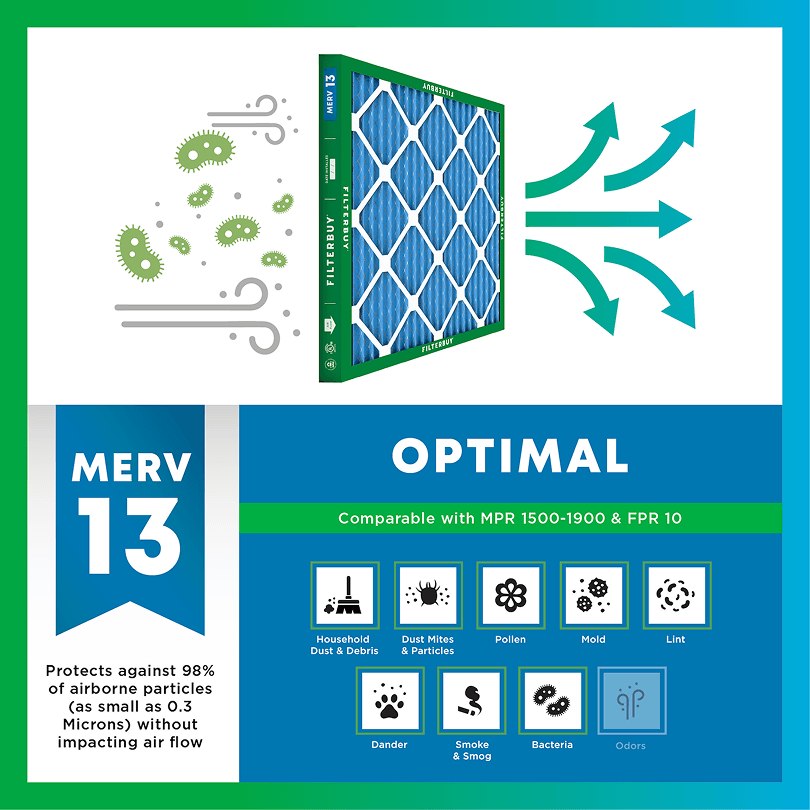
- Captures PM2.5 particles
- Blocks ash, soot, and smoke odor
- Keeps your indoor air safe—even when the outdoor air is dangerous
- Meets the EPA's recommended rating for filtering fine wildfire smoke particles.

Wildfire Smoke FAQs
Facts About Wildfires
Over 70,000 wildfires burn in the U.S. every year.
Wildfire smoke can travel 1,000+ miles, affecting states that aren't even near the blaze.
Exposure to wildfire smoke can worsen asthma, trigger heart issues, and lead to ER visits.
Indoor air can hold more fine particles during wildfire events unless it's properly filtered.
The EPA advises using MERV 13 filters or portable HEPA air cleaners during wildfire smoke events.
Don't Wait Until The Smoke's Inside.
Use the live wildfire smoke tracker and upgrade your air filters today to protect your lungs and your home.
Shop Filters For Smoke Protection
Live Spokane, WA Forest Wildfire & Smoke Map Today: Local Air Quality Tracking & Indoor Protection Solutions
Author: Michelle Wan | Reviewer: David Clark, Licensed HVAC Technician | Published: August 21, 2026 | Updated: August 21, 2026
TL;DR
Check the map first, then the two-day forecast. Spokane sits in a valley airshed where overnight inversions press smoke against the ground, so a morning reading is often worse than an afternoon one. When the Air Quality Index climbs, close the house up, run the HVAC fan, and put a MERV 13 filter in the return.
Key Takeaways
Spokane Clean Air runs the county monitoring network and issues the two-day forecast. From 2020 to 2025, it counted about six unhealthy air days each summer from smoke.
On August 20, 2023, Spokane Clean Air measured an AQI of 465, the worst reading in the country that day.
The countywide AQI is the highest reading from any Spokane monitor, so it runs worse than your block. Use it to judge the day; the nearest map dot is for your street.
The EPA recommends MERV 13 or higher during smoky stretches, and says to replace it once it looks dark rather than on a calendar date.
Live Spokane Wildfire And Smoke Maps To Check Right Now
Four official sources answer four different questions, and reaching for the wrong one is the most common mistake during a smoke event. A fire map shows where the flames are. An air quality map shows what you are breathing. The two often disagree, because a fire 200 miles upwind can be worse at your door than a contained fire nearby.
Read them in that order. The official guide to the map icons and trend arrows decodes each symbol; Spokane County monitor readings and the forecast discussion come from the local agency; the statewide smoke forecast map extends it statewide; and the national incident clearinghouse carries fire size and status. Our walkthrough on how to read a wildfire smoke map takes the icons one by one, and the Filterbuy guide to how to use EPA AirNow covers the rest.
What Today’s Spokane AQI Number Means For Your Household
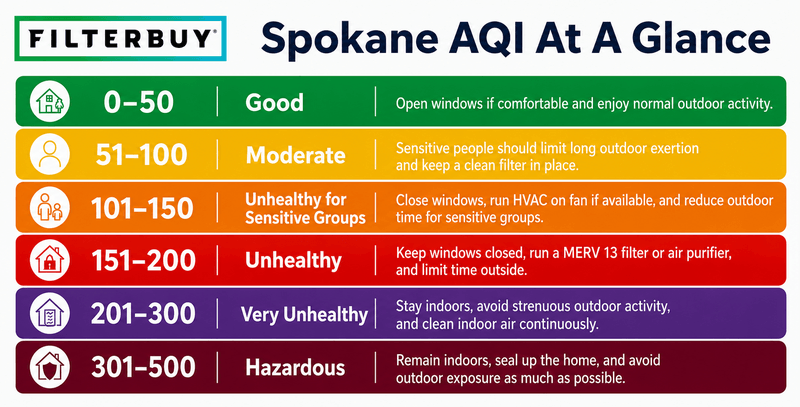
The Air Quality Index converts pollutant concentrations into a 0 to 500 scale with matching health categories. During wildfire smoke, the pollutant driving that number in Spokane is PM2.5, fine particulate matter 2.5 micrometers and smaller. AirNow reports NowCast AQI, weighted toward recent hours so it keeps pace with fast-moving smoke.
Values reflect the U.S. Environmental Protection Agency Air Quality Index. During wildfire smoke, the driving pollutant in Spokane is PM2.5.
The Washington State Departments of Health and Ecology recommend cancelling outdoor public events once the AQI reaches 201, or is forecast to.
Why The County Number And The Map Dot Disagree
Spokane Clean Air and the AirNow map can report different numbers for the same hour, which trips up households every August. Spokane Clean Air publishes the highest reading from any county monitor as the countywide AQI, so that number is a worst-case for the region, not a measurement of your block. It updates at 35 minutes past the hour and keeps its lower-cost SensWA sensors out of that figure, while AirNow folds corrected sensor data in. Both are accurate, doing different jobs.
Why The Spokane Airshed Holds Smoke Longer Than Most Cities
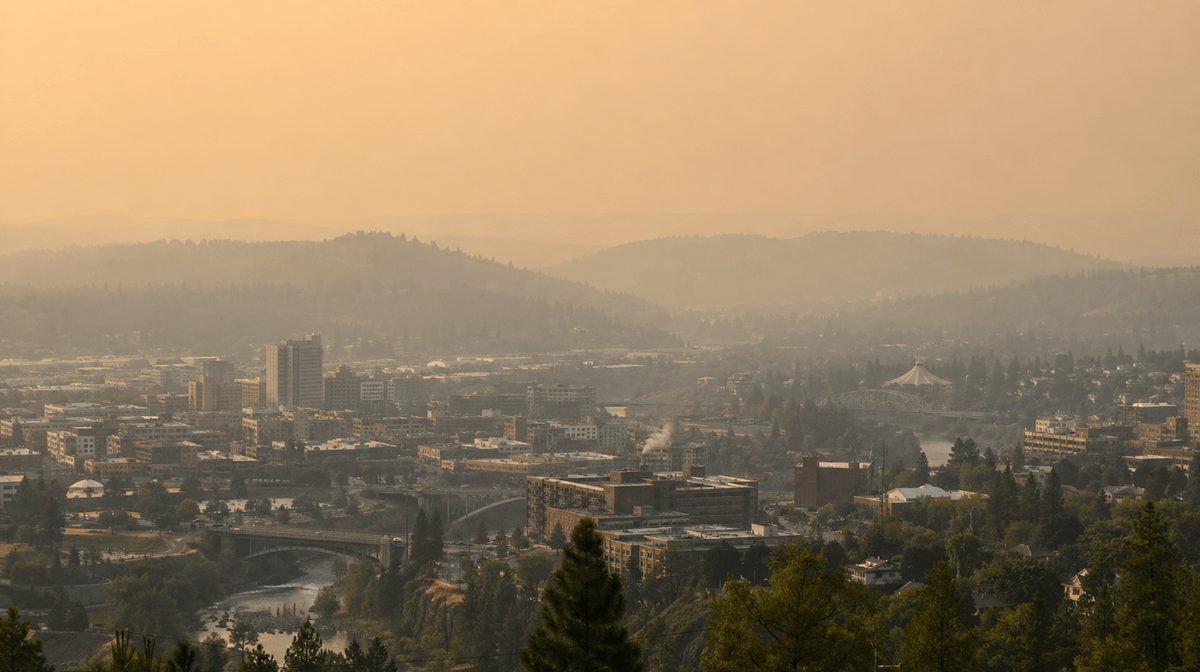
Spokane sits at roughly 2,000 feet in an inland valley, which is why smoke settles in long after it clears elsewhere. On calm nights, the ground cools quickly, and warmer air forms a layer above it. That surface temperature inversion works like a lid, and smoke that would otherwise disperse stays pressed against the valley floor until the afternoon sun breaks it.
Spokane smoke follows a daily rhythm residents will recognize. Air quality is worst between about 8 a.m. and 11 a.m., improves through the afternoon as the inversion lifts, then slides overnight. In July 2026, a downtown monitor read 111 that morning while a Spokane Valley monitor had fallen to 62 by mid-afternoon.
How To Protect Your Indoor Air During A Spokane Smoke Event
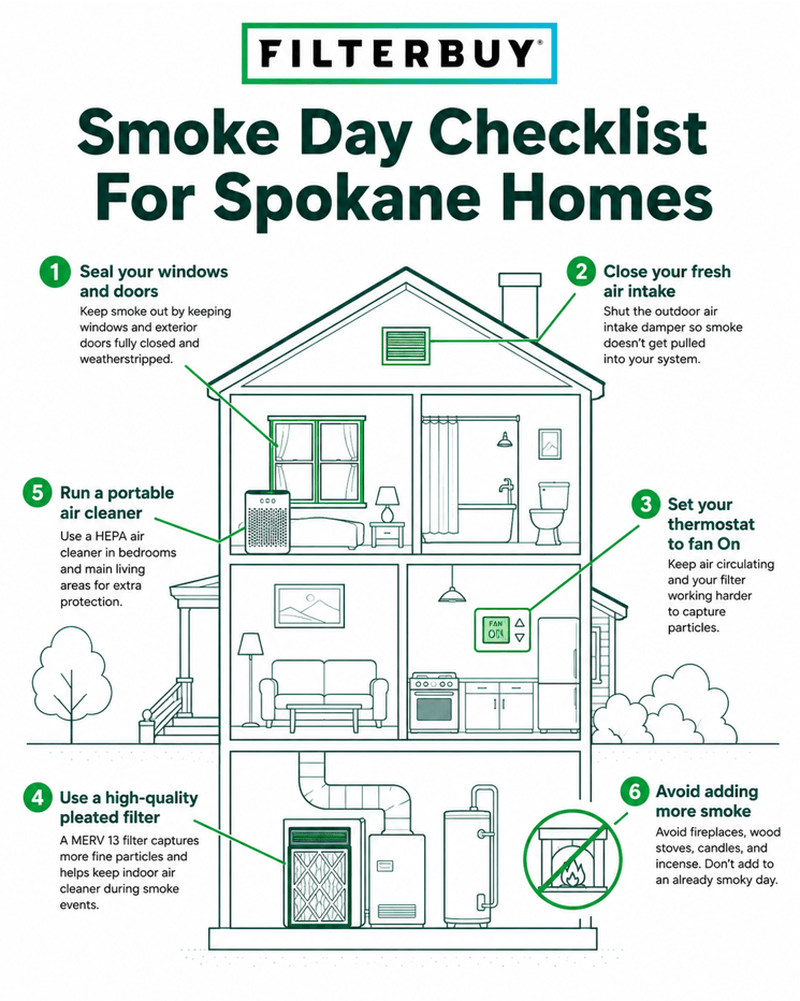
Close the building up first, then filter what is inside. Smoke that has worked into a home will not settle out on its own. The EPA also advises households to set up a cleaner air room where people spend the most hours.
Close the windows and doors and shut the fresh air intake.
Set the thermostat fan to On, not Auto, so air keeps moving through the filter.
Install a MERV 13 pleated filter, or the highest rating your system takes.
Add a portable HEPA air cleaner in the bedroom or main living area.
Skip anything that adds particles indoors: candles, wood stoves, sprays, frying, vacuuming.
Inspect the filter every couple of weeks in heavy smoke, replacing it once it looks dark.
One caution about MERV 13 matters most. The EPA recommends MERV 13 or higher during smoky periods, but a higher rating means denser media and more airflow resistance. Most systems built in the last 15 years handle MERV 13 without complaint, though older equipment may not. A licensed HVAC technician can measure static pressure and tell you what yours takes.
When To Open The Windows Again
Reopening is the question the map never quite answers. Because of the inversion, the first green reading of the morning is the least trustworthy of the day. Wait until the AQI has held in Good territory for a few hours and the trend arrow has flattened, which in Spokane means mid to late afternoon. Close up before evening as the inversion reforms, and leave the fan running, since indoor particles outlast the outdoor number.
Choosing The Right MERV Rating For Spokane Smoke Season
MERV, or Minimum Efficiency Reporting Value, rates how well a filter captures particles on the ASHRAE 52.2 scale, and higher numbers catch smaller ones. Wildfire smoke is dominated by PM2.5, so a standard MERV 8 is the wrong tool for a smoke week.
The U.S. Environmental Protection Agency recommends MERV 13 or the highest rating a system fan and filter slot can safely accommodate during smoky periods. MERV 13 is not equivalent to True HEPA.
Treating the upgrade as seasonal works well. Run MERV 13 through July to September and drop back after, limiting how long the blower fights the added resistance. Our comparison of MERV 13 versus HEPA for wildfire smoke explains why the two are complementary, and the best MERV filter for wildfire smoke covers the swap. Filterbuy manufactures MERV 13 pleated air filters in standard and custom sizes.
What The Smoke Map Cannot Show You
The map reads outdoor PM2.5 and nothing else, which leaves three hazards invisible. The first is indoor air, where particles linger long after the outdoor reading clears. The second is ash on the ground, which is not smoke in the air, and ash from burned structures carries more toxic material than forest ash, because homes are built with plastics and treated lumber. Third is regulatory. Owners of structures damaged in 2026 must get an asbestos survey before removing debris and file a Notice of Intent either way. A green dot on the map does not mean a burned lot is safe to work on.
What We See From Inside The Filter Business Every Smoke Season
At Filterbuy, we build these filters in plants we own in Talladega, Alabama, and we maintain air quality pages for cities across the country, so the AirNow map is a tool we work in year-round, not one we opened for this page.
One thing we will say plainly, because it cuts against our own packaging. We rate the Filterbuy MERV 13 for 90 days, and that assumes ordinary household dust. A heavy Spokane smoke week can finish it in 30. Trust the color of the media over the date on the box.
After manufacturing filters for over a decade and serving more than two million households, we see the same thing every smoke season. Demand arrives the week the sky turns amber, and by then the common sizes are gone. The households that breathe easy in August bought in June.
The Filterbuy Team
Supporting Statistics
Indoor PM2.5 sits at roughly 55 to 60 percent of outdoor levels during a smoke event when windows are closed, and no air cleaner runs. Closing up the house alone leaves more than half the smoke inside, which is why filtration matters.
Source: U.S. EPA
Asthma-related emergency department visits ran 17 percent above expected across 19 wildfire smoke days in 2023. Smoke days are measurably harder on people with asthma, so act early on the sensitive-groups thresholds above.
Source: CDC MMWR
The Spokane Area Fires, three fires that ignited August 1, 2026, burned roughly 9,900 acres across Spokane and Stevens Counties and reached 97 percent containment. The federal incident record carries live acreage per fire.
Source: InciWeb
Frequently Asked Questions About Spokane Wildfire Smoke
Get Spokane Smoke Season Ready Before The Next Air Quality Alert
Filterbuy builds pleated MERV 13 filters in the United States in more than 600 sizes, plus custom dimensions, so the filter that fits your return is the one rated for the fine particles smoke carries. Find your size and keep a spare on the shelf before the next alert.
Glossary Of Terms On This Page
MERV: Minimum Efficiency Reporting Value, the ASHRAE 52.2 scale from 1 to 20 rating how well a filter captures airborne particles. See the Filterbuy primer on all about MERV ratings.
Sensitive Groups: People affected at lower pollution levels: children, adults over 65, pregnant people, and anyone with asthma or heart disease. The CDC maintains the full list of people at higher risk from smoke.
Subscribe to wildfire smoke alerts for Spokane, WA, to get a heads-up before the next event reaches your area.