The moment a wildfire starts near you, you'll get an instant alert and simple tips to reduce your smoke exposure.
30xSmaller than a human hair
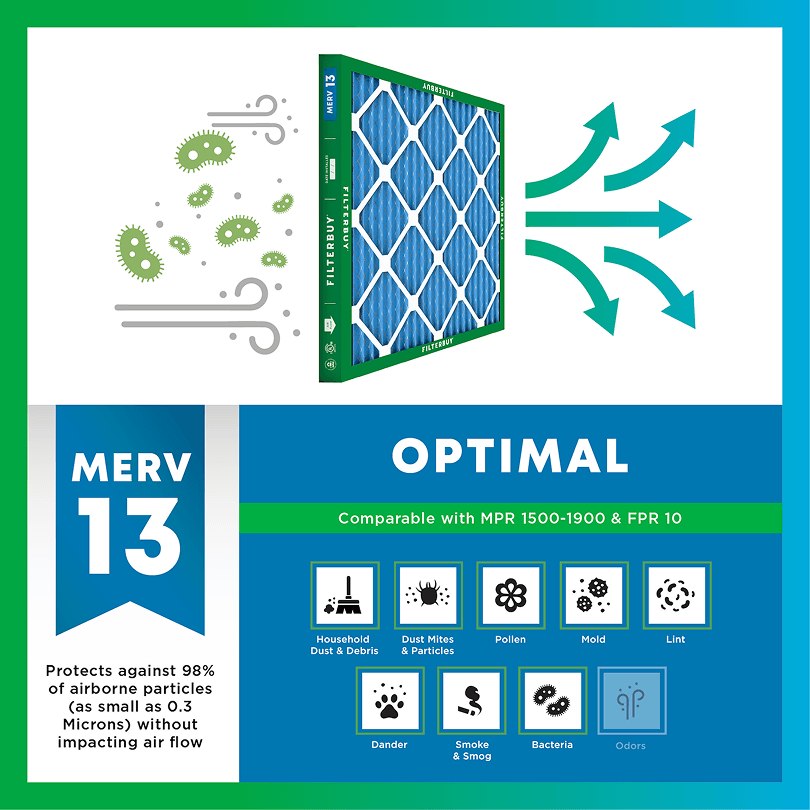
Fine enough to reach deep into the lungs. A MERV 13 is built to capture it.
It Doesn't Stay Local
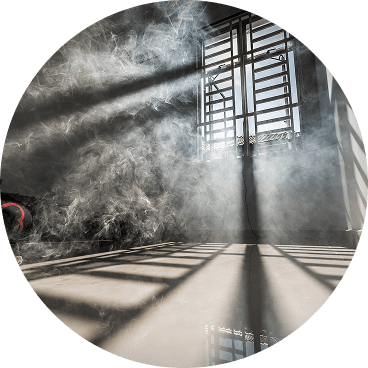
Smoke rides the wind far downwind — you can get smoky air with no fire nearby.
Simple steps to reduce indoor exposure.
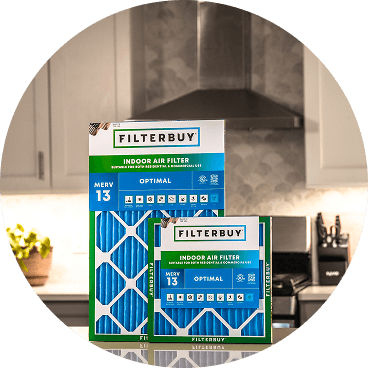
During smoke events, the EPA recommends upgrading to a MERV 13 filter — or the highest-rated filter your system can handle — to help reduce the fine particles smoke brings indoors. MERV 13 is the level most home HVAC systems can run while still capturing PM2.5, the fine particulate that makes up the bulk of wildfire smoke.
Over 70,000 wildfires burn in the U.S. every year.
Wildfire smoke can travel 1,000+ miles, affecting states that aren't even near the blaze.
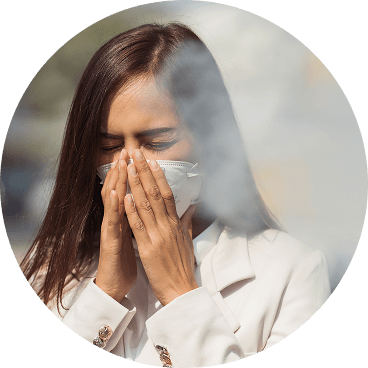
Exposure to wildfire smoke can worsen asthma, trigger heart issues, and lead to ER visits.
Indoor air can hold more fine particles during wildfire events unless it's properly filtered.
The EPA advises using MERV 13 filters or portable HEPA air cleaners during wildfire smoke events.
Use the live wildfire smoke tracker and upgrade your air filters today to protect your lungs and your home.
Shop Filters For Smoke Protection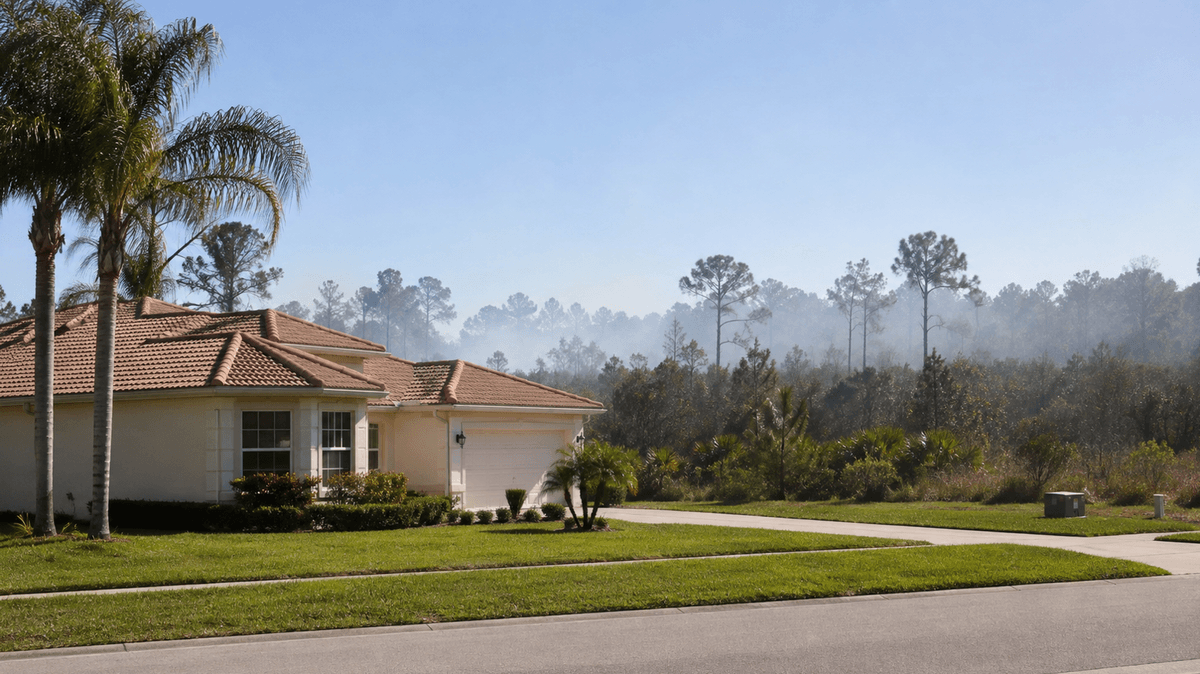
By Michelle Wan, Brand Manager & Air Quality Writer
Reviewed By: David Clark, Licensed HVAC Technician
Published: August 9, 2026 | Updated: August 9, 2026
If you searched this from your driveway because the air smells like a campfire, start with the map above. Then read this, because the number beside it is not what most Port St. Lucie residents think.
Before Filterbuy built this page, we went looking for the instrument that measures smoke in St. Lucie County. There isn’t one. That fact changes how you read every AQI figure for this city, and it is missing from every national wildfire map we checked.
Port St. Lucie smoke comes mostly from brush and vegetative-debris fires west of I-95, and fire season peaks February through April. The county has no regulatory PM2.5 monitor, so your local AQI is estimated, not measured. Use the Filterbuy two-signal rule: treat the number and your senses as independent signals and act on whichever is worse. Close the house, set the fan to ON, run a clean MERV 13 filter.
The county’s only state air monitor measures ozone, not smoke, so your AQI here is interpolated or modeled.
The fire ground sits west of I-95, and the people sit east, so any wind with west in it brings smoke into town.
Fire season peaks February to April, the mildest weeks here, when a thermostat on AUTO barely runs the filter.
The EPA recommends MERV 13 or higher during smoky periods. Filterbuy makes filters in Florida, so this is our own weather.
Check the map, then confirm containment on the Florida Forest Service wildfire dashboard. For smoke specifically, the EPA AirNow Fire and Smoke Map overlays satellite plumes onto sensor readings. Three fire types drive nearly every local smoke complaint: brush fires that clear in days, prescribed burns lasting an afternoon, and vegetative-debris (mulch) fires that smolder beneath a crust for weeks. The third is underestimated. A 35-acre debris fire near Range Line Road burned from March 1 to March 24, 2026, with smoke reaching Jensen Beach.
Because nothing in this county measures smoke. Filterbuy went looking. The Florida Department of Environmental Protection lists a single air monitor for St. Lucie County, AQS ID 12-111-0013 at the Savannahs site in Fort Pierce, and the pollutant beside it reads "Ozone." Wildfire smoke is almost entirely PM2.5. Consumer apps fill the gap by interpolating from neighboring counties, modeling from satellite data, or blending in low-cost sensors. All are useful. None is a reference-grade reading near your house, and no national wildfire map we checked says so.
With no regulatory PM2.5 monitor in the county, every Port St. Lucie AQI figure is interpolated, modeled, or sensor-derived.
Treat the AQI reading and your senses as two independent signals, and act on whichever is worse. Where monitoring is dense, the rule is unnecessary. In a county with no PM2.5 monitor, your nose competes with the instrument.
Number low, you smell smoke: believe your nose. The common failure here. Close up, fan to ON.
Number high, air seems clear: believe the number. Smoke aloft settles after dark.
Both bad: close the house, run the fan continuously, portable cleaner in the bedroom.
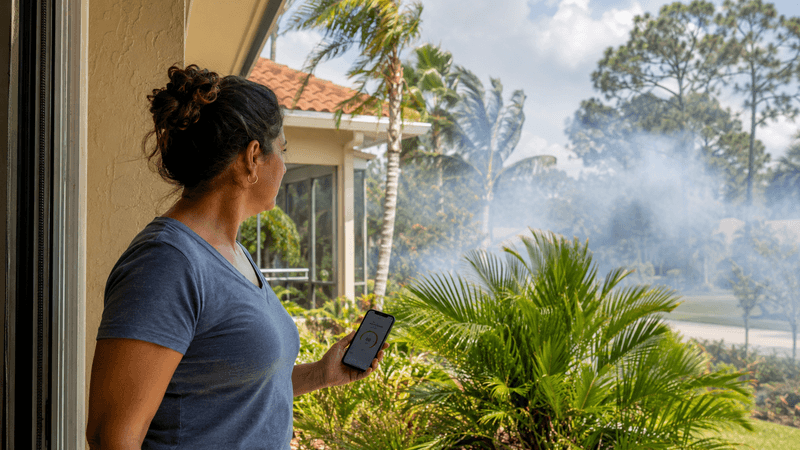
If the wind has west in it, Port St. Lucie gets the smoke. If it has east in it, the smoke goes inland. The fire ground sits west of I-95 while the people sit east, so that one check often tells you more than the AQI figure.
Morning and afternoon can be different smoke days. The sea breeze sets in between noon and 2 p.m., turning the flow onshore, so a smoky morning can clear by mid-afternoon and close back in after sunset.
Dawn and dusk are worst near a smoldering fire, when calm air lets smoke pool. Plan the dog walk around it.
If it smells like burning, your filter matters. Haze with no burnt smell between June and August is more likely Saharan dust, which settles most false alarms here.
Burnt smell means combustion, and your filter matters. Haze without it, June to August, is likely Saharan dust.
Peak fire risk here lands February through April, not August, tracking the dry season measured by the Keetch-Byram Drought Index, a 0 to 800 soil-dryness scale where 600 and above signals deep-burning fires. Drought lingers into the wet season: on July 28, 2026, 42.8% of county residents were still in drought. Check the current figure on the county drought dashboard.
The consequence almost nobody connects: Florida’s smoke season and its air-conditioning season do not overlap. February through April is the mildest stretch of the year, when a thermostat on AUTO barely calls for cooling. A filter only cleans air that passes through it, so on a 74-degree March afternoon a new MERV 13 does close to nothing. Out West, fire season arrives when systems run constantly. Ours does not.
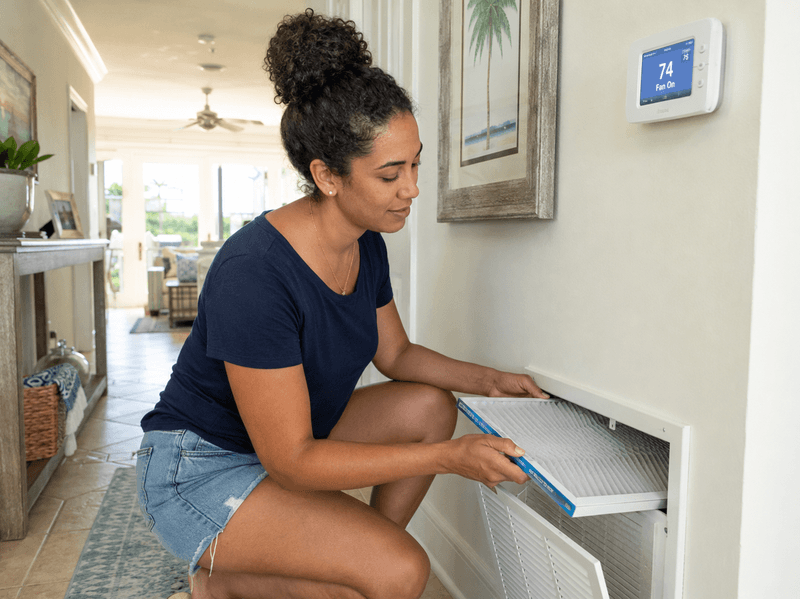
Close the house, switch the fan from AUTO to ON, then check the filter. In that order. The first two are free.
Close windows and doors. Skip the whole-house fan.
Set the fan to ON. Air is filtered only while the blower runs.
Install a MERV 13 filter. The EPA recommends MERV 13 or higher during smoky periods. Filterbuy MERV 13 filters trap 98% of particles to 0.3 microns. For odor, an activated-carbon Odor Eliminator adds gas-phase capture.
Inspect weekly. Replace when the media looks dark brown or black, which arrives well before the usual schedule.
Add a portable HEPA cleaner in the bedroom. We compare both MERV 13 vs HEPA for wildfire smoke.
Weatherstrip the garage-to-house door, which matters in block construction.
Pick one room, usually the bedroom, and make it the clean room rather than treating the whole house. Nearly a quarter of county residents are 65 or older. The CDC lists older adults with asthma, COPD, heart, diabetes, and kidney patients, children, and pregnant people as most at risk. Act on whichever signal comes first, not whichever is worse. No central air? Set a window unit to recirculate, run a portable HEPA cleaner where you spend most time, and keep mini split filters clean.
Filterbuy has built air filters in the United States since 2013, across plants in Alabama, Pennsylvania, Utah. And Florida. Many filters in Treasure Coast return grilles were made here. That is our vantage point: not what smoke does outside, but what it does inside a Florida house.
We manufacture in Florida, so this is our own weather. Homeowners here inherit smoke advice written for the West, where fire season and air-conditioning season are the same months. On the Treasure Coast, they are opposite, and that mismatch undoes a lot of good filter buying.
The Filterbuy Air Quality Team
The government sources Filterbuy checks on Florida air.
Florida Forest Service: Current Wildfire Information. Active wildfire points and county burn bans.
EPA AirNow Fire and Smoke Map. Monitors, sensors and satellite plumes in one view, partly filling the PM2.5 gap.
Alert St. Lucie emergency notifications. Wildfire alerts by street address.
DOH-St. Lucie smoke health guidance. Written for this county’s fires.
The monitoring gap. 31 fine-particle monitors statewide, none here. Florida DEP.
Smoke events are short-term spikes. Florida was one of six states with no county improvement. American Lung Association.
Growth and age compound it. More homes near the flatwoods, more at-risk residents. U.S. Census Bureau.
No one can give you a measured PM2.5 reading for your street here. No dashboard confirms a smoldering debris fire is out, since "contained" does not mean the smoke stopped. And Filterbuy has not published its own Florida filter-loading data, so we will not put a number on it.
Call 911 and follow evacuation instructions from St. Lucie County Public Safety and the Florida Forest Service. Register for Alert St. Lucie so they reach your address. Air quality guidance applies after your safety is settled.
The county has no regulatory PM2.5 monitor, so local AQI is interpolated or modeled. Smoldering mulch fires also produce ground-hugging smoke that satellites and distant monitors miss.
It peaks in the dry season, roughly February through April, as the Keetch-Byram Drought Index climbs. That is the opposite of the summer-peaking fire seasons out West.
MERV 13 or higher, the EPA recommendation for smoky periods and the lowest rating capturing a meaningful share of PM2.5. Most systems built after 2000 handle it; older PSC-motor air handlers may need static pressure checked first.
Smoke season arrives with the dry season, so the time to stock filters is February. Every year, Florida orders spike about a week after the smoke does. Shop MERV 13 filters, set up auto-delivery so they arrive before you need them, or build a custom size for an odd slot. Check conditions on our live Florida AQI map.
Michelle Wan is Filterbuy’s Brand Manager and Air Quality Writer, working with the U.S. manufacturing team across plants in Alabama, Florida, Pennsylvania, and Utah. David Clark is a Licensed HVAC Technician and CEO of Filterbuy HVAC Solutions. He reviewed this page for airflow and filter-compatibility accuracy.
PM2.5: Fine particles 2.5 microns or smaller, the dominant hazard in wildfire smoke.
MERV 13: The rating the EPA recommends as the minimum for wildfire smoke in a residential HVAC system.
KBDI: Keetch-Byram Drought Index, a 0 to 800 soil-dryness scale used to estimate Florida wildfire potential.
Filterbuy: A family-owned American air filter maker founded in 2013, headquartered in Talladega, Alabama, with plants including Florida.
Subscribe to wildfire smoke alerts for Port St. Lucie, FL, to get a heads-up before the next event reaches your area.