
Washington, DC Live Wildfire Smoke Map
Get Alerts For Wildfires In Your Area
The moment a wildfire starts near you, you'll get an instant alert and simple tips to reduce your smoke exposure.
What's In The Smoke
30xSmaller than a human hair
Fine enough to reach deep into the lungs. A MERV 13 is built to capture it.
How Far It Travels


It Doesn't Stay Local
Smoke rides the wind far downwind — you can get smoky air with no fire nearby.
What To Do During A Smoke Event
Simple steps to reduce indoor exposure.
- Stay In, Close UpShut windows and doors to keep smoke out.
- Set Fan To "On"Keeps air cycling through your filter, not just when heating or cooling.
- Recirculate AirSwitch off fresh-air intake so you're not pulling smoke in.
- Run A MERV 13Built to capture the fine PM2.5 in smoke.
- Add A PurifierExtra filtration for the room you use most.
- Wear an N95 if OutsideFits snug to block fine particles — a cloth mask won't.


The Best Air Filter For Wildfire Smoke
During smoke events, the EPA recommends upgrading to a MERV 13 filter — or the highest-rated filter your system can handle — to help reduce the fine particles smoke brings indoors. MERV 13 is the level most home HVAC systems can run while still capturing PM2.5, the fine particulate that makes up the bulk of wildfire smoke.
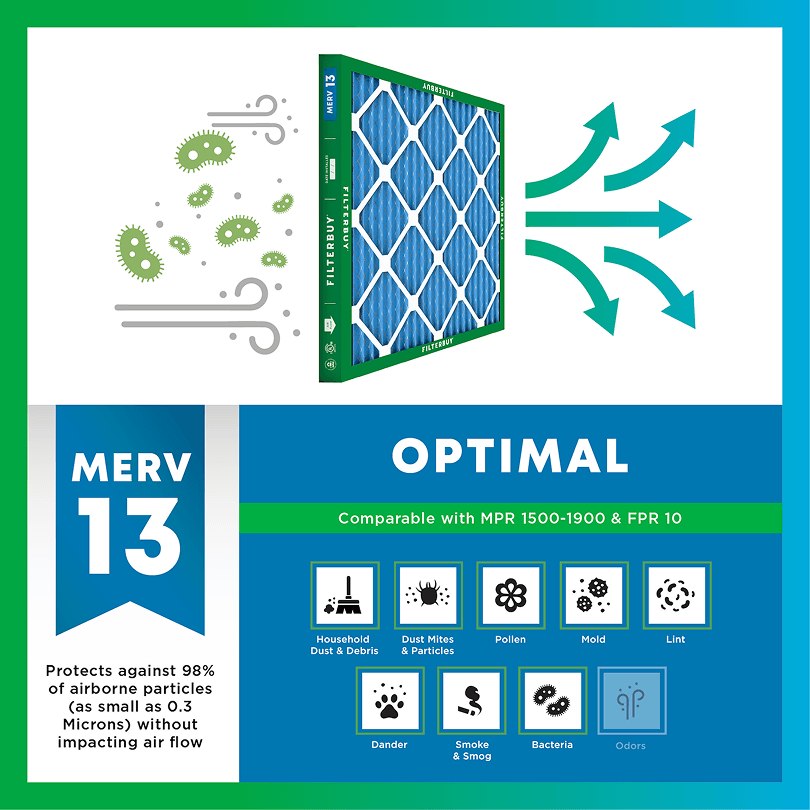
- Captures PM2.5 particles
- Blocks ash, soot, and smoke odor
- Keeps your indoor air safe—even when the outdoor air is dangerous
- Meets the EPA's recommended rating for filtering fine wildfire smoke particles.

Wildfire Smoke FAQs
Facts About Wildfires
Over 70,000 wildfires burn in the U.S. every year.
Wildfire smoke can travel 1,000+ miles, affecting states that aren't even near the blaze.
Exposure to wildfire smoke can worsen asthma, trigger heart issues, and lead to ER visits.
Indoor air can hold more fine particles during wildfire events unless it's properly filtered.
The EPA advises using MERV 13 filters or portable HEPA air cleaners during wildfire smoke events.
Don't Wait Until The Smoke's Inside.
Use the live wildfire smoke tracker and upgrade your air filters today to protect your lungs and your home.
Shop Filters For Smoke Protection
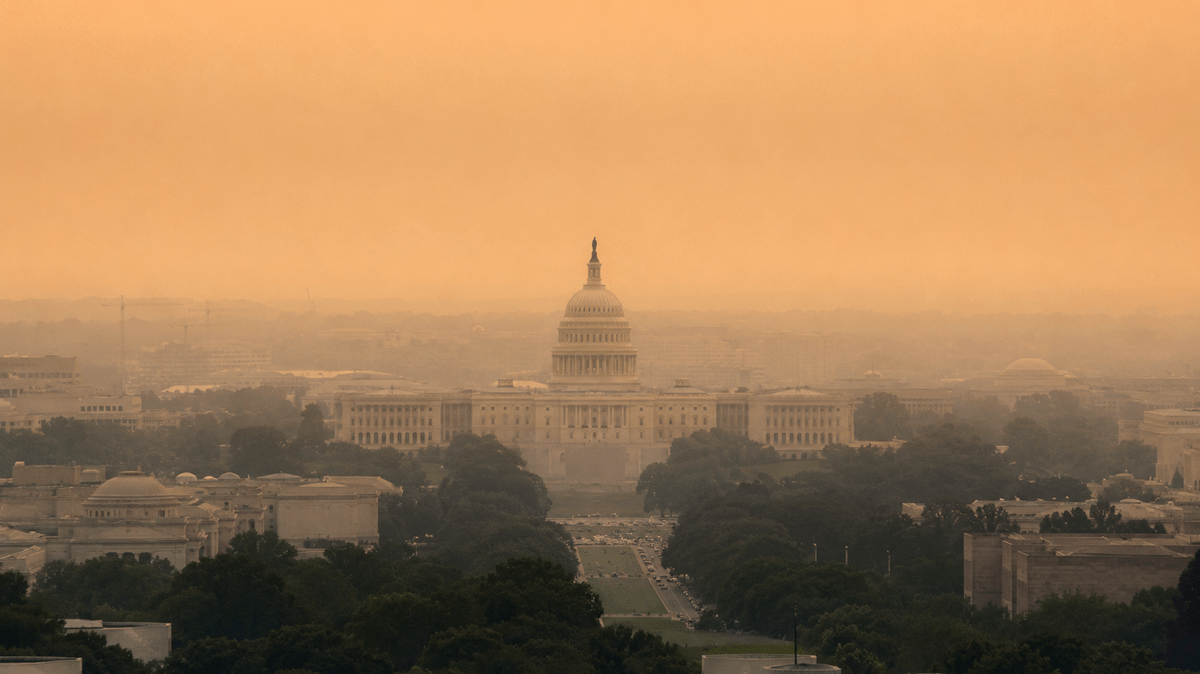
Current Live Wildfire and Smoke Map Washington DC Today From Filterbuy.com
Author: Michelle Wan (https://filterbuy.com/author/michelle-wan/)
Reviewer: David Clark, Licensed HVAC Technician
Publish Date: July 22, 2026
Updated Date: July 22, 2026
Smoke from wildfires in Ontario and northeast Minnesota is riding a shifting jet stream into the Mid-Atlantic today, July 15, 2026, and ground-level haze is expected to thicken across the I-95 corridor through Thursday. Washington sits in a shallow river basin that already traps heat and humidity, so a weather app's number and the air filling a living room can tell different stories. This page tracks today's fire and smoke conditions in real time and covers the part no map shows: the air already circulating inside your home.
TL;DR
Smoke from wildfires in Ontario and northeast Minnesota is riding a cold front into the Mid-Atlantic, with ground-level haze expected across the I-95 corridor through Thursday. DC's air was already vulnerable, earning an F for ozone in the American Lung Association's 2026 State of the Air report. Check the live map above, then match your home's filter to the forecast, since roughly half of what's outside typically ends up inside during a smoke event.
Key Takeaways
Today's smoke is transported, arriving from Ontario and northeast Minnesota on the same wind pattern that reached the region in June 2023.
DC earned an F for ozone and a D for short-term particle pollution in the American Lung Association's 2026 report, plus a Code Purple alert on July 5.
Sensitive groups, including children, older adults, and anyone with asthma, COPD, or heart disease, should limit outdoor exertion once the AQI passes 100.
Roughly half of outdoor PM2.5 infiltrates a typical home during a smoke event, through gaps, doors, and an HVAC system's fresh-air intake.
MERV 13 is the EPA-referenced filtration level for smoke days and fits the same slot as a standard filter in most systems.
Homes without central HVAC should rely on a portable air cleaner and sealed windows instead of a filter upgrade.
Why Wildfire Smoke Is Reaching Washington DC
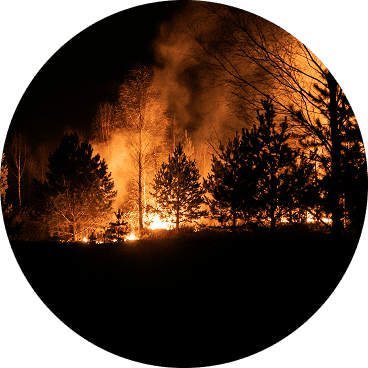
Washington does not need a nearby wildfire to see smoke. More than 800 fires are burning across Canada, and a separate complex has burned in northeast Minnesota since May. A heat dome pushing into the Carolinas is setting up a northwesterly wind flow that steers that smoke south into the Mid-Atlantic.
DC has been through this before. Canadian wildfire smoke pushed the District's AQI into the maroon range in June 2023, and today's event lands on an already-stressed baseline, including a Code Purple alert after the July 4th fireworks show just eleven days ago.
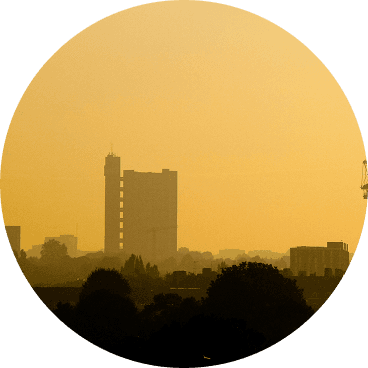
Humidity haze is a soft white-gray film with no smell. Wildfire smoke sits lower, often carries a yellow or brownish tint, and can bring a faint campfire smell before the AQI number moves.
How to Read Today's Live Wildfire and Smoke Map
The map above layers active fire locations with the AQI reading nearest you. Color bands run from green (good) through yellow, orange, red, purple, and maroon (hazardous). PM2.5, the fine particulate matter smoke is made of, matters more than ozone on a smoke day. Filterbuy's guide to reading a wildfire smoke map covers fire icons and plume tracking in more detail.
DC's readings come from a Department of Energy and Environment monitoring network feeding into the EPA's AirNow system. Readings can vary block to block, so treat the citywide number as a starting point and check the map again in the afternoon.
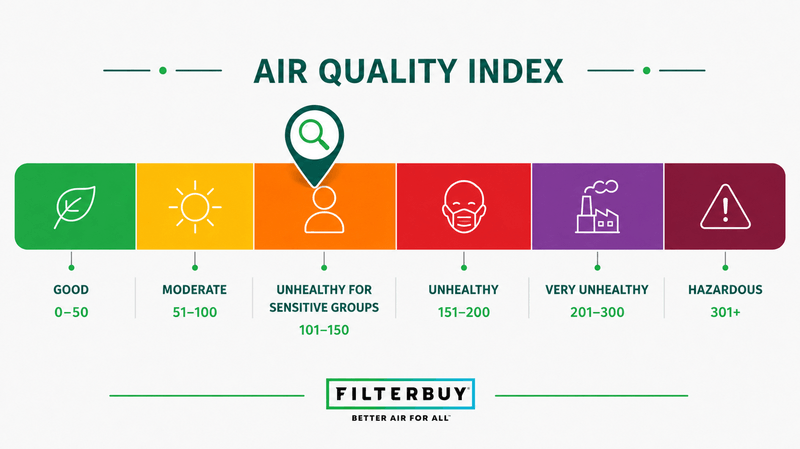
DC Air Quality Index (AQI) Category and Recommended Action
AQI categories and health guidance follow the EPA Air Quality Index scale. Check the live map above for today's DC-area reading.
Who Faces the Greatest Risk During a DC Smoke Event
Wildfire smoke can irritate anyone's eyes, throat, and lungs, but the CDC flags several groups who should act sooner: children, whose lungs are still developing, older adults with underlying heart or lung conditions, pregnant people, and anyone living with asthma, COPD, heart disease, or diabetes. Air pollution is a documented asthma trigger, so households managing asthma should treat today's smoke like a high-pollen day.
Outdoor workers should shorten strenuous tasks once readings turn orange or higher. Many District rowhouses and pre-war apartments run on window or through-wall AC instead of central HVAC, so a whole-home MERV 13 upgrade is not an option for every household. A portable air cleaner, sealed windows, and skipping a window unit's fresh-air vent setting cover the same ground.
How to Protect Your Home's Indoor Air When Smoke Rolls In
Outdoor pollution slips in through gaps around windows and doors and an HVAC system's fresh-air intake, and older DC row homes tend to leak the most. A filter that comes out darker than expected is not bad housekeeping. It is the outside air made visible, part of why the EPA notes indoor air can run two to five times dirtier than outdoor air.
Close windows and doors, and skip the window fan until smoke clears.
Set an HVAC system to recirculate indoor air instead of pulling in outdoor air, if that option exists.
Upgrade to MERV 13, the filtration level the EPA points to for smoke days. It fits the same slot as a standard filter and captures far more fine particulate matter. Filterbuy makes MERV 13 filters in over 600 sizes, shipped factory-direct. Our MERV rating guide compares MERV 8, 11, and 13.
Run a portable air cleaner in one closed-off room, especially a bedroom, if a new filter is still in transit.
Hold off on frying, grilling indoors, or burning candles while the AQI is high.
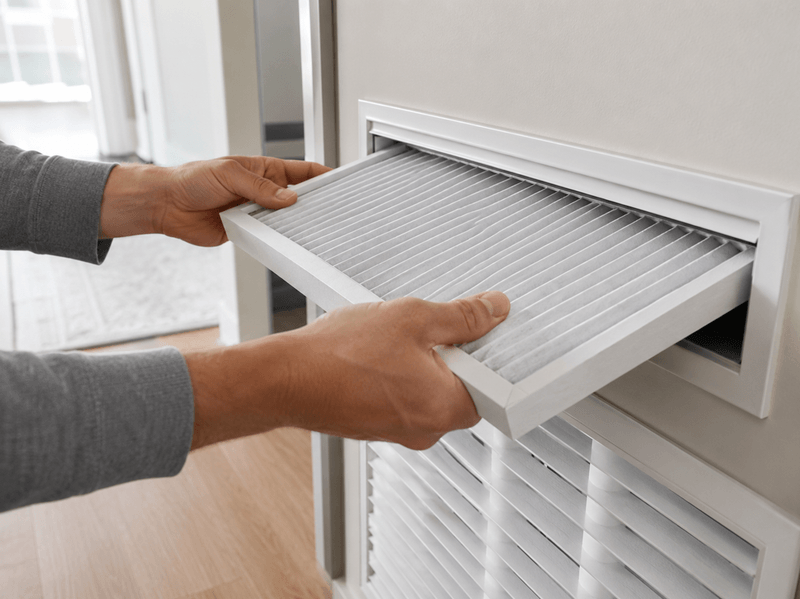
Set a reminder to swap the filter on schedule, since a clogged filter loses efficiency fast. For the full playbook, see our guide to keeping wildfire smoke out of your house.
MERV Filter Rating Comparison for Wildfire Smoke
Capture-rate ranges reflect general filtration performance by MERV class, not a single study. [PLACEHOLDER: Andrew to confirm exact capture-rate figures against current manufacturing specs before publish.]
DC taught us something in June 2023 that we haven't forgotten: a smoke day doesn't wait for anyone to shop. The families who already had a MERV 13 installed when the sky turned orange told us their home felt different within hours. You can't control a wildfire burning five hundred miles away, but you can control what's moving through your own ductwork this afternoon.
David Heacock, Founder and CEO, Filterbuy
Essential Resources
See Every Active Fire and Smoke Plume Near DC in Real Time
Layers live PM2.5 readings, fire locations, and drifting smoke plumes onto one updated view.
Source: AirNow Fire and Smoke Map
Get the District's Official Playbook for Air Quality Alert Days
Spells out which health risks rise with the AQI and the steps to take before conditions worsen.
Source: DC DOEE Healthy Air Actions
Check Whether DC Is Under an Active Air Quality Alert Right Now
Posts the District's current Code Orange, Red, or Purple status the moment an alert is issued.
Source: NWS Baltimore/Washington Air Quality Alert
Plan With the Region's Multi-Day Air Quality Forecast
Forecasts conditions across DC, suburban Maryland, and Northern Virginia days in advance.
Source: MWCOG Air Quality Forecast
Learn the Federal Health Guidance for Reducing Smoke Exposure
Lays out who is most at risk and how to keep smoke outside.
Source: CDC Safety Guidelines: Wildfires and Wildfire Smoke
See How DC's Air Quality Ranks Nationally, Year After Year
Grades the District on ozone and particle pollution.
Source: American Lung Association: District of Columbia State of the Air
Build a Wildfire and Smoke Preparedness Plan for Your Household
Covers what to do before, during, and after a wildfire or smoke event.
3 Supporting Statistics
More than 3,586,000 acres have burned across the United States so far in 2026, with more than 39,000 individual fires recorded.
Source: National Interagency Fire Center
PM2.5 is small enough to penetrate deep into the lungs and, in some cases, enter the bloodstream, which drives most smoke-day health guidance.
Source: EPA, Health and Environmental Effects of Particulate Matter
A 10 µg/m³ increase in wildfire-specific PM2.5 was associated with a 1.3% to 10% increase in respiratory hospitalizations, a larger effect than the 0.67% to 1.3% increase tied to non-wildfire PM2.5.
Source: Aguilera et al., 2021, Nature Communications (PMC7935892)
Final Thoughts
Ozone builds locally, particle pollution drifts in from upwind states, and today wildfire smoke from a thousand miles away settles over the same monuments. Wind carrying that smoke south is out of anyone's control. The filter working inside your own walls is not.
Frequently Asked Questions
Protect the Air Inside Your Home Today
The map shows what's outside. Your filter decides what's inside. Filterbuy ships every order factory-direct from its American manufacturing facilities. Shop MERV 13 air filters sized for your system, check today's DC AQI reading, or set up auto-delivery so you are never caught without a clean filter on a bad air day.
Glossary
AQI: A 0-500 EPA scale for air pollution, color-coded from green (good) to maroon (hazardous).
PM2.5: Fine particulate matter 2.5 microns or smaller, the main pollutant in wildfire smoke.
MERV: A 1-16 scale rating of how well an HVAC filter captures airborne particles.
About the Author
Michelle Wan is Filterbuy's Brand Manager and Air Quality Writer, covering AQI trends, wildfire smoke, and indoor air quality across Filterbuy's city and regional resource pages. This page was technically reviewed by David Clark, a Licensed HVAC Technician.
Subscribe to wildfire smoke alerts for Washington, DC, to get a heads-up before the next event reaches your area.