Washington, DC Air Quality Today: Live AQI Map, Forecast, and What It Means Indoors
TL;DR
Washington's air quality index shifts hour to hour and block to block, so the live map above is the only reliable read for right now. Anything below 51 is good for everyone. Once the number passes 100, sensitive groups should ease up outdoors, and past 150 that applies to everyone. Ozone causes most of the District's bad-air days between May and September, while wildfire smoke drives the sharpest PM2.5 spikes from June through October. Whatever the outdoor number says, the filter in your HVAC return governs what you breathe at home.
Key Takeaways
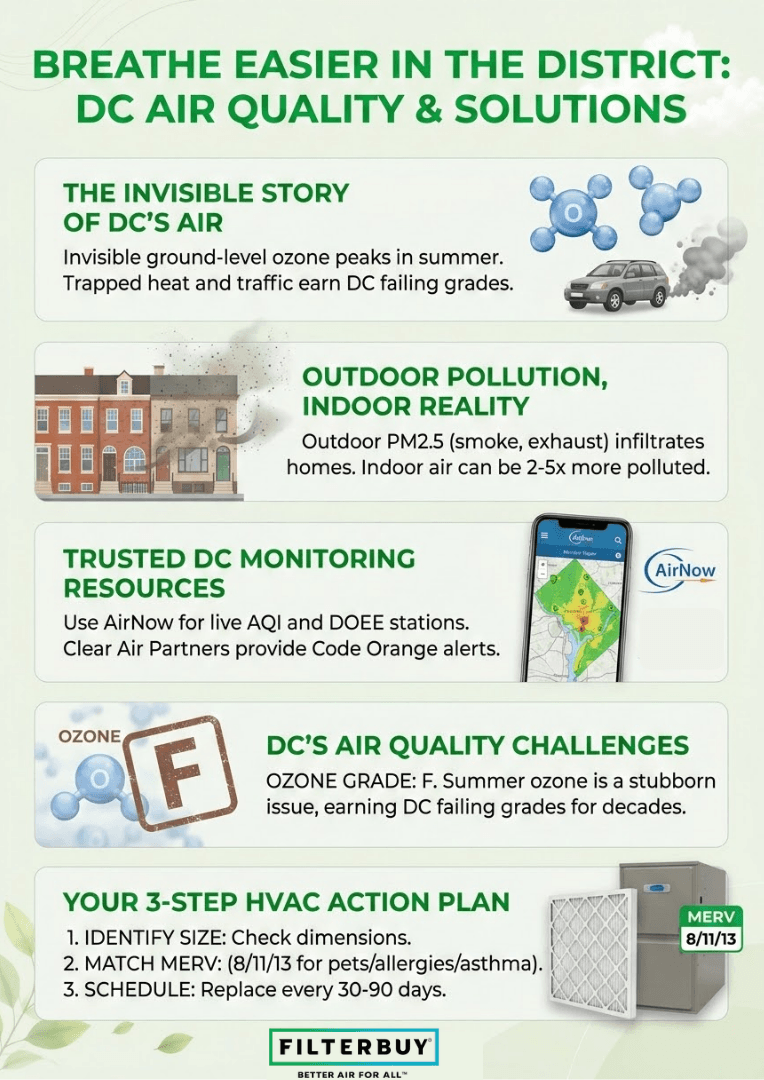
The American Lung Association's 2026 State of the Air gave the District an F for ozone and a D for short-term particles.
The area carries an ozone nonattainment designation, yet EPA determined in April 2025 that it had attained the 2015 ozone standard on 2021-2023 data.
Lawrence Berkeley National Laboratory reports that indoor particle levels during wildfires rise 49% to 76% as much as outdoor levels, and only 33% to 44% with central air and closed windows.
Above an AQI of 100, pair a MERV 13 filter in the HVAC with a portable HEPA cleaner in each occupied room, bedrooms first. EPA recommends MERV 13 or higher during smoke events.
How to Read Washington, DC's Live Air Quality Map
The live map above pulls from EPA AirNow and the District's six-station monitoring network. What it shows is not an average of everything in the air. It reports whichever criteria pollutant happens to be worst at the station nearest you, which usually means ozone on a hot afternoon and fine particulate during smoke season.
Two caveats come with that. The reading describes a monitoring station rather than your street, and the scale is national, so a 90 in Washington means what a 90 means in Denver. See how the District compares on the national AQI map.
What Each AQI Level Means in Washington, DC
The Air Quality Index runs from 0 to 500 across six color-coded categories. The table below translates each band for a household in the District, and our guide to what an AQI of 100 actually means goes deeper on the threshold that matters most.
Why DC's AQI Reading Can Lag What You're Actually Breathing
When the sky looks hazy and the map still says Moderate, the map is working as designed. The PM2.5 figure uses NowCast, a weighted average of the past several hours, which keeps the reading steady but also means it climbs behind fast-moving smoke.
Coverage explains the rest of the gap. Six stations cannot describe every block, and the two pollutants behave differently once they reach you. Ozone is invisible, peaks in mid-afternoon, and breaks down indoors. Fine particulate follows you inside.
What's Actually in Washington's Air: Ozone, PM2.5, and Pollen
Three pollutants shape the District's air, each with its own season.
Ground-level ozone forms when heat and sunlight react with vehicle and industrial emissions. Washington sits in a shallow basin where heat and humidity stall on still mornings, and the precursors that feed ozone arrive on the wind from Virginia, Maryland, and the Ohio Valley. No HVAC filter removes ozone, so the fix there belongs to regional policy and the federal standards behind it.
Fine particulate matter (PM2.5) comes from traffic, construction, wood burning, and wildfire smoke. It produces the District's worst readings, and it is the pollutant your filter can actually capture. DC earned a D for short-term particles in the 2026 report.
Tree pollen peaks between late March and May. It never shows up in the AQI, but it lands in your filter all the same.
Where to Check the Washington, DC Air Quality Forecast
The live map covers right now. For tomorrow, start with the MWCOG air quality forecast, which spans the District, suburban Maryland, and Northern Virginia and is what local stations quote when they announce a Code Orange day. EPA AirNow adds a multi-day outlook alongside its Fire and Smoke Map, and Clean Air Partners will send free alerts so you never have to remember to look.
All of it traces back to DOEE, which feeds the District's readings into EPA's AirNow database. If you commute across the line, Maryland's live AQI map and the Virginia DEQ forecast cover the rest of the region.
What a Code Orange or Code Red Air Quality Alert Means in DC
Air quality alerts here are issued by color. Code Orange means a forecast AQI between 101 and 150, the band where sensitive groups should scale back outdoor exertion. Code Red means 151 to 200, and at that point it applies to everyone. In the District, the alert comes from MWCOG and DOEE and reaches you through the National Weather Service.
What it changes at home is short. Move hard exercise to early morning, keep the windows shut, and switch your HVAC fan from AUTO to ON, because on AUTO the fan only runs while the system is heating or cooling.
Air Quality by DC Neighborhood: Why Your Block May Not Match the Citywide Number
Six stations cannot map every street, so DOEE went looking with cars. In 2023 it partnered with Aclima to drive instrumented vehicles through priority neighborhoods, measuring pollution segment by segment. Nitrogen dioxide came back low, and so did ozone.
Fine particulate was the pollutant that exceeded federal standards, running at roughly twice the national limit in parts of Buzzard Point. One stretch showed high PM2.5 alongside low soot, which points away from traffic as the source, while hotspots in Ivy City/Brentwood and Mayfair traced back to diesel.
DOEE expanded the program in August 2024 to eleven neighborhoods, most chosen for a documented history of disproportionate exposure. If you live near the Anacostia Freeway, an industrial corridor, or heavy construction, assume your air runs a category worse than the citywide number.
Is Washington, DC Still in Ozone Nonattainment?
Yes and no, and the difference matters. EPA designated the Washington, DC-MD-VA area Marginal nonattainment for the 2015 ozone standard in 2018, then moved it to Moderate in 2022 after it missed the deadline. Then the monitors improved.
In April 2025, EPA determined the Washington area had attained the 2015 ozone standard by its August 2024 attainment date, using certified 2021-2023 monitoring data (Federal Register, 90 FR 14730). The designation stays in place until the District, Maryland, and Virginia request redesignation, and the five Maryland counties in the same area sit in the same position.
Monitoring has improved faster than the paperwork. The exceedance that blocked the earlier determination came from Canadian wildfire smoke, which ties the District's ozone record directly to its smoke problem.
When Canadian Wildfire Smoke Reaches Washington, DC
Smoke from Canadian boreal wildfires travels thousands of miles on prevailing winds and can settle over the Mid-Atlantic for days. In June 2023 it pushed District readings into hazardous territory and turned the sky over K Street orange at midday.
Our live wildfire and smoke map for Washington, DC tracks plumes heading this way, which usually leaves enough time to put a fresh filter in first.
Supporting Statistics Behind Washington, DC's Air Quality
Three numbers explain how the District's air behaves and where filtration fits.
1. DC's ozone sits exactly at the federal limit
The McMillan Reservoir monitor recorded a 2021-2023 ozone design value of 0.070 ppm, and the federal standard is 0.070 ppm. The area only cleared it after EPA excluded a June 29, 2023 reading caused by wildfire smoke, so no cushion is left in that number. Source: EPA, 90 FR 14730.
2. Failing ozone grades are spreading nationally
In the 2026 State of the Air report, 219 counties across 36 states plus Washington, DC earned an F for ozone, the highest count since 2016. More than 129 million people now live in a failing county, which places the District's grade inside a national reversal. Source: American Lung Association.
3. Most of the air you breathe is indoor air
EPA reports that Americans spend roughly 90 percent of their time indoors, where some pollutants run 2 to 5 times higher than outdoors. The outdoor reading sets the ceiling, but your fan setting and your filter decide how much of it reaches you. Source: EPA, Report on the Environment.
What Today's AQI Means for the Air Inside Your DC Home
Outdoor air does not stop at the front door. During wildfires, indoor particle levels rise 49% to 76% as much as outdoor levels in a typical home, though the range narrows to 33% to 44% in houses with central air and closed windows and widens to 64% to 80% without central air and 83% to 95% with the windows open (Lawrence Berkeley National Laboratory). That spread is the whole argument for a good filter and a closed window, and older DC rowhouses sit at the leakier end of it.
Once the reading passes 100, the two tools work together rather than as alternatives. A MERV 13 in the return handles the whole house, and a portable HEPA cleaner in each occupied room, bedrooms first, covers the spaces where you spend the most time.
If your home has no ducted system, whether steam radiators, window units, or a mini-split, an HVAC filter will not help, and we would rather say so than sell you something that does not fit. Run the HEPA units on their own, and EPA's guidance covers setting up a clean room.
Frequently Asked Questions About Washington, DC Air Quality
Is the air quality bad in DC today?
Check the live map at the top of this page. Once the reading passes 100, sensitive groups should ease up outdoors: children, adults over 65, pregnant residents, and anyone with asthma, COPD, or heart disease.
What is the air quality forecast for Washington, DC tomorrow?
The Metropolitan Washington Council of Governments issues the regional forecast covering DC, suburban Maryland, and Northern Virginia, and EPA AirNow adds a multi-day outlook on top of it.
What is DC's PM2.5 level right now?
Check the live map above for the current reading. PM2.5 runs highest during winter inversions, when cold air traps particles near the ground, and during summer smoke episodes, when it can climb several categories inside a day.
Is there an air quality alert in DC today?
Alerts run on tomorrow's forecast rather than the live reading, so the map alone will not tell you. Check Clean Air Partners or the National Weather Service instead. Code Orange means a forecast AQI of 101 to 150, and Code Red means 151 to 200.
Why does Washington, DC keep getting an F for ozone?
Two reasons, and they compound. The District sits in a shallow basin where heat and humidity stall on still summer mornings, and the precursors that form ozone blow in from Virginia, Maryland, and the Ohio Valley. Local policy cannot fix pollution that arrives on the wind.
What is the best air filter for a Washington, DC home?
MERV 13 is the right call for households with asthma, allergies, young children, anyone over 65, or exposure to smoke season, and above an AQI of 100 it should run alongside a portable HEPA cleaner in each occupied room. MERV 11 makes a reasonable everyday step up. Either way, confirm your system can handle the added static pressure.
Find the Right Filter Before the Next Code Orange Day
The MERV 13 you order this week costs the same as the one you will wish you had in August. Filterbuy has built air filters in the United States since 2013, in more than 600 sizes plus custom dimensions for older DC rowhouses. If you are not sure what your system can take, compare MERV ratings first.