
Missouri Live Wildfire Smoke Map
Get Alerts For Wildfires In Your Area
The moment a wildfire starts near you, you'll get an instant alert and simple tips to reduce your smoke exposure.
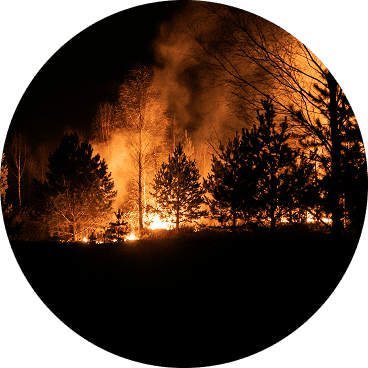
What's In The Smoke
30xSmaller than a human hair
Fine enough to reach deep into the lungs. A MERV 13 is built to capture it.
How Far It Travels


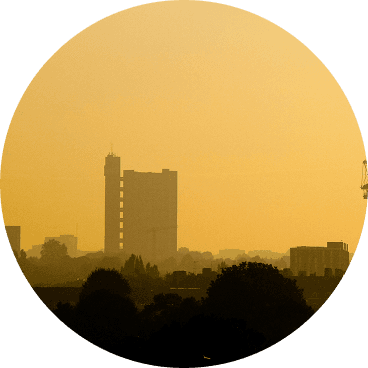
It Doesn't Stay Local
Smoke rides the wind far downwind — you can get smoky air with no fire nearby.
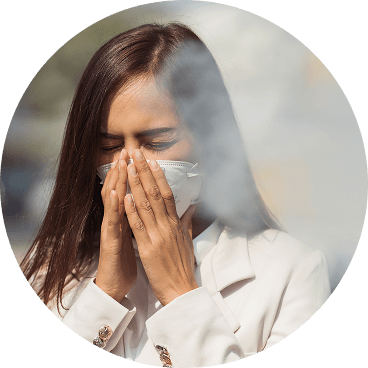
What To Do During A Smoke Event
Simple steps to reduce indoor exposure.
- Stay In, Close UpShut windows and doors to keep smoke out.
- Set Fan To "On"Keeps air cycling through your filter, not just when heating or cooling.
- Recirculate AirSwitch off fresh-air intake so you're not pulling smoke in.
- Run A MERV 13Built to capture the fine PM2.5 in smoke.
- Add A PurifierExtra filtration for the room you use most.
- Wear an N95 if OutsideFits snug to block fine particles — a cloth mask won't.


The Best Air Filter For Wildfire Smoke
During smoke events, the EPA recommends upgrading to a MERV 13 filter — or the highest-rated filter your system can handle — to help reduce the fine particles smoke brings indoors. MERV 13 is the level most home HVAC systems can run while still capturing PM2.5, the fine particulate that makes up the bulk of wildfire smoke.
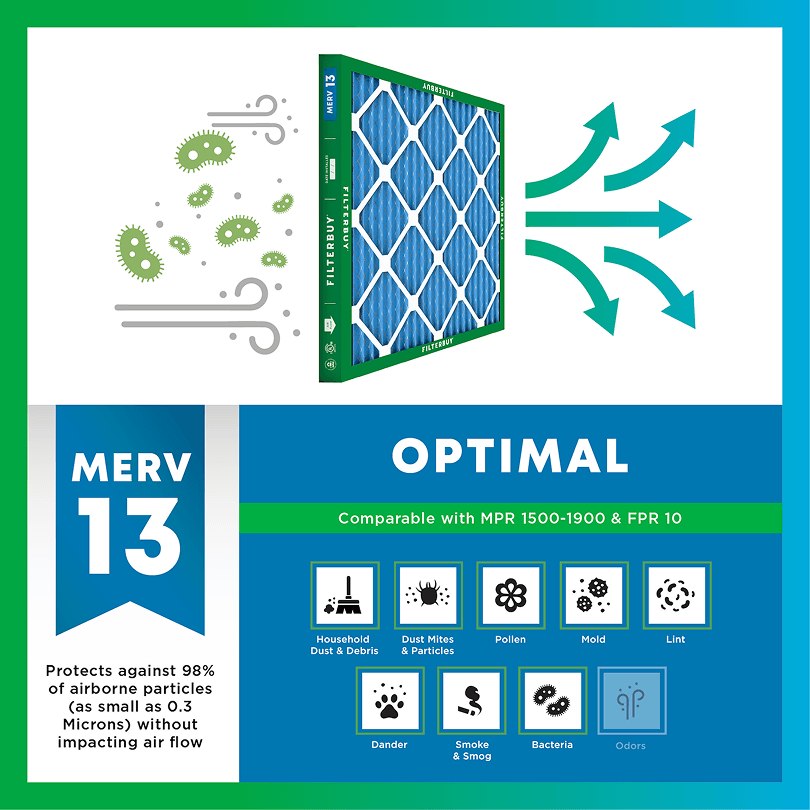
- Captures PM2.5 particles
- Blocks ash, soot, and smoke odor
- Keeps your indoor air safe—even when the outdoor air is dangerous
- Meets the EPA's recommended rating for filtering fine wildfire smoke particles.

Wildfire Smoke FAQs
Facts About Wildfires
Over 70,000 wildfires burn in the U.S. every year.
Wildfire smoke can travel 1,000+ miles, affecting states that aren't even near the blaze.
Exposure to wildfire smoke can worsen asthma, trigger heart issues, and lead to ER visits.
Indoor air can hold more fine particles during wildfire events unless it's properly filtered.
The EPA advises using MERV 13 filters or portable HEPA air cleaners during wildfire smoke events.
Don't Wait Until The Smoke's Inside.
Use the live wildfire smoke tracker and upgrade your air filters today to protect your lungs and your home.
Shop Filters For Smoke Protection
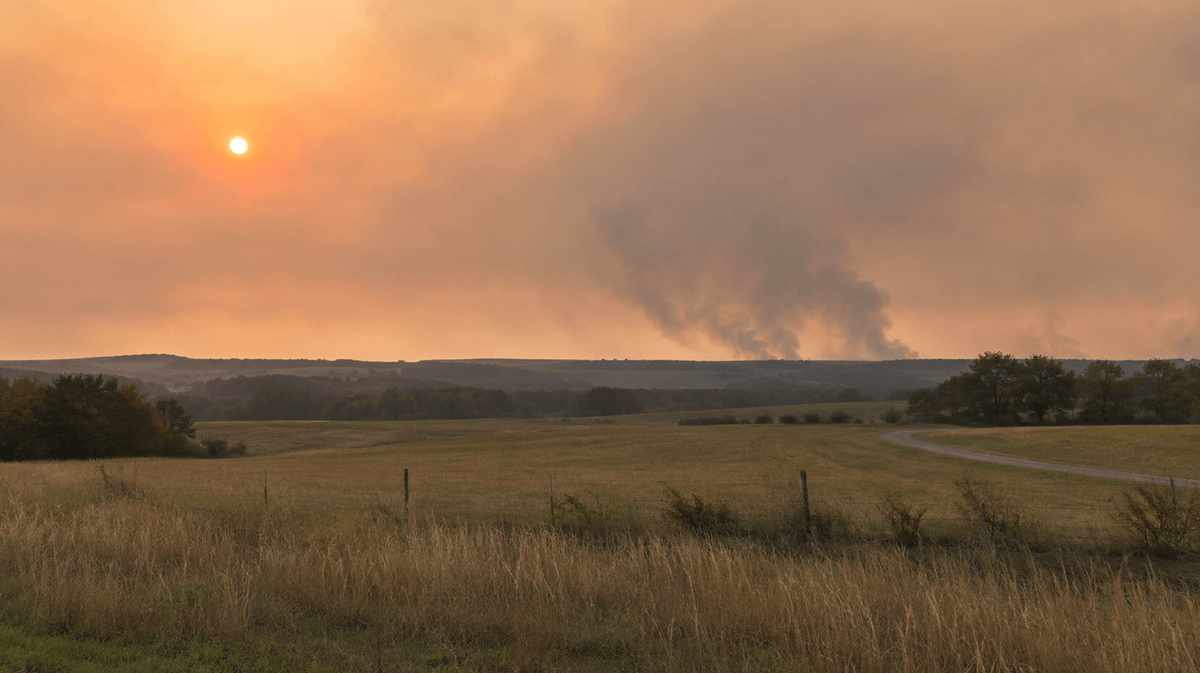
Current Live Wildfire And Smoke Map Missouri Today From Filterbuy.com
By Michelle Wan, Brand Manager at Filterbuy | Reviewed by David Clark, Licensed HVAC Technician
Published July 6, 2026. Updated July 6, 2026.
Missouri Wildfire And Smoke Conditions, Updated Today
Missouri fire crews responded to more than 224 wildfires across roughly 15,500 acres in a single week last March, and most of them started from escaped debris burns rather than lightning. That pattern shapes how smoke moves through the state. On an early-July day like today, local fire activity across Missouri usually runs low as summer green-up raises fuel moisture, yet smoke from distant fires in the western United States or Canada can still drift into St. Louis, Kansas City, Springfield, and rural counties and push particle pollution higher. This page gives Missouri residents a real-time way to see active fires, smoke plumes, and local air quality, plus clear steps to protect indoor air when smoke arrives. Because we build our filters in the United States and ship them to Missouri homes through every smoke season, the guidance here reflects what we have watched wildfire smoke do inside real homes, not just what the maps show outside.
TL;DR Quick Answers
Missouri wildfire and smoke conditions change hour by hour, so the fastest way to check them today is the live AirNow Fire and Smoke Map, which shows active fires, smoke plumes, and current Air Quality Index readings for your ZIP code. Local fire risk in Missouri climbs in late winter through spring and again in fall, though out-of-state smoke can raise particle pollution any time of year. When the map shows orange or higher, stay indoors, keep windows closed, and run a well-fitted HVAC or portable filter to capture fine particles.
Top Takeaways
The AirNow Fire and Smoke Map is the official EPA and U.S. Forest Service tool for checking live Missouri wildfire smoke and Air Quality Index readings by location.
Missouri has two main fire seasons, one running from late February through mid-April and another from late August through early October, when dry vegetation and wind drive fast-moving grass and brush fires.
Improper debris burning is the leading cause of Missouri wildfires, according to the Missouri Department of Conservation.
Wildfire smoke carries fine particulate matter (PM2.5) that reaches deep into the lungs and can worsen asthma, heart, and breathing problems.
A MERV 13 filter captures a high share of fine smoke particles, though MERV 13 is not the same as HEPA.
When the AQI reaches orange or higher, closing windows and running a clean filter reduces the smoke particles you breathe indoors.
How To Read The Live Missouri Wildfire And Smoke Map Today
To check Missouri wildfire and smoke conditions right now, open the live AirNow Fire and Smoke Map and enter your city or ZIP code. The map combines current Air Quality Index readings from official monitors and low-cost sensors, red fire icons for active incidents, and gray shading for smoke plumes drifting overhead. Tap any monitor to see the exact PM2.5 level and a short action recommendation for your location.
The Air Quality Index reading is the number to watch. AirNow reports it using the standard U.S. color scale, so a green dot means healthy air and an orange, red, or purple dot means smoke has pushed fine particles into a range that affects health. The EPA and the U.S. Forest Service update the map continuously during smoke events, which is why checking it again a few hours later often shows a different picture.
For incident-level detail, InciWeb publishes maps and updates for individual wildfires across the country, and the National Weather Service posts a Red Flag Warning whenever dry, windy conditions make new Missouri fires likely to start and spread. Reading all three together gives you a clear view of where fire is burning, where smoke is heading, and how bad the air is at your address. For a step-by-step walkthrough of the tool, see our guide on how to read a wildfire smoke map.
From shipping filters during past smoke events, we have learned that the map only answers what the air is doing outdoors. Fine particles keep circulating inside for hours after the outdoor reading improves, so the filter running in your system matters as much as the number on the screen.
One Missouri-specific catch is worth knowing. Most of Missouri's counties have no permanent air quality monitor of their own, so the official monitor nearest you on the map can sit many miles away. When that happens, read the low-cost sensor readings and the gray smoke-plume shading together instead of trusting one distant monitor, and treat a visible haze or a smoky smell as its own signal to close up the house and switch your system to recirculated air.
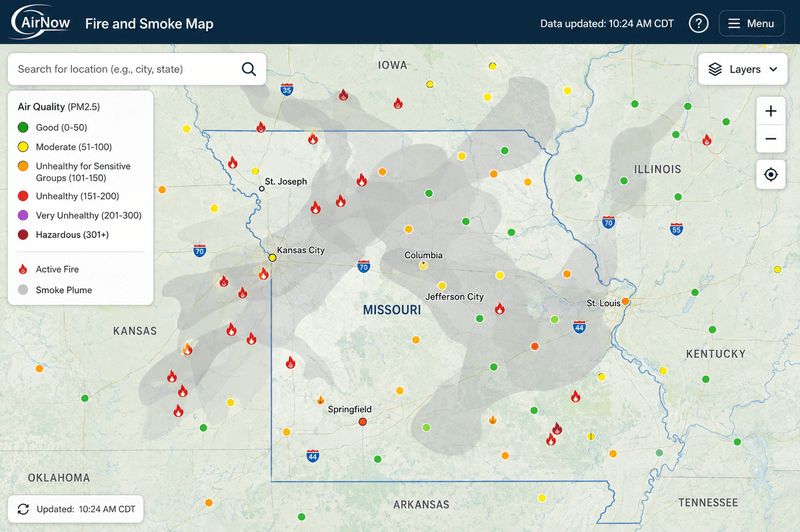
What Missouri Air Quality Index Colors Mean On Smoke Days
The Air Quality Index runs from 0 to 500 and sorts into six color-coded categories. On the live map, the color of the dot nearest you tells you how much smoke is in the air and what to do about it. The table below shows each category and the action Missouri residents should take.
Source: U.S. Air Quality Index, EPA AirNow. Check the live map for your current reading.
Why Missouri Sees Wildfire Smoke
Missouri sees wildfire smoke from two directions. Local grass and brush fires flare during the state's dry, windy seasons, and smoke from large fires hundreds of miles away drifts in on upper-level winds. The Missouri Department of Conservation reports that improper debris burning, such as trash and brush piles that escape control, is the leading cause of wildfires in the state.
Timing matters. Missouri runs two fire seasons, one from late February through mid-April and one from late August into early October, when dormant grasses, low humidity, and wind let fires move fast. In mid-March 2025, dry conditions and gusts near 60 miles per hour drove more than 224 wildfires across roughly 15,500 acres statewide in a single week, damaging homes and stretching suppression crews thin.
People start most of these fires. On the Mark Twain National Forest, humans caused about 54 percent of wildfires over the past decade, with lightning responsible for the rest. Statewide, natural ignitions are rarer still. That human cause is also good news, because careful burning and following local burn bans prevent many smoke days before they begin.
Even when Missouri stays green and wet, western and Canadian wildfire smoke can travel across the country and settle over the state under calm, stable air. Those out-of-state events are the ones that surprise residents, since the sky can turn hazy and the AQI can climb while no fire burns anywhere nearby. We break down that cross-border pattern in our guide to how Canadian wildfire smoke reaches the U.S.
How Air Filters Reduce Wildfire Smoke Inside Your Missouri Home
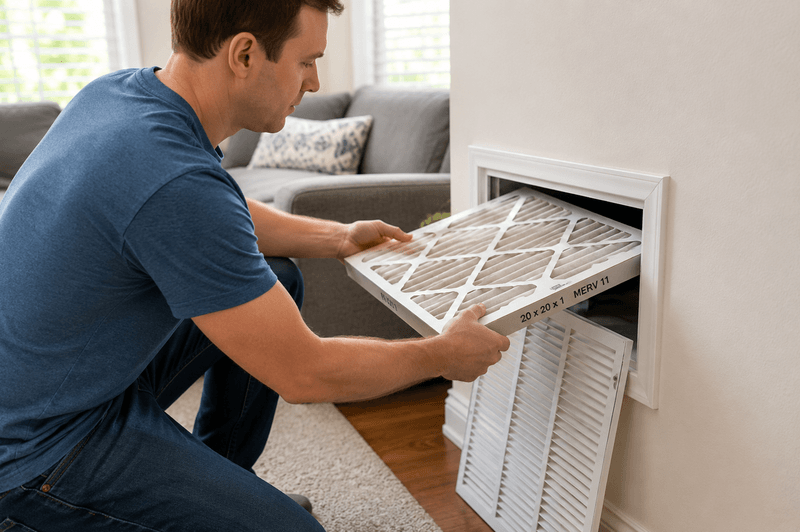
A quality air filter reduces wildfire smoke indoors by capturing the fine particles that pass through ordinary defenses. Wildfire smoke is mostly PM2.5, particles 2.5 micrometers wide or smaller, which slip past window seals and settle in your lungs. When you run your HVAC system with a fresh, correctly sized filter, or add a portable air cleaner in one closed room, the filter captures a large share of those particles and lowers the amount you breathe.
Both the CDC and Ready.gov recommend the same core steps on a smoke day. Close windows and doors, run an HVAC system with a filter or a portable air cleaner, and set up one room you can keep cleaner than the rest of the house. During heavy smoke, change your filter more often than usual, since a loaded filter captures less. MERV 13 air filters capture a high share of fine smoke particles and are a strong choice for smoke season, though it is worth knowing that MERV 13 is not the same as HEPA.
Filtration works best as everyday maintenance rather than a last-minute reaction. A clean filter already running when smoke arrives keeps indoor particle levels lower than one swapped in after the haze sets in. Because we build and ship these filters ourselves, we also see what heavy smoke does to them. A filter built to last about 90 days can load up within a few weeks once smoke moves in, so we tell Missouri customers to check theirs far more often during an event. Filterbuy has manufactured air filters in the United States since 2013 and offers MERV 8, MERV 11, and MERV 13 in exact and custom sizes, so most Missouri homes can match a fit that captures and reduces the particles wildfire smoke brings inside.
When To Get Your Missouri Home Ready For Smoke Season
Missouri's smoke risk follows a rhythm, so timing your prep beats reacting to it. Using the state's two fire seasons and the summer arrival of out-of-state smoke, here is a prep calendar you can set a reminder around.
Local fire risk peaks in spring and fall, but out-of-state smoke can raise particle pollution any time.
If your home has no central HVAC, you are not stuck. A portable air cleaner sized for one room, or a do-it-yourself box-fan filter built from MERV 13 filters, can protect renters and older Missouri homes when a ducted system is not an option.
After manufacturing filters for over a decade and serving more than two million households, we have seen how fast indoor air changes once smoke moves into a region. The homes that stay comfortable are the ones that treat filtration as everyday maintenance, not an emergency purchase. A clean, correctly sized filter running before smoke arrives does far more than one swapped in at the last minute.
David Heacock, Founder and CEO, Filterbuy
7 Essential Resources
These government resources let Missouri residents verify current fire and smoke conditions, understand alerts, and prepare their homes.
Live air quality, active fires, and smoke plumes nationwide, from the EPA and U.S. Forest Service.
Source: AirNow Fire and Smoke Map wildfire hub
How Missouri wildfires start and how to burn debris safely.
Source: Missouri Department of Conservation wildfire prevention guidance
Daily national wildfire situation and large-fire summaries.
Source: National Interagency Fire Center National Fire News
What a Red Flag Warning and a Fire Weather Watch mean for your area.
Source: National Weather Service fire weather alert definitions
How to find and read air quality smoke reports during a fire.
Source: EPA guide to air quality smoke reports
Health steps to take before, during, and after wildfire smoke.
Source: CDC wildfire and wildfire smoke safety guidelines
Home preparation and evacuation planning for wildfires.
Source: Ready.gov wildfire preparedness guidance
3 Supporting Statistics
Federal agencies and a leading national health group back the guidance on this page.
Wildfire PM2.5 is harder on the lungs than ordinary pollution. Every 10 micrograms per cubic meter of wildfire PM2.5 raised respiratory hospitalizations 1.3 to 10 percent, versus 0.67 to 1.3 percent for other PM2.5 (2021, Nature Communications).
Source: Aguilera et al., 2021, National Library of Medicine (PMC7935892)
497,182 Missouri children breathe unhealthy air. The American Lung Association names wildfires among the fine-particle sources behind those grades.
Source: American Lung Association State of the Air 2026, Missouri
People cause about 54 percent of Mark Twain National Forest wildfires. Lightning causes the other 46 percent, so most local smoke starts with a preventable ignition.
Source: U.S. Forest Service, Mark Twain National Forest fire program
Final Thoughts And Opinion
In the years I have spent writing about indoor air quality for Filterbuy and working with our U.S. manufacturing team, one pattern stands out. Missouri households do best when they treat wildfire smoke as a year-round possibility, not a summer-only or a western-state problem. The state's own fire seasons fall outside summer, and the smoke that most often catches Missourians off guard rolls in from fires far away. A live map answers what the air is doing right now, but the homes that ride out a smoke day comfortably are the ones that already had a clean, well-fitted filter working before the haze appeared. Preparing early costs little and pays off on the exact days it is hardest to shop. If you are weighing options, our guide to choosing the right MERV rating for your home walks through the trade-offs.
Next Steps
Check the live map above for your ZIP code and note today's AQI color.
If the reading is orange or higher, close windows, run your HVAC or a portable cleaner, and stay in one cleaner room.
Confirm your filter size and replace it if it looks loaded or gray.
Follow the full home playbook in our guide on steps to keep wildfire smoke out of your house.
Frequently Asked Questions
Protect Your Home Before The Next Missouri Smoke Day
See the current Air Quality Index for your Missouri ZIP code on the live map above, then get your home ready. Filterbuy manufactures MERV-rated filters in more than 600 sizes in the United States and ships them factory-direct, so you can capture and reduce the fine particles wildfire smoke brings indoors. Find your filter size and stock up before the next smoke day.
Glossary
AQI (Air Quality Index): A color-coded scale from 0 to 500 that the EPA uses to report how clean or polluted the air is and what health effects to expect.
PM2.5: Fine particulate matter 2.5 micrometers wide or smaller, the main harmful pollutant in wildfire smoke, small enough to reach deep into the lungs.
AirNow Fire and Smoke Map: An interactive EPA and U.S. Forest Service map that shows live air quality readings, active fires, and smoke plumes across the United States.
MERV: Minimum Efficiency Reporting Value, a 1 to 16 scale that rates how effectively an air filter captures airborne particles.
MERV 13: A filter rating that captures a high share of fine particles, including much wildfire smoke, and is not the same as HEPA.
HEPA: High-Efficiency Particulate Air, a filter standard that captures at least 99.97 percent of particles 0.3 micrometers in size.
Red Flag Warning: A National Weather Service alert issued when dry, windy conditions make wildfires likely to start and spread quickly.
InciWeb: A federal system that publishes maps and updates for individual wildfire incidents across the country.
Prescribed Burn: A planned, controlled fire that land managers set to reduce fuel buildup and improve wildlife habitat.
Defensible Space: The maintained area around a home, cleared of flammable material, that slows a wildfire's approach.
Subscribe to wildfire smoke alerts for Missouri to get a heads-up before the next event reaches your area.