
Air Quality in Hawaii
Air quality index (AQI⁺) and PM2.5 air pollution in Hawaii •


Get Alerts For Unhealthy AQI In Your Area
When air quality in your area reaches unhealthy levels, we'll send you a quick alert, along with expert tips on how to reduce your exposure.
Live Air Quality Ratings in Hawaii
Live Most Polluted City Ranking
Real-time most polluted cities in Hawaii
Live Cleanest City Ranking
Real-time cleanest cities in Hawaii
The Right Air Filter For High AQI Days
When outdoor air quality drops, the EPA recommends upgrading to a MERV 13 filter — or the highest-rated filter your HVAC system can handle — to help capture more of the fine particulate (PM2.5) that comes with poor air quality. MERV 13 is the highest rating most residential systems can run without restricting airflow.
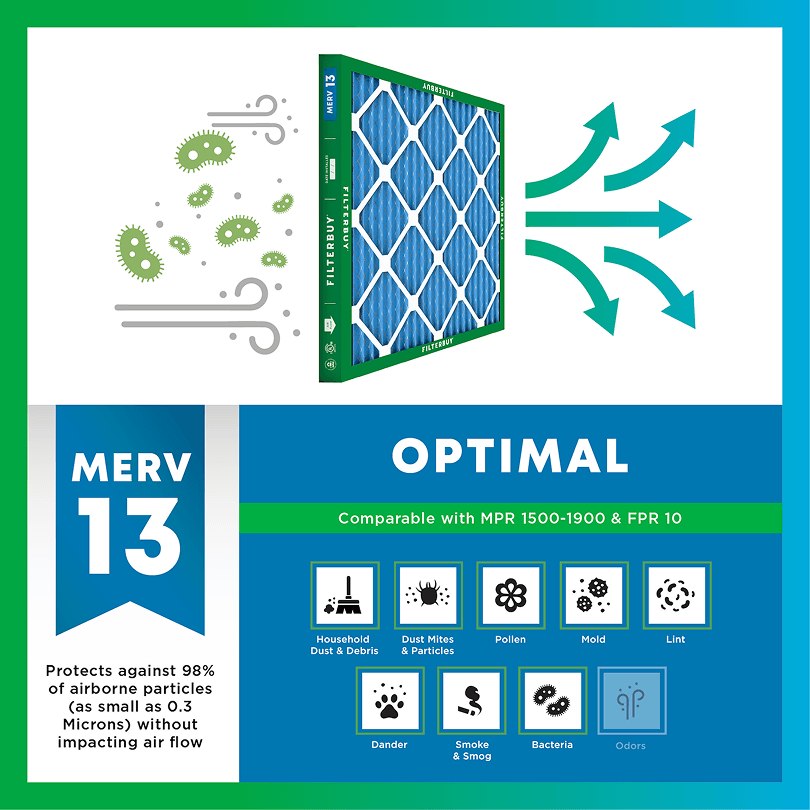

- Captures PM2.5 and other fine particulates
- Filters ash, soot, and smoke particles
- Rated to capture particles as small as 0.3 microns
- Matches the filter rating the EPA suggests during high-AQI and smoke events

AQI FAQs
What is AQI?
AQI stands for Air Quality Index, the EPA's scale for reporting daily air quality. It runs from 0 to 500. The higher the number, the greater the level of air pollution. Values at or below 100 are generally considered satisfactory; values above 100 mean air quality is unhealthy, first for sensitive groups, then for everyone as numbers climb.
What does AQI measure?
The AQI tracks five major pollutants regulated by the Clean Air Act: ground-level ozone, particle pollution (PM2.5 and PM10), carbon monoxide, sulfur dioxide, and nitrogen dioxide. The reported AQI value reflects whichever pollutant is highest at that time — most often ozone or fine particles (PM2.5).
How is AQI calculated?
Monitoring stations measure pollutant concentrations, and the EPA converts each into a standardized 0–500 score using set breakpoints. Each pollutant gets its own sub-index, and the highest sub-index becomes the reported AQI. That's why a single number can represent different pollutants on different days.
What is a good AQI?
An AQI of 0–50 is rated "Good" — air quality poses little or no risk. 51–100 is "Moderate," acceptable for most people though unusually sensitive individuals may want to limit prolonged outdoor exertion. Anything at or below 100 is generally considered satisfactory air quality.
What does an AQI of 100 (or 150) mean?
100 is the dividing line: at or below it, air quality is satisfactory for the general public. From 101–150, air is "Unhealthy for Sensitive Groups" — people with respiratory conditions, older adults, and children. From 151–200, it's "Unhealthy" and everyone may begin to feel effects.
Why is the AQI bad today?
Short-term AQI spikes usually come from wildfire smoke, temperature inversions that trap pollutants near the ground, high-ozone weather (hot, sunny, stagnant days), or heavy traffic and industrial activity. Check a real-time source like the map on this page to see which pollutant is driving today's reading in your area.
What AQI is bad for running or exercise?
Many runners follow the EPA category lines: below 50, no adjustment needed; 51–100, unusually sensitive people may shorten intense workouts; above 100, sensitive groups are advised to reduce prolonged or heavy outdoor exertion; above 150, that advice extends to everyone. Exercise increases how much air you breathe in, which is why thresholds matter more during workouts.
What AQI is safe to open windows?
A common rule of thumb is to keep windows open when the AQI is under 100 and close them when it climbs above, especially during wildfire smoke events when fine particles are elevated. When windows are closed, running your HVAC system with a fresh filter helps capture particles circulating indoors.
Should I wear a mask based on AQI?
Public health agencies generally suggest considering a well-fitted N95-style respirator outdoors when the AQI exceeds 150, particularly during smoke events. Cloth and surgical masks don't filter fine particles effectively. Follow guidance from your local health department, which may adjust recommendations during severe episodes.

Check Today's Live Real Time Air Quality Index AQI Map in Hawaii Now
By Michelle Wan, Brand Manager & Air Quality Writer · Reviewed by David Clark, Licensed HVAC Technician · Published: July 6, 2026 · Updated: July 6, 2026
What Hawaii's Live AQI Reading Means For The Air In Your Home
Hawaii's air is usually clean, but it swings by island and wind because of vog, the volcanic haze from Kilauea. Check the live map above for your own town. The one thing worth knowing before you act is that vog is two pollutants at once, and a standard filter catches only one of them.
The fine PM2.5 particles in vog are captured well by a high-MERV filter like MERV 13. The sulfur dioxide gas passes straight through, and removing it takes activated carbon media. We build both, so you can match the filter to what's actually in the air where you live.
Which Filter Catches The Particle Half Of Vog?
MERV 8 captures everyday dust, lint, and pollen.
MERV 11 adds finer dust, pet dander, and some smoke particles.
MERV 13 captures fine PM2.5 particles, the same particle half you find in vog and wildfire smoke.
For the sulfur dioxide gas, add activated carbon media, which adsorbs gases a particle filter cannot touch. That pairing is how families in Kona and Ka'u cover both halves of vog on a hazy day.
Vog's Two Pollutants, Side By Side

Not Sure Which MERV Rating Fits Your System?
Answer a few quick questions and we'll match you to the right filter for your home and your air.
Ready before the next hazy day? Find your size at Filterbuy and match the MERV rating to what's in your air.
On the same afternoon, someone in Kailua can breathe some of the cleanest ocean air in the country while someone in Kona squints through a pale haze that catches in the throat. That haze has a local name, and it drives almost everything about air quality in the islands. People here call it vog.
Live AQI readings update through the day. Tap your island or town to see conditions where you are, since Hawaii's air can differ from one coast to the next.
Quick Answers About Hawaii's Air Quality
TL;DR: Hawaii usually has good air, but it swings by island and wind more than almost anywhere in the country. The main driver is vog, a mix of sulfur dioxide gas and PM2.5 fine particles from Kilauea. Windward areas often stay clean while Kona and Ka'u turn hazy on the same day. Check the live map above for your exact location, and run a good filter indoors when readings climb.
Is The Air Quality Bad In Hawaii Today?
It depends on where you are and how the wind blows. Use the live map above. Green, 0 to 50, means healthy air, and higher numbers mean sensitive groups, then everyone, should cut back on time outdoors.
Why Does Hawaii Get Hazy When It Has So Much Ocean Air?
Kilauea releases sulfur dioxide that reacts in the air to form vog. Trade winds usually push it toward the leeward Kona side, so one coast can be clear while another is socked in. For the basics behind the numbers, see how the Air Quality Index works.
Top Takeaways
Hawaii's main air quality issue is vog from Kilauea, not wildfire smoke.
Vog is two pollutants at once, sulfur dioxide gas and PM2.5 fine particles.
Conditions vary by island and wind, so a statewide number tells you little. Check your town.
A high-MERV filter captures the PM2.5 in vog. It does not remove the sulfur dioxide gas, which needs activated carbon.
The Hawaii Department of Health does not recommend respirators for the general public against volcanic gas, since an N95 filters particles, not gas.
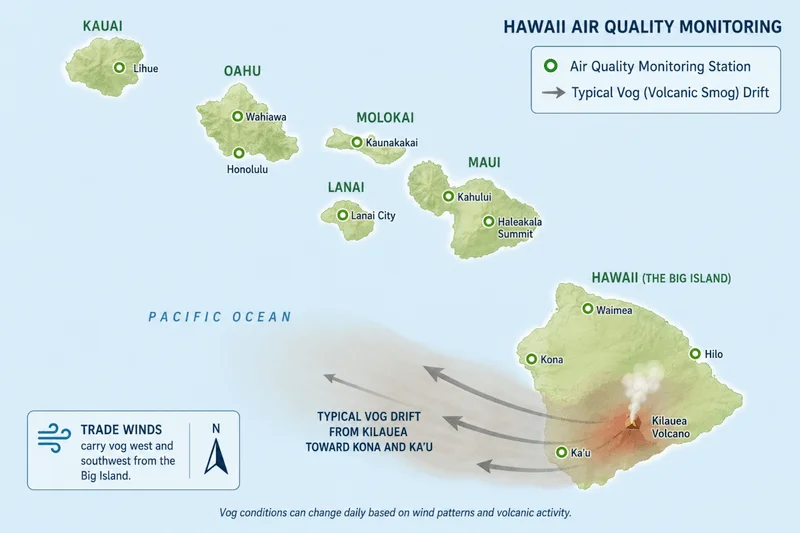
What Is Vog, And Why Hawaii's Air Is Different
Vog is volcanic smog. When Kilauea is active, it releases sulfur dioxide, and that gas reacts with sunlight, oxygen, and moisture to form a fine haze of sulfate particles. Those fine particles are the PM2.5 you see on an air quality reading. If you want the detail on that pollutant, read what PM2.5 is.
Kilauea has been erupting in an on-and-off pattern in recent years, with lava-fountaining episodes separated by quieter pauses, so vog levels rise and fall week to week.
Hawaii's air differs from a mainland city's in two ways. The pollution is volcanic, so it carries a gas and a particle together. And the islands are small with steady trade winds, so one coast can be clear while another sits under thick vog.
How Air Quality Changes By Island And Wind
Windward, ocean-facing areas usually enjoy excellent air. The leeward Kona side and the Ka'u district downwind of the summit take the brunt of the vog, and readings there can reach levels that are unhealthy for sensitive groups when the wind lines up. That is why a single Hawaii number misleads, and why the live map lets you check your own town.
Vog's Two Pollutants: SO2 Gas vs PM2.5 Particles
How To Read The Live AQI Map For Your Location
The Air Quality Index turns pollutant readings into a 0 to 500 scale with color bands. Green is healthy, yellow is moderate, orange flags risk for sensitive groups, and red or higher means everyone should take care. On the Big Island you may also see a separate sulfur dioxide advisory, because vog is a gas problem as well as a particle problem.
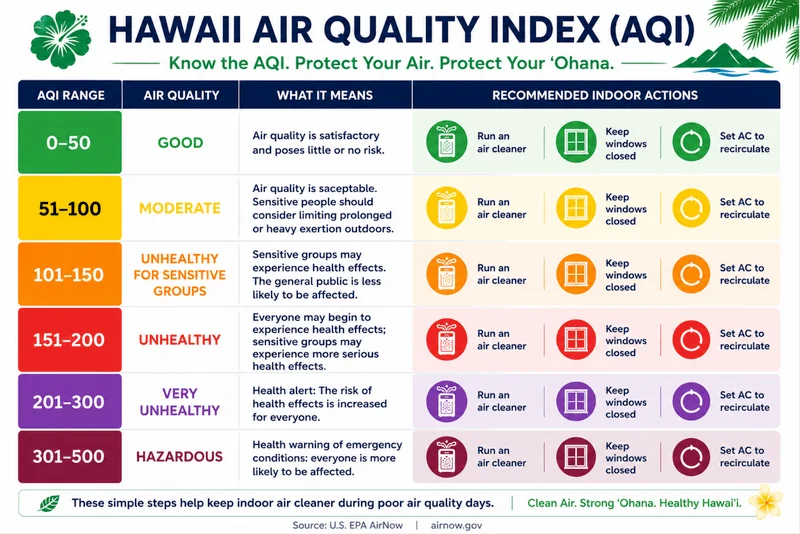
What Actually Protects You From Vog Indoors
Families get this part confused, so we will keep it clear. Vog's fine PM2.5 particles are captured well by a quality filter. High-efficiency media rated MERV 13, or true HEPA in a portable air cleaner, pull those particles out of the air you breathe at home. Sulfur dioxide is a gas, and a standard particle filter lets it pass straight through. Removing gas takes activated carbon media, which adsorbs it. That is also why the Department of Health advises against relying on N95 masks for volcanic gas, since a mask built for particles does nothing for the gas half of vog.
When readings climb, close your windows and set your air conditioner to recirculate rather than pull in outside air. Then run an air cleaner sized for the room.
| Pollutant or Odor | Standard High-MERV Filter | Activated Carbon Media |
|---|---|---|
| PM2.5 fine particles | Yes | Limited |
| SO2 volcanic gas | No | Helps |
| Vog odors and other gases | No | Yes |
What Removes Vog Indoors: Filter Type vs Pollutant
The Hidden Vog Hazard: Rainwater Catchment Systems
Many Big Island homes collect rooftop rainwater for household use. Sulfuric acid in vog makes rain slightly acidic, and that acidity can leach lead and copper from roofing nails, flashing, solder, and paint into the tank. Households on catchment should test their water and follow the state's guidance on treatment, because a whole-home air filter cannot touch this risk.
Glossary
Vog: Volcanic smog, a haze of sulfur dioxide gas and fine sulfate particles formed when volcanic emissions react in the atmosphere.
AQI: Air Quality Index, a 0 to 500 color-coded scale that turns pollutant levels into health guidance.
PM2.5: Fine particles 2.5 microns wide or smaller that reach deep into the lungs and can enter the bloodstream.
SO2: Sulfur dioxide, a volcanic gas that irritates the airways and can trigger asthma symptoms.
MERV: A rating from 1 to 16 for how much fine particulate a filter captures. Higher captures more.
HEPA: High-Efficiency Particulate Air, a filter standard that captures at least 99.97 percent of 0.3-micron particles.
Activated Carbon: A porous media that adsorbs gases and odors, including sulfur dioxide, which particle filters cannot remove.
Air Filter: A device that removes particles from the air passing through it. See the general reference on the air filter.
Expert Quote
After manufacturing filters for over a decade and serving more than two million households, we've learned that clean indoor air comes down to matching the tool to the threat. In Hawaii that means capturing vog's fine PM2.5 particles indoors while being honest that the gas is a separate job, and giving families a clear plan for both.
David Heacock, Founder and CEO, Filterbuy
7 Trusted Resources To Make Hawaii's Invisible Air Visible
You can't see vog drifting across your neighborhood. These seven sources can, and they're the ones we rely on at Filterbuy to help you protect your family's air.
1. See The Real Numbers For Your Island In Seconds
The Hawaii Department of Health's Clean Air Branch tracks live and historic SO2 and PM2.5 levels from monitors across the state. These are the readings we check ourselves, so you can act on facts instead of a hazy horizon.
Source: Hawaii DOH Clean Air Branch air quality data, available at https://health.hawaii.gov/cab/hawaii-ambient-air-quality-data/
2. Understand The Vog You're Breathing
The USGS Hawaiian Volcano Observatory reveals how Kilauea's sulfur dioxide becomes the haze that settles over your home. Its plain-language answers cover health effects and protective steps, including the rainwater-catchment risk that catches many Big Island families off guard.
Source: USGS Hawaiian Volcano Observatory vog FAQ, available at https://www.usgs.gov/observatories/hawaiian-volcano-observatory/frequently-asked-questions-about-volcanic-smog-vog
3. Get Federal Air Guidance Tuned To Hawaii
AirNow, the EPA's air quality service, gathers Hawaii-specific vog advice into one trustworthy place. Lean on it to see how conditions change with volcanic activity and the trade winds that carry vog from one island to the next.
Source: AirNow air quality guidance for Hawaii, available at https://www.airnow.gov/air-quality-information-hawaii-residents-visitors/
4. Watch The Plume Before It Reaches Your Town
The International Volcanic Health Hazard Network maps live and 10-day SO2 and PM2.5 readings using Hawaii's own color-code advisory system. It's the fastest way to know whether today calls for open windows or a sealed-up, filtered home.
Source: IVHHN real-time vog air quality data, available at https://vog.ivhhn.org/current-air-quality
5. Picture What PM2.5 Does Inside Your Lungs
The EPA shows why fine particles smaller than 2.5 microns slip past your body's natural defenses and reach your lungs and bloodstream. Once you can picture the invisible half of vog, protecting against it gets simpler.
Source: EPA Particulate Matter (PM) Basics, available at https://www.epa.gov/pm-pollution/particulate-matter-pm-basics
6. Turn A Scary AQI Color Into A Calm Plan
The American Lung Association translates every AQI color into clear steps your household can follow. It spells out what an orange or red day really means for the sensitive people under your roof, from kids to grandparents.
Source: American Lung Association Air Quality Index guide, available at https://www.lung.org/clean-air/outdoors/air-quality-index
7. Protect The People Who Feel Bad Air First
The CDC identifies who in your home is most sensitive to particle pollution and how to shield them as levels climb. You're the one looking out for everyone under your roof, and this makes that job easier.
Source: CDC air pollutants and particle pollution, available at https://www.cdc.gov/air-quality/pollutants/index.html
Bookmark the ones that fit your island, and you'll always know the moment to head indoors and put a clean filter to work.
What The Research Says About Hawaii's Air And Your Health
At Filterbuy, we're air-obsessed, and we build the filters families reach for when the air turns bad. We read the vog research closely, and one point kept surfacing. Vog is two pollutants at once, and that changes how you protect your home.
1. Vog's Sulfur Dioxide Sends More People To The ER In Hilo
Every 10 ppb rise in volcanic SO2 lined up with a 6.8% jump in ER visits for asthma and COPD.
Sensitive groups feel it first, and fast.
Source: Study of vog and emergency department visits in Hilo, Hawaii (PubMed), available at https://pubmed.ncbi.nlm.nih.gov/15068926/
2. A Vog Particle Is Small Enough To Reach Your Heart
A fine particle is about 1/30th the width of a human hair.
It travels deep into the lungs and into the blood.
Federal health experts tie PM2.5 exposure to higher heart-attack risk.
Source: Particle Pollution and Heart Disease, Million Hearts (U.S. Dept. of Health and Human Services), available at https://millionhearts.hhs.gov/about-million-hearts/building-communities/particle-pollution.html
3. About 200,000 People Live In Vog's Path On Hawaii Island
Roughly 200,000 residents call Hawaii Island home.
Kona and Ka'u sit right where vog drifts off Kilauea.
Your local reading matters more than a statewide number.
Source: Hawaii County population, U.S. Census Bureau QuickFacts, available at https://www.census.gov/quickfacts/hawaiicountyhawaii
What These Numbers Add Up To For Your Home
Read together, the findings point to a filter strategy that treats vog as two separate jobs.
The SO2 finding is a gas problem. Activated carbon media is what adsorbs gases and odors like sulfur dioxide.
The PM2.5 finding is a particle problem. A high-MERV filter, like MERV 13, captures those fine particles indoors.
The population and wind pattern make it personal. Families in Kona or Ka'u should plan for heavier vog days than a windward neighbor sees.
One tool rarely covers both halves. Filterbuy builds both high-MERV particle filters and activated carbon media, so you can answer each half of vog under one roof.
The usual wildfire-smoke playbook also gets you only halfway in Hawaii. An N95 or a plain particle filter handles the soot side of smoke, and neither one removes the sulfur dioxide gas that makes vog its own problem. We watch Hawaii families run into that gap every vog season.
A word from Michelle Wan, Air Quality Writer at Filterbuy:
I track these readings the way a lot of people check the surf report. The thing I want every Hawaii family to know is that a clear morning in Hilo and a hazy afternoon in Kona can land on the same day. Watch your own town, and treat vog as two problems that each need their own fix.
Michelle Wan, Air Quality Writer, Filterbuy
The air inside your home is the part you can manage. At Filterbuy, we help you match the filter to the threat so vog's fine particles stay out of the rooms where your family breathes.
Final Thoughts And Opinion
Most of Hawaii breathes beautifully clean air most of the time. The honest read is that the risk is local and it moves. Our view at Filterbuy is that the smartest move a household can make is to watch their own town on the live map rather than Hawaii as a whole, then keep an air cleaner ready for the days the wind turns. Capture the particles, add carbon when gas is in play, and an invisible hazard becomes something you can manage.
Next Steps
Check the live map above for your town before outdoor plans, and again if the wind shifts.
Keep windows closed and set your AC to recirculate when readings rise.
Run a MERV 13 filter in your HVAC system, or a HEPA air cleaner in the rooms you use most.
If you smell sulfur or notice throat irritation, learn how carbon filters handle gases, since a particle filter alone won't clear the sulfur dioxide.
On rooftop catchment water, follow state testing and treatment guidance during heavy vog.
Frequently Asked Questions
Protect Your Home's Air Before The Next Hazy Day
Don't wait for a hazy day to think about the air inside your home. Filterbuy makes filters in hundreds of sizes, so you can match the right MERV rating to your system, and add carbon media when vog's gas rolls in. Find your size and protect your household today.