
Gainesville Real-Time AQI Tracker


Get Alerts For Unhealthy AQI In Your Area
When air quality in your area reaches unhealthy levels, we'll send you a quick alert, along with expert tips on how to reduce your exposure.
What's Actually In Gainesville Air Today?
What High AQI Means for Your Lungs in Gainesville
How to Read AQI
The Air Quality Index (AQI) measures how polluted the air is and how it may affect your health.
0–50 (Good): Air quality is satisfactory.
51–100 (Moderate): Acceptable, but some pollutants may pose minor concerns.
101–150 (Unhealthy for Sensitive Groups)
151–200 (Unhealthy)
201–300 (Very Unhealthy)
301+ (Hazardous)
Moderate
Still okay for most, but if you have asthma or allergies, take it easy and avoid long outdoor workouts.
Shop MERV 11 filters→What's the Right Filter for Your AQI Level?
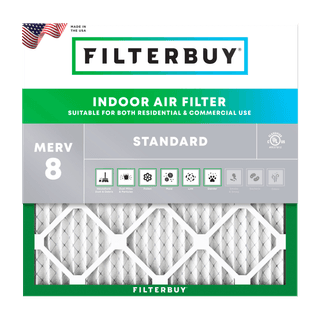
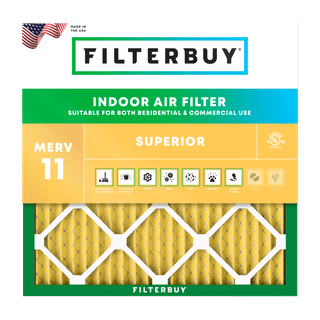
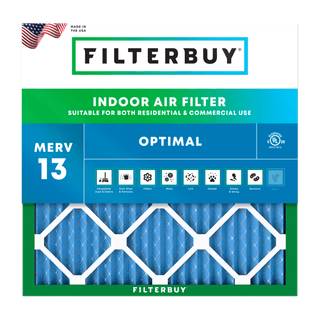



Check Today's Live Real Time Air Quality Index AQI Map in Gainesville, FL Now
By Michelle Wan, Brand Manager and Air Quality Writer. Technically reviewed by David Clark, Licensed HVAC Technician. Published September 7, 2026. Updated September 7, 2026.
TL;DR
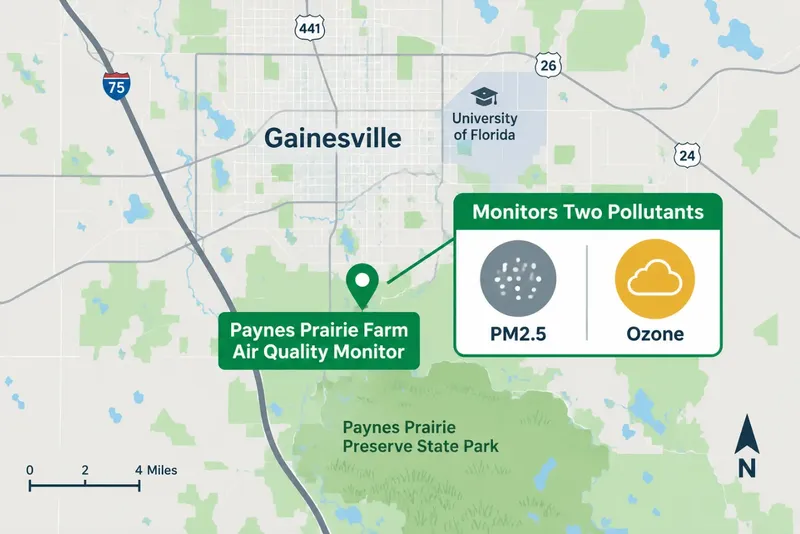
Gainesville, Florida air quality is measured by a single state-run monitor south of the city that reports two pollutants, ground-level ozone and fine particle pollution (PM2.5). Use the map above for the current reading. A value of 50 or below is Good, 51 to 100 is Moderate, and 101 or higher means sensitive groups should scale back outdoor activity. Tree pollen, the most common respiratory complaint here, is not part of the AQI at all.
Key Takeaways
The Air Quality Index is the EPA scale for outdoor air, running from 0 to 500 across six color-coded categories.
Alachua County has exactly one active regulatory air monitor, Paynes Prairie Farm, and it measures only ozone and PM2.5.
The Gainesville AQI number cannot reflect oak or pine pollen, because pollen is not one of the pollutants the index tracks.
Prescribed fire is routine land management across North Central Florida, and drifting smoke is a common cause of short-term particle spikes near Gainesville.
Federal guidance advises using an HVAC filter rated MERV 13 or better, or the most efficient filter a system can accommodate, during smoke events.
What Is The Air Quality In Gainesville Today?
Gainesville air quality today is reported as an Air Quality Index value between 0 and 500. The live map above pulls the current reading for Gainesville and the surrounding Alachua County area. The U.S. Environmental Protection Agency designed the AQI as a plain-language scale for outdoor air. A value of 50 or below represents good air quality, a value over 300 represents hazardous air, and six color-coded categories divide everything in between.
Source: AirNow, U.S. EPA.
A Gainesville AQI reading carries two pieces of information. The value tells you how bad the air is. The dominant pollutant tells you what is making it that way, which is what decides what a good AQI actually means for your household. The map above draws on the same national monitoring feeds as the Filterbuy live AQI and smoke map.
The word live deserves a caveat. What the map reports is a NowCast, a weighted average of up to the past 12 hours rather than a reading from this minute. Rapid changes push more weight onto the recent hours, though the number still trails a plume arriving right now.
Gainesville adds a local wrinkle. The two measured pollutants compete for the same slot, so on a hot, smoky afternoon ozone can outrank PM2.5 and quietly take over the reading, hiding how much smoke is in the air.
Where The Official Gainesville Air Quality Reading Comes From
Most air quality pages report the Gainesville number without saying where it comes from. We went looking. The Florida Department of Environmental Protection monitoring roster for Alachua County lists exactly one active site, Paynes Prairie Farm, AQS ID 12-001-3012. A second site, Paynes Prairie State Park, stopped operating in December 2016.
That site measures ozone and particle pollution, nothing else, and it sits in the Paynes Prairie area south of the city near Paynes Prairie Preserve State Park, rather than in a dense urban corridor. Both facts change how the number should be read. Your own street can differ from the county reading, especially near a busy road or an active burn. Anything the site does not measure stays invisible to the index no matter how much of it is in the air, which is easier to picture once you understand how the Air Quality Index is calculated.
Alachua County government confirms the arrangement plainly and describes county air quality as good. Residents who want to report smoke, dust, or open burning can call the Alachua County Environmental Protection Department at 352-264-6800.
What Drives Gainesville Air Quality Through The Year
Gainesville air pollution follows a seasonal rhythm that differs sharply from a western wildfire city or a northern industrial one. We built the calendar below to separate the drivers that actually move the index from the ones people assume do, season by season.
Original Filterbuy synthesis built from Florida Department of Environmental Protection monitoring scope and U.S. EPA AQI pollutant definitions.
Fine particle pollution in Gainesville comes mostly from smoke, and ozone builds mostly on summer heat. Prescribed fire is a permitted land management tool used heavily across North Central Florida, so smoke on any given day is far more often planned than accidental. When a distant fire is the cause instead, the live wildfire and smoke map shows where the plume is coming from, and our guide to what ground-level ozone does to your lungs covers the summer half of the calendar.
Why Gainesville Pollen Does Not Show Up In The AQI
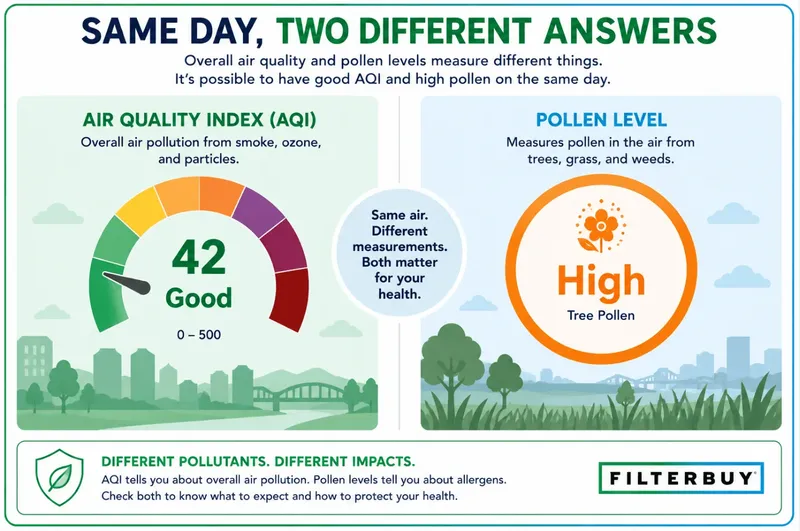
Pollen is not included in the Air Quality Index. The EPA builds the index from five major pollutants regulated under the Clean Air Act: ground-level ozone, particle pollution, carbon monoxide, sulfur dioxide, and nitrogen dioxide. Pollen is not among them.
This creates the single most common misreading of Gainesville air quality data. On a February morning when oak and pine pollen coat every windshield in Alachua County, the AQI can still read Good. The index is not broken and it is not wrong. It is simply measuring something else. We call it out because the number and the symptom point in opposite directions on the same day.
Our breakdown of why pollen does not register on air quality readings explains the particle-size reason behind the gap.
What To Do At Each Gainesville AQI Level
Match your response to the AQI category rather than to how the sky looks. Haze is a poor guide in Gainesville, because the fine particles that matter most are invisible and because humidity alone can make clean air look thick. The table below pairs each category with one outdoor step and one indoor step.
AQI ranges are EPA's. The action at each level is a Filterbuy house recommendation, not an EPA threshold.
Check AirNow and Alachua County guidance before anything else. Official instructions come first and filtration supports them rather than replacing them. The EPA recommends a filter rated MERV 13 or higher in a central system during smoke events. AQI 100 is where Filterbuy tells customers to act on that, and to run a portable HEPA cleaner in each occupied room rather than a single clean room. AQI 100 is still the top of the Moderate band. The category above it begins one point higher. Filterbuy moves at the threshold rather than after it, which is a house call and not a category change. Anyone in Gainesville with asthma, COPD, heart disease, or diabetes should follow their own clinician and official guidance. Deciding which MERV rating to run on high AQI days is part of that same advance planning.
Every city page has one fact that reframes the whole number. In Gainesville it is that a single monitor south of town speaks for the entire county, and it listens for only two pollutants. Once you know that, you stop reading the number as a verdict on your own street.
Michelle Wan, Brand Manager and Air Quality Writer, Filterbuy
How To Protect Indoor Air In A Gainesville Home
The AQI describes outdoor air. Indoor air is the part a Gainesville household actually controls, and it is the part we care most about. When outdoor conditions decline, close windows and doors, switch the system to recirculate, and set the thermostat fan to On rather than Auto so air keeps cycling through the filter instead of only during heating or cooling calls.
Efficiency decides the rest. Filterbuy pleated filters capture 90% of airborne particles at MERV 8, 95% at MERV 11, and 98% at MERV 13. MERV 13 is the tier Filterbuy recommends when smoke is in the air.
Apartments, window units, and older Gainesville homes without ductwork have no whole-home layer, so a portable HEPA cleaner is the main defense there rather than a supplement. Size one by the EPA clean-room rule of a smoke CADR at least two thirds of the room square footage. A 300 square foot bedroom wants a smoke CADR near 200. Skip anything that produces ozone, including ionizers and ozone generators.
Capture rates are Filterbuy pleated filter house figures for airborne particles.
Most furnaces and HVAC systems accommodate MERV 13 without equipment problems, provided the filter is replaced often. Check the size the way you would for any filter. During smoke, check the filter itself rather than the calendar and replace it when it looks dirty, dark brown or black, which can be well before the normal interval. Keep spares on hand. For a single room rather than a whole house, see MERV 13 compared with a true HEPA cleaner.
One limit is worth naming plainly. A pleated filter captures particles, and ozone is a gas, so no MERV rating removes it. Filterbuy builds a carbon-lined Odor Eliminator line separately for gas-phase pollutants.
Ready to get ahead of the next smoke day? shop Filterbuy MERV 13 air filters and keep a spare on the shelf.
Supporting Statistics
Each figure backs a specific claim above. All three come from U.S. government sources.
1. Florida permits about 2 million acres of prescribed burns a year.
That is roughly 16 times California's annual acreage.
Source: U.S. Geological Survey, with Tall Timbers Research Station (usgs.gov)
2. About 1 in 11 Florida adults has asthma, or 9.3%.
So does 1 in 14 Florida children, or 7.1%.
Source: Florida Department of Health, Florida Asthma Program (floridahealth.gov)
3. Gainesville has 148,671 residents across 59,816 households.
Nearly 12% are aged 65 or older.
Source: U.S. Census Bureau QuickFacts (census.gov)
Gainesville Air Quality FAQ
Glossary
Air Quality Index (AQI): The EPA scale for reporting outdoor air quality, running from 0 to 500 across six color-coded categories.
PM2.5: Fine particulate matter 2.5 micrometers or smaller in diameter, one of two pollutants measured in Alachua County.
Ground-level ozone: A gas formed when pollutants react in sunlight, generally peaking on hot afternoons.
Paynes Prairie Farm: The active Florida Department of Environmental Protection air monitoring site in Alachua County, AQS ID 12-001-3012.
MERV: Minimum Efficiency Reporting Value, the standard rating scale for how much airborne particulate an air filter captures.
Prescribed fire: A planned, permitted burn used to manage vegetation and reduce wildfire fuel.
Dominant pollutant: The pollutant with the highest sub-index on a given day, which sets the reported AQI value.
Sensitive groups: Children, older adults, and people with heart or lung conditions, who respond to air pollution at lower levels than the general public.