
New Haven Real-Time AQI Tracker


Get Alerts For Unhealthy AQI In Your Area
When air quality in your area reaches unhealthy levels, we'll send you a quick alert, along with expert tips on how to reduce your exposure.
What's Actually In New Haven Air Today?
What High AQI Means for Your Lungs in New Haven
How to Read AQI
The Air Quality Index (AQI) measures how polluted the air is and how it may affect your health.
0–50 (Good): Air quality is satisfactory.
51–100 (Moderate): Acceptable, but some pollutants may pose minor concerns.
101–150 (Unhealthy for Sensitive Groups)
151–200 (Unhealthy)
201–300 (Very Unhealthy)
301+ (Hazardous)
Moderate
Still okay for most, but if you have asthma or allergies, take it easy and avoid long outdoor workouts.
Shop MERV 11 filters→What's the Right Filter for Your AQI Level?



Check Today's Live Real Time Air Quality Index AQI Map in New Haven, CT Now
Author: Michelle Wan | Reviewer: David Clark, Licensed HVAC Technician | Publish Date: September 1, 2026 | Updated Date: September 1, 2026
New Haven's air quality today is measured at Criscuolo Park, a federal reference station on the harbor in Fair Haven, and reported through the EPA's AirNow network. The Filterbuy map below shows the current Air Quality Index for the New Haven area. Most days here land in the Good or Moderate range. When the number does climb, ground-level ozone is usually the reason, not smoke.
View New Haven, CT Current Air Quality Map
TL;DR Quick Answers
Today's New Haven reading. The live AQI map above refreshes through the day.
The pollutant that matters. Ground-level ozone drives most of New Haven's unhealthy air days, and PM2.5, the fine soot-sized particles in smoke, drives the rest.
Ozone season. Connecticut DEEP forecasts New Haven ozone from May 1 through September 30, and PM2.5 year-round.
Worst hours. DEEP puts the ozone risk window at roughly 2 p.m. to 8 p.m.
What your filter changes. An HVAC filter captures particles. It cannot capture ozone, a gas.
Top Takeaways
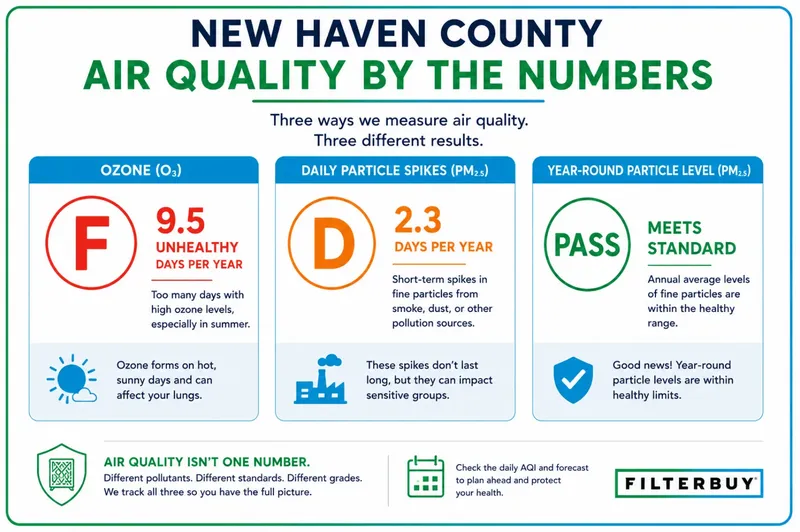
New Haven County earned an F for ozone in the American Lung Association's 2026 “State of the Air” report, averaging 9.5 unhealthy ozone days per year across 2022–2024.
The same county passed the federal annual standard for year-round particle pollution and earned a D for daily spikes, at 2.3 unhealthy days per year.
New Haven County belongs to the New York-Northern New Jersey-Long Island ozone nonattainment area, not the Greater Connecticut area, so its ozone tracks the New York metro plume.
Criscuolo Park is one of two NCore stations in Connecticut, the top tier of EPA's monitoring network.
Ozone and particle days call for different indoor moves, so check the dominant pollutant first.
How Is The Air Quality In New Haven Today?
The number on the live map is the Air Quality Index, EPA's 0-to-500 scale folding six pollutants into one hourly reading. The card row above breaks down each band.
Whichever pollutant scores highest that hour sets the number, and that one is the dominant pollutant. Most people skip past it, which is a mistake in New Haven, because a 90 driven by ozone and a 90 driven by smoke look identical while calling for different responses.
All of it traces back to a single station. The Connecticut Department of Energy and Environmental Protection runs the Criscuolo Park monitor, EPA site 09-009-0027, which has sat about ten feet above sea level beside New Haven Harbor since 2004 and measures ozone, PM2.5, PM10, black carbon, nitrogen oxides, and carbon monoxide. DEEP also publishes a town-level table listing New Haven by name, so tomorrow's forecast arrives first. The station has one limitation, though. It sits in Fair Haven beside the harbor and I-95, so it reads the shoreline more faithfully than East Rock or Westville.
For the math, see how the Air Quality Index is calculated.
Ozone Drives Most Unhealthy Air Days In New Haven
New Haven County's report card splits in a way that surprises residents. The county fails on smog and passes on soot.
Source: American Lung Association, State of the Air 2026, New Haven–Hartford–Waterbury metro area.
Geography explains the gap. New Haven sits on Long Island Sound at the downwind edge of the New York metropolitan plume, which is why EPA groups the county with New York and New Jersey for ozone planning, not Hartford. On hot afternoons, southwest winds carry nitrogen oxides and volatile organic compounds up the I-95 corridor. Sunlight cooks them into ozone over the water, and the sea breeze pushes the result ashore. DEEP calls Connecticut the tailpipe of the nation, and even the local alerts come from out of state, relayed by the National Weather Service office in Upton, New York.
That split is why this page exists, because it changes the advice. Ozone is a gas, and a pleated HVAC filter is a particle device, so filtration does nothing for the pollutant behind New Haven's failing grades. Filterbuy makes those filters, and we would rather say so than sell you one for the wrong day. On a particle day, whether that's Canadian wildfire smoke or January wood smoke, the filter in your return is the strongest tool you own.
More on what this gas does to airways in the Filterbuy guide to ground-level ozone health effects.
So What Does Help On An Ozone Day?
Shut the windows through the afternoon peak. Ozone breaks down on indoor surfaces, so a closed house runs below street level.
Move outdoor exertion to early morning.
Skip ozone-generating purifiers. No federal agency has approved them for occupied spaces. They do not clean air effectively, and they emit the same gas that is already the problem outside.
Most city air quality pages answer a high reading by telling you to buy a better filter. For New Haven that is wrong more often than right. Filterbuy has made pleated air filters in the USA since 2013, so we will say the unprofitable part out loud. A pleated filter catches particles, and New Haven’s failing grade is for ozone, a gas. On a smoke day that filter is the best move in the house. On an ozone afternoon it barely matters.
Filterbuy Editorial Team
Supporting Statistics
Three U.S. agency figures behind Filterbuy's New Haven guidance.
Connecticut has a heavy asthma burden.
4th highest adult asthma prevalence in the nation, 2022.
8.2% of Connecticut children have asthma, against a 6.2% national average.
Ozone is among the pollutants most closely tied to asthma attacks.
Source: Connecticut Department of Public Health Asthma Program
Ozone raises asthma risk for active kids.
A large U.S. study of air pollution and children's lungs.
Kids playing several outdoor sports in high-ozone areas are likelier to develop asthma.
Source: National Institute of Environmental Health Sciences, Air Pollution and Your Health
Indoor air is where exposure happens.
Americans spend roughly 90% of their time indoors.
Some pollutants run 2 to 5 times higher indoors.
Frequently Asked Questions
Glossary
AQI (Air Quality Index). EPA's 0-to-500 daily scale for outdoor air.
Dominant pollutant. The pollutant scoring highest that day, which sets the AQI you see.
Ground-level ozone. A gas formed when sunlight acts on nitrogen oxides and volatile organic compounds. The main ingredient in smog.
PM2.5. Particles 2.5 micrometers or smaller, fine enough to reach deep lung tissue.
MERV. Minimum Efficiency Reporting Value, the ASHRAE scale for filter capture.
New Haven's air shifts with the weather and the time of day. Ten seconds spent on the dominant pollutant tells you whether this is a timing day or a filtration day.
Compare against the rest of the state on the Connecticut statewide AQI map.
Find Your MERV 13 Filter