How Many Watts Does a Window AC Use? A Real-World Power & Cost Guide
June 25, 2026

How Many Watts Does a Window AC Unit Use?
Most window air conditioners use between 450 and 1,800 watts of electricity while they run. The biggest factor by far is the unit's BTU size: a small 5,000 BTU bedroom unit draws about 450 watts, while an 18,000 BTU great-room unit can pull 1,800 watts or more.
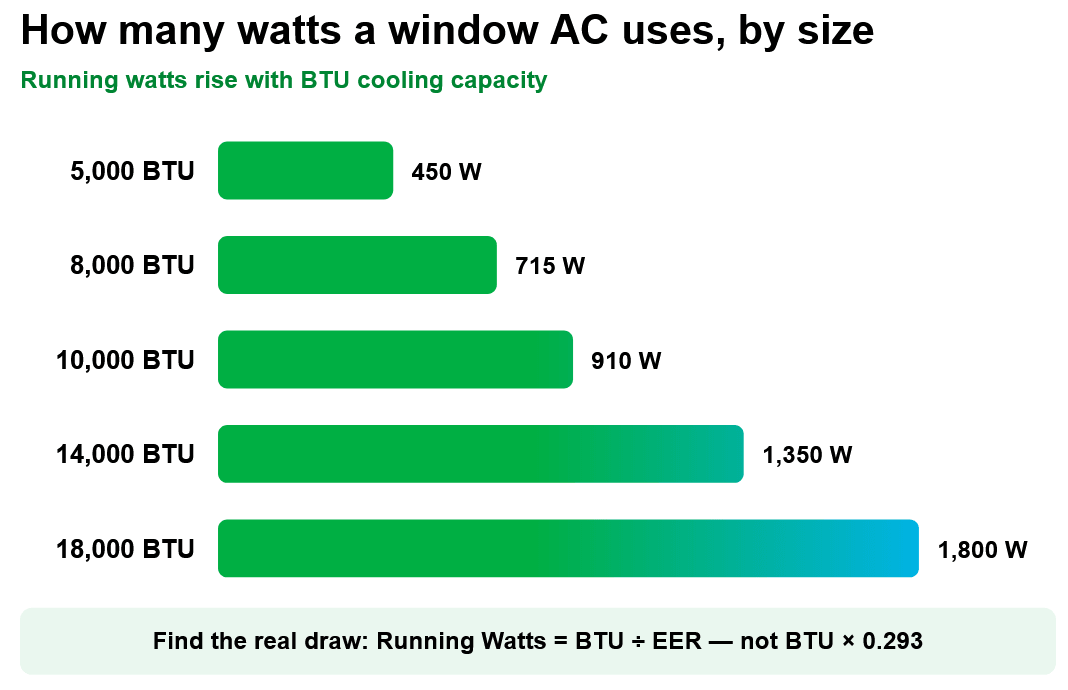
To find your unit's real electrical draw, divide its BTU by the EER printed on the label — not BTU × 0.293, which only measures cooling output and badly overestimates the bill.
Typical running watts by size:
5,000 BTU — about 450 watts
8,000 BTU — about 715 watts
10,000 BTU — about 910 watts
14,000 BTU — about 1,350 watts
18,000 BTU — up to 1,800 watts
Window ACs are economical for cooling one room — but if you're cooling more space, or want a quieter, more efficient setup, a ductless mini split may be the better fit.
Not sure which one fits? Answer 5 quick questions and we'll match you to the right mini split system.
Written by Michelle Wan, Brand Manager and Air Quality Writer at Filterbuy. Technically reviewed by David Clark, Licensed HVAC Technician, Filterbuy HVAC Solutions, who verified the wattage, amperage, and generator guidance below.
Published June 25, 2026 · Updated September 11, 2026
TL;DR
A window air conditioner uses 400 to 1,800 running watts. A 5,000 BTU unit draws about 450, a 10,000 BTU unit about 910, and a 12,000 BTU unit about 1,150.
For your own unit, divide its BTU rating by the EER on the label. That is the whole calculation. Ignore the BTU × 0.293 formula that most top-ranking guides publish, because it measures heat moved rather than electricity consumed and overstates the answer by roughly three times.
Key Takeaways
Running Watts = BTU ÷ EER. The BTU × 0.293 formula measures heat moved, not electricity consumed.
Expect $12 to $35 a month at eight hours a day and 18.44¢ per kWh, once cycling is counted.
Most window ACs draw 3.5 to 13 amps. A 15-amp circuit carries 12 safely, and only 7.5 if it also feeds lights.
Size a generator to startup surge, since compressors spike to two or three times running wattage.
An old unit rarely pays to replace on efficiency alone. The payback usually outlasts the machine.
How Many Watts Does a Window AC Use?
Most window air conditioners use between 400 and 1,800 running watts. A 5,000 BTU unit draws about 450 watts, a 10,000 BTU unit about 910, a 12,000 BTU unit about 1,150, and an 18,000 BTU great-room unit as much as 1,800. Nothing moves that number as much as BTU size.
Window AC Wattage Chart by BTU Size
| Window AC Size | Running Watts | Amps @ 115V | kWh/Hour | Room Size |
|---|---|---|---|---|
| 5,000 BTU | 400–550 W | 3.5–4.8 A | 0.40–0.55 | 100–250 sq ft |
| 8,000 BTU | 650–800 W | 5.7–7.0 A | 0.65–0.80 | 300–350 sq ft |
| 10,000 BTU | 800–1,050 W | 7.0–9.1 A | 0.80–1.05 | 350–450 sq ft |
| 12,000 BTU | 1,000–1,300 W | 8.7–11.3 A | 1.00–1.30 | 450–550 sq ft |
| 14,000 BTU | 1,150–1,500 W | 10.0–13.0 A | 1.15–1.50 | 550–700 sq ft |
| 18,000 BTU | 1,400–1,800 W | 12.2–15.7 A | 1.40–1.80 | 700–1,000 sq ft |
Two units with the same BTU rating can still pull different wattage because efficiency, outdoor temperature, thermostat setting, and how clean the unit is all shift the figure. An ENERGY STAR-certified unit sits at the low end of each range, while an older, dust-clogged one on a 98°F afternoon sits near the top.
Averaged across the five most common sizes at EER 11, from 5,000 up to 14,000 BTU, the typical window air conditioner draws about 890 watts.
How Do You Calculate Window AC Watts? (And the Mistake Most Guides Make)
Divide BTU by EER. That one calculation gives you a window AC's real electrical draw:
Running Watts = BTU ÷ EER
You'll find the rating in one of two places. The yellow EnergyGuide label carries CEER, the federal standard since 2014, while the spec plate on the cabinet lists EER alongside the nameplate amps. Either works here, and most window units land between 9 and 12. The Department of Energy defines EER as cooling capacity in BTU per hour divided by power input in watts, which is exactly why dividing BTU by EER returns the watts your unit pulls from the outlet. Weighing a window unit against central air or a mini split? Run it through our EER to SEER calculator first, since the ratings aren't interchangeable.
So a 10,000 BTU unit at EER 11 works out to 10,000 ÷ 11, or about 910 running watts.
Why BTU × 0.293 Is Wrong
We read every result on page one for this question in August 2026, and most publish a different formula: BTU × 0.293 = watts. Run a 5,000 BTU unit through it, and you get 1,465 watts. Run a 10,000 BTU unit and you get 2,930. Both are wrong by more than three times, and two top-ranking guides still print them today.
The reason is that the 0.293 conversion turns BTU into its thermal-energy equivalent, the heat the unit moves, and tells you nothing about the electricity it consumes. Think of it as the difference between how much water a pump moves and the power its motor draws.
The pattern behind the error is hard to miss. Nearly every guide repeating that number sells generators, and a figure three times too high sells a much bigger machine. Filterbuy manufactures air filters in the USA and sells ductless mini splits. We have no generator to move, and no reason to inflate the figure.
Michelle Wan, Brand Manager and Air Quality Writer, Filterbuy: "Every summer we hear the same thing: the bill doubled, so something must be broken. Usually nothing is. The unit is doing exactly what it was built to do, and nobody ever told the owner what that costs."
How Much Electricity Does a Window AC Use, and What Does It Cost?
A window air conditioner uses 0.4 to 1.8 kilowatt-hours for every hour it runs. At the U.S. residential average of 18.44¢ per kWh, that works out to 7 to 33 cents an hour, or roughly $12 to $35 a month at eight hours a day. The formula behind it is simple: (watts ÷ 1,000) × hours × your rate.
That average is only a benchmark, though, and your own rate may look nothing like it. EIA data for May 2026 puts state averages anywhere from roughly 12¢ per kWh in the cheapest states to nearly 27¢ in Rhode Island.
Window AC Running Cost by Size
At 8 hours a day and 18.44¢ per kWh:
| Size | Cost per Hour | Realistic Monthly |
|---|---|---|
| 5,000 BTU | $0.08 | ~$12 |
| 8,000 BTU | $0.13 | ~$19 |
| 10,000 BTU | $0.17 | ~$24 |
| 12,000 BTU | $0.21 | ~$30 |
Those monthly figures already account for cycling. Run the raw wattage around the clock, and a 12,000 BTU unit would cost about $51, but that only happens when a unit is undersized. A conventional room AC runs either at full capacity or not at all, so most households land nearer 60% of that.
Why does the bill spike in a heat wave?
Every EER on every label is measured at a single condition: 95°F outside. Climb past that, and the compressor works harder against higher pressure, so its draw rises while its cooling capacity falls. On a 105°F afternoon, a unit rated at 910 watts will pull more than 910 and run longer to hold the same room temperature. The chart above is a 95°F number, not a worst case.
How Many Amps Does a Window AC Use?
Most window air conditioners draw 3.5 to 13 amps on a standard 115-volt circuit. A 5,000 BTU unit pulls about 4 amps, and a 12,000 BTU unit pulls closer to 10. Converting is straightforward: amps = watts ÷ volts.
Here's the rule most guides skip. An air conditioner counts as a continuous load, which the National Electrical Code defines as anything running three hours or more, and continuous loads are capped at 80% of a breaker's rating. That puts the real ceiling on a 15-amp circuit at 12 amps, not 15.
Almost nobody mentions the next part. That ceiling only applies when the air conditioner has its own circuit. Share it with lights or outlets, and the NEC's room air conditioner provisions cut the limit to 50%, or 7.5 amps on a 15-amp circuit. A 12,000 BTU unit drawing 10 amps needs a circuit of its own.
Whatever the arithmetic says, size the circuit from the nameplate. Watts ÷ volts gets you close, but power factor makes real draw slightly higher than simple division suggests. If your lights dim when the compressor starts, the breaker trips, or the plug feels warm, call a licensed electrician. Never run one on an extension cord.
David Clark, Licensed HVAC Technician, Filterbuy HVAC Solutions: "We get called out for tripping breakers all summer, and it's almost never the air conditioner that's broken. It's a big unit sharing a bedroom circuit with a lamp and a TV. People read the BTU on the box and never check the amps on the nameplate."
Filterbuy HVAC Solutions services residential systems in Texas, Florida, and Georgia.
How Many Watts Do You Need to Run a Window AC on a Generator?
Size the generator to the startup surge, not the running watts. A conventional compressor briefly pulls two to three times its running wattage the moment it starts, so a 900-watt unit can spike to anywhere between 1,800 and 2,700 watts. A generator sized to the running figure alone will stall every time the compressor cycles.
| Window AC Size | Startup Surge | Generator / Power Station |
|---|---|---|
| 5,000 BTU | 900–1,350 W | 1,500–1,800 W |
| 10,000 BTU | 1,820–2,730 W | 3,000 W |
| 12,000 BTU | 2,300–3,450 W | 3,600 W |
There are two ways to get by with something smaller. Most ENERGY STAR-certified room ACs now use variable-speed compressors that ramp up gradually, cutting the surge to roughly 1.1 or 1.3 times running watts. A soft starter does the same job for a conventional unit, often enough to run a 13,500 BTU RV unit off a 2,000-watt inverter generator. On a battery station, divide usable capacity by running watts and take off another 10 to 15% for losses.
Is It Worth Replacing an Old Window AC?
Usually not on energy savings alone. Here's the arithmetic on a 10,000 BTU unit:
A 15-year-old unit at EER 8 draws about 1,250 watts.
A new ENERGY STAR model at CEER 12 draws about 830 watts.
That 420-watt gap comes to about 60 kWh a month at 8 hours a day, or $11 a month and $44 a season.
A new 10,000 BTU unit costs $300 to $400, putting the payback at roughly eight years against the nine-year service life DOE assumes. The savings barely outlive the machine.
Replacement makes sense when the old unit fails, when it's the wrong size for the room, or when power where you live is expensive. At Rhode Island's 27¢ per kWh, the same swap breaks even in about five years. Short of that, run it at 75–78°F in Energy Saver mode, keep the filter clean, and put the money somewhere it does more good.
Window AC vs. Mini Split: What Each Costs to Run
The difference is the compressor. A window unit only knows full power or off, so it cycles hard to hold a temperature. A ductless mini split uses a variable-speed inverter that adjusts output to demand, so it draws less power to maintain a room than to pull it down to temperature. How much less depends on your unit, your room, and your climate.
For scale, central air pulls 3,000 to 5,000 watts, so a window unit stays cheap as long as you only need one room cooled. A mini split earns its place once you're cooling year-round, want heat from the same box, or need to reach a room central air can't, which is really a heat pump vs. mini split question. Already own one? Here's how often to service it.
Comparing the two on paper is harder than it looks: window units are rated in EER, mini splits in SEER2, and the two are measured differently. Use our EER to SEER calculator rather than reading one against the other.
Our own single-zone 12,000 BTU covers up to 550 sq ft at $799, with free 2-day delivery on in-stock systems, a 7-year compressor and 3-year parts warranty, and reliable heating down to 5°F. It's ETL- and AHRI-certified. At 17 SEER2, it clears the federal minimum and is built for value rather than maximum efficiency, and it's single-zone only. Professional installation is required, and the warranty is void if self-installed.
Compare Filterbuy mini split systems →
Supporting Statistics
1. Air conditioning is 19% of all electricity used in U.S. homes
Cooling accounted for 254 billion kilowatt-hours in 2020, one of the largest single line items on a U.S. power bill.
*Source: U.S. Energy Information Administration, Residential Energy Consumption Survey.
2. Half of Northeast households cool with individual units, not central air
88% of U.S. households use air conditioning, and two-thirds rely on central systems.
But 50% of Northeast households primarily use individual units, and renters are the least likely of anyone to have central air. They're exactly who window units serve.
*Source: U.S. Energy Information Administration, Today in Energy.
3. Two 12,000 BTU units can differ by ~285 watts at identical cooling output
| Model | CEER | Annual kWh | Avg. watts over 750 hrs |
|---|---|---|---|
| Less efficient | 10.9 | 826 kWh | ~1,100 W |
| ENERGY STAR | 14.7 | 612 kWh | ~815 W |
| Best available | 15.4 | 584 kWh | ~780 W |
The ENERGY STAR model uses about 26% less electricity for the same cooling.
The two carry the same BTU rating but have a 35% efficiency gap.
These are season-long averages that include standby, so they sit below peak draw.
It's why our chart gives a range and why EER tells you more than the BTU on the box.
*Source: U.S. Department of Energy, FEMP, at 750 operating hours a year. DOE prices energy at 11.1¢/kWh for federal facilities; at the 18.44¢ residential average, that gap is worth about $39 a year.
Glossary
BTU / Watt / kWh. BTU measures cooling capacity, a watt measures power draw, and a kilowatt-hour, the unit your utility bills you for, is 1,000 watts running for one hour.
EER and CEER. EER is BTU per hour divided by power input in watts, measured at 95°F outdoors, and higher is more efficient. CEER is the federal version, which also counts standby power.
Startup surge and soft starters. The surge is the spike when a compressor starts, typically two to three times the running wattage. A soft starter is an add-on device that limits it.
Continuous load. Anything running three hours or more. The National Electrical Code caps these at 80% of a breaker's rating, which is what turns a 15-amp circuit into a 12-amp one.
Nameplate amps and power factor. The rated amperage is stamped on the unit. It sits slightly above watts ÷ volts because motors don't draw current perfectly in phase with voltage, a gap called power factor.
Frequently Asked Questions
How Many Watts Does A 5,000 Btu Window Air Conditioner Use?
About 400 to 550 running watts, with efficient models near 450, plus a startup surge of 900 to 1,350 watts.
How Many Watts Does A 10,000 Btu Window Air Conditioner Use?
Between 800 and 1,050 running watts, or roughly 910 at a typical EER of 11.
How Many Watts Does A 12,000 BTU Window AC Use?
Between 1,000 and 1,300 running watts, most models are near 1,150.
How Much Power Does A Window Ac Use Per Hour?
0.4 to 1.8 kilowatt-hours per hour of continuous running: 7 to 33 cents at 18.44¢ per kWh, less in practice because the compressor cycles.
*Sources: EIA, DOE, ENERGY STAR, NFPA 70, and manufacturer EnergyGuide labels. Filterbuy manufactures air filters in the USA. Better Air For All.