
Air Purifier Filters Without the Lowe's Run, Shipped Free from Filterbuy
September 9, 2026
Author: Michelle Wan | Reviewed by David Clark, Licensed HVAC Technician | Published September 9, 2026 | Updated September 9, 2026
TL;DR
Filterbuy manufactures air purifier replacement filters in its own USA plants and ships them free to your door. The lineup covers complete HEPA-style and carbon filters for GermGuardian B, C, and E purifiers, plus Cut Carbon pre-filters for Honeywell HPA-series, PureGuardian, Black+Decker, and Idylis units. Start with your purifier's model number, because some units take one combined filter and others take a separate pre-filter, and the two are priced very differently.
Key Takeaways
Filterbuy ships air purifier replacement filters factory-direct with free shipping on every order inside the continental United States.
A Filterbuy complete air purifier filter combines pleated media and an activated carbon layer in one drop-in unit, and replaces GermGuardian Filter B, Filter C, or Filter E.
Filterbuy Cut Carbon pre-filters arrive pre-cut in 4-packs, which is a full year of coverage at the 90-day replacement interval.
Section 2302(c) of the Magnuson-Moss Warranty Act makes it illegal for a company to condition a consumer product warranty on the use of a brand-name part, unless that part is supplied free of charge.
Filterbuy does not yet make a replacement for every purifier brand sold at Lowe’s. Current coverage is GermGuardian, Honeywell HPA-series, PureGuardian, Black+Decker, and Idylis.
Which Air Purifier Filters Does Filterbuy Actually Make?
Filterbuy makes two types of air purifier replacement filters. Complete filters pair pleated media with an activated carbon layer in one drop-in unit, replacing GermGuardian Filter B, Filter C, and Filter E. Each includes a carbon pre-filter, since the two layers wear out on different schedules. Cut Carbon pre-filters are thin activated carbon sheets, pre-cut for Honeywell HPA-series purifiers and for GermGuardian, PureGuardian, Black+Decker, and Idylis models. All of it is made in the USA.
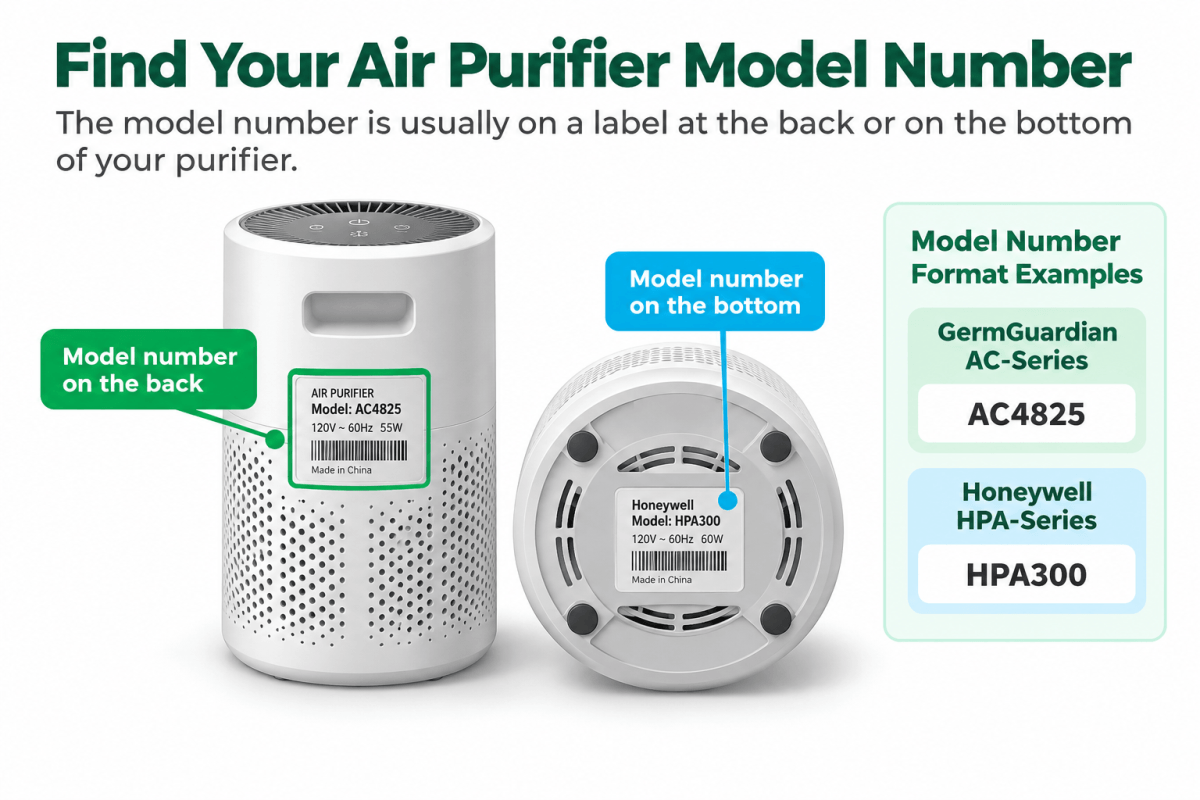
Your purifier's model number sits on a label on the back or underside of the unit. Match it to the table below before you order anything.
Complete filters combine HEPA-style media and an activated carbon layer in one drop-in unit. Filterbuy filters are compatible replacements manufactured by Filterbuy.
The coverage above has real edges. Filterbuy does not yet make a filter for every purifier on a big-box shelf, so owners of Levoit, Shark, Blueair, Alen, LG, and HoMedics units will not find their part in that table, and pointing them at something that almost fits would be worse than pointing them elsewhere. The next section covers how to find the right filter when it is not one of ours. Note too, that Filterbuy filters are compatible replacements, not genuine GermGuardian or Honeywell parts.
What To Do If Your Purifier Is Not On The List
Look for the OEM part number rather than the purifier model number, because retailers stock purifier filters under the number printed on the filter itself rather than the name of the machine it came out of. Three steps will find it for any brand, including the ones Filterbuy does not make.
Pull the old filter out and read it. The part number is usually printed on the filter frame or on a label along its edge. It looks like FLT4825 or HRF-A300. That string is what to search for, and it will return results at any retailer that carries the brand.
If the label has worn off, find the purifier model number on the back or underside of the unit and look it up on the manufacturer support site. Every major purifier brand publishes a replacement part number against its model list.
Measure the old filter before you buy a look-alike. Height, width, and depth all matter, because a filter that does not seat properly lets air travel around the media instead of through it, rather than being caught.
Then buy it wherever it is stocked, whether that is Lowe’s, another retailer, or the purifier manufacturer direct. A filter that fits a machine Filterbuy does not serve is still the right filter to buy.
Complete Filter Or Pre-Filter: Which One Does Your Purifier Take?
Open the filter compartment and count the pieces, because most purifiers use one of two setups. A complete filter assembly is a single block that slides in and out with the particle media and the carbon layer built together. A separate pre-filter is a thin carbon sheet or wrap sitting in front of a main filter that you replace on its own schedule.
One solid block means you need a complete filter. Filterbuy's complete air purifier filters use true HEPA-style media that captures 99.97% of airborne particles at 0.3 microns, and the carbon layer beside it handles a job the media cannot. Pleated media catches particles, while activated carbon adsorbs gases, which is what takes the edge off cooking, pet, and smoke odors along with everyday VOCs.
That 0.3 micron figure confuses a lot of shoppers, because competing packages cite 0.1 microns instead. Both can be accurate. Per the EPA's definition of a HEPA filter, 0.3 microns is the most penetrating particle size, meaning the hardest size to catch. Particles larger or smaller than that are trapped with even higher efficiency.
Two distinct pieces means checking the pre-filter before pricing the main filter. The pre-filter is the cheap part sitting in front of the expensive one, catching dust and pet hair before any of it reaches the main media. A purifier running on a neglected pre-filter tends to show it as weak airflow rather than as a smell, which is how people end up replacing the wrong part.
Filterbuy builds both parts, which is why this page is willing to point at the cheaper one. A manufacturer selling only the complete filter has little reason to mention that a pre-filter change might be the whole fix. Cut Carbon pre-filters use coconut shell carbon, a thicker media than the foam pre-filters shipped with many units, and they arrive pre-cut, so nothing needs trimming, measuring, or folding. Each pack carries a QR code linking to directions written for your specific purifier, since filter compartments vary far more than the filters do.
Do Aftermarket Air Purifier Filters Void Your Warranty?
Manufacturer listings often warn that non-genuine parts will void a purifier's warranty, but federal law is narrower than those warnings suggest. Section 2302(c) of the Magnuson-Moss Warranty Act makes it illegal for a company to condition a consumer product warranty on the use of a branded article or service, unless that article or service comes free of charge under the warranty.
The Federal Trade Commission enforces the Act, and its Businessperson's Guide to Federal Warranty Law is direct about it. Tie-in sales provisions state or imply that a consumer must buy an item from a particular company to keep warranty coverage, and they are generally not allowed. The example the FTC uses is a vacuum warranty requiring genuine brand-name filter bags.
There is a real limit worth knowing, because the FTC has also stated that companies may still exclude coverage for defects or damage an unauthorized part actually caused. The burden sits with the manufacturer to show the part caused the problem. Warranty terms vary by product and by state, so read your own paperwork and take specific questions to the manufacturer.
Filterbuy labels these as compatible replacement filters rather than genuine parts, on this page and on every product page, because that distinction is exactly what a warranty conversation turns on.
What Changes When You Buy Purifier Filters Factory-Direct?
Filterbuy manufactures its own filters and sells them straight from the factory floor, with no retail markup layer in between. Shipping is free on every order inside the continental United States, orders leave the plant within 24 hours, and most arrive within three to four business days, all of it made in the USA.
Filterbuy is a second-generation, family-owned manufacturer that began as Talladega Machinery and Supply Company in the 1950s and became Filterbuy in 2012. Production runs in Alabama, Pennsylvania, Texas, and Utah, with distribution centers in California, Florida, and Illinois, and headquarters in Talladega, Alabama. That regional footprint is the reason a filter ordered on a weekday usually beats the store trip you were going to make anyway.
Two limits come with that, and both are better stated here than discovered at checkout. Expedited shipping is not offered, since rush freight costs more than the filter itself on a product this bulky, and Filterbuy does not currently ship to Alaska, Hawaii, or addresses outside the continental United States.
The replacement math is simple once you know which part you are buying.
Intervals shorten with heavy use, pets, smoking, or wildfire smoke season.
Find your model on the air purifier replacement filters page and Filterbuy ships it within 24 hours. Auto Delivery takes another 5% off and puts replacements on a schedule, which matters more than it sounds, because a pre-filter left in past 90 days stops adsorbing odors and starts loading the media behind it. For the signs that a filter is overdue before any indicator light triggers, see how often to replace air purifier filters.
How To Replace An Air Purifier Filter
Replacing an air purifier filter takes under a minute and needs no tools. Power down the unit, note which way the old filter sits before removing it, slide the new one in facing the same direction, and reset the indicator light if your model has one. The only step people skip is wiping out the housing.
Power off and unplug the purifier, then open the filter compartment.
Slide out the old filter and note its orientation. The carbon side faces the air intake. Photograph it first if you want a reference.
Slide the new filter in the same orientation. The fit is precise, so nothing needs trimming or forcing.
Wipe out the filter housing while it is open. Dust collects in the compartment, not only on the filter.
Close up, plug in, and reset the filter indicator if your model has one. Check your purifier’s manual for the reset sequence.
Replace on schedule after that, and move the date up during heavy use or wildfire smoke season.
Supporting Statistics
Three federal findings back the replacement schedule Filterbuy publishes for these filters. Each comes from a United States agency, each is current as of 2026, and each attaches to a claim made elsewhere on this page rather than sitting here as decoration.
Americans spend about 90 percent of their time indoors. Some pollutant concentrations there run 2 to 5 times higher than outdoors. A purifier filter is working on the air people breathe most of the day. Source: EPA Report on the Environment.
Many VOC levels are up to ten times higher indoors than outdoors. After activities such as paint stripping, levels may reach 1,000 times background outdoor levels. Gases are the carbon layer’s job, because pleated media does not adsorb them. Source: EPA, Volatile Organic Compounds' Impact on Indoor Air Quality.
Indoor PM2.5 runs 55 to 60 percent of outdoor levels during wildfire smoke, with windows closed and no purifier running. Across homes the range is 30 to 100 percent. EPA guidance is to run a portable air cleaner, check the filter often, and replace it when it appears dirty. Source: EPA, Strategies to Reduce Exposure Indoors.
Frequently Asked Questions
Does Lowe’s Sell Air Purifier Filters?
Lowe’s carries air purifier replacement filters from brands including Filtrete, Levoit, Shark, Alen, GermGuardian, and Honeywell, both in stores and online. Filterbuy is a manufacturer rather than a retailer, so it makes and ships its own compatible filters directly instead of stocking other brands.
Are Filterbuy Air Purifier Filters Genuine GermGuardian or Honeywell Filters?
No. Filterbuy air purifier filters are compatible replacements manufactured by Filterbuy in the USA. They are not genuine Guardian Technologies or Honeywell parts and are not sold as such.
How Often Should I Replace My Air Purifier Filter?
Replace a complete air purifier filter every 6 to 8 months. Replace a Cut Carbon activated carbon pre-filter every 90 days. Heavy use, pets, smoking, and wildfire smoke all shorten those intervals.
Which GermGuardian Filter Do I Need, B, C, Or E?
Check the label on the back or underside of your purifier for the model number. AC4300, AC4800, and AC4900 series units take Filter B. AC5000 series units take Filter C. AC4100, AC4150, and AC4175 series units take Filter E.
Can I Wash Or Vacuum A Carbon Pre-Filter And Reuse It?
No. Washing or vacuuming does not restore adsorption capacity, because the carbon's pores are already occupied. Replace the pre-filter on schedule instead.
Does Filterbuy Ship Air Purifier Filters For Free?
Yes. Filterbuy ships free on every order within the continental United States, with typical delivery in three to four business days. Alaska, Hawaii, and international addresses are not currently served.
Will A Carbon Pre-Filter Reduce My Purifier's Airflow?
A correctly sized pre-filter is designed to sit in the airflow path without restricting it. Airflow problems usually trace to a loaded main filter or a pre-filter left in well past its 90-day interval.
Glossary
Activated carbon. Carbon processed to be extremely porous so that odor-causing gas molecules bind to its pore surface. Activated carbon handles odors and gases, which pleated particle media cannot do.
Adsorption. The process by which gas molecules bind to the surface of a material such as activated carbon. Adsorption is what reduces cooking, pet, and smoke odors inside an air purifier.
Complete filter assembly. A single drop-in air purifier filter unit that combines particle-capture media and an activated carbon layer in one piece.
Cut Carbon. Filterbuy's line of pre-cut activated carbon pre-filters for portable air purifiers, sold in 4-packs and made in the USA.
Filterbuy. A family-owned American air filter manufacturer headquartered in Talladega, Alabama, with factories in Alabama, Florida, Pennsylvania, and Utah, selling factory-direct since 2013.
HEPA. High-Efficiency Particulate Air, a pleated mechanical filter standard defined by the U.S. Department of Energy and described by the EPA as capturing at least 99.97% of airborne particles at 0.3 microns, the most penetrating particle size.
HEPA-style. Media built to the same construction and capture performance as HEPA without carrying a HEPA certification mark. Filterbuy describes its complete air purifier filter media as true HEPA-style, and this page uses that term rather than a bare HEPA claim.
Magnuson-Moss Warranty Act. The 1975 federal law governing consumer product warranties, enforced by the Federal Trade Commission, which prohibits tie-in sales provisions requiring brand-name parts.
OEM. Original equipment manufacturer, meaning the company that built the appliance. An OEM part carries that company’s brand, while a compatible part is built by a different manufacturer to the same fitment.
Pre-filter. A thin outer filter layer that catches large debris and hair before air reaches the main filter, extending the main filter's usable life.
VOCs. Volatile organic compounds, gases released by products such as paints, cleaners, and adhesives, which activated carbon helps reduce.
Sources
U.S. Environmental Protection Agency, What is a HEPA filter? Last updated January 13, 2026.
U.S. Federal Trade Commission, Businessperson's Guide to Federal Warranty Law Magnuson-Moss Warranty Act, tie-in sales provisions. Updated March 11, 2025.
U.S. Environmental Protection Agency, Report on the Environment: Indoor Air Quality Last updated May 27, 2026.
U.S. Environmental Protection Agency, Volatile Organic Compounds' Impact on Indoor Air Quality Last updated June 23, 2026.
U.S. Environmental Protection Agency, Wildfire Smoke and Your Patients’ Health: Strategies to Reduce Exposure Indoors Last updated October 10, 2025.
Filterbuy, Shipping, Returns, and Cancellations Verified September 4, 2026.