Mini Split vs. Space Heater: Which Costs Less to Heat a Room?
BY Michelle Wan, Brand Manager and Air Quality Writer at Filterbuy · REVIEWED BY David Clark, Licensed HVAC Technician · PUBLISHED & UPDATED September 2, 2026
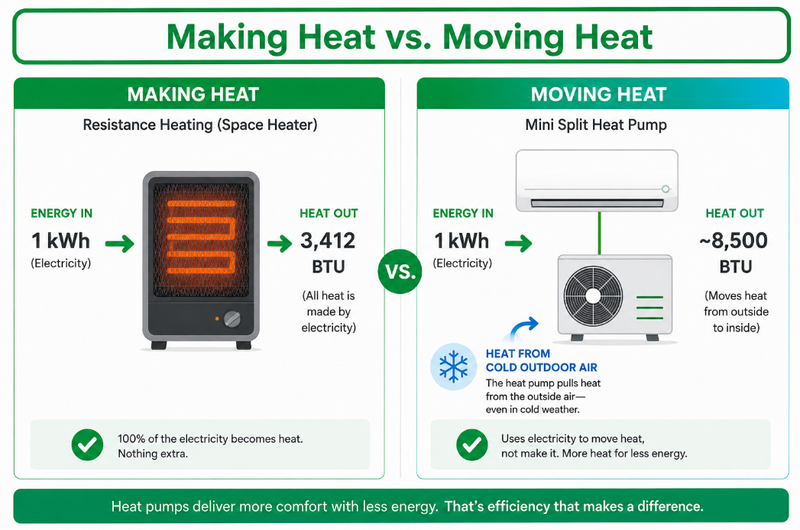
A ductless mini split costs about 60% less to run than a 1,500-watt electric space heater. At the U.S. average rate of 18.44 cents per kWh, putting 10,000 BTU of heat into a room costs about 54 cents from a space heater and about 22 cents from an ENERGY STAR mini split. A space heater is about 100% efficient. A mini split heat pump moves heat instead of making it, so it delivers 250% to 350% of the energy it uses.
The space heater still wins on upfront cost, so the right pick comes down to how many hours the room needs heat.
- Space heater, $40 to $150. About 100% efficient, and it tops out near 5,120 BTU per hour.
- Ductless mini split, $2,000 to $8,000 installed. A 12,000 BTU system covers up to 550 sq ft and cools the same room all summer.
- Neither one cleans the air in the room. The EPA states a mini split filter protects the equipment, not your lungs.

Answer 3 quick questions and we will point you to the right setup for your room.
Already know your size? Shop Filterbuy ductless mini split systems in 12,000, 18,000, and 24,000 BTU, with free 2-day delivery.
TL;DR: Quick Answers
A ductless mini split heat pump costs roughly 60% less to run than a 1,500-watt electric space heater, because a heat pump moves heat instead of making it. At the U.S. average rate of 18.44 cents per kWh, 10,000 BTU of heat costs about 54 cents from a space heater and about 22 cents from an ENERGY STAR mini split. The space heater still wins on upfront cost, and for a room you heat a few hours a week it usually wins overall.
Top Takeaways
A space heater is about 100% efficient. A mini split delivers 250% to 350%. That gap is the whole cost story.
A 1,500-watt space heater tops out near 5,120 BTU per hour. A 12,000 BTU mini split delivers more than twice that.
A single-zone mini split runs $2,000 to $8,000 installed. Heating savings alone rarely repay that in under a decade; year-round cooling is what makes the math work.
Neither unit filters the air you breathe. The EPA states mini split filters protect the equipment, not your lungs.
Which Costs Less To Run, A Mini Split Or A Space Heater?
A ductless mini split costs about 60% less per unit of heat than a portable electric space heater. A space heater converts electricity into heat at roughly 100% efficiency, while a mini split moves existing heat from outdoor air into the room and delivers 250% to 350% of the energy it consumes. Both run on the same electricity at the same rate; only one of them multiplies it.
Priced at the U.S. average residential rate of 18.44 cents per kilowatt-hour from the EIA Electric Power Monthly, Table 5.6.A, the difference looks like this.
Operating Cost Per Unit Of Heat Delivered
Filterbuy calculation. Seasonal COP = HSPF2 divided by 3.412. Efficiency thresholds from ENERGY STAR and DOE minimum standards; electricity rate of 18.44 cents per kWh from EIA, May 2026 data.
Those are full-output figures. A thermostatic heater cycles off once the room is warm, so real cost drops for both units in the same proportion and the ratio holds. Every comparison we read states the efficiency ratio without pricing it, so Filterbuy normalized both to one unit, the cost to put 10,000 BTU into the room, using published federal efficiency floors and the current national rate.
Your local rate scales the gap. At Idaho’s 12.35 cents per kWh the same 10,000 BTU costs 36 cents against 15; at Massachusetts’ 28.82 cents, 85 against 34.
Why A "100% Efficient" Space Heater Still Costs Three Times More
Every electric space heater is about 100% efficient, and that is exactly the problem. It cannot do better, because 100% is the ceiling for anything that makes heat by pushing current through a resistance element.
A heat pump is not bound by that ceiling because it does not make heat. A ductless mini split pairs an outdoor compressor with indoor wall units and no ductwork, extracting heat already present in the outdoor air and moving it inside, which takes far less energy than creating it.
COP (coefficient of performance) is heat delivered divided by electricity consumed at one temperature, while HSPF2 averages that across a season; divide HSPF2 by 3.412 for seasonal COP. The federal minimum for ductless systems is 7.5 HSPF2, and ENERGY STAR ductless certification requires 8.5. Filterbuy’s guide to the most energy-efficient mini splits breaks the tiers down further.
What A 1,500-Watt Space Heater Physically Cannot Do
A 1,500-watt space heater produces about 5,120 BTU per hour, and that number is fixed. Multiply 1,500 watts by 3.412 BTU per watt-hour and you get 5,118 BTU, which is why nearly every full-size portable heater advertises 5,120.
That ceiling comes from your wiring. A 1,500-watt unit draws 12.5 amps at 120 volts, and the National Electrical Code caps any load running three hours or more at 80% of a circuit’s rating, or 1,440 watts on a standard 15-amp circuit. One heater consumes a household circuit, which is why manufacturers warn against extension cords.
A 12,000 BTU mini split, the size Filterbuy sells for bedrooms, studios, and small living rooms up to 550 sq ft, delivers more than twice that heat. Most ductless systems are hardwired to a dedicated circuit, and mini split electrical requirements cover the exceptions. The U.S. Department of Energy names homes heated by space heaters and other non-ducted systems as a primary retrofit case. In a mild climate a space heater takes the chill off a 300-square-foot bedroom; in a Minnesota January, or a 500-square-foot garage, it runs nonstop without reaching setpoint.
What Does A Mini Split Cost Upfront, And When Does It Pay Back?
A single-zone ductless mini split runs about $2,000 to $8,000 installed by a pro, or $700 to $3,500 as a DIY pre-charged kit, with permits adding $250 to $400 where required. Our breakdown of single-zone mini split installation costs covers what drives the spread. A quality 1,500-watt space heater costs $40 to $150.
What Each Option Costs Before You Switch It On
Installed ranges reflect 2026 pricing across multiple industry cost sources. Filterbuy systems require professional installation, and the warranty is void if self-installed. The Section 25C credit was terminated for systems placed in service after December 31, 2025; confirm eligibility with a tax professional.
One distinction on that DIY line. Filterbuy’s own ductless systems require professional installation, and the warranty is void if self-installed, so those figures describe the category rather than our line.
Heating one room for 1,000 hours of full-output operation costs about $277 with a space heater against $111 with an ENERGY STAR mini split, a saving of roughly $166 a season. That is a nine-season payback on a $1,500 DIY kit, closer to twenty on a $3,500 install. The shortcut: a mini split saves about 16.5 cents per full-output hour, so divide installed cost by that for the hours it must deliver to break even, roughly 9,100 at $1,500.
Most people overestimate those hours. A home office heated four hours a weekday from November through March is about 440; a bedroom kept warm all winter, closer to 1,200; a garage as sole heat can pass 2,000.
Filterbuy sells ductless mini splits, which makes the next sentence worth reading twice. For a spare bedroom you heat a few evenings a week, the space heater is the better buy. Efficiency is a rate, not a savings, and a 60% discount on a small number is still a small number.
What flips the math is not efficiency but hours. A mini split also cools the same room all summer, and that second season is what carries payback from twenty years down to five or eight. One caution: the Section 25C credit was terminated for systems placed in service after December 31, 2025. Confirm eligibility with a tax professional, then check DSIRE for rebates your utility may still offer.
How Cold Weather Changes The Math
A heat pump’s advantage is narrowest exactly when you need heat most, because efficiency falls as the outdoor temperature drops. A mini split delivering a COP of 3.5 at 47°F may deliver 1.75 at 5°F, still 75% more heat per kWh than a space heater but a much narrower lead.
ENERGY STAR cold-climate models must retain 70% of rated capacity and a COP of at least 1.75 at 5°F, where standard models hold about 42% at 0°F. Filterbuy’s own line is rated for reliable heating down to 5°F. If one unit is your only winter heat below that, buy a cold-climate-certified model from a brand that builds for it rather than ours.
Does Either One Actually Clean The Air In The Room?
Neither a space heater nor a mini split cleans the air in the room. This is the part of the comparison Filterbuy knows best, after a decade of manufacturing air filters, and it is the question we get asked once the equipment is already on the wall.
A space heater has no filter at all. It pulls room air across a hot element and pushes it straight back out, which is why one stored all summer smells like dust baking onto the element.
A mini split does have a filter, a thin washable mesh screen behind the front face of each indoor head, but it protects the component rather than cleaning the air. The EPA states that ductless mini split heat pumps generally do not filter fine particles, because those filters exist to keep pet hair and lint off the coil. Where a manufacturer claims fine-particle capture, the EPA’s test is a documented MERV 13 or higher rating.
So the air in a heated room is only as clean as your whole-home filtration. If the room sits on your central HVAC return, a MERV 11 or MERV 13 pleated filter does that work, fitted to the highest rating your system fan and filter slot can accommodate. In a garage or attic your ductwork never reached, add a portable air cleaner, which we compare in mini split vs. air purifier. Either way, rinse the pre-filter every two to four weeks in the heavy-use season.
“I don’t want anyone to feel like they need an HVAC license just to pick the right filter. My job is to give you the straight answer, explain why it matters, and let you get back to your day.”
— Michelle Wan, Brand Manager and Air Quality Writer, Filterbuy
So Which Should You Choose?
It comes down to how many hours the room stays cold, and whether it also needs cooling.
Matching The Equipment To The Room
Garages, additions, sunrooms, and finished basements fall on the mini split side of this table more often than not.
Whichever you pick, run a space heater safely. Keep three feet of clearance, plug it directly into a wall outlet, and never leave it running unattended or while sleeping. NFPA data for 2019–2023 attributes 77% of home heating fire deaths to space heaters and heating stoves, and the NFPA publishes a one-page electric portable space heater safety sheet worth keeping on the fridge.
Supporting Statistics
Space heaters are the default supplemental heat in American homes.
The data: 37% of U.S. households use a secondary heat source, and nearly half of those reach for a portable electric heater, the top choice in every climate region.
Why it matters here: This is the mainstream answer to a cold room, not a niche one.
Heating is the largest energy expense in a U.S. home.
The data: Space heating was the top energy end use in U.S. homes in 2020 at 42% of residential consumption, averaging $519 per household.
Why it matters here: 16.5 cents an hour compounds fast against the biggest line in the energy budget.
Source: U.S. Energy Information Administration, 2020 RECS end-use results
In real homes, heat pumps cut electric-resistance heating use by about half.
The data: Across nearly 2,000 U.S. homes with electric resistance heat, converting to heat pumps cut heating electricity by a little over half.
Why it matters here: Field data, not a lab rating, landing close to the 60% gap the table above derives from efficiency standards.
Frequently Asked Questions
Keep The Air In That Room Clean, Too
However you heat a room, the filter decides how the air in it feels. Filterbuy makes MERV 8, MERV 11, and MERV 13 pleated filters, built in the USA and shipped free, with auto-delivery so a fresh one arrives on time. Find your filter size.
Glossary
BTU (British Thermal Unit): A unit of heat energy; one kWh equals 3,412 BTU.
COP (Coefficient of Performance): Heat delivered divided by electricity consumed at one outdoor temperature. A COP of 3.0 means three units of heat per unit of electricity.
Ductless mini split: A heat pump with an outdoor compressor connected by refrigerant lines to one or more indoor heads. No ductwork required.
Electric resistance heating: Heat made by passing current through a resistive element: space heaters, baseboard heaters, furnace heat strips. Efficiency is capped near 100%.
HSPF2 (Heating Seasonal Performance Factor 2): Seasonal heating efficiency in BTU per watt-hour, under the DOE test procedure effective January 1, 2023. Divide by 3.412 for seasonal COP.
MERV (Minimum Efficiency Reporting Value): A 1–16 scale rating a filter’s particle capture, defined by ASHRAE 52.2. MERV 13 captures particles down to roughly one micron.
Primary Sources: EIA, ENERGY STAR, U.S. Department of Energy, EPA, NFPA, ACEEE Report A1603, DSIRE, and the National Electrical Code. Verified August 29, 2026.
Disclosure: Filterbuy manufactures air filters and also sells ductless mini split systems. The operating-cost figures below come from published federal efficiency standards and utility rate data, not from our own product line, and the honest answer for many rooms is still a space heater.