
Mini Split vs. Heat Pump: What's the Difference? (They're Related)
A mini split is almost always a heat pump, but a heat pump is not always a mini split. Heat pump names what the equipment does, because a reversing valve lets one system both heat and cool. Mini split names how the equipment is built, because refrigerant lines feed indoor heads instead of ductwork.
- Heat pump describes function. Ducted and ductless versions both exist.
- Mini split describes configuration. Most U.S. mini splits are heat pumps, though cooling-only versions exist.
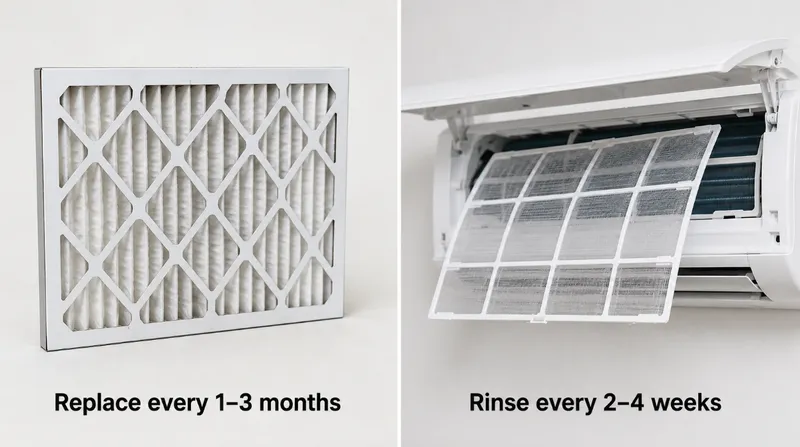
- Upkeep is where they split. A ducted return takes a replaceable pleated filter. A ductless head takes a washable mesh screen.
Not sure which one fits your home? Take the quick match quiz below and we will point you to the right system.

Already know you want ductless? Filterbuy sells variable speed ductless mini split systems from 12,000 to 24,000 BTU.
Answer a few quick questions and we will match you to your system.
TL;DR
A mini split is almost always a heat pump. A heat pump is not always a mini split. Heat pump names what the equipment does, moving heat in either direction. Mini split names how it is built and where the conditioned air comes out. Filterbuy sells both, which is why we care about the wording. The two paths lead to different aisles.
Key Takeaways
Heat pump describes function. A reversing valve lets one system heat and cool.
Mini split describes configuration. Refrigerant lines feed indoor heads instead of ductwork.
Most U.S. mini splits are heat pumps, though cooling-only versions exist.
Heat pumps come in ducted and ductless forms, and some mini splits are themselves ducted.
Upkeep splits by configuration. A ducted return takes a pleated filter, a ductless head takes a washable screen.
Why We Wrote This Page
Most companies explaining this distinction sell one side of it. Filterbuy sits in an odd spot, because we manufacture the pleated return filters that ducted heat pumps run on and we also sell ductless mini split systems. Both answers to this question are product lines on our own site.
That changes what we notice. Our Heat Pump Replacement filter is the same pleated media we sell for furnaces, because the equipment label never changes the filter. The duct configuration does. Our mini split systems ship with washable filters, and our pleated filters are not washable at all. The upkeep is where the two paths separate.
The Short Answer
A heat pump moves heat with a reversible refrigerant cycle, so one system covers heating and cooling. A mini split is a compact split system that sends refrigerant to indoor heads mounted in the rooms they serve, with no central ductwork required.
Those two answers describe different properties, which is why the terms overlap instead of competing. Nearly every mini split on the U.S. market is a heat pump, so a mini split quote is almost certainly a heat pump quote. The reverse does not hold. A ducted heat pump feeding your existing registers is no kind of mini split at all. Rebate programs lean on the broader term, which is where the mismatch starts.
What The Term Heat Pump Actually Names
Heat pump names a working principle. Refrigerant circulates between an outdoor coil and an indoor coil, a compressor drives the cycle, and a reversing valve flips the direction of flow. That valve is the whole difference between a heat pump and an air conditioner. Reverse the flow and the same hardware that pulled heat out of your house in July pulls heat out of the winter air and delivers it inside.
Nothing in that description mentions ducts. Air-source models are the common residential type, and ground-source models work the same way with a different heat source outside. Our guide to how a heat pump works covers the cycle in more depth.
What The Term Mini Split Actually Names
Mini split names a physical arrangement. Split refers to the two halves, an outdoor condensing unit and one or more indoor units. Mini refers to the size of those indoor units compared with a central air handler. A single conduit carries the refrigerant lines and the condensate drain through a hole roughly three inches across.
Because the indoor unit sits in the room it conditions, each one can run at its own setpoint. That zoning ability is what most people are really buying. Sizing and voltage selection follow from the configuration rather than from the function, which our mini split buying guide works through.
The Four Combinations You Can Actually Buy
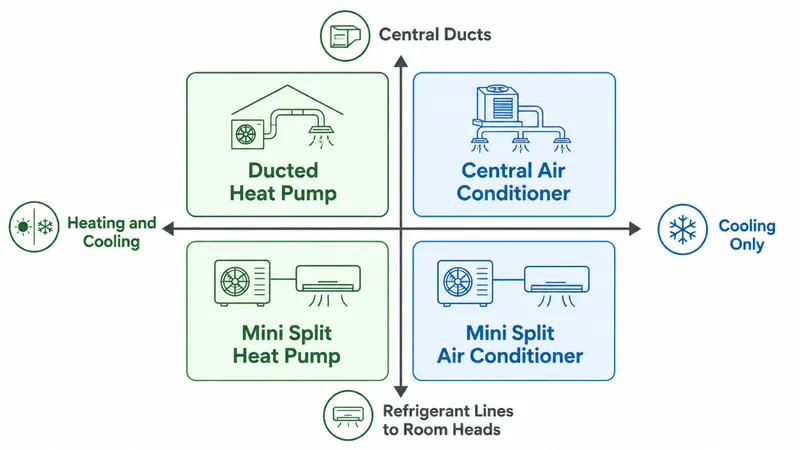
Cross the two ideas and four real product categories appear instead of two opposed ones.
Three of these four are heat pumps. The Filterbuy mini split systems in our own lineup fall in the second row, ductless and reversible, and they run R-32 rather than the R-410A being phased out of new equipment.
The bottom two rows break the shortcuts. A cooling-only mini split has no reversing valve, so it cannot be called a heat pump. A concealed-duct mini split feeds a short duct run from a hidden air handler, so a mini split can itself be ducted.
How To Tell Which One You Have
Start with where the conditioned air comes out. Air arriving through ceiling or floor registers means a ducted system. Air blowing from a unit mounted on the wall or ceiling of the room itself means a mini split. That settles the configuration in about five seconds.
Function takes one more step. Run the system in heating mode on a cool day. If the outdoor unit runs and warm air arrives, you have a heat pump. If your heat comes from a furnace or baseboards while the outdoor unit sits idle, the cooling equipment is an air conditioner.
For a mini split, check the remote for a heat mode and the nameplate for an HSPF2 rating. A cooling-only unit has none. Your model number in the certified performance directory confirms it.
What If Your Contractor Says Heat Pump And You Asked For A Mini Split
Probably nothing went wrong. Almost every mini split sold in the United States is a heat pump, so the two terms often describe the same equipment on the same quote. Confirm it by asking whether the indoor units are wall-mounted heads or a central air handler on ductwork.
Where The Two Terms Genuinely Diverge
Ductwork And Distribution
A ducted heat pump reuses the ducts already in the walls. A mini split needs none, which suits an older house or a room the central system never reaches. Duct losses can exceed 30 percent of space conditioning energy in an unconditioned attic, and a ductless system avoids that loss.
Zoning And Control
Each mini split head runs independently, so different rooms hold different temperatures without extra equipment. A ducted system can zone as well, though it takes dampers and multiple thermostats. The claim that heat pumps cannot zone at all is simply wrong.
Why The Wrong Word Costs You Money
State and utility incentive programs are written around the term heat pump. A homeowner reading eligibility pages using only the words mini split can conclude they do not qualify when they actually do. The same gap narrows the bids you collect, because a contractor who installs both may never surface for the narrower search.
Ask for both. A request phrased around heat pump options for a house without ductwork returns more of the market than a request for mini split pricing.
"People treat this as a shopping decision when it is closer to a vocabulary problem. Heat pump describes what the machine does. Mini split describes how it is built. Once that lands, the quotes and rebate pages start to make sense."
Michelle Wan, Brand Manager and Air Quality Writer, Filterbuy
When The Difference Does Not Matter
Plenty of decisions do not hinge on this. Both types run most efficiently at a steady setpoint instead of deep setbacks. Both defrost in cold weather, so a brief pause and a little steam are normal on either one.
Two situations make it worth getting right. Requesting quotes is one, and checking rebate eligibility is the other. The filter aisle is a third, covered below. Everywhere else the terms sit close enough to interchangeable that correcting someone is rarely worth it.
What The Difference Means For Your Filter
This is where the terminology stops being trivia. The two configurations create two different upkeep routines, and they run on different clocks.
If yours is ducted, the return filter is the one part you handle yourself, and getting the size right matters more than the brand on the box. Filterbuy builds pleated media from MERV 8 through MERV 13 in more than 600 sizes, with custom dimensions when a return does not match anything standard. Our heat pump replacement filter fits the same return whether the equipment is a heat pump or a furnace. For depth on rating selection, see our guide to heat pump filters.
If yours is ductless, there is no size to order. The mesh screen behind the front panel is a permanent part that you rinse and reinstall every two to four weeks, and the ductless mini split systems we sell are built around that routine.
Aftermarket upgrades deserve one warning. Add-on pads sold to boost a ductless head's filtration often cover only part of the mesh screen. Pacific Northwest National Laboratory documented the result. Air takes the path of least resistance around the pad, so the upgrade delivers very little. When fine particle capture matters in a room served by a head, a room air cleaner sized for that space beats a partial pad.
Seven Sources That Settle The Mini Split And Heat Pump Question
Each source below answers one specific question a homeowner runs into while shopping for a system.
1. Confirm In One Sentence That Your Mini Split Is A Heat Pump
ENERGY STAR treats mini split heat pumps and ductless heat pumps as the same equipment under two names, which resolves the terminology question without interpretation. Their ductless heating and cooling page also covers sizing and cold climate model selection.
2. Find Out Whether Your Unit Cools Only
The Department of Energy maintains a separate page for ductless minisplit air conditioners, and its existence is the cleanest proof that a mini split names a form factor rather than a function. That page also states outright that mini split filters carry low MERV ratings and do not capture the fine particles that affect indoor air quality. We hit the same split building our own catalog, which is why the pleated filters and the ductless systems sit in different departments.
3. See Every Mini Split Configuration Before You Buy
Pacific Northwest National Laboratory publishes a ductless heat pump design guide written for builders, and it documents concealed-duct mini splits alongside the familiar wall-mounted heads. This is the configuration that breaks the ductless-only assumption, and it is the one almost every comparison page omits. The guide also gives real service intervals, including the two-week mesh filter cleaning most product pages leave out.
4. Get The Exact Industry Definition Of Any Term On Your Quote
ASHRAE keeps a free HVAC terminology glossary of more than 3,700 built-environment terms, maintained by its terminology committee. An unfamiliar word on a contractor proposal can be checked there in a few seconds.
5. Verify That The Two Halves Of Your System Are Rated Together
AHRI certifies performance for specific indoor and outdoor unit pairings. The rating belongs to the pairing rather than to either box on its own. Swap the indoor unit for something the certificate does not list and the published numbers no longer apply, so ask your contractor for the reference number and look it up in the directory of certified product performance before signing.
6. Check Whether Your Model Actually Heats In Cold Weather
The Northeast Energy Efficiency Partnerships cold climate heat pump product list publishes low-temperature performance data for more than 35,000 air source heat pumps, ducted and ductless alike. Many state and utility rebate programs qualify equipment directly from this list, which is a second reason to know the broader term applies to your ductless unit.
7. Know Which Refrigerant Your New System Will Use
EPA restrictions on higher global warming potential refrigerants apply to residential air conditioners and heat pumps as an equipment class, so the rules follow the machine rather than the duct layout. The refrigerant technology transitions program page tracks the current requirements as they shift.
Three Statistics That Back Up The Distinction
Three sources confirm different parts of the argument above.
1. Federal Housing Data Files Mini Splits And Central Heat Pumps Separately
Two thirds of U.S. households use central air conditioning or a central heat pump as their main cooling equipment.
Half of Northeast households primarily use individual units instead.
That individual category groups window units, wall units, mini splits, and portable units together.
Federal statisticians classify by how air reaches the room rather than by what the equipment does.
The same split runs through our catalog. A ducted system sends you to a filter size, while a ductless system sends you to a cleaning schedule.
Source: 2020 Residential Energy Consumption Survey, U.S. Energy Information Administration, May 2022. household cooling equipment survey
2. Two National Laboratories Have Studied Ducted Mini Splits
Ducted mini splits saved roughly 33 to 60 percent against zonal electric resistance heat.
Ductless units saved 37 to 64 percent.
The ducted version used about 4 percent more energy than the ductless version.
Modeling covered five home configurations across three heating zones.
Federally funded modeling of the ducted version has existed since 2018, which settles the always-ductless claim without argument.
Source: Metzger, Zhang, Maguire, and Winkler, Are Ducted Mini-Splits Worth It, ASHRAE Journal volume 60, 2018. Report NREL/JA-5500-70404, hosted on DOE PAGES. ducted mini split field study
3. Twelve Percent Of Northwest Homes Already Run A Ductless Heat Pump
12 percent of Northwest single-family homes have one or more ductless mini split heat pumps.
96 percent of regional HVAC installation companies reported installing ductless systems in 2021.
The wrong search term costs real money at rebate time once adoption reaches that level.
Source: Northwest Energy Efficiency Alliance, Market Transformation in a Maturing Heat Pump Market, AESP Energy Intel, third quarter 2024. Northwest heat pump market analysis
Frequently Asked Questions
Glossary
Reversing valve. The part that flips refrigerant flow so one system can heat and cool.
SEER2. Seasonal cooling efficiency under the test procedure in force since 2023.
HSPF2. Seasonal heating efficiency. A cooling-only unit has none.
Head. The indoor unit of a ductless system, holding a small fan and coil behind a washable screen.