Mini Split for a Small Office: Sizing, Cost, and Setup Guide
Author: Michelle Wan, Brand Manager & Air Quality Writer | Reviewer: David Clark, Licensed HVAC Technician | Published September 9, 2026
What Size Mini Split Do You Need For An Office?
A small office needs about 20 BTU per square foot, plus 450 BTU per hour for each person and 425 for each workstation. A 400 square foot office with three staff lands near 10,625 BTU per hour, which points to a 12,000 BTU system. Residential sizing charts leave out the heat that bodies and computers add, so they come in 22% to 38% light.
- 200 to 300 sq ft, 1 to 2 people: 9,000 BTU
- 400 sq ft, 3 people: 12,000 BTU
- 600 sq ft, 5 people: 18,000 BTU
- 800 sq ft, 7 people: 24,000 BTU
- 1,000 sq ft or more, 8 or more people: multi-zone
Shop Ductless Mini Split Systems

Answer a few quick questions and we will match your office to the right system size.
TL;DR
A ductless mini split conditions a single zone without ductwork, which makes it a good fit for a small office, and a 300 to 450 sq ft space runs $1,500 to $3,100 installed. Size it by adding the heat people and equipment throw off to the square-footage load, because a consumer chart alone leaves you 22% to 38% short. What it will not do is filter your air, since the EPA states that ductless systems generally do not capture fine particles.
Key Takeaways
Office sizing is not bedroom sizing. ASHRAE puts an office worker at 450 BTU per hour and a workstation at 425. A consumer chart runs 22% light for one person and 38% for seven.
A single-zone office system costs $1,200 to $5,500 installed in 2026; multi-zone runs $4,000 to $9,000. Section 25C expired December 31, 2025.
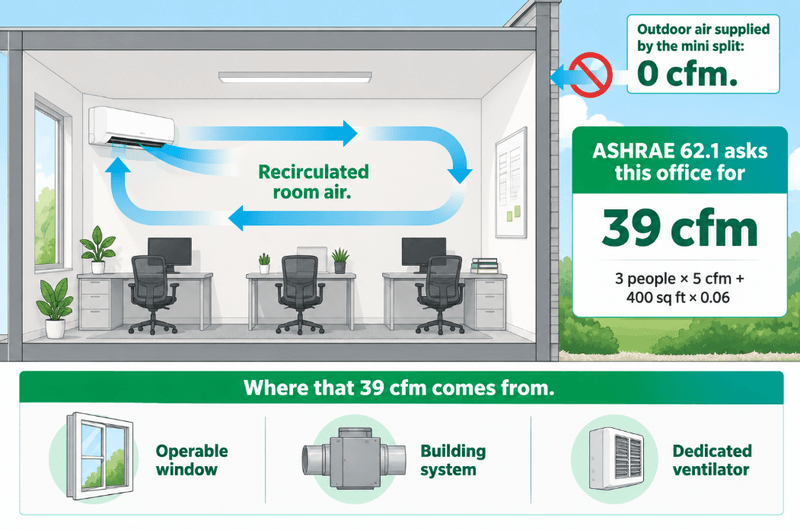
A mini split supplies zero outdoor air. ASHRAE 62.1 asks an office for 5 cfm per person plus 0.06 cfm per square foot, which a ductless head cannot supply.
The mesh screen is a coil guard, not an air filter. It carries no MERV rating, so filtration comes from a ducted unit, a central system or a HEPA cleaner.
What Size Mini Split Does A Small Office Need?
A small office needs roughly 20 BTU per square foot for the envelope, plus about 450 BTU per hour per person and 425 per workstation. A 400 sq ft office with three staff lands near 10,600 BTU/h, pointing to a 12,000 BTU system. Residential charts skip those internal loads, which is why offices sized from them run warm by mid-afternoon.
A bedroom holds one sleeping person and a lamp. An office the same size holds bodies, screens and a printer, all throwing off heat during the hours the sun is highest, and those gains can reach half the cooling load.
Filterbuy comes at this from an odd angle, having made air filters in Talladega since 2013, sold its own single-zone ductless systems at published prices with free 2-day delivery, and installed HVAC in Florida and Texas through Filterbuy HVAC Solutions. Most guides come from one of those seats. Sitting in all three is why the sizing below comes from the equipment side and the filter advice from the manufacturing side, and why the two point in different directions.
The Office Load Adder
Values convert manufacturer wattage to BTU/h at 3.412 BTU per watt. Add these to the base envelope load, not instead of it.
Office Sizing, And How Far Off A Residential Chart Puts You
Filterbuy analysis. Residential column uses the 20 BTU per square foot rule of thumb; office column adds the Table 1 values at one workstation per person. Assumes 8-foot ceilings and a moderate climate.
Filterbuy ran the same offices through both methods, and the error is not a fixed offset. It widens with headcount, because every desk adds a person and a machine the square-footage rule never counts.
An inverter can usually absorb the gap at the top of the table but not the one at the bottom, which is the difference between a room that feels warm on bad afternoons and one that never catches up. Only a Manual J calculation gives an exact number, and on a commercial space it is worth the hour.
How Much Does An Office Mini Split Cost In 2026?
A single-zone office mini split costs $1,200 to $5,500 fully installed, with a common 12,000 BTU system landing between $1,500 and $3,100, while multi-zone systems run $4,000 to $9,000. Equipment accounts for roughly 60% of that, and labor, electrical work and permits make up the rest. The figures below match our full mini split installation cost breakdown.
Installed Cost By System Size
2026 installed pricing. A dedicated 208/230V circuit adds $300–$800 where one does not already exist. Commercial permits and after-hours labor in occupied tenant space are additional.
Three line items catch commercial buyers off guard. A 208/230V circuit adds $300 to $800 where none exists, which is why 115V models matter in older buildings. Commercial permits run higher and often need a contractor’s stamp. And work inside an occupied space happens after hours, at premium rates.
Section 25C covered up to $2,000 for qualifying heat pumps until the One Big Beautiful Bill Act ended it. The IRS states the credit is not allowed for any property placed in service after December 31, 2025, so a 2026 install does not qualify. Commercial buyers have a second date, because the same guidance ends the Section 179D commercial buildings deduction for construction beginning after June 30, 2026. Rules vary by business structure, so confirm eligibility with a tax professional and check state rebates separately.
When A Mini Split Is The Wrong Answer
A ductless system suits most small offices, though four situations point elsewhere. Two are about air rather than temperature, one is a cheaper route you may own, and the last is a load a wall head cannot carry.
Fresh air is the real problem. Stuffiness in an occupied room is a ventilation symptom, and a mini split moves no outdoor air.
Clean air is why you are buying. The EPA is explicit that a ductless head is not a filtration device, so budget for a HEPA cleaner or ducted equipment instead.
You already have ductwork with spare capacity. Extending it is usually cheaper and keeps filtration on one filter, not two.
A server rack runs around the clock. An equipment closet is a nearly all-sensible load running at 3 a.m., which needs a different class of equipment.
How Do You Set Up A Mini Split In A Commercial Office?
A commercial install adds three steps to a residential one: a mechanical permit, a commercial circuit and a ventilation check. A single zone takes about a day, and nearly every manufacturer, Filterbuy included, voids the warranty on a self-install.
Get a Manual J calculation. Bring headcount, equipment list and window orientation. Table 2 shows what skipping it costs.
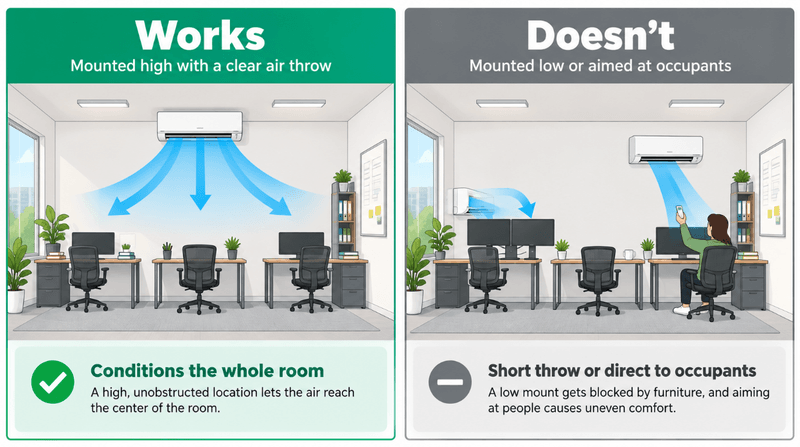
Place the head high and clear. Heads throw air downward and need open space, not a spot behind a monitor wall. Do not aim one at a desk; whoever sits there will switch it off.
Confirm the electrical. Most 12,000 BTU units run on 115V or 208/230V; 18,000 and above need 230V. Verify panel capacity early, since this most often stalls an install.
Pull the permit. Most jurisdictions require one, and some want refrigerant charge documentation at inspection. Filterbuy HVAC Solutions files permits on Florida and Texas installs; elsewhere, ask who files.
Solve ventilation separately. This is the step offices skip. ASHRAE 62.1 sets office outdoor air at 5 cfm per person plus 0.06 cfm per square foot, about 39 cfm for a 400 sq ft office with three people. A ductless head delivers none of it, so that air comes from a window, the building system or a ventilator.
Commission and document. Confirm the refrigerant charge, verify airflow, and record model and serial for warranty.
What Filter Does An Office Mini Split Use?
A wall-mounted mini split uses a washable mesh pre-filter, not a pleated one, and the EPA states that ductless heat pumps generally do not filter fine particles. That mesh keeps lint off the coil and carries no MERV rating, which matters in an office running eight to ten hours a day.
Rinse it every two to four weeks in cooling season; ENERGY STAR puts the loss from restricted airflow at up to 15%. More in do mini splits have filters and how to clean a mini split.
“We make the pleated filters that ducted systems take, and we sell the ductless heads that don’t. That gap is the part offices miss. A mini split will hold a room at 72 degrees all day and do very little about what is in the air while it does it. Two separate jobs, and you buy for both.”
— Michelle Wan, Brand Manager and Air Quality Writer, Filterbuy
Three setups give real fine-particle capture:
A ducted or concealed-duct mini split, the only configuration that takes a 1-inch pleated filter. Those returns are often odd sizes, which is what Filterbuy’s custom line was built for. Shop MERV 13 filters in 600+ sizes or build a custom size.
Your existing central system, if the office has one. Run MERV 11 to 13 there and let the mini split handle temperature. Multi-site buyers order via Filterbuy Business.
A portable HEPA cleaner, sized by Clean Air Delivery Rate. EPA sets 65 cfm per 100 square feet, so a 400 sq ft office needs 260 cfm. Compare both in mini split vs. air purifier.
If a manufacturer advertises high-efficiency filtration on a ductless head, the EPA test is simple: look for a documented rating of MERV 13 or higher, or as high as the fan and filter slot can take. Without one, fine-particle capture has not been demonstrated, and even then the unit treats only its own room, only while running.
Supporting Statistics
Three federal findings behind the guidance above.
Figures retrieved from the primary source; pages confirmed live September 7, 2026.
Sources: EIA 2018 CBECS, EPA Report on the Environment, EPA Guide to Air Cleaners, ENERGY STAR, IRS FS-2025-05. Table 1 values are ASHRAE Handbook of Fundamentals and ASHRAE 90.1 figures.
Frequently Asked Questions
Glossary
Ductless mini split: An outdoor compressor linked to indoor heads by refrigerant lines, no ductwork.
BTU: British Thermal Unit, the measure of capacity. 12,000 BTU per hour equals one ton.
Manual J: The ACCA procedure for calculating a building’s heating and cooling load.
MERV: The 1-to-16 ASHRAE particle-capture scale. MERV 13 is the EPA threshold for fine particles; mesh screens are unrated.
ASHRAE Standard 62.1: The commercial ventilation standard in the International Mechanical Code, setting outdoor air rates by occupancy.
CADR: Clean Air Delivery Rate, used to size a portable air cleaner.
HEPA: A grade capturing 99.97% of particles at 0.3 microns, used in portable cleaners.
Section 25C: The federal Energy Efficient Home Improvement Credit, terminated after December 31, 2025.
Filterbuy: An air filter manufacturer in Talladega, Alabama, making its filters in the USA since 2013. Filterbuy also sells a single-zone ductless mini split line, and Filterbuy HVAC Solutions installs HVAC in Florida and Texas.