Installation, Costs & Filter Guide (CO Climate)
By Michelle Wan · Technically reviewed by David Clark, Licensed HVAC Technician · Published August 24, 2026 · Updated August 24, 2026
A single-zone mini split in Denver runs about $4,800 to $9,500 installed for a cold-climate heat pump, or $3,000 to $5,000 for a cooling-only unit. Which one you need comes down to one number: Denver's design temperature is −2°F, and most units are rated at 5°F.
So match the unit to the job:
Answer a few quick questions and we will point you to the right system for your space.

Find your match. Answer 3 quick questions and we will match you to the right mini split for your space.
Ready to look at units? Shop Filterbuy mini split systems , single zone, from $799 for the 12,000 BTU (up to 550 sq ft), with free 2-day delivery on in-stock systems. Professional installation required; the warranty is void if self-installed.
A cold-climate ductless mini split in Denver costs about $4,800 to $9,500 installed for a single zone and $22,000 to $32,600 whole-home in 2026, before incentives. Xcel Energy pays $2,250 per heating ton for cold-climate models, but that rate drops to $1,500 on October 1, 2026. Denver's rebate stack and its −2°F design temperature both reward the cold-climate unit.
Disclosure: Filterbuy manufactures air filters and sells single-zone mini split systems. This page names the conditions a Denver system has to meet before it names ours, and it says plainly where our unit is not the right answer.
A mini split suits Denver's older, duct-free housing stock, but only a cold-climate model on the NEEP product list belongs on a Denver exterior wall. Installed cost runs $4,800 for one zone to $32,600 whole-home. Three 2026 programs stack on top of that: Xcel, the state Heat Pump Tax Credit, and Power Ahead Colorado. Their published amounts can total $7,000 to $12,000 on a typical job, subject to each program's eligibility rules. Xcel's cold-climate rate falls by a third on October 1.
Denver's ASHRAE 99% winter design temperature is −2°F, seven degrees colder than the 5°F benchmark Xcel uses for rebates. Rebate-qualifying and Denver-capable are different tests.
Xcel pays $2,250 per heating ton at 5°F for cold-climate ductless through September 30, 2026, then $1,500. Standard ductless drops from $900 to $600 per cooling ton the same day.
A mini split added to a garage, sunroom, or bonus room may drop to a flat $500 Xcel rebate after October 1, 2026 if it covers under half the home's heating load or conditions a previously unconditioned space.
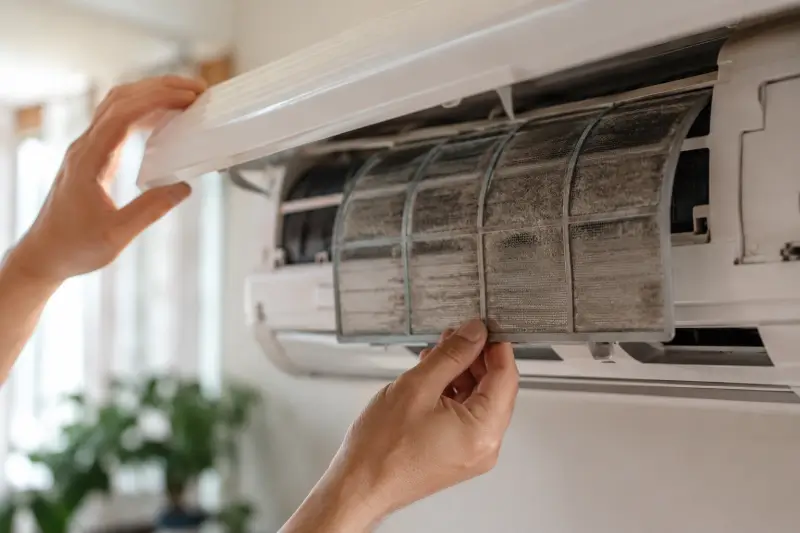
A mini split's factory mesh filter performs near MERV 1–4. It is a coil guard, not an air cleaner.
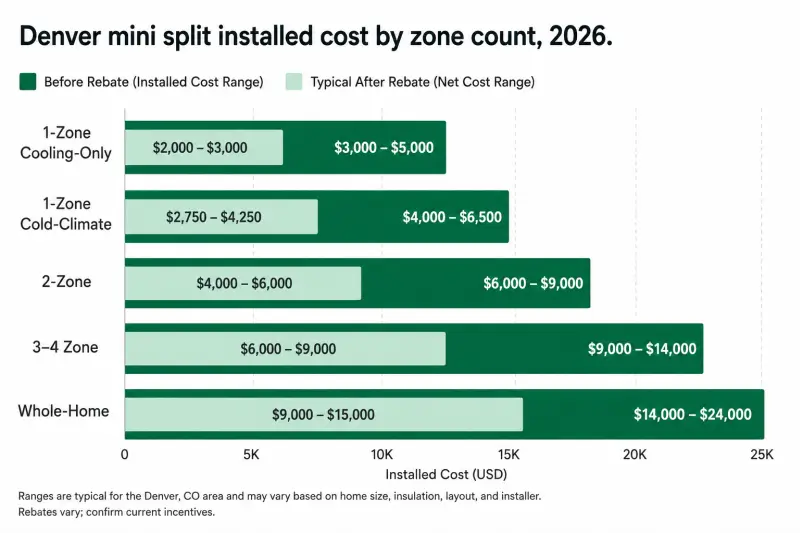
Mini split installation in Denver costs $3,000 to $5,000 for a single cooling-only zone, $4,800 to $9,500 for a cold-climate heat pump zone, and $22,000 to $32,600 whole-home, before rebates. Zone count drives the price; electrical capacity is the surprise, since pre-1960 housing stock often needs panel work.
Installed cost before incentives, by configuration:
Single zone, cooling-only: $3,000 to $5,000
Single zone, cold-climate heat pump: $4,800 to $9,500
Two zones, cold-climate: $9,000 to $15,000
Three to four zones: $14,000 to $22,000
Whole-home, five to eight zones: $22,000 to $32,600
Filterbuy compiled these ranges in August 2026 from published Denver-metro contractor pricing. Our own line is single zone only; the multi-zone figures are market pricing, not our product. Budget separately: cassette heads $900 to $1,900 each, a 240V circuit $500 to $900, a panel upgrade $4,500 to $6,500. The cold-climate premium runs $1,200 to $2,000 and is self-financing: the Xcel rebate is $1,350 per ton higher for cold-climate equipment, so the better system usually costs less out of pocket. See our Colorado mini split rebates guide.
Denver sits entirely inside Xcel Energy's Colorado territory, so every homeowner here can access the state's largest heat pump rebate with no income check. Filterbuy checked each program's own page in August 2026 rather than relying on a roundup. Nearly every competing Denver guide we looked at still lists a dead program as live.
Three programs are live for Denver in 2026.
Xcel Energy cold-climate ductless (ccMSHP): $2,250 per heating ton at 5°F, with no income test. Falls to $1,500 per ton on October 1, 2026. Standard ductless (MSHP) pays $900 per cooling ton and falls to $600 on the same date.
Colorado Heat Pump Tax Credit: $1,000 for air-source equipment, applied at point of sale by a state-registered contractor. At least $333 must reach you as a discount.
Power Ahead Colorado (DRCOG): $1,500 flat, cold-climate equipment only, no income limit. Opened June 29, 2026, and requires pre-approval before work begins.
Three more are closed, and Denver guides still list them.
Federal 25C credit: nothing. Terminated for systems placed in service after December 31, 2025.
HEAR, the federal Home Electrification and Appliance Rebates program: up to $8,000 for income-qualified households, but Region 1 funds along the Front Range were fully reserved on April 28, 2026.
Denver CARe: nothing. The program ended in May 2025.
Two rules decide most outcomes here. Power Ahead Colorado does not stack with HEAR, the federal Home Electrification and Appliance Rebates program, since both draw on the same funding, and Power Ahead requires contractor pre-approval before work begins, so it belongs on the estimate.
A 3-ton system quoted at $15,000, assuming every program's terms are met: $6,750 from Xcel, $1,500 from Power Ahead, and $333 to $1,000 from the state credit nets roughly $5,750 to $6,400. Install on October 2 and the Xcel share drops to $4,500. These are published program amounts, not an estimate of what you will receive; your contractor confirms eligibility, and a tax professional should confirm any credit.
A footnote that catches homeowners off guard: from October 1, 2026, a supplemental ductless unit covering under 50% of the home's heating load, or conditioning a previously unconditioned space, drops to a flat $500 Xcel rebate. If your project is one head for a hot bedroom, the calendar matters more than the negotiation.
Denver's design temperature is colder than the benchmark its biggest rebate is rated on. Denver County is IECC Climate Zone 5B, with an ASHRAE 99% winter design temperature of −2°F. Xcel's premium rebate is rated at 5°F. Seven degrees apart, and this is the gap we kept returning to while building the page, because we have not found another Denver guide that connects them. A system can qualify for Colorado's largest rebate and still fall short on the coldest morning in February. Ask for published capacity at Denver's design condition, not the AHRI nameplate.
Altitude is the second correction, and it is widely mishandled. Denver's 5,280 feet cuts air density by roughly 17%, but the familiar "derate 4% per 1,000 feet" rule comes from the National Fuel Gas Code and governs combustion equipment. Mini splits are refrigerant-cycle, corrected through manufacturer altitude tables plus airflow and charge adjustments under ACCA Manual S, after a Manual J load calculation. An installer quoting a furnace derate for a heat pump is guessing.
A competent sizing process runs in three steps: a room-by-room Manual J at −2°F and 93°F; Manual S selection against expanded performance data at 5,280 feet; and a NEEP Cold-Climate ASHP Product List check on that model, with heating capacity at or below 0°F in writing.
"A nameplate rating is a lab number taken at 47 degrees. It tells you almost nothing about the coldest morning of the year. The first thing I want on a proposal is published capacity at the design temperature. Without it, the sizing is a guess dressed up as a spec."
David Clark, Licensed HVAC Technician, technical reviewer
Denver requires a mechanical permit, and in nearly all cases a Denver-licensed contractor must pull it and do the work. One narrow exception: under Denver Building Code Section 131.3, an owner-occupier of a single-family home may pull a mechanical/HVAC permit for their own residence after passing a city exam. The City and County of Denver publishes heat pump permitting instructions precisely because these are often filed wrong, and a delay is expensive when a rebate deadline is attached.
Whatever brand you choose, professional installation is required on our line and the warranty is void if self-installed. Two questions separate an installer worth hiring. First: "Can I see the Manual J and Manual S for my house?" A refusal is your answer. Second: "Will you apply the Xcel rebate and state credit up front, and file Power Ahead pre-approval?" Good contractors discount the invoice rather than send you chasing a check. Cross-check any name against the state's registered contractors, the Power Ahead contractor finder, and the ACCA locator.
Where our experience comes from, and where it stops. Filterbuy manufactures air filters in the United States, and our HVAC Solutions technicians service ductless systems daily in Florida and Texas. That is real knowledge of how these units run and how fast their filters load. It does not make us your Denver installer; we do not operate in Colorado.
And our own mini splits are not the answer for a Denver winter. Filterbuy mini split systems are single zone and rated for reliable heating down to 5°F. Denver's design temperature is −2°F. If this unit is your heat source, buy a cold-climate system off the NEEP list from another brand. Where ours does fit a Denver home is summer cooling and supplemental zones: a garage, a workshop, a room addition, or the upstairs bedroom your central system never reaches. Published prices start at $799 for the 12,000 BTU (up to 550 sq ft), with free 2-day delivery on in-stock systems, a 7-year compressor and 3-year parts warranty, and ETL and AHRI certification. Professional installation is required and the warranty is void if self-installed, so the install belongs to a Denver-licensed contractor either way.
Denver's duct-free housing stock, the Victorians and 1920s bungalows a mini split suits best, overlaps heavily with the city's landmark districts: Baker, Potter Highlands, Alamo Placita, La Alma Lincoln Park, and dozens more. Almost no mini split guide mentions it.
An outdoor condenser and a line-set penetration are exterior changes. On a landmark or in a historic district, Denver Landmark Preservation reviews them and issues a Certificate of Appropriateness before Development Services issues your permit. Section 2.15 of the landmark design guidelines covers mechanical equipment. In practice:
Condenser placement gets steered off primary facades and the public right-of-way
Line-set routing on a visible elevation may need screening or a different path
The COA comes first; the mechanical permit follows it
Small, low-visibility work can qualify for Landmark Quick Review
Check your address before you sign anything. Denver publishes landmark guidance on electrical and mechanical permits.
Honestly: sometimes no.
The Xcel rate is tied to the invoice date, and every good Denver contractor knows the deadline is coming, so late September is the worst week of the year to shop. Rushing buys a thinner quote pool, less leverage to demand a Manual J, and a real chance of an oversized system. Do the math on your own job:
3-ton cold-climate system: waiting costs about $2,250
A wrong-sized system: costs more than that, every winter, for fifteen years
Have a signed proposal with published capacity at design temperature? Move. Still collecting quotes in mid-September? Take the smaller rebate and the better install. Either way, have the contractor confirm your rebate eligibility in writing before the invoice date.
A mini split's factory filter is a washable mesh screen performing near MERV 1 to 4. Its job is keeping dust off the coil, not capturing wildfire smoke. That gap matters more here than in most metros: the American Lung Association ranked the Denver-Aurora-Greeley area 8th worst in the nation for ozone, and the Front Range logged its 13th ozone action day of 2026 by the end of June.
Filterbuy's Denver cleaning cadence, adjusted for dry air and ozone season:
November through April, when the air is cold and dry and heating runtime is high: rinse the mesh filter every three to four weeks, and change a central MERV 11 to 13 filter every 60 to 90 days.
May through October, through ozone season and wildfire smoke: rinse the mesh filter every two weeks, and change a central MERV 13 filter every 30 to 60 days.
Within 48 hours of a CDPHE action day or any smoke event, when PM2.5 spikes: inspect and rinse the mesh, and change the central filter regardless of its age.
"We make the filters, so we see what comes back off a coil. The mesh screen in a mini split is a coil guard, not an air cleaner. It was never designed to catch smoke particulate. And in air this dry, it loads faster than the manual's cleaning interval assumes."
Michelle Wan, Filterbuy
Rinse on a schedule, not on a symptom: hold the mesh to white paper, and if it reads gray it is already costing you airflow. Filterbuy's how to clean mini split filters guide covers the routine; our mini split service schedule covers the annual visit. If any part of your home is still forced-air, that filter is your real lever. The EPA recommends MERV 13 or higher during smoky periods, and Filterbuy MERV 13 air filters capture particulate a mesh screen cannot. Check that your system can handle the added static pressure before stepping up a MERV rating; not every blower is sized for it, and a filter your system cannot pull through helps nothing. An auto-delivery subscription means no hardware-store run on an action day.
Supporting Statistics
Three federal datapoints behind the advice above.
81 ppb: Denver Metro/North Front Range design value, 2022–2024
70 ppb: the 2015 federal standard (75 ppb under 2008)
Severe under 2008; Serious under 2015, deadlines in 2027
Denver filtration is year-round, not a fire-season reaction.
Source: U.S. EPA, Denver Metro/North Front Range Ozone Planning
DOE's Cold Climate Heat Pump Technology Challenge requires:
100% capacity ratio, 5°F to 47°F
2.1–2.4 minimum COP at 5°F
The Challenge covers ducted systems, not ductless. But 5°F is the same threshold Xcel applies to mini splits, so the bar transfers. Hold your quote to it, remembering 5°F is the benchmark, not Denver's −2°F design condition.
Source: U.S. DOE, Residential Cold-Climate Heat Pump Technology Challenge
EPA findings for wildfire smoke events:
~50% less indoor PM2.5 with a high-efficiency filter, fan running continuously
~24% less with a typical low-efficiency filter, fan continuous
55–60% of outdoor levels with windows closed and no air cleaner
MERV 13+ is EPA's recommendation during smoky periods
Closing the windows is not the plan. Filtration is.
Source: U.S. EPA, Strategies to Reduce Exposure Indoors
A single-zone cold-climate mini split costs about $4,800 to $9,500 installed before incentives; whole-home multi-zone runs $22,000 to $32,600. Published amounts for Xcel, the state credit, and Power Ahead Colorado can total $7,000 to $12,000 on a typical job, though eligibility depends on your equipment, contractor, and property. Confirm each program's terms before you count on a number.
Cold-climate certified models do; standard-efficiency models generally do not. Denver's 99% winter design temperature is −2°F, so ask for published heating capacity at or below 0°F for the exact model quoted.
Yes. Denver requires a mechanical permit plus electrical permitting, with rough and final inspections. In nearly all cases a Denver-licensed contractor must pull the permit and do the work. Denver Building Code Section 131.3 allows a narrow owner-occupier exception, but it requires passing a city exam first.
If your home is a designated landmark or sits in a historic district, yes. The outdoor condenser and line-set penetration are exterior changes, so Denver Landmark Preservation must issue a Certificate of Appropriateness before Development Services issues the mechanical permit. Check your address before signing a proposal. It is the step most likely to delay a project with a rebate deadline attached.
No. The 25C credit was terminated for systems placed in service after December 31, 2025; confirm eligibility with a tax professional. For 2026 Denver installations, Xcel, the Colorado Heat Pump Tax Credit, and Power Ahead Colorado carry the value.
Only if you already have a signed proposal showing published heating capacity at Denver's design temperature. The Xcel cold-climate rate falls from $2,250 to $1,500 per heating ton on October 1, which costs about $2,250 on a 3-ton system. An oversized system costs more than that every winter for the life of the equipment. If you are still collecting quotes in mid-September, take the smaller rebate and the better install.
Rinse the mesh filter every three to four weeks from November through April, and every two weeks from May through October when ozone and smoke are active. Check it within 48 hours of any smoke event.
Whatever brand goes on your wall, the filtration plan has to suit dry air, dust, and Front Range smoke. Find your filter size and start Filterbuy auto-delivery. And if what you actually need is a single-zone unit for a garage, workshop, or room addition rather than a whole-home cold-climate system, Filterbuy mini split systems start at $799 with free 2-day delivery on in-stock systems.
Ductless mini split: one outdoor condenser linked by refrigerant lines to indoor air handlers, each its own zone. Denver homes typically use one to four.
Cold-climate heat pump (ccMSHP): certified to hold rated heating capacity in cold weather; Xcel's Colorado threshold is 5°F.
NEEP Cold-Climate ASHP Product List: the Northeast Energy Efficiency Partnerships list verifying cold-climate performance. Xcel's top rate requires a listed model.
MERV: the ASHRAE 52.2 filter efficiency scale. Mesh screens sit near MERV 1–4; MERV 13 captures smoke particulate.
Power Ahead Colorado: a DRCOG rebate of $1,500 for cold-climate heat pumps in participating Denver-metro jurisdictions, open since June 2026.