Adding a Mini Split AC System in Colorado
Installation, Costs & Rebates (CO Guide)
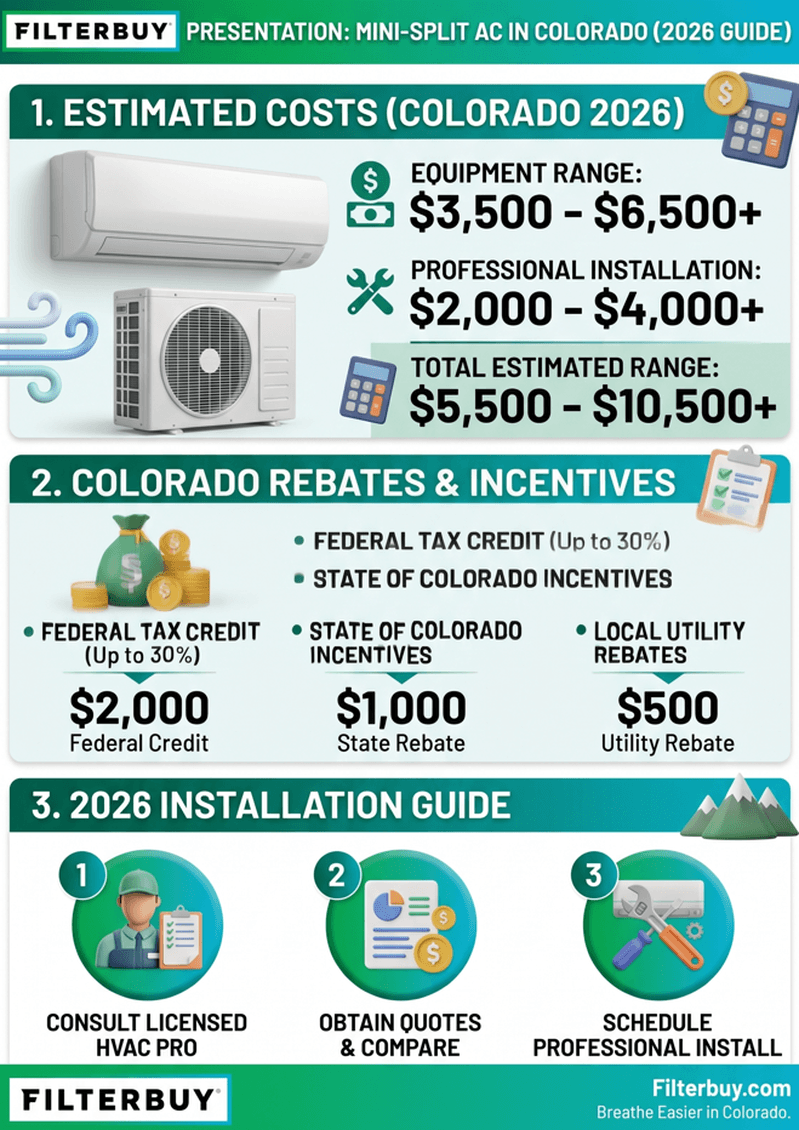
A professionally installed cold-climate mini-split in Colorado runs about $4,800 for a single zone and up to $29,000+ for a whole-home multi-zone system in 2026 — and Colorado's rebate stack can cut that cost 40% to 70%. Xcel Energy pays $2,250 per ton for cold-climate models, and homes in select mountain ZIP codes qualify for up to $7,500 per ton. Stack the state Heat Pump Tax Credit and, for income-qualified households, federal HEAR funds, and a typical $15,000 install can land near $7,000 net — or close to $0.
The 2026 Colorado rebate stack, at a glance:
- Xcel cold-climate rebate: $2,250 per ton (up to $7,500 per ton in select mountain ZIPs)
- Colorado Heat Pump Tax Credit: about $1,000, applied at the point of sale
- Federal HEAR rebate: up to $8,000 for income-qualified households
Not sure which system or filter fits your home? Take the quick match quiz below.

Answer 3 quick questions and we'll match you to the right Filterbuy mini-split system and filtration plan.
Xcel Energy will pay Colorado homeowners up to $7,500 per ton this year to install a cold-climate mini-split heat pump in select mountain ZIP codes. The standard cold-climate rebate runs $2,250 per ton everywhere else in the state. Stack that with the Colorado Heat Pump Tax Credit and—for income-qualified households—up to $8,000 in federal HEAR funds, and a typical $15,000 install lands closer to $7,000 net. For some households, closer to zero.
We've shipped over a million American-made air filters into Colorado homes for more than a decade, from Fort Collins down to Durango. That long view tells us two things most installer guides won't mention. The equipment that qualifies for the biggest rebates is also the equipment that survives a Front Range February. And the filtration plan you choose matters as much as the system you install, especially during wildfire season.
TL;DR Quick Answers
Adding a Mini Split AC System, Including Rebates in Colorado
A professionally installed cold-climate mini-split in Colorado runs $4,800 for a single zone and $24,000 to $29,000+ for whole-home multi-zone setups in 2026. Cold-climate certified models qualify for $2,250 per ton in Xcel Energy rebates, and homes in Mountain Energy Project ZIPs—Breckenridge, Frisco, Dillon, Silverthorne, Leadville, Grand Lake, and Red Cliff—qualify for up to $7,500 per ton. The Colorado Energy Office Heat Pump Tax Credit adds a point-of-sale discount through registered contractors, and income-qualified households can stack up to $8,000 from the federal HEAT program. The federal 25C tax credit expired December 31, 2025, so state and utility programs now carry the full incentive value.
Top 5 Takeaways
The short list before you dive in:
Installed cost runs $4,800 to $29,000+. Single-zone systems start around $4,800. Whole-home multi-zone setups go up to $29,000 before rebates.
Only NEEP-listed cold-climate heat pumps belong on a Colorado exterior wall. Standard mini-splits can lose significant heating capacity as temperatures drop below 20°F and may not provide reliable performance in extreme cold conditions.
Xcel Energy is the anchor of your rebate stack. $900 per ton for standard models, $2,250 per ton for cold-climate models. Applied as an upfront discount on your invoice.
The federal heat pump credit ended December 31, 2025. Colorado state and utility rebates more than cover the gap for most households in 2026.
Pair your mini-split with MERV 11 or MERV 13 central filtration if you have a forced-air system. Mini-split onboard filters alone won't keep wildfire smoke out of your bedrooms.
What Is a Ductless Mini-Split AC System?
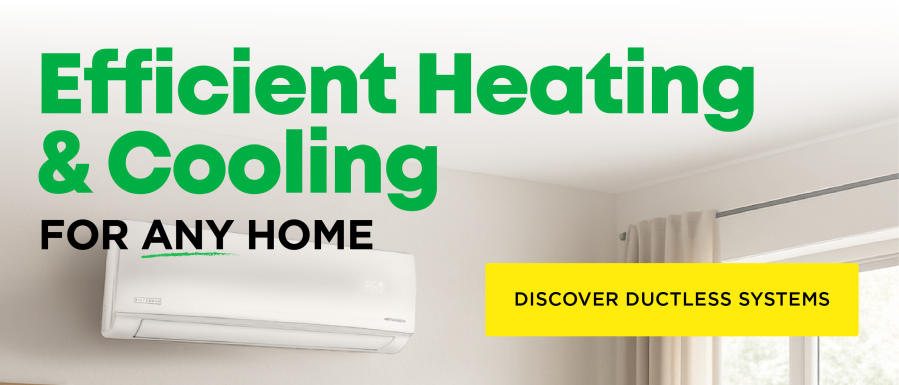
A ductless mini-split is a type of air conditioning and heating system built around two main parts. An outdoor condenser, about the size of a carry-on suitcase, sits on a pad outside your home. One or more indoor air handlers are mounted on walls or ceilings inside. A small refrigerant line connects them through a 3-inch hole in your wall. No ductwork, no major renovation, no forced trips to the attic to swap a furnace filter.
Two flavors matter for Colorado:
Heat pump mini-splits heat AND cool. They qualify for every major Colorado rebate, and they're what most Colorado buyers install.
Cooling-only mini-splits do AC only. They cost less upfront but don't qualify for heat pump rebates. They make sense for sunrooms, garages, or homes with a relatively new furnace already doing the heating work.
Each indoor head creates a "zone" you can control independently. Most Colorado homes use 1 to 4 zones, depending on whether you're targeting cooling for a hot upstairs room or replacing your whole HVAC system.
Why Colorado's Climate Calls for Cold-Climate Mini-Splits
Colorado isn't a sea-level California suburb, and your mini-split shouldn't be sized like one. Three realities of installing here that out-of-state guides routinely miss:
Altitude Changes the Math
Denver sits at 5,280 feet. Mountain homes sit much higher. Thinner air means your system needs roughly 5% to 10% more capacity than a sea-level Manual J load calculation would suggest. The good Colorado installers build that into every quote. The shortcut quotes don't, and the result is a system that runs constantly and never quite gets the upstairs bedroom comfortable.
Cold Snaps Demand Cold-Climate Equipment
Many standard mini-splits lose a significant portion of their heating capacity as temperatures drop, with some models unable to provide reliable heating in extreme cold conditions. For Front Range winters, cold-climate-rated systems are designed to maintain better performance at low temperatures.
Cold-climate mini-splits—specifically those listed in the Northeast Energy Efficiency Partnerships (NEEP) Cold-Climate Air-Source Heat Pump Specification Product List—keep producing 70% or more of their rated heating capacity at 5°F. Mitsubishi Hyper-Heating models operate down to -13°F, and select Carrier and Bosch models keep going to -22°F. These are the models that qualify for the biggest Colorado rebates. Standard-efficiency units leave both winter comfort and rebate money on the table.
Dry Air and Wildfire Smoke Drive the Air Quality Story
Colorado's low humidity means standard AC dehumidification isn't really the win here. Filtration is. Mini-split indoor units come with a washable mesh pre-filter that performs at roughly the MERV 1 to 4 level. During wildfire season, May through September, and lengthening every year, that's not enough to keep PM2.5 out of your bedrooms.
If your home has any central forced-air system alongside your mini-split zones, upgrading the central filter to MERV 11 or MERV 13 is the cheapest air-quality win you can make. Most installers won't bring it up. We will.
The 2026 Colorado Rebate Stack That Cuts Your Cost 40% to 70%
Colorado has more stackable mini-split incentives than almost any other state. Here's how each piece fits.
Xcel Energy Cold-Climate Heat Pump Rebate
$900 per ton for standard-efficiency mini-split heat pumps.
$2,250 per ton for NEEP-listed cold-climate models. This is where the savings live.
Applied as an upfront discount on your installation invoice. No waiting for a rebate check.
Eligibility: Xcel electric customer in Colorado, working with a registered contractor.
Colorado Heat Pump Tax Credit
A point-of-sale discount delivered through registered contractors. For 2026 installations, contractors may keep up to two-thirds of the credit and pass the rest to you as a discount line labeled "State of Colorado Heat Pump Discount" on your invoice. Worth roughly $1,000 for most residential heat pump installs. The credit steps down again in tax year 2029, so installing sooner saves more than installing later.
HEAR — Home Electrification and Appliance Rebates
Federal Inflation Reduction Act dollars administered by the Colorado Energy Office, aimed at income-qualified households at or below 150% of Area Median Income. Worth up to $8,000 for heat pump installations and stackable with Xcel and the state credit for total project savings up to $14,000. Front Range funds have moved fast this year, so eligibility doesn't equal availability. Check before you plan.
Mountain Energy Project — High-Altitude Xcel Rebates
The largest mini-split rebate program in Colorado, reserved for these specific Xcel ZIPs:
80424 — Breckenridge
80435 — Dillon
80443 — Frisco
80447 — Grand Lake
80461 — Leadville
80497 / 80498 — Silverthorne
81649 — Red Cliff
Rebates run up to $7,500 per ton for mini-splits, three to six times the standard rate. Active Xcel natural gas service at the property is required.
A Word on the Federal Credit (Important for 2026)
The federal 25C Energy Efficient Home Improvement Credit, worth up to $2,000 for qualifying heat pumps, expired for installations placed in service after December 31, 2025. If your system went in during 2025, you can still claim on your 2025 return using IRS Form 5695. For 2026 installations, the state and utility programs above carry the value, and for most Colorado homeowners, that math works out more favorably than the old federal credit ever did.
Choosing Equipment That Qualifies and Earns Its Keep
Verify your prospective model on both the NEEP cold-climate list and ENERGY STAR's certified product list. Look for inverter-driven compressors and WiFi-enabled smart controls so you can monitor system performance, watch zone usage, and get filter cleaning reminders from your phone. We put together a guide to the best WiFi mini-split options for homeowners who want that level of visibility. It's especially useful during wildfire smoke events when you want to confirm the system is running efficiently without walking from room to room.
What a Stack Looks Like in Practice
A 3-ton cold-climate mini-split installed for around $15,000 in metro Denver might break out like this:
Xcel cold-climate rebate: $6,750 (3 tons × $2,250)
Colorado Heat Pump Tax Credit discount: ~$1,000
HEAR rebate (income-qualified): up to $8,000
Net cost for income-qualified household: $0 to $2,000
Net cost for market-rate household: ~$7,250
"After ten years of shipping filters into Colorado, one pattern jumps out of our customer data. Homeowners who install a cold-climate mini-split AND pair it with MERV 13 filtration in any central forced-air system they still have report dramatically fewer allergy, asthma, and smoke-irritation calls during fire season—often within the first week. Equipment matters. Filtration matters just as much."
— The Filterbuy HVAC Solutions Team
Essential Resources on Adding a Mini Split AC System, Including Rebates in Colorado
Every Colorado mini-split project runs smoother when you go to the source. These are the seven resources we point customers toward before they sign a contract, in the order you'll actually need them.
1. Lock In Your Colorado Heat Pump Tax Credit Before the 2029 Cut
The Colorado Energy Office runs the state's Heat Pump Tax Credit and keeps the official list of registered contractors who can pass the discount through at the point of sale. Credit rates step down in tax year 2029, so confirming current percentages directly from the source is the highest-leverage move you can make before signing.
Source: Colorado Energy Office — Heat Pump Tax Credit
2. Verify Your Mini-Split Actually Qualifies for Major Rebates
ENERGY STAR maintains the government's certified product list for ductless heat pumps. Checking your prospective model here before you buy confirms it meets the efficiency floor for both state and utility rebates, and it spares you the headache of finding out you don't qualify after the install crew leaves.
Source: ENERGY STAR — Ductless Heating & Cooling
3. Confirm Your Heat Pump Will Survive a Front Range February
The Northeast Energy Efficiency Partnerships (NEEP) Cold-Climate Air-Source Heat Pump Specification Product List is the standard for verifying that a mini-split holds heating capacity below freezing. Colorado's biggest rebates, including Xcel's $2,250-per-ton cold-climate rate, require a NEEP-listed model.
Source: NEEP — Cold-Climate ASHP Product List
4. Know What the Federal Credit Covers (If You Installed in 2025)
If your mini-split was placed in service on or before December 31, 2025, you can still claim the 25C Energy Efficient Home Improvement Credit on your 2025 tax return using IRS Form 5695. The IRS program page walks through eligibility, credit caps, and documentation in plain language.
Source: IRS — Energy Efficient Home Improvement Credit
5. Hunt Down Every Local Rebate in Your Specific Colorado ZIP
DSIRE, the Database of State Incentives for Renewables and Efficiency kept current by the N.C. The Clean Energy Technology Center is the only national clearinghouse of state, utility, and municipal incentives.
Source: DSIRE — Database of State Incentives
6. See the Research Behind the "Heat Pumps Are 3x More Efficient" Claim
The American Council for an Energy-Efficient Economy (ACEEE) publishes peer-reviewed research on heat pump performance. If you want a non-marketing read on what cold-climate efficiency really looks like, and why Colorado's rebate programs picked the efficiency thresholds they did, start here.
Source: ACEEE — Heat Pumps
7. Hold Your Installer to the Industry's Actual Design Standards
ASHRAE publishes the engineering standards (Manual J load calculations, Standard 62.2 ventilation) that a competent HVAC contractor should be working from. Knowing what the standard requires gives you the right questions to ask any installer before you sign a contract.
Source: ASHRAE — Engineering Standards & Resources
Supporting Statistics on Colorado Heat Pumps and Indoor Air Quality
Three numbers from federal data that should shape this project before you write your first check:
1. Heating and Cooling Account for 52% of an Average American Home's Energy Use
The U.S. Energy Information Administration's most recent Residential Energy Consumption Survey reports that space heating and air conditioning together account for about 52% of annual household energy consumption. For Colorado homeowners, that means more than half of every utility bill rides on the single choice of what HVAC system you install. An inefficient pick echoes through two decades of bills.
Source: U.S. Energy Information Administration — Use of Energy in Homes
2. Air-Source Heat Pumps Deliver Up to 4x More Heat Energy Than They Consume
The U.S. Department of Energy reports that a properly installed air-source heat pump can deliver up to two to four times more heat energy than the electrical energy it pulls. That's why a Colorado mini-split can cut heating operating costs roughly in half compared to electric resistance heating, and noticeably below a typical natural gas furnace at current rates. Heat pumps move heat instead of creating it from scratch.
Source: U.S. Department of Energy — Air-Source Heat Pumps
3. Indoor Pollutants Are Often 2 to 5 Times Higher Than Outdoor Levels
The U.S. Environmental Protection Agency reports that Americans spend about 90% of their time indoors, where some pollutant concentrations run two to five times higher than outdoor levels. During Colorado's wildfire season, this is exactly why a mini-split's onboard mesh filter doesn't cut it on its own. Homes without true MERV 11 or MERV 13 central filtration see indoor PM2.5 climb sharply when outdoor smoke arrives.
Source: U.S. Environmental Protection Agency — Indoor Air Quality
Final Thoughts & Opinion
For most Colorado homeowners, the 2026 question isn't whether to add a mini-split. The economics have moved on from that. The question now is whether you're doing it the right way for this specific climate.
Our honest take, after a decade of shipping filters into Colorado homes:
Skip any contractor pushing a standard-efficiency mini-split. If it's not on the NEEP cold-climate list, it doesn't belong on a Colorado exterior wall.
Don't leave rebate money on the table because the paperwork looks intimidating. Registered contractors handle it for you. If your installer wants you to chase the rebate after the fact, keep shopping.
Buy the cold-climate premium. Always. The extra $1,500 to $2,000 in equipment cost is more than covered by the larger Xcel rebate, so you pay less out of pocket for the better system.
Plan filtration from day one. Wildfire smoke isn't a maybe in Colorado anymore. It's a seasonal certainty, and your filter strategy isn't an afterthought.
Next Steps
From research to action, here's the sequence we'd walk through if it were our own home:
Check your Xcel Energy service status. You need to be an Xcel electric customer for the main rebate stack. The Mountain Energy Project requires active Xcel natural gas service at the property, too.
Pre-qualify for HEAR. Visit the Colorado Energy Office's Home Energy Rebate Program page and run the income-qualification check. This decides how many incentives you can stack.
Get three quotes from CEO-registered contractors, cold-climate models only. Ask each contractor for their NEEP-listed model recommendation by manufacturer and model number, in writing.
Verify the equipment before you sign. Cross-check the proposed model on both the NEEP cold-climate list and the ENERGY STAR certified products list. If it's missing from either, it's the wrong equipment.
Plan your filtration. Measure your central HVAC filter slots, even if you're also adding mini-splits, and set up a MERV 11 or MERV 13 subscription before fire season starts. Running out of filters during a smoke event is a position you do not want to be in.
Schedule the install for spring or fall when you can. Colorado HVAC contractors are most available and most willing to negotiate, outside the June-to-August and December-to-January peaks.
Frequently Asked Questions
Breathe Easier in Your New Colorado Mini-Split Home
Your new cold-climate mini-split deserves a filter strategy built for Colorado wildfire smoke and dry air, not a default 1-inch fiberglass placeholder. Start your MERV 13 air filter subscription with Filterbuy today and check one more thing off your home project list for good.